
Adobe stock forecast for 2026 amid AI growth and margin pressure
Adobe increased revenue by 13%, while AI-first ARR grew by more than 150%. However, slower overall ARR growth and a decline in operating margin do not yet provide evidence of a sustained recovery in the business. The outlook for Adobe stock remains cautious, with a break above 265 USD representing the key technical signal for further gains.
Adobe Inc. (NASDAQ: ADBE) delivered strong Q3 2026 financial results. Revenue increased by 13% to 6.76 billion USD, non-GAAP EPS reached 6.13 USD, and AI-first ARR exceeded 650 million USD, rising by more than 150% year-on- year. However, the overall picture remains mixed. Total ARR Growth was 11.2%, quarterly ARR growth slowed noticeably, and non-GAAP operating margin declined to 44%, meaning there is still no convincing evidence of an acceleration in the core business.
For Q4 of the 2026 financial year, Adobe expects revenue of 6.80–6.85 billion USD and non-GAAP EPS of 6.30–6.35 USD, with an operating margin of around 44%. The company also raised its guidance for the full 2026 financial year. Revenue is now expected to reach 26.576–26.626 billion USD, non-GAAP EPS 24.45–24.50 USD, and Total Adobe ARR Growth 10.2% year-on-year.
This article reviews Adobe’s results over recent quarters, its key revenue sources, and the indicators shaping the company’s future performance. It focuses on fundamental analysis of ADBE, analyst forecasts, and technical analysis, which together form the basis for the Adobe stock forecast for the second half of 2026.
About Adobe Inc.
Adobe was founded in December 1982 by John Warnock and Charles Geschke. The company specialises in software for businesses and individual users through the Adobe Acrobat, Illustrator, Photoshop, and Premiere Pro applications. It also provides digital marketing and document management solutions through the Creative Cloud and Experience Cloud platforms. The company went public on 20 August 1986, listing its shares on the NASDAQ under the ticker symbol ADBE.

Adobe Inc.’s main sources of revenue
Adobe’s revenue comes from the following sources:
- Digital Media: products and solutions that help create, edit, and distribute digital content. This segment enables users to work with graphics, video, animation, web design, and other digital media. It forms the core of Adobe’s business.
- Digital Experience: business solutions that improve client interaction through digital channels. This includes Adobe Experience Cloud, which offers analytics, marketing campaign management, content personalisation, and client experience optimisation tools. It helps businesses analyse data, automate marketing processes, and create a seamless user experience across websites, apps, and other platforms.
Since Q1 of fiscal year 2025, Adobe has begun providing information on subscription revenue by creating two groups:
- Business Professionals and Consumers Group: this group includes revenues from Acrobat, Adobe Express, and Document Cloud subscriptions.
- Creative and Marketing Professionals Group: includes revenues from Digital Experience subscriptions and all other Creative Cloud subscriptions.
Adobe Inc. Q1 2025 financial results
On 12 March, Adobe Inc. released its Q1 2025 financial results for the quarter ended 28 February 2025. Below are its highlights:
- Revenue: 5.71 billion USD (+10%)
- Net income: 2.22 billion USD (+8%)
- Earnings per share: 5.08 USD (+13%)
- Operating income: 2.71 billion USD (+10%)
Revenue by segment:
- Digital Media: 4.23 billion USD (+11%)
- Digital Experience: 1.41 billion USD (+10%)
- Business Professionals and Consumers Group: 1.53 billion USD (+15%)
- Creative and Marketing Professionals Group: 3.92 billion USD (+10%)
Commenting on its record Q1 FY 2025 revenue, Adobe’s management emphasised the significant role of AI-based innovation. CEO Shantanu Narayen stated that Adobe’s AI achievements drive creative economic growth. In particular, he noted that AI-focused products (Acrobat AI Assistant, Firefly App, and GenStudio) generated over 125.00 million USD in revenue, which is expected to double by the end of fiscal year 2025.
As part of its Q2 2025 financial guidance, Adobe expects total revenue to be between 5.77 and 5.82 billion USD and EPS between 4.95 and 5.00 USD. The company also anticipates an operating margin of approximately 45%. In the Digital Media segment, Adobe expects revenue of 4.27-4.30 billion USD. Overall, these projections are broadly in line with analysts’ expectations. However, following their release, the company’s stock fell by over 14% as investors voiced concerns about the pace of monetising Adobe’s AI initiatives.
Adobe Inc. Q2 2025 financial results
On 12 June 2025, Adobe Inc. published its Q2 2025 financial results for the quarter ended 30 May 2025. The key figures are presented below:
- Revenue: 5.87 billion USD (+11%)
- Net income: 2.17 billion USD (+8%)
- Earnings per share (EPS): 5.06 USD (+13%)
- Operating income: 2.67 billion USD (+10%)
Revenue by segment:
- Digital Media: 4.35 billion USD (+11%)
- Digital Experience: 1.46 billion USD (+10%)
- Business Professionals and Consumers Group: 1.60 billion USD (+15%)
- Creative and Marketing Professionals Group: 4.02 billion USD (+10%)
Adobe ended Q2 2025 with record revenue of 5.87 billion USD, up 11% year-on-year, driven by sustained demand for Creative Cloud and growth in the Digital Experience segment. Adobe’s AI products were another growth driver, including Firefly, Acrobat AI Assistant, Adobe Express, and GenStudio. For the full year, Adobe expected its AI solutions to generate more than 250 million USD in annual revenue.
Management raised its guidance for the 2025 financial year to 23.50–23.60 billion USD in revenue and 20.50–20.70 USD in earnings per share. For Q3, the company expected revenue of 5.87–5.92 billion USD, non-GAAP earnings per share of 5.15–5.20 USD, and an operating margin of around 45.5%. Operating cash flow for the quarter reached 2.19 billion USD, while the company allocated 3.5 billion USD to share repurchases. The remaining amount under the share repurchase program stood at 10.9 billion USD.
Despite the strong results, Adobe stock remained under pressure due to competition from Canva, OpenAI, and Alphabet. Investors wanted evidence that AI adoption could deliver sustained revenue and profitability growth.
Adobe Inc. Q3 2025 financial results
On 11 September 2025, Adobe Inc. published its Q3 2025 financial results for the quarter ended 29 August 2025. The key figures are presented below:
- Revenue: 5.99 billion USD (+11%)
- Net income: 2.25 billion USD (+8%)
- Earnings per share (EPS): 5.31 USD (+14%)
- Operating income: 2.77 billion USD (+10%)
Revenue by segment:
- Digital Media: 4.46 billion USD (+12%)
- Digital Experience: 1.48 billion USD (+9%)
- Business Professionals and Consumers Group: 1.65 billion USD (+15%)
- Creative and Marketing Professionals Group: 4.12 billion USD (+11%)
Adobe’s Q3 2025 results exceeded expectations. Revenue increased by 11% year-on-year to 5.99 billion USD, while non-GAAP earnings per share reached 5.31 USD, compared with expectations of 5.18 USD. Digital Media generated 4.46 billion USD in revenue (+12%), while its annual recurring revenue increased to 18.59 billion USD (+11.7%). Digital Experience revenue reached 1.48 billion USD (+9%), while remaining performance obligations stood at 20.44 billion USD. Operating cash flow reached 2.20 billion USD, and the company repurchased around 8 million shares.
Management raised its full-year guidance to 23.65–23.70 billion USD in revenue and 20.80–20.85 USD in non-GAAP earnings per share. For Q4, the company expected revenue of 6.075–6.125 billion USD and non-GAAP earnings per share of 5.35–5.40 USD. Revenue was forecast at 4.53–4.56 billion USD for Digital Media and 1.495–1.515 billion USD for Digital Experience.
Adobe also reported that ARR from products with AI features exceeded 5 billion USD, while revenue from new AI solutions surpassed its full-year target of 250 million USD ahead of schedule. However, investors remained concerned about slowing ARR growth in Digital Media and uncertainty surrounding the future monetisation of generative AI amid increasing competition.
Adobe Inc. Q4 2025 financial results
On 10 December 2025, Adobe Inc. published its Q4 2025 financial results for the quarter ended 28 November 2025. The key figures are presented below:
- Revenue: 6.19 billion USD (+10%)
- Net income (non-GAAP): 2.29 billion USD (+7%)
- Earnings per share (EPS): 5.50 USD (+14%)
- Operating income: 2.82 billion USD (+8%)
Revenue by segment:
- Digital Media: 4.62 billion USD (+11%)
- Digital Experience: 1.52 billion USD (+9%)
- Business Professionals and Consumers Group: 1.72 billion USD (+15%)
- Creative and Marketing Professionals Group: 4.25 billion USD (+11%)
Adobe ended Q4 2025 with record results that exceeded market expectations. Revenue increased by 10% year-on-year to 6.19 billion USD, while non-GAAP earnings per share rose by 14% to 5.50 USD. Digital Media generated 4.62 billion USD in revenue (+11%), while Digital Experience generated 1.52 billion USD (+9%). Total ARR reached 25.2 billion USD (+11.5%), with more than a third coming from products with AI capabilities.
Operating cash flow reached 3.16 billion USD. Adobe repurchased 7.2 million shares during the quarter and 30.8 million shares over the full year. For Q1 of the 2026 financial year, the company forecast revenue of 6.25–6.30 billion USD and non-GAAP earnings per share of 5.85–5.90 USD. Full-year guidance called for revenue of 25.9–26.1 billion USD and adjusted earnings per share of 23.30–23.50 USD.
Adobe continued to expand AI features across its cloud services, announced the acquisition of Semrush for 1.9 billion USD, and the integration of its applications with ChatGPT. The results confirmed that AI was already supporting subscription growth, although the company’s outlook for 2026 remained cautious.
Adobe Inc. Q1 2026 financial results
On 12 March 2026, Adobe Inc. published its Q1 2026 financial results for the quarter ended 27 February 2026. The key figures are presented below:
- Revenue: 6.40 billion USD (+12%)
- Net income (non-GAAP): 2.49 billion USD (+12%)
- Earnings per share (non-GAAP): 6.06 USD (+19%)
- Operating income: 3.04 billion USD (+12%)
Revenue by segment:
- Total Customer Group subscription revenue: 6.17 billion USD (+13%)
- Business Professionals & Consumers subscription: 1.78 billion USD (+16%)
- Creative & Marketing Professionals subscription: 4.39 billion USD (+12%)
Adobe’s Q1 2026 results exceeded market expectations. Revenue increased by 12% year-on-year to 6.40 billion USD, while non-GAAP earnings per share rose by 19% to 6.06 USD. Total ARR reached 26.06 billion USD (+10.9%), while non-GAAP operating margin remained high at 47.4%.
ARR from applications built natively around AI more than tripled. Firefly, Acrobat AI Assistant, and Adobe Express continued to expand their user bases and monetisation, while Acrobat, Express, and Photoshop features were integrated with ChatGPT. At the same time, Adobe Stock revenue declined more than expected, pointing to risks associated with the transition to a new content creation model.
For Q2, the company forecast revenue of 6.43–6.48 billion USD and non-GAAP earnings per share of 5.80–5.85 USD. Full-year guidance remained unchanged at revenue of 25.90–26.10 billion USD, non-GAAP earnings per share of 23.30–23.50 USD, and Total ARR Growth of 10.2%.
Adobe Inc. Q2 2026 financial results
On 11 June 2026, Adobe Inc. published its Q2 2026 financial results for the quarter ended 29 May 2026. The key figures are presented below:
- Revenue: 6.62 billion USD (+13%)
- Net income (non-GAAP): 2.40 billion USD (+11%)
- Earnings per share (non-GAAP): 5.96 USD (+18%)
- Operating income: 2.95 billion USD (+12%)
Revenue by segment:
- Total Customer Group subscription revenue: 6.39 billion USD (+14%)
- Business Professionals & Consumers subscription: 1.85 billion USD (+16%)
- Creative & Marketing Professionals subscription: 4.54 billion USD (+13%)
Adobe’s Q2 2026 results exceeded expectations. Revenue growth accelerated from 12% in Q1 to 13%, with revenue reaching a record 6.62 billion USD, compared with guidance of 6.43–6.48 billion USD. Non-GAAP earnings per share reached 5.96 USD. Total Customer Group subscription revenue increased to 6.39 billion USD, while Total ARR reached 27.10 billion USD, including around 480 million USD from Semrush.
ARR from applications built natively around AI more than tripled and exceeded 500 million USD. This suggests Firefly, Acrobat AI Assistant, and Express are gradually reaching commercial scale. However, investors remain concerned about Adobe’s focus on free and freemium products, which are expanding its user base but may temporarily slow ARR growth and monetisation. The upcoming CEO transition and the departure of CFO Dan Durn also put additional pressure on the stock.
For Q3, the company forecasts revenue of 6.67–6.72 billion USD and non-GAAP earnings per share of 6.05–6.10 USD. Full-year guidance has been raised to 26.50–26.60 billion USD in revenue and 24.35–24.45 USD in earnings per share. These forecasts incorporate the Semrush acquisition and confirm expectations of sustained demand in the second half of the year.
Adobe Inc. Q3 2026 financial results
On 10 September 2026, Adobe Inc. published its Q3 2026 financial results for the quarter ended 28 August 2026. The key figures are presented below:
- Revenue: 6.76 billion USD (+13%)
- Net income (non-GAAP): 2.42 billion USD (+8%)
- Earnings per share (non-GAAP): 6.13 USD (+15%)
- Operating income (non-GAAP): 2.97 billion USD (+7%)
Revenue by segment:
- Total Customer Group subscription revenue: 6.56 billion USD (+14%)
- Business Professionals & Consumers subscription: 1.91 billion USD (+16%)
- Creative & Marketing Professionals subscription: 4.65 billion USD (+13%)
Adobe continued to deliver double-digit growth, with revenue increasing by 12% excluding the impact of currency movements. Strong performance across both business groups indicates that competition from Canva, Figma, and new generative AI services has not yet led to a contraction in the company’s core business.
The AI business is growing particularly rapidly. ARR from new applications built natively around AI exceeded 650 million USD, rising by more than 150% year-on-year, while Firefly ARR increased by 40% compared with Q2. Adobe’s total monthly user base exceeded 1 billion. The user base of its free creative applications grew by more than 70% to over 100 million, and the number of Acrobat AI Assistant users doubled during the quarter. These results confirm that Adobe remains strongly positioned amid the transition to AI. The company’s main challenge now is to convert its rapidly growing free user base into paying customers.
At the same time, leading indicators appear less encouraging. One reason for caution is the decline in non-GAAP operating margin to 44%, compared with 46.3% a year earlier and 47.4% in Q1 of the 2026 financial year. Operating income increased by 7% while revenue grew by 13%, as spending on AI development, free products, and the integration of new solutions increased faster than revenue. As a result, the operating margin has most likely already reached its local peak.
Earnings per share growth was also partly driven by share repurchases. Non-GAAP net income increased by 8%, while earnings per share rose by 15% as the average number of shares declined from 424 million to 395 million. In Q3, Adobe repurchased 9.5 million shares for 2.23 billion USD. Free cash flow reached 2.44 billion USD, with a margin of 36%, and totalled 10.6 billion USD over the past four quarters. A further 24.55 billion USD remains available under the current share repurchase program, providing additional support for the share price.
Overall, the results do not indicate that Adobe’s revenue or its business as a whole has peaked, although the peak in profitability for the current cycle may already have passed. The potential for further share price growth remains, supported by the resilient subscription business, strong cash flow, share repurchases, and rapid growth in AI products.
Fundamental analysis of ADBE and key drivers of Adobe stock
In 2026, Adobe’s investment case largely depends on whether the company can accelerate growth in its subscription business through AI while maintaining high profitability. Four key indicators can be used to assess the company’s future prospects:
- AI-first ARR
- Total ARR Growth
- Quarterly Net New ARR
- Non-GAAP Operating Margin
AI-first ARR shows how successfully Adobe is monetising its new AI products. Total ARR Growth reflects the overall growth rate of the subscription business, while Quarterly Net New ARR can provide an earlier indication of whether new recurring business is accelerating or slowing. Non-GAAP operating margin shows whether the company can maintain high profitability while investing in AI and facing increasing competition.
The strongest scenario for Adobe would be a combination of rapid AI-first ARR growth, accelerating Total ARR Growth, a recovery in quarterly net new ARR, and stable operating margin. When analysing Adobe stock, these indicators can provide an early indication of changes in the subscription business’s growth trajectory and the impact of AI on the company’s financial performance.
If AI-first ARR continues to grow but Total ARR Growth and Net New ARR remain weak while operating margin continues to decline, this would indicate that AI is not yet sufficient to fully change the business’s overall trajectory.
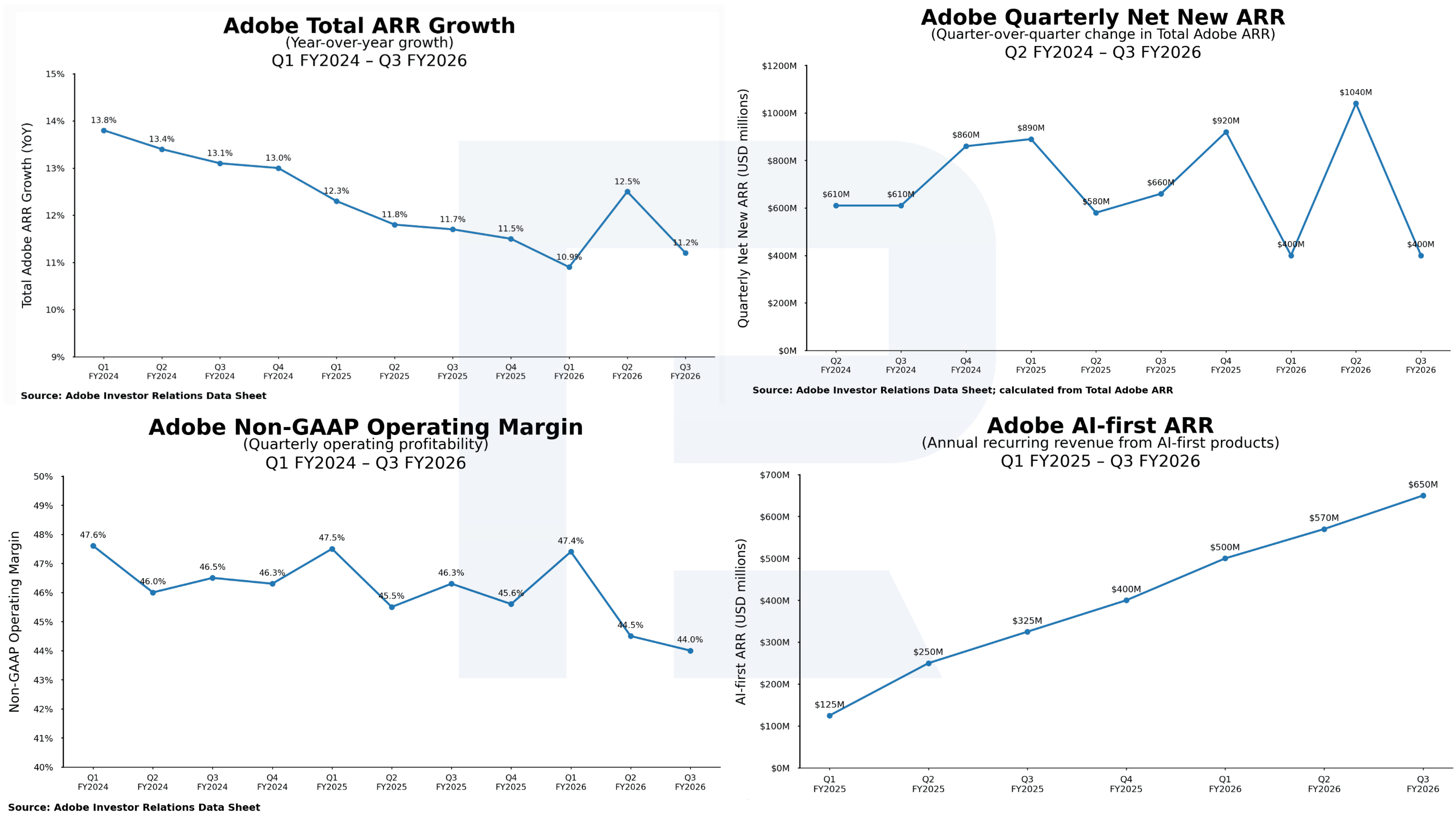
Based on the fundamental analysis of Adobe, there is still no convincing evidence of a sustained business recovery.
AI-first ARR is growing rapidly, indicating that the company is successfully monetising AI. However, this business is not yet large enough to change Adobe’s overall trajectory. Total ARR Growth remains near its lowest levels in recent years, quarterly net new ARR has slowed noticeably, and non-GAAP operating margin has declined to 44%. This means the core business continues to grow, but it has not yet accelerated enough to significantly shift investor sentiment.
To restore investor confidence, Adobe needs to demonstrate a sustained acceleration in Total ARR Growth, an increase in quarterly net new ARR, and a stabilisation of operating margin. So far, there are no such signals, meaning the fundamental factors behind the prolonged weakness in Adobe stock have not been fully resolved.
Analyst ratings of ADBE and Adobe stock forecast for 2026
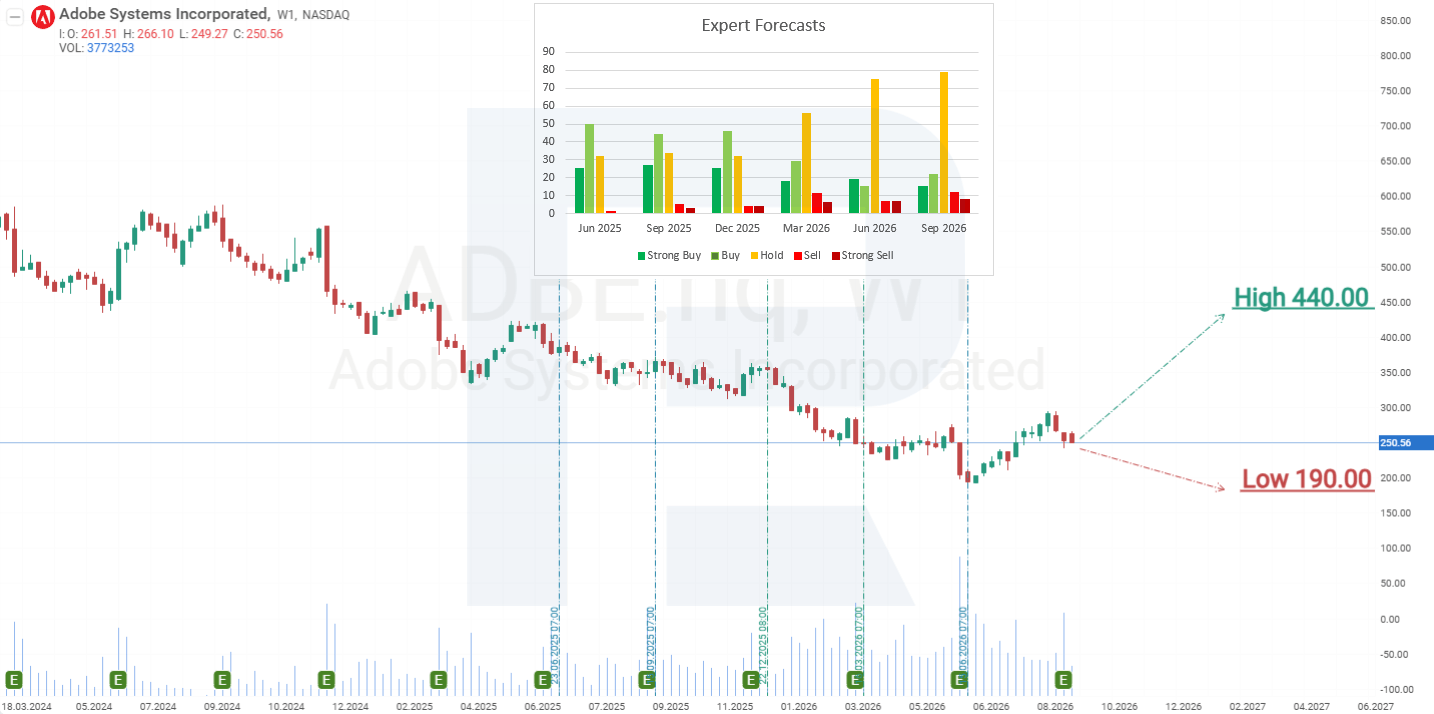
- Barchart: 7 of 38 analysts rate Adobe stock as Strong Buy, 2 as Moderate Buy, 23 as Hold, 2 as Sell, and 4 as Strong Sell. The highest price target is 379 USD, while the lowest is 195 USD.
- MarketBeat: 7 of 33 analysts rate Adobe stock as Buy, 21 as Hold, and 5 as Sell. The highest price target is 440 USD, while the lowest is 190 USD.
- TipRanks: 9 of 25 analysts rate Adobe stock as Buy, 12 as Hold, and 4 as Sell. The highest price target is 385 USD, while the lowest is 195 USD.
- Stock Analysis: 8 of 40 analysts rate Adobe stock as Strong Buy, 4 as Buy, 23 as Hold, 1 as Sell, and 4 as Strong Sell. The highest price target is 377 USD, while the lowest is 195 USD.
Analyst forecasts for ADBE stock in 2026 remain cautious. Hold ratings predominate across most platforms, while Buy ratings are noticeably less common. At the same time, the range of price targets remains wide, from 190 USD to 440 USD, reflecting considerable uncertainty about the company’s future prospects.
Adobe Inc. stock price forecast for 2026
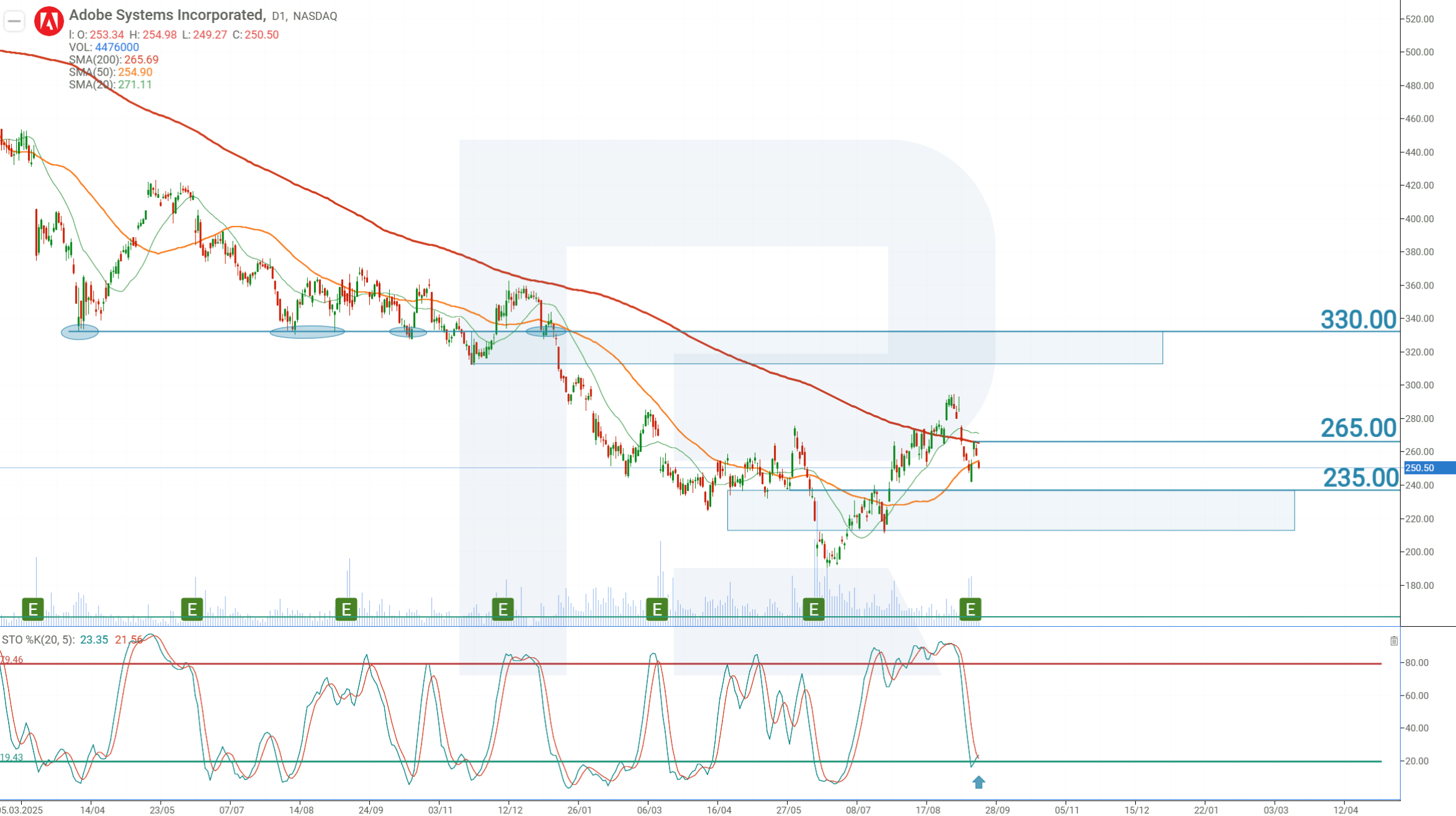
At the time of writing, ADBE stock is trading at around 250 USD.
On the daily chart, Adobe stock is trading close to its 200-period Moving Average. Following the previous decline, this may indicate an attempt by the share price to stabilise and form a sideways trading range. A sustained uptrend has not yet been confirmed. The Stochastic indicator is in oversold territory, which could precede a short-term rise in the share price.
However, the fundamentals do not yet provide clear signals of sustained share price growth. The share repurchase program could provide support for the stock, with more than 24 billion USD still available for buybacks. Adobe’s share repurchases could help limit downside pressure and, if investor interest returns, support a further rise.
Given ADBE’s recent performance, the trading idea for the second half of 2026 is to buy on a break above resistance at 265 USD. A break above this level could indicate strengthening buying interest. In this scenario, a Buy Stop order is placed at 266.00 USD. Take Profit is set at 320.00 USD, below resistance at 330.00 USD, to lock in profits before the price reaches this area. Stop Loss is set at 249.00 USD.
Buy Stop – 266.00 USD
Take Profit – 320.00 USD
Stop Loss – 249.00 USD
Accordingly, the Adobe stock forecast for the second half of 2026 assumes waiting for a confirmed break above resistance at 265 USD. Until then, the risk of continued sideways trading or another correction remains elevated.
Position management: Once the stock has moved 70% of the way towards the target, move the Stop Loss to the entry price. The protective stop should then be trailed at a distance of 10% from the price. Continue trailing the stop until the position is closed, either at the Take Profit or the Stop Loss, depending on which level is reached first.
Risks of investing in Adobe Inc. stock
Investing in Adobe stock involves several risks that may negatively impact the company’s profitability, revenue, and investor returns:
- Macroeconomic factors: Adobe’s performance is influenced by the broader global economy. Economic downturns and geopolitical events may adversely affect the company’s financial position.
- Competitive environment: the emergence of new competitors, including affordable AI models from startups such as DeepSeek, threatens Adobe’s market share. Intensified competition may exert pricing pressure and reduce profitability.
- Market volatility: Adobe’s financial performance is subject to market fluctuations and other macroeconomic factors. Investors should consider diversifying their portfolio to mitigate the risks associated with investing in the company’s shares.
Ang mga pagtataya na ipinakita sa seksyong ito ay nagpapakita lamang ng pribadong opinyon ng may-akda at hindi dapat ituring bilang gabay para sa pagtetrade. Walang pananagutan ang RoboForex para sa mga resulta ng pagtetrade batay sa mga rekomendasyon sa pagtetrade na inilarawan sa mga analytical review na ito.