
AMD stock forecast: Data Center revenue doubles – what comes next for AMD shares after Q2 2026?
AMD doubled its Data Center revenue, maintained strong margins, and continues to strengthen its position in the AI market. We examine AMD's Q2 2026 results, key growth drivers, principal risks, and the outlook for AMD stock in the second half of 2026.
Advanced Micro Devices, Inc. (NASDAQ: AMD) delivered strong Q2 2026 results. Revenue increased by 50% year-on-year to 11.54 billion USD, while non-GAAP earnings per share reached 1.66 USD and gross margin improved to 56%. The Data Center segment remained the company's primary growth driver, with revenue more than doubling to 6.72 billion USD, supported by strong demand for EPYC processors and Instinct accelerators.
The company's Q3 revenue guidance of 13.0 billion USD points to continued strong growth. Overall, the results were encouraging, while the future performance of AMD stock will depend primarily on continued growth in the Data Center business, further margin expansion, and the company's ability to translate its substantial investment in AI into sustainable profit growth.
This article examines Advanced Micro Devices, Inc., explains the company's business model, revenue structure, and AI product portfolio, provides a fundamental analysis of AMD's financial results, reviews AMD stock performance through technical analysis, and presents a forecast for AMD stock for 2026.
About Advanced Micro Devices, Inc.
Advanced Micro Devices, Inc. (AMD) is a US-based company founded in 1969 by Jerry Sanders and a group of fellow engineers. It designs and manufactures semiconductor devices, including processors, graphics chips, and server solutions. The company went public with an IPO on the NYSE in 1972 under the ticker AMD.
AMD is present in the rapidly expanding AI market with the following products:
- Graphics Processing Units (GPUs) for data centres: AMD produces Radeon Instinct microprocessors and has recently introduced new models in the MI series designed for high-performance computing and AI workloads. For example, the MI300 is a high-powered processor optimised for deep data analysis and large AI models.
- Radeon Open Compute (ROCm) software: AMD has developed an open-source software platform, ROCm, providing tools for AI development and high-performance computing on the company’s GPUs.
- Field-Programmable Gate Arrays (FPGAs): following the acquisition of Xilinx, AMD expanded into FPGAs, which are widely used for AI applications, including signal processing and adaptive computing.
- Central Processing Units (CPUs): AMD also optimises its EPYC series processors to support AI computing in server solutions.
- Products for end devices: in addition to server solutions, AMD develops specialised GPUs and FPGAs for AI-powered end devices, such as autonomous vehicles, smart cameras, and medical equipment.
Advanced Micro Devices, Inc. Q3 2024 financial results
AMD released its Q3 2024 earnings report on 29 October, confirming continued revenue and net income growth. Below are the report’s key figures:
- Revenue: 6.82 billion USD (+18%)
- Net income: 0.77 billion USD (+158%)
- Earnings per share: 0.47 USD (+161%)
- Operating profit: 0.72 billion USD (+223%)
Revenue by segment:
- Data Center: 3.55 billion USD (+122%)
- Client segment: 1.88 billion USD (+29%)
- Gaming segment: 462 million USD (–69%)
- Embedded segment: 927 million USD (–25%)
AMD benefited substantially from AI advancements, reflected in its Data Center segment, where revenue surged 122%, contributing to 52% of total revenue. The Gaming segment suffered the steepest decline (–69%), making it the weakest performer.
For Q4 2024, AMD projected revenue in the 7.20–7.80 billion USD range, with an average estimate of 7.50 billion. This implied a 22% year-on-year increase and a 10% rise compared to Q3 2024. However, the forecast fell slightly short of analysts’ expectations, sparking investor concerns, particularly amid intensifying competition in the AI market and a broader slowdown in segment growth.
Advanced Micro Devices, Inc. Q4 2024 financial results
On 4 February 2025, Advanced Micro Devices, Inc. (NASDAQ: AMD) published its Q4 2024 financial results. The key figures are presented below:
- Revenue: 7.65 billion USD (+24%)
- Net income: 0.48 billion USD (–37%)
- Earnings per share: 0.29 USD (+29%)
- Operating profit: 0.87 billion USD (+155%)
Revenue by segment:
- Data Center: 3.86 billion USD (+69%)
- Client: 2.31 billion USD (+58%)
- Gaming: 563 million USD (–59%)
- Embedded: 923 million USD (–13%)
Financial results for 2024:
- Revenue: 25.78 billion USD (+14%)
- Net income: 1.64 billion USD (+92%)
- Earnings per share: 1.00 USD (+88%)
- Operating profit: 1.90 billion USD (+375%)
AMD CEO Lisa Su highlighted the company's record annual revenue of 25.8 billion USD for 2024, up 14% from the previous year. The primary growth drivers were the Data Center and Client segments, where revenue rose by 94% and 52%, respectively. At the same time, the company remained focused on revenue growth rather than processor shipment volumes, reflecting the risk of oversupply in the PC CPU market.
Management remained optimistic about 2025, expecting double-digit growth in both revenue and earnings per share. AMD's Data Center AI business was expected to be the primary growth driver, generating more than 5.0 billion USD in revenue in 2024. According to the company, this business could eventually generate tens of billions of USD in annual revenue.
Advanced Micro Devices, Inc. Q1 2025 financial results
AMD released its Q1 2025 report on 6 May. Below are its highlights compared to the corresponding period in 2024:
- Revenue: 7.44 billion USD (+36%)
- Net income: 0.71 billion USD (+476%)
- Earnings per share: 0.44 USD (+529%)
- Operating profit: 0.81 billion USD (+2,139%)
Revenue by segment:
- Data Center: 3.67 billion USD (+57%)
- Client segment: 2.29 billion USD (+68%)
- Gaming segment: 647 million USD (–30%)
- Embedded segment: 823 million USD (–3%)
AMD’s Q1 2025 financial performance strengthened confidence in the company as one of the leaders in the AI and data centre segment. AMD exceeded Wall Street expectations, reporting a 36% increase in revenue and a 476% rise in net income. Meanwhile, the key segments showed even stronger growth. The data centre segment increased sales by 57%, while PC processor revenue rose by 68%, driven by sustained demand for EPYC server processors, Instinct accelerators, and Ryzen chips for consumer PCs.
For Q2 2025, AMD management projected revenue to range between 7.1 and 7.7 billion USD but cautioned about potential losses of approximately 800 million USD, as the company might postpone or entirely abandon the sales of a significant amount of its AI chips in China. The reason is the new export restrictions imposed by the US government, which have banned exports of advanced technology to the Chinese market. As a result, these chips cannot be sold, and their cost will likely be written off as losses. However, AMD management warned about this as early as 16 April, so this information was most likely already factored into the current stock price. For 2025, CFO Jean Hu estimated revenue losses of 1.5 billion USD due to export restrictions.
Advanced Micro Devices, Inc. Q2 2025 financial results
On 5 August 2025, Advanced Micro Devices, Inc. (NASDAQ: AMD) published its Q2 2025 financial results. The key figures are presented below, compared with the corresponding period of 2024:
- Revenue: 7.69 billion USD (+32%)
- Net income: 0.78 billion USD (-31%)
- Earnings per share: 0.48 USD (-30%)
- Operating profit: 0.90 billion USD (-29%)
Revenue by segment:
- Data Center: 3.24 billion USD (+14%)
- Client segment: 2.49 billion USD (+67%)
- Gaming segment: 1.12 billion USD (+73%)
- Embedded segment: 824 million USD (-4%)
AMD delivered record Q2 2025 revenue of 7.7 billion USD, up 32% year-on-year. However, profitability came under pressure due to an approximately 800 million USD charge related to MI308 inventory and purchase commitments following US export restrictions. As a result, gross margin declined to 40% on a GAAP basis and 43% on a non-GAAP basis. Excluding this charge, the non-GAAP gross margin would have been approximately 54%.
The company's guidance for Q3 2025 remained encouraging. AMD expected revenue of 8.7 billion USD ±300 million USD, representing approximately 28% year-on-year growth and around 13% sequential growth, while targeting a non-GAAP gross margin of approximately 54%. The guidance did not include MI308 shipments to China, as the issue was still under review by the US government. It later emerged that AMD had reached an agreement under which it would receive export licences for the MI308 in exchange for remitting 15% of its revenue from sales in China.
Advanced Micro Devices, Inc. Q3 2025 financial results
On 4 November 2025, Advanced Micro Devices, Inc. (NASDAQ: AMD) published its Q3 2025 financial results. The key figures are presented below, compared with the corresponding period of 2024:
- Revenue: 9.25 billion USD (+36%)
- Net income (non-GAAP): 1.97 billion USD (+31%)
- Earnings per share: 1.20 USD (+30%)
- Operating profit: 2.24 billion USD (+31%)
Revenue by segment:
- Data Center: 4.34 billion USD (+22%)
- Client segment: 2.75 billion USD (+46%)
- Gaming segment: 1.30 billion USD (+181%)
- Embedded segment: 857 million USD (-8%)
AMD delivered strong Q3 2025 results, exceeding market expectations. Revenue reached 9.25 billion USD, up 36% year-on-year, while non-GAAP earnings per share increased by 30% to 1.20 USD. Gross margin recovered to 54%, while operating profit reached 2.24 billion USD, with an operating margin of 24%.
For Q4 2025, management forecast revenue of 9.6 billion USD, plus or minus 300 million USD, representing approximately 25% year-on-year growth. Gross margin was expected to reach 54.5%.
AMD also unveiled a new three- to five-year strategic plan. The company targeted compound annual revenue growth of more than 35%, an operating margin above 35%, and earnings per share of more than 20 USD. The Data Center business was expected to grow by more than 60% annually, while the remaining segments were targeted to expand by more than 10% per year. Overall, AMD signalled that AI accelerators and server processors would remain its primary strategic focus in 2026 and were expected to be the company's main drivers of future growth.
Advanced Micro Devices, Inc. Q4 2025 financial results
On 3 February 2026, Advanced Micro Devices, Inc. (NASDAQ: AMD) published its Q4 2025 financial results. The key figures are presented below, compared with the corresponding period of 2024:
- Revenue: 10.27 billion USD (+34%)
- Net income (non-GAAP): 2.52 billion USD (+42%)
- Earnings per share: 1.53 USD (+40%)
- Operating profit: 2.85 billion USD (+41%)
Revenue by segment:
- Data Center: 5.38 billion USD (+39%)
- Client: 3.10 billion USD (+34%)
- Gaming: 0.84 billion USD (+50%)
- Embedded: 950 million USD (+34%)
AMD delivered strong Q4 2025 results, although the market reacted negatively. Revenue reached 10.27 billion USD, up 34% year-on-year and above analysts' expectations of 9.65–9.7 billion USD. Non-GAAP earnings per share came in at 1.53 USD, exceeding the consensus forecast of 1.32 USD. Overall, 2025 was a record year for AMD in both revenue and profit, driven primarily by continued growth in the Data Center business and resilient demand for EPYC server processors and Ryzen consumer processors.
The company's guidance for Q1 2026 also exceeded market expectations. AMD forecast revenue of 9.8 billion USD (plus or minus 300 million USD), compared with market expectations of 9.4 billion USD. This indicated that the company continued to see strong demand for AI and server solutions. Management also emphasised that it expected further growth in its Data Center AI business, including EPYC processors and Instinct accelerators, while planning to expand shipments to major enterprise and cloud customers throughout 2026.
Advanced Micro Devices, Inc. Q1 2026 financial results
On 5 May 2026, Advanced Micro Devices, Inc. (NASDAQ: AMD) published its Q1 2026 financial results. The key figures are presented below, compared with the corresponding period of 2025:
- Revenue: 10.25 billion USD (+38%)
- Net income (non-GAAP): 2.27 billion USD (+45%)
- Earnings per share: 1.37 USD (+43%)
- Operating profit: 2.54 billion USD (+43%)
- Free cash flow: 2.57 billion USD (+252%)
Revenue by segment:
- Data Center: 5.78 billion USD (+57%)
- Client segment: 2.89 billion USD (+26%)
- Gaming segment: 720 million USD (+11%)
- Embedded segment: 870 million USD (+6%)
AMD's Q1 2026 results confirmed that the record performance delivered in Q4 2025 was not driven solely by one-off factors. Revenue totalled 10.25 billion USD, remaining broadly unchanged quarter-on-quarter while increasing 38% year-on-year. Non-GAAP earnings per share declined from 1.53 USD to 1.37 USD. However, the company maintained a high level of profitability following the exceptionally strong previous quarter.
The Data Center business remained the primary growth driver. Segment revenue increased from 5.4 billion USD in Q4 2025 to 5.8 billion USD, supported by strong demand for EPYC processors and Instinct accelerators. This confirmed that the server business and AI infrastructure are becoming the foundation of AMD's long-term growth.
The market reacted positively to the results, with AMD stock rising by more than 18%. Additional support came from the company's strong Q2 2026 guidance, which projected revenue of approximately 11.2 billion USD, representing 46% year-on-year growth, with a non-GAAP gross margin of approximately 56%.
Advanced Micro Devices, Inc. Q2 2026 financial results
On 4 August 2026, Advanced Micro Devices, Inc. (NASDAQ: AMD) published its Q2 2026 financial results. The key figures are presented below, compared with the corresponding period of 2025:
- Revenue: 11.54 billion USD (+50%)
- Net income (non-GAAP): 2.76 billion USD (+253%)
- Earnings per share: 1.66 USD (+246%)
- Operating profit (non-GAAP): 3.09 billion USD (+245%)
- Free cash flow: 1.56 billion USD (+32%)
Revenue by segment:
- Data Center: 6.72 billion USD (+107%)
- Client segment: 3.06 billion USD (+23%)
- Gaming segment: 779 million USD (-31%)
- Embedded segment: 977 million USD (+19%)
AMD's Q2 2026 results confirmed that the business continues to accelerate, building on the strong momentum established at the beginning of the year. Revenue reached a record 11.54 billion USD. Non-GAAP earnings per share increased to 1.66 USD, while non-GAAP net income reached 2.76 billion USD. More importantly, revenue growth translated more effectively into profit. Non-GAAP operating profit increased by 22% quarter-on-quarter to 3.09 billion USD, while the operating margin improved from 25% to 27%. Gross margin also continued to improve, with the non-GAAP figure increasing from 55% in Q1 to 56% in Q2.
The Data Center business remained AMD's primary growth driver. Revenue reached a record 6.72 billion USD, increasing by 107% year-on-year and 16% quarter-on-quarter. The segment now accounts for approximately 58% of AMD's total revenue. Growth was not limited to sales alone. Segment operating profit increased from 1.60 billion USD in Q1 to 2.10 billion USD in Q2. This was one of the report's most significant findings, demonstrating that the scaling of EPYC processors and Instinct accelerators is driving a meaningful improvement in the company's profitability.
Free cash flow presents a more mixed picture. It declined to 1.56 billion USD from 2.57 billion USD in Q1, while the free cash flow margin fell from 25% to 14%. One of the main reasons was a sharp increase in capital expenditure, which rose from 389 million USD to 808 million USD. As a result, investors should ideally see continued revenue acceleration accompanied by a recovery in free cash flow. For now, this appears to reflect an active investment phase rather than a significant concern, particularly given AMD's 13.11 billion USD in cash and short-term investments compared with debt of approximately 3.23 billion USD.
The company's guidance for Q3 2026 indicates that management expects the business to continue accelerating. AMD forecast revenue of 13.0 billion USD, plus or minus 300 million USD, representing 41% year-on-year growth and a further 13% quarter-on-quarter increase. Management also said it expects Data Center revenue growth to accelerate during the second half of the year, supported by rising demand for EPYC processors, expanding Instinct shipments, and the initial deployment of the Helios platform.
At the same time, guidance for a non-GAAP gross margin of 56% implies no further expansion compared with Q2. This is an important nuance. The market already views AMD as one of the leading potential beneficiaries of rising AI investment, meaning investors will expect not only accelerating earnings growth but also further margin expansion. These elevated expectations were one of the reasons AMD stock fell by 7% following the release of an otherwise strong earnings report.
Overall, Q2 2026 was a very strong quarter. AMD maintained its record level of revenue following the exceptionally strong Q1, accelerated quarter-on-quarter revenue growth to 13%, expanded its operating margin, and increased Data Center revenue by more than 16% quarter-on-quarter. The company's investment case is now centred almost entirely on two businesses: EPYC server processors and Instinct accelerators.
Key growth drivers for Advanced Micro Devices, Inc. stock
When assessing AMD after its Q2 2026 results, the key question is whether the company can expand its presence in the Data Center market and translate strong demand for AI infrastructure into profit growth. As a result, investors should focus primarily on the following indicators in future earnings reports:
Data Center revenue growth. Data Center revenue growth remains the primary driver of AMD stock. Following Q2 2026, this segment accounted for approximately 58% of the company's total revenue. Continued growth in Data Center revenue will provide the clearest confirmation that AMD is capturing its share of the rapidly expanding AI infrastructure market.
Conversely, a slowdown in sequential growth could become one of the earliest signs that expectations for AMD's AI business are proving too optimistic.
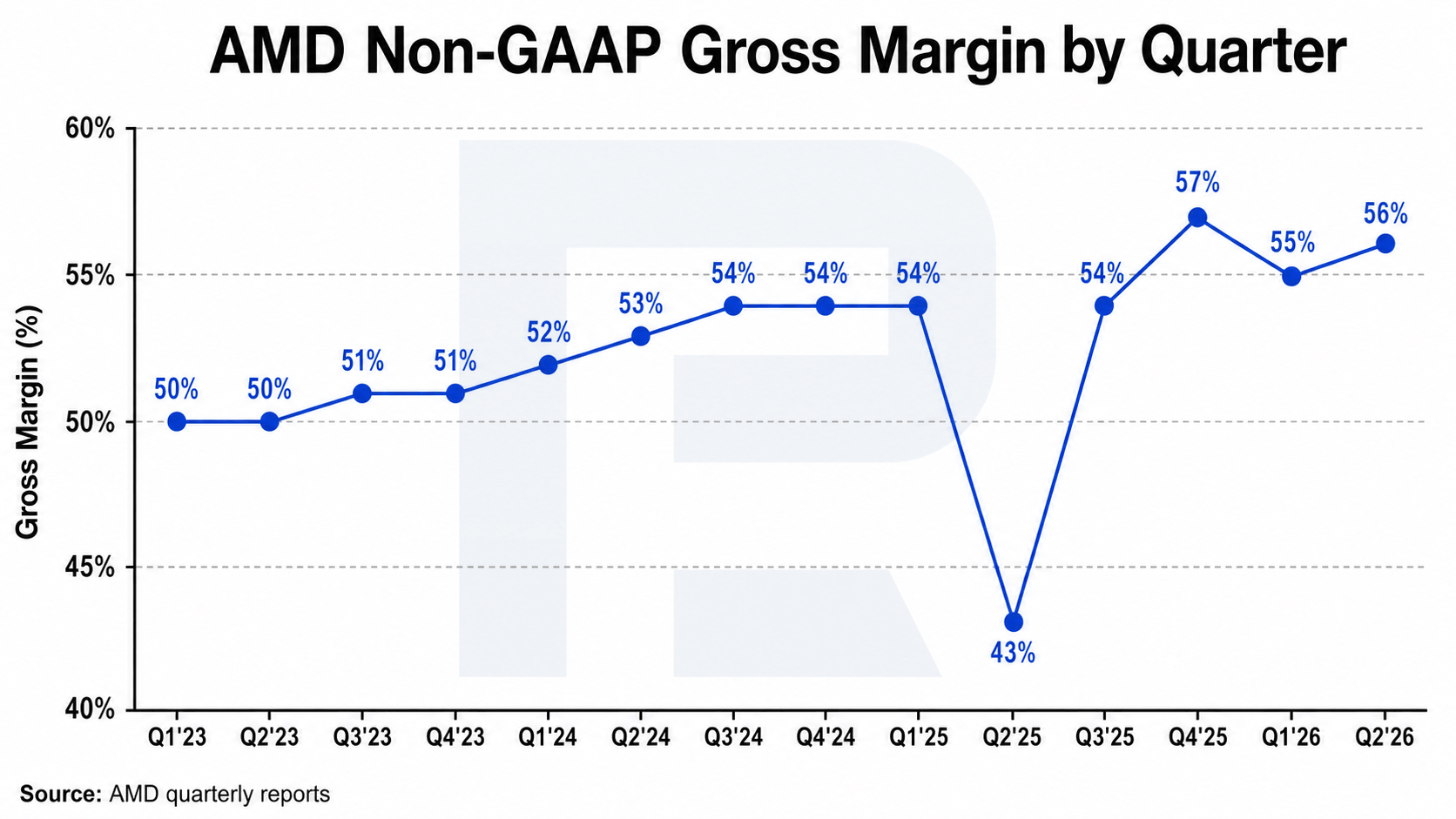
Non-GAAP gross margin. Growth in non-GAAP gross margin is particularly important as the Data Center business accounts for an increasing share of AMD's revenue, since server processors and accelerators are among the company's most profitable products.
If the Data Center business continues to account for a larger share of revenue and non-GAAP gross margin moves towards 57–60%, this would signal strong operating leverage, with revenue growing faster than costs, allowing profit to increase at an even faster rate.
Conversely, if Data Center revenue continues to grow rapidly but non-GAAP gross margin begins to decline, it would indicate that AMD is generating less profit from each additional dollar of revenue.
Data Center operating margin. A more precise measure of the quality of AMD's growth is the Data Center operating margin. In Q2 2026, the segment generated approximately 2.10 billion USD in operating profit on revenue of 6.72 billion USD, corresponding to an operating margin of 31.3%. In Q1, the figure was approximately 27.7%.
An expanding Data Center operating margin alongside rising revenue demonstrates that the company's server business is generating increasing profits. If AMD can continue to increase Data Center revenue while maintaining or expanding the segment's operating margin above 30% over the coming quarters, this would be one of the clearest indications that growth in its AI business is creating value for shareholders.
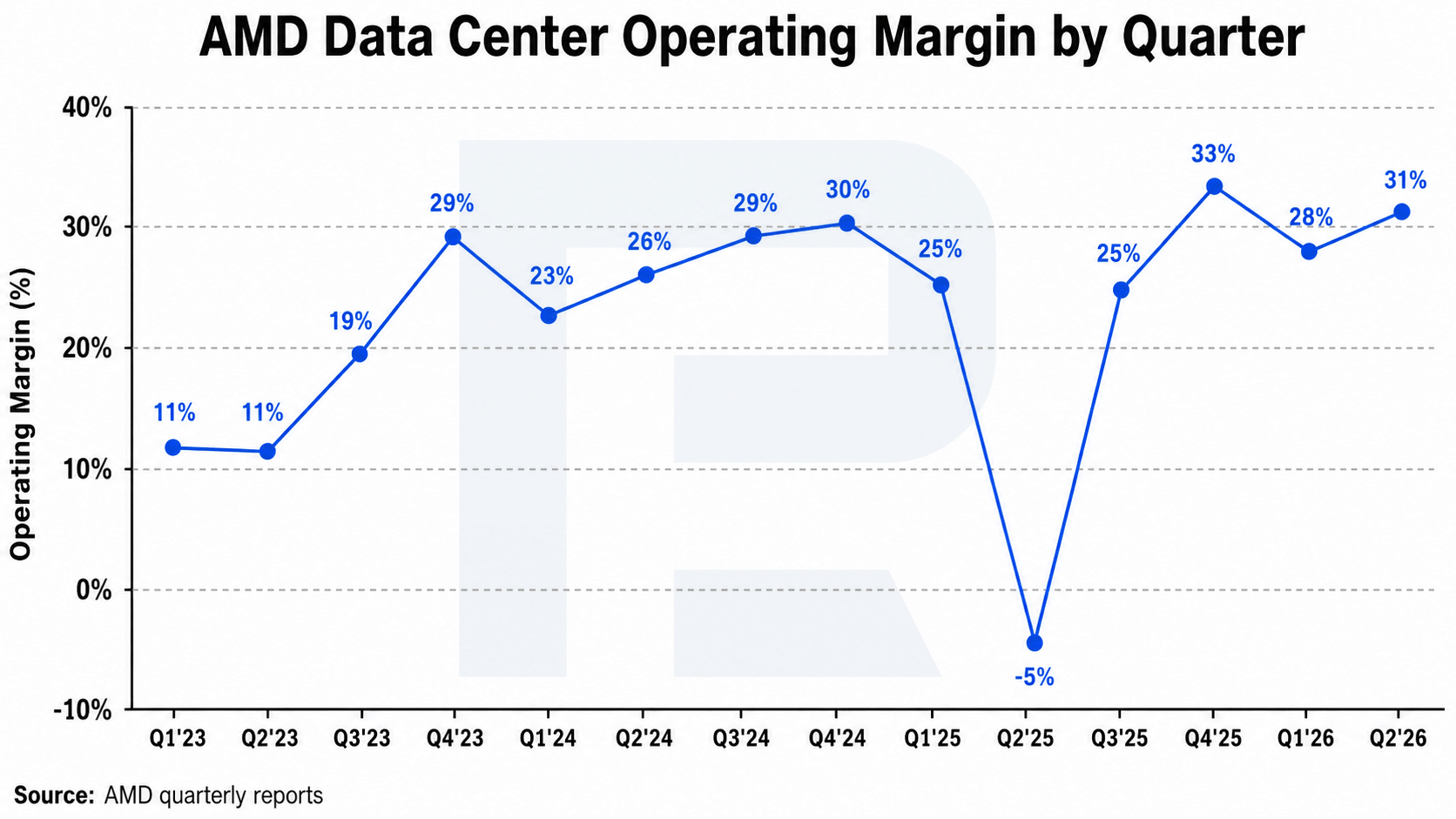
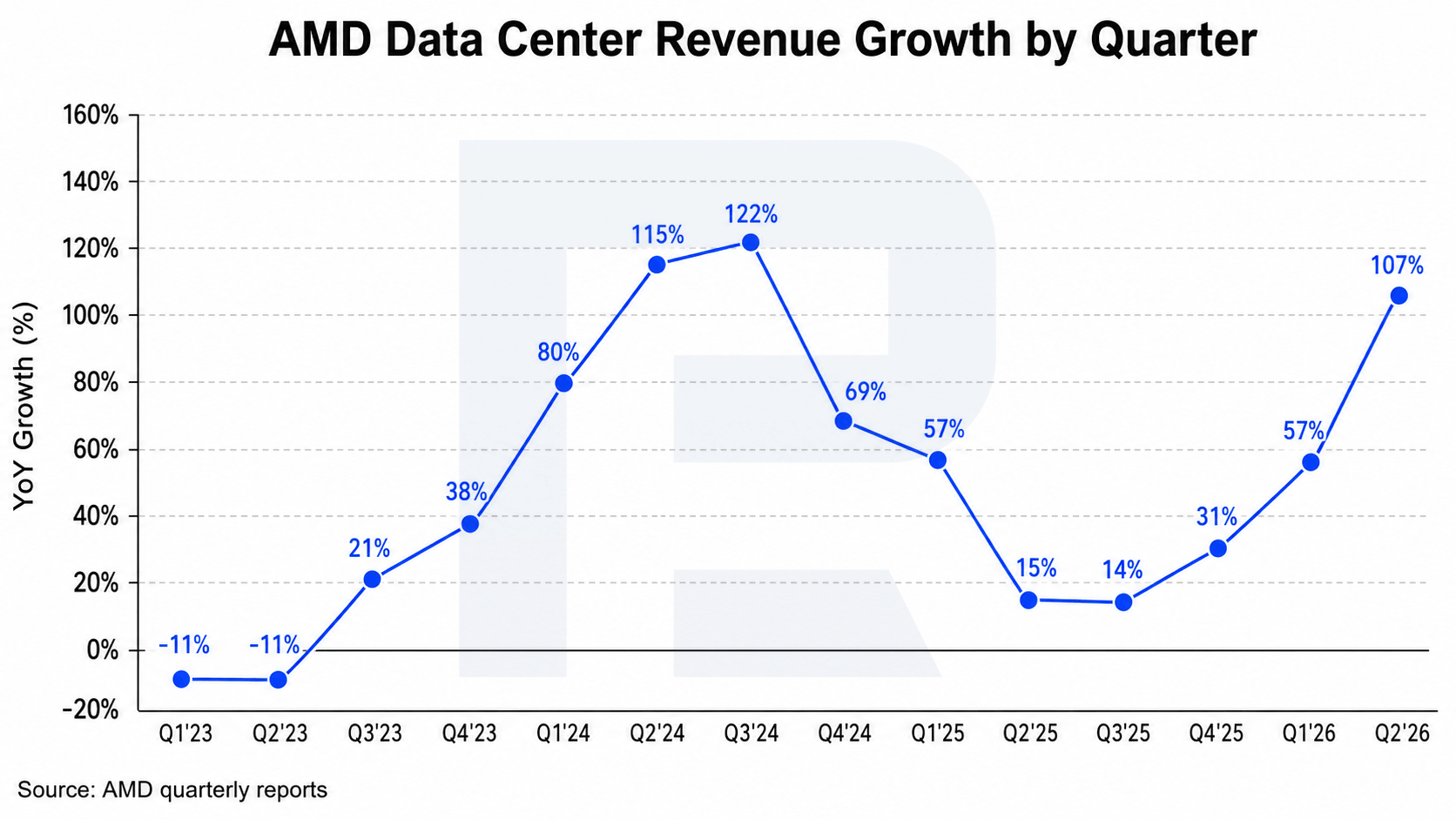
The key growth drivers suggest that AMD is in a significantly stronger position than a year ago. The most positive development is the renewed acceleration in the Data Center business. After revenue growth slowed to 14–15% in mid-2025, it rebounded to 107% in Q2 2026. Importantly, this acceleration has once again been accompanied by strong profitability. The Data Center operating margin recovered from an exceptionally weak –5% in Q2 2025 to 31% in Q2 2026, almost returning to its record high of 33%. Meanwhile, the overall non-GAAP gross margin remained strong at 56%.
This combination is particularly important for AMD stock. The company is increasing sales of its AI accelerators while maintaining high margins. The key question now is whether AMD can sustain Data Center growth at around its current pace while consistently maintaining the segment's operating margin above 30–33%. If it succeeds, the market will have further reason to raise earnings expectations and assign a higher valuation to AMD stock.
Expert forecasts for Advanced Micro Devices, Inc.’s stock
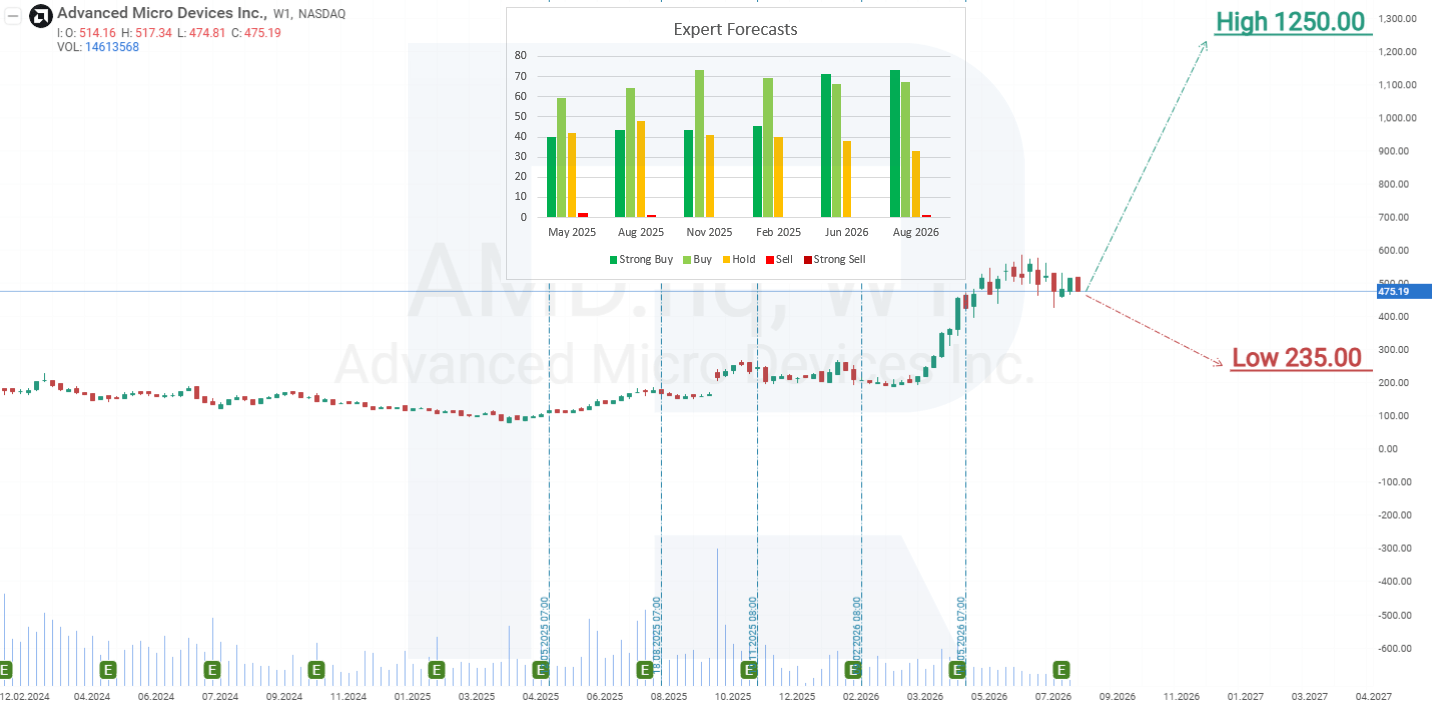
- Barchart: 36 of 45 analysts rate AMD stock as Strong Buy, 2 as Moderate Buy, and 7 as Hold. The highest price target is 1,250 USD, while the lowest is 410 USD.
- MarketBeat: 34 of 45 analysts rate the stock as Buy, 10 as Hold, and 1 as Sell. The highest price target is 1,250 USD, while the lowest is 235 USD.
- TipRanks: 26 of 32 analysts rate the stock as Buy, while 6 recommend Hold. The highest price target is 1,250 USD, while the lowest is 465 USD.
- Stock Analysis: 37 of 52 analysts rate AMD stock as Strong Buy, 5 as Buy, and 10 as Hold. The highest price target is 1,250 USD, while the lowest is 365 USD.
Analysts' forecasts for AMD stock remain strongly bullish. Across all major platforms, the vast majority of analysts recommend buying AMD, while negative ratings remain rare. The highest price target reaches 1,250 USD. Although some bearish forecasts remain well below the current share price, they represent a clear minority. Overall, the consensus reflects high expectations for continued growth in AMD's Data Center business, EPYC server processors, and Instinct AI accelerators.
Advanced Micro Devices, Inc. stock price forecast for 2026
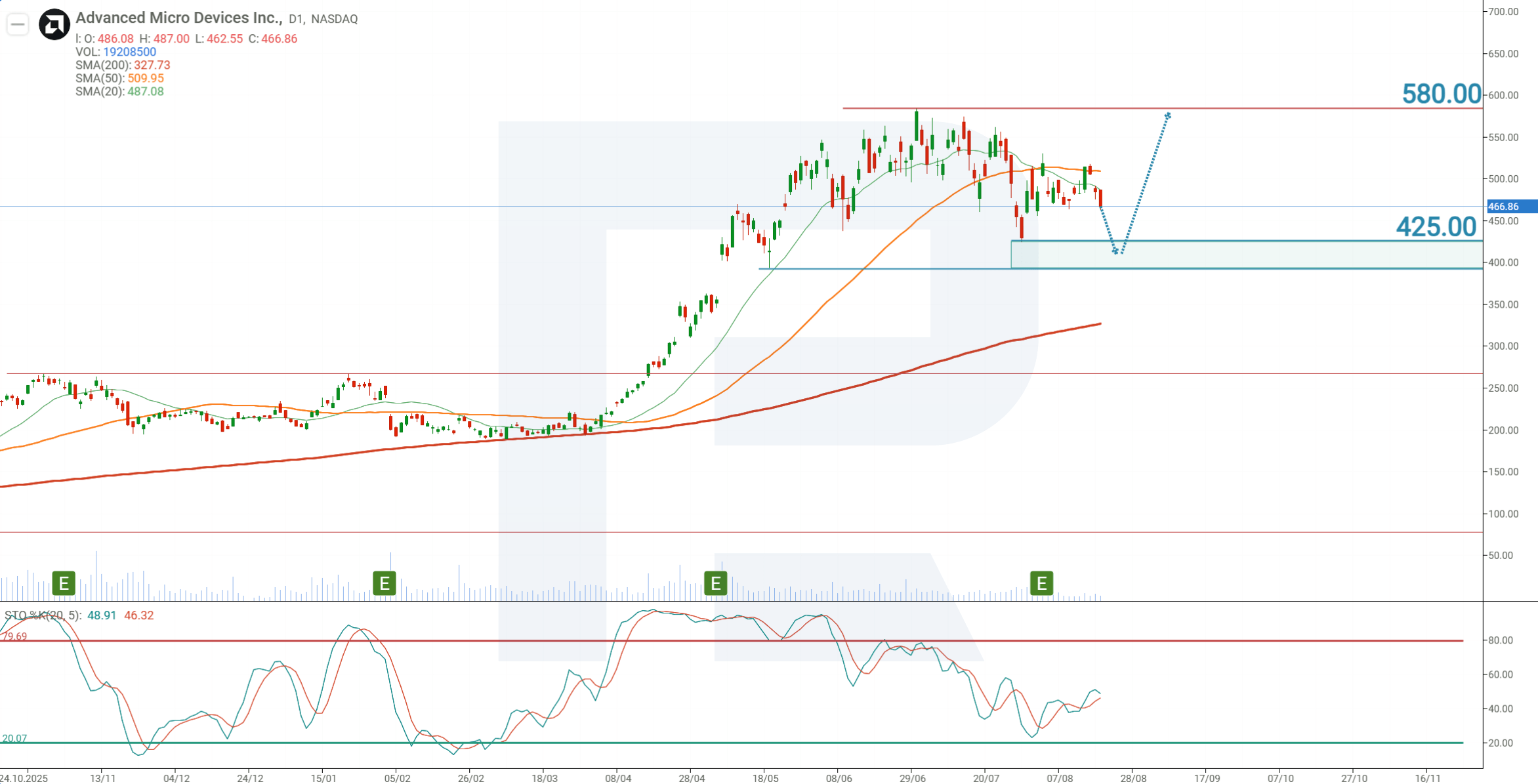
At the time of writing, AMD stock is trading at around 466 USD.
On the weekly chart, Advanced Micro Devices (AMD) stock continues to trade above the 200-period Moving Average, confirming that the long-term uptrend remains intact. At the same time, the 20-period and 50-period Moving Averages have formed a bearish crossover, indicating that a medium-term correction is developing.
The Stochastic indicator remains in the neutral zone and has not yet signalled oversold conditions. This suggests there is still scope for further downside as the current correction unfolds. Based on the current Advanced Micro Devices stock performance, the following scenario outlines its potential movement in the second half of 2026.
The forecast for Advanced Micro Devices stock anticipates that the correction will continue towards the 400–425 USD support zone. Demand for the stock is expected to strengthen at these levels, potentially bringing the correction to an end and allowing the long-term uptrend to resume. The primary upside target is the previous all-time high near 580 USD.
A break below the 200-period Moving Average at 330 USD, followed by a sustained move below this level, would invalidate the bullish scenario and indicate that the current long-term uptrend has come to an end.
Position management: Once the stock has moved 15% in the projected direction, move the stop-loss to the entry level. The protective stop should then be trailed 15% behind the price.
Risks of investing in Advanced Micro Devices, Inc. stock
The main risks to consider when investing in AMD stock include:
- High competition: AMD faces intense competition from Intel Corporation (NASDAQ: INTC) and NVIDIA, both of which could lower prices or accelerate the introduction of new technologies, potentially putting pressure on AMD's market share.
- Dependence on TSMC: AMD relies on Taiwan Semiconductor Manufacturing Company (NYSE: TSM) to manufacture its chips. Any supply chain disruptions or delays in introducing new manufacturing processes could adversely affect AMD's business.
- Export restrictions: Sales of AMD's advanced accelerators in China depend on decisions by the US authorities and Chinese import regulations. Export restrictions have already resulted in significant inventory-related charges, and any further measures could again weigh on the company's revenue and margins.
- Execution risks relating to AMD's AI strategy: AMD's future growth depends heavily on the successful scaling of the Instinct MI450, the Helios platform, and the ROCm software ecosystem. Delays in new product launches or slower adoption by major customers could lead to slower growth in the Data Center business.
- High investor expectations: Rapid growth in the Data Center business has already led investors to price in further acceleration. Following the release of Q2 2026 results, AMD stock fell despite 50% revenue growth and 107% growth in the Data Center business, as the company's guidance failed to exceed the market's already elevated expectations. As a result, any slowdown in growth or margin expansion could trigger a sharp correction in the stock.
Ang mga pagtataya na ipinakita sa seksyong ito ay nagpapakita lamang ng pribadong opinyon ng may-akda at hindi dapat ituring bilang gabay para sa pagtetrade. Walang pananagutan ang RoboForex para sa mga resulta ng pagtetrade batay sa mga rekomendasyon sa pagtetrade na inilarawan sa mga analytical review na ito.