
Amazon stock forecast: AMZN shares could climb towards 350 USD as AI investment begins to pay off
Amazon's investment in artificial intelligence is beginning to deliver results. With AWS growing at its fastest pace in several years, AMZN stock appears well positioned for a fresh rally towards 350 USD.
Amazon.com, Inc. (NASDAQ: AMZN) reported stronger-than-expected results for Q2 2026. Revenue increased by 20% to 200.6 billion USD, while operating profit rose by 43% to 27.5 billion USD. AWS was the main growth driver, with revenue growth accelerating to 37% and its operating margin approaching 40%. The advertising business also maintained strong momentum, with revenue increasing by approximately 26%, while the North America and International segments grew by 16% and 15%, respectively.
A key positive signal was the accelerating demand for cloud computing and AI services. Amazon continues to expand AWS computing capacity, develop its proprietary Trainium and Graviton AI chips, and invest heavily in data centres. The company raised its 2026 capital expenditure guidance to approximately 220 billion USD. Although this is putting pressure on free cash flow, robust demand for AI infrastructure continues to support further expansion of its computing capacity.
For Q3 2026, Amazon expects revenue of 197–202 billion USD and operating profit of 22.5–26.5 billion USD. As a result, the company's main growth drivers remain accelerating AWS growth, continued expansion of its advertising business, improving operating efficiency, and the ongoing monetisation of its AI infrastructure investment.
This article examines Amazon.com, Inc., provides a fundamental analysis of Amazon.com's financial results, reviews the performance of AMZN stock through technical analysis, and presents a forecast for Amazon stock for 2026. It also examines Amazon.com's business model, evaluates the risks of investing in Amazon.com, and reviews analysts' forecasts for Amazon stock.
About Amazon.com, Inc.
Amazon.com, Inc. is one of the world’s largest technology companies. It was established by Jeffrey Bezos in 1994 in Seattle, US. Initially, the company specialised in selling books online but has since evolved into a multi-industry platform. Today, Amazon is engaged in e-commerce, provides cloud computing services through Amazon Web Services (AWS), manufactures electronics (such as Kindle and Echo), and develops media services, including streaming and content production.
The company held its IPO on 15 May 1997, listing its shares on the NASDAQ under the ticker AMZN.

Amazon.com, Inc.’s main financial flows
Amazon’s revenue is based on several key segments, reflecting the company’s varied, multisectoral operations:
- Online retail: selling goods directly on behalf of the company, including books, electronics, clothing, household appliances, and more.
- Marketplace: providing the company’s platform to third-party sellers to sell their goods through its website. Amazon generates revenue from sales commissions, paid storage and delivery services and other seller support services.
- Cloud computing (Amazon Web Services): this is the world’s largest cloud service provider. The service includes server rentals, data storage, big data analytics tools, and other cloud solutions. This segment generates Amazon’s highest profits among the other business areas.
- Subscriptions (Amazon Prime and other services): providing access to streaming platforms (video and music), cloud storage, and other products. This category also includes revenue from subscriptions to other services, such as Kindle Unlimited and Amazon Music Unlimited.
- Advertising: actively developing its digital advertising business, including income from placing advertisements on the platform, such as in search results. Revenue from these and other advertising services has increased significantly in recent years.
- Offline retail stores: physical sales outlets, including Amazon Go and Amazon Fresh stores, Whole Foods Market supermarkets, and speciality book and electronics stores.
- Electronics and technology sales: producing and selling its own products, including the popular Kindle eBooks, Echo smart speakers with Alexa voice assistant, Fire TV streaming boxes, and other technology products.
- Other areas: less significant revenue streams, such as providing logistics services to third parties, acting as an intermediary in book publishing (Amazon Publishing), developing video games (Amazon Game Studios), generating income from the Twitch streaming platform, and pursuing other innovative projects.
These diversified revenue streams enable Amazon.com, Inc. to remain resilient amid changing market conditions and to expand its influence across multiple sectors.
Amazon.com, Inc. Q3 2024 financial results
Amazon reported it ended Q3 2024 with gains across key financial indicators. Below is the main report data:
- Revenue: 158.9 billion USD (+11%)
- Net income: 15.3 billion USD (+54%)
- Earnings per share: 1.43 USD (+52%)
- Operating profit: 17.5 billion USD (+55%)
Revenue by segment:
- North America: 95.5 billion USD (+8%)
- Operating income (loss): 5.7 billion USD (+30%)
- International: 35.9 billion USD (+11%)
- Operating income (loss): 1.3 billion USD – in Q3 2023, the company posted a loss of 95 million USD
- Amazon Web Services (AWS): 27.4 billion USD (+19%)
- Operating income (loss): 10.4 billion USD (+49%)
All key financial metrics showed growth in Q3 2024. The international segment saw increased sales, but costs also rose concurrently. As a result, it remained the most vulnerable and could be the first to incur losses in the event of even minor economic disruptions.
The North American segment contributed the most to the company’s total revenue but also incurred the highest costs.
AWS remained Amazon’s most promising and profitable division, demonstrating sustained growth and strong profitability.
For Q4 2024, Amazon forecasts revenue between 181.0 and 188.0 billion USD, representing a 7-11% increase compared to the corresponding period in 2023. Operating profit is expected to range between 16.0 and 20.0 billion USD, up from 13.0 billion USD a year earlier.
Amazon.com, Inc. Q4 2024 financial results
Amazon delivered another strong quarter in Q4 2024 with growth across all key financial metrics. The key figures from the report are as follows:
- Revenue: 187.8 billion USD (+10%)
- Net income: 20.0 billion USD (+88%)
- Earnings per share: 1.86 USD (+86%)
- Operating profit: 21.2 billion USD (+60%)
Revenue by segment:
- North America: 115.5 billion USD (+9%)
- Operating income (loss): 9.6 billion USD (+43%)
- International: 43.4 billion USD (+8%)
- Operating income (loss): 1.3 billion USD - In Q4 2023, the company posted a loss of 419 million USD
- Amazon Web Services (AWS): 28.8 billion USD (+19%)
- Operating income (loss): 10.6 billion USD (+48%)
In its commentary on the Q4 2024 report, Amazon’s management provided forecasts for 2025, focusing on revenue, operating profit, and capital expenditures. For Q1 2025, revenue is expected to range between 151.0 and 155.5 billion USD, below the consensus forecast of 158.6 billion USD. Operating profit for this period is projected at 16.0 billion USD, which also falls short of analysts’ expectations.
The company also announced a significant increase in capital expenditures, which could reach 105.0 billion USD in 2025. This marks a notable rise from 77.0 billion USD in 2024 and more than double the 48.0 billion USD spent in 2023. These investments will primarily focus on infrastructure, including expanding the AWS cloud business and developing AI solutions.
AWS is anticipated to remain Amazon’s key growth driver in 2025 due to a trend of companies migrating to cloud infrastructure, the end of the cost optimisation phase, and increasing demand for AI solutions. The company has described artificial intelligence as a once-in-a-lifetime opportunity.
Amazon.com, Inc. Q1 2025 financial results
On 1 May 2025, Amazon.com published its Q1 2025 financial results for the quarter ended 31 March. The key figures are presented below, compared with the corresponding period of 2024:
- Revenue: 155.66 billion USD (+9%)
- Net income: 17.12 billion USD (+64%)
- Earnings per share: 1.59 USD (+62%)
- Operating profit: 18.40 billion USD (+22%)
Revenue by segment:
- North America: 92.89 billion USD (+8%)
- Operating income: 5.84 billion USD (+17%)
- International: 33.51 billion USD (+5%)
- Operating income: 1.01 billion USD (+12%)
- Amazon Web Services (AWS): 29.26 billion USD (+17%)
- Operating income: 11.54 billion USD (+22%)
Amazon's Q1 2025 results demonstrated resilient business growth and improved profitability. Revenue increased by 9% year-on-year, operating profit rose by 22%, while net income increased by 64%.
AWS remained the company's primary profit driver. However, the segment's revenue growth of 17% lagged behind that of Microsoft Azure and Google Cloud. Nevertheless, AWS maintained its leadership in the cloud computing market, with a market share of approximately 29%.
Amazon's advertising business also grew rapidly, with revenue increasing by 19% to 13.92 billion USD. A negative factor was a charge of approximately 1 billion USD related to product returns, inventory, and the impact of tariffs.
Following the earnings release, AMZN stock declined as investors reacted to slower AWS growth and cautious Q2 guidance. Amazon expected operating profit of 13.0–17.5 billion USD, compared with the consensus forecast of 17.8 billion USD. The main risks remained tariffs and intensifying competition in the cloud computing market. However, Amazon's strong positions in AWS, advertising, and e-commerce continued to support the company's long-term growth potential.
Amazon.com, Inc. Q2 2025 financial results
On 31 July 2025, Amazon.com published its Q2 2025 financial results for the quarter ended 30 June. The key figures are presented below, compared with the corresponding period of 2024:
- Revenue: 167.70 billion USD (+13%)
- Net income: 18.16 billion USD (+34%)
- Earnings per share: 1.68 USD (+33%)
- Operating profit: 19.17 billion USD (+30%)
Revenue by segment:
- North America: 100.07 billion USD (+11%)
- Operating income: 7.51 billion USD (+48%)
- International: 36.76 billion USD (+16%)
- Operating income: 1.49 billion USD (+345%)
- Amazon Web Services (AWS): 30.87 billion USD (+17%)
- Operating income: 10.16 billion USD (+9%)
Amazon delivered Q2 2025 results that exceeded market expectations. Revenue increased by 13% to 167.7 billion USD, operating profit reached 19.2 billion USD, while net income totalled 18.2 billion USD. AWS revenue grew by 17.5%, the North America segment by 11%, the International segment by 16%, while advertising revenue increased by 23% to 15.7 billion USD.
However, the company's guidance for Q3 was more cautious. Amazon expected revenue of 174–179.5 billion USD and operating profit of 15.5–20.5 billion USD.
The main area of concern remained AWS's growth rate. For the second consecutive quarter, Amazon's cloud business grew more slowly than Microsoft Azure and Google Cloud, as its competitors monetised AI demand more rapidly. Amazon continued to invest heavily in infrastructure and computing capacity. As a result, the weaker growth in AWS was more likely to reflect the company's current investment cycle than a loss of market position.
Amazon.com, Inc. Q3 2025 financial results
On 30 October 2025, Amazon.com published its Q3 2025 financial results for the quarter ended 30 September. The key figures are presented below, compared with the corresponding period of 2024:
- Revenue: 180.17 billion USD (+13%)
- Net income: 21.19 billion USD (+38%)
- Earnings per share: 1.95 USD (+37%)
- Operating profit: 17.42 billion USD (0%)
Revenue by segment:
- North America: 106.27 billion USD (+11%)
- Operating income: 4.79 billion USD (-15%)
- International: 40.90 billion USD (+14%)
- Operating income: 1.20 billion USD (-8%)
- Amazon Web Services (AWS): 33.01 billion USD (+20%)
- Operating income: 11.43 billion USD (+9%)
Amazon delivered Q3 2025 results that exceeded market expectations. Revenue increased by 13% to 180.2 billion USD, compared with market expectations of around 178 billion USD, while earnings per share reached 1.95 USD, well above the consensus forecast of 1.56 USD.
Operating profit reached 17.4 billion USD, including 4.3 billion USD in one-off charges. Excluding these items, operating profit would have totalled approximately 21.7 billion USD, while the operating margin would have been 12% rather than 9.7%. Net income rose by 39% to 21.2 billion USD, although part of the increase reflected a 9.5 billion USD gain from the revaluation of Amazon's stake in Anthropic.
AWS revenue growth accelerated to 20%, delivering its strongest performance in 11 quarters, while its operating margin remained close to 35%. The North America and International segments increased revenue by 11% and 14%, respectively, while advertising revenue grew by more than 20%.
For Q4 2025, Amazon expected revenue of 206–213 billion USD and operating profit of 21–26 billion USD. Capital expenditure for 2025 was expected to reach approximately 125 billion USD and continue to increase as Amazon expanded AWS and invested in AI infrastructure. This had already reduced free cash flow to 14.8 billion USD.
Amazon.com, Inc. Q4 2025 financial results
On 5 February, Amazon.com, Inc. (NASDAQ: AMZN) released its Q4 2025 financial results for the quarter ended 31 December. Below are the key figures compared with the same period in 2024:
- Revenue: 213.38 billion USD (+14%)
- Net income: 21.19 billion USD (+6%)
- Earnings per share: 1.95 USD (+5%)
- Operating profit: 24.98 billion USD (+18%)
Revenue by segment:
- North America: 127.08 billion USD (+10%)
- Operating income: 11.47 billion USD (+24%)
- International: 50.72 billion USD (+17%)
- Operating income: 1.04 billion USD (–21%)
- Amazon Web Services (AWS): 35.58 billion USD (+24%)
- Operating income: 12.47 billion USD (+17%)
Amazon's Q4 2025 results were mixed relative to market expectations. Revenue increased by 14% year-on-year to 213.4 billion USD, exceeding analysts' forecasts. Growth was broad-based across the company's key businesses: retail sales increased, the International segment delivered double-digit growth, and Amazon Web Services (AWS) expanded revenue by 24%, marking its fastest growth in several quarters.
Earnings per share came in at 1.95 USD, slightly below the consensus forecast of approximately 1.97 USD, although net income increased year-on-year from 20.00 billion USD to 21.19 billion USD.
Management also highlighted a significant expansion of infrastructure investment, including plans to spend approximately 200 billion USD in 2026 on AWS, AI infrastructure, proprietary chip development, robotics, and low Earth orbit satellite networks.
For Q1 2026, Amazon forecast revenue of 173.5–178.5 billion USD and operating income of 16.5–21.5 billion USD. The guidance pointed to continued growth but adopted a cautious tone, reflecting both the seasonal nature of the business and the scale of the company's planned investment program.
Amazon.com, Inc. Q1 2026 financial results
On 29 April 2026, Amazon.com published its Q1 2026 financial results for the quarter ended 31 March. The key figures are presented below, compared with the corresponding period of 2025:
- Revenue: 181.52 billion USD (+17%)
- Net income: 30.26 billion USD (+77%)
- Earnings per share: 2.78 USD (+75%)
- Operating profit: 23.85 billion USD (+30%)
Revenue by segment:
- North America: 104.14 billion USD (+12%)
- Operating income: 8.27 billion USD (+43%)
- International: 39.79 billion USD (+19%)
- Operating income: 1.42 billion USD (+40%)
- Amazon Web Services (AWS): 37.59 billion USD (+28%)
- Operating income: 14.16 billion USD (+23%)
Amazon delivered Q1 2026 results that significantly exceeded market expectations. Revenue increased by 17% to 181.5 billion USD, while earnings per share reached 2.78 USD, well above the consensus forecast of approximately 1.65 USD.
AWS once again was the company's main growth driver. Revenue growth accelerated from 24% in Q4 2025 to 28% in Q1 2026, marking the segment's fastest growth in 15 quarters. The North America segment increased revenue by 12%, while operating income reached 8.3 billion USD. The International segment also improved its profitability, generating 1.4 billion USD in operating income.
Net income increased to 30.3 billion USD, although it included a one-off pre-tax gain of 16.8 billion USD related to the revaluation of Amazon's investment in Anthropic. At the same time, Amazon's advertising business generated more than 70 billion USD in revenue over the previous 12 months, while its custom chip business surpassed an annualised revenue run rate of 20 billion USD.
For Q2 2026, Amazon expected revenue of 194–199 billion USD and operating income of 20–24 billion USD. The main risk remained the company's substantial capital expenditure on AI infrastructure, which reduced free cash flow over the previous 12 months to 1.2 billion USD.
Amazon.com, Inc. Q2 2026 financial results
On 30 July 2026, Amazon.com published its Q2 2026 financial results for the quarter ended 30 June. The key figures are presented below, compared with the corresponding period of 2025:
- Revenue: 200.61 billion USD (+20%)
- Net income: 62.65 billion USD (+245%)
- Earnings per share: 5.75 USD (+242%)
- Operating profit: 27.46 billion USD (+43%)
Revenue by segment:
- North America: 116.18 billion USD (+16%)
- Operating income: 9.12 billion USD (+21%)
- International: 42.20 billion USD (+15%)
- Operating income: 1.72 billion USD (+15%)
- Amazon Web Services (AWS): 42.23 billion USD (+37%)
- Operating income: 16.62 billion USD (+64%)
Amazon delivered one of its strongest quarterly results in recent years. Revenue increased by 20% year-on-year to 200.6 billion USD, operating profit rose by 43% to 27.5 billion USD, while the operating margin expanded from approximately 11.4% to 13.7%. Profit continued to grow significantly faster than revenue, indicating further improvements in operating efficiency.
The standout development was the sharp acceleration in AWS. AWS revenue increased by 37% to 42.2 billion USD, following 28% growth in Q1 2026. This was the fastest growth rate in 18 quarters. AWS operating profit rose by 64% to 16.6 billion USD, while the operating margin improved from 32.9% to 39.4%. As a result, the cloud business is not only accelerating its growth but also becoming more profitable.
AWS's acceleration was driven primarily by strong demand for AI services. AWS's AI business exceeded a 25 billion USD annualised revenue run rate and continues to grow at a triple-digit rate. The value of future customer commitments reached 496 billion USD, up from 364 billion USD in the previous quarter. This improves visibility into future revenue and indicates that a significant proportion of the company's new computing capacity has already been committed by customers.
At the same time, net income of 62.6 billion USD should be interpreted with caution. It included a 53.4 billion USD non-operating pre-tax gain, primarily related to the revaluation of Amazon's investment in Anthropic. As a result, the 43% increase in operating profit provides a more meaningful measure of the underlying business than the sharp rise in net income and earnings per share.
Capital expenditure remains the company's main risk. Amazon raised its 2026 capital expenditure guidance to 220 billion USD as it continues to expand its data centres, AI infrastructure, and computing capacity while also facing higher component costs. Despite these substantial investments, management still expects computing capacity shortages to persist until at least 2027.
These elevated investment levels are already having a noticeable impact on cash flow. Operating cash flow over the previous 12 months increased to 161.4 billion USD, while capital expenditure reached 169.0 billion USD, resulting in negative free cash flow of 7.6 billion USD. At the same time, long-term debt increased to 128.9 billion USD, increasing the importance of generating adequate returns from Amazon's AI investment.
For Q3 2026, Amazon expects revenue of 197–202 billion USD and operating profit of 22.5–26.5 billion USD. Although revenue growth is expected to moderate, profit should continue to grow faster than revenue, indicating that Amazon is maintaining a high level of operating efficiency.
Key growth drivers for Amazon.com, Inc. stock in 2026
When assessing Amazon stock in August 2026, investors should focus on four key indicators. Together, they provide the clearest picture of how successfully the company is translating its substantial investment in cloud computing, artificial intelligence, and its e-commerce platform into profit growth.
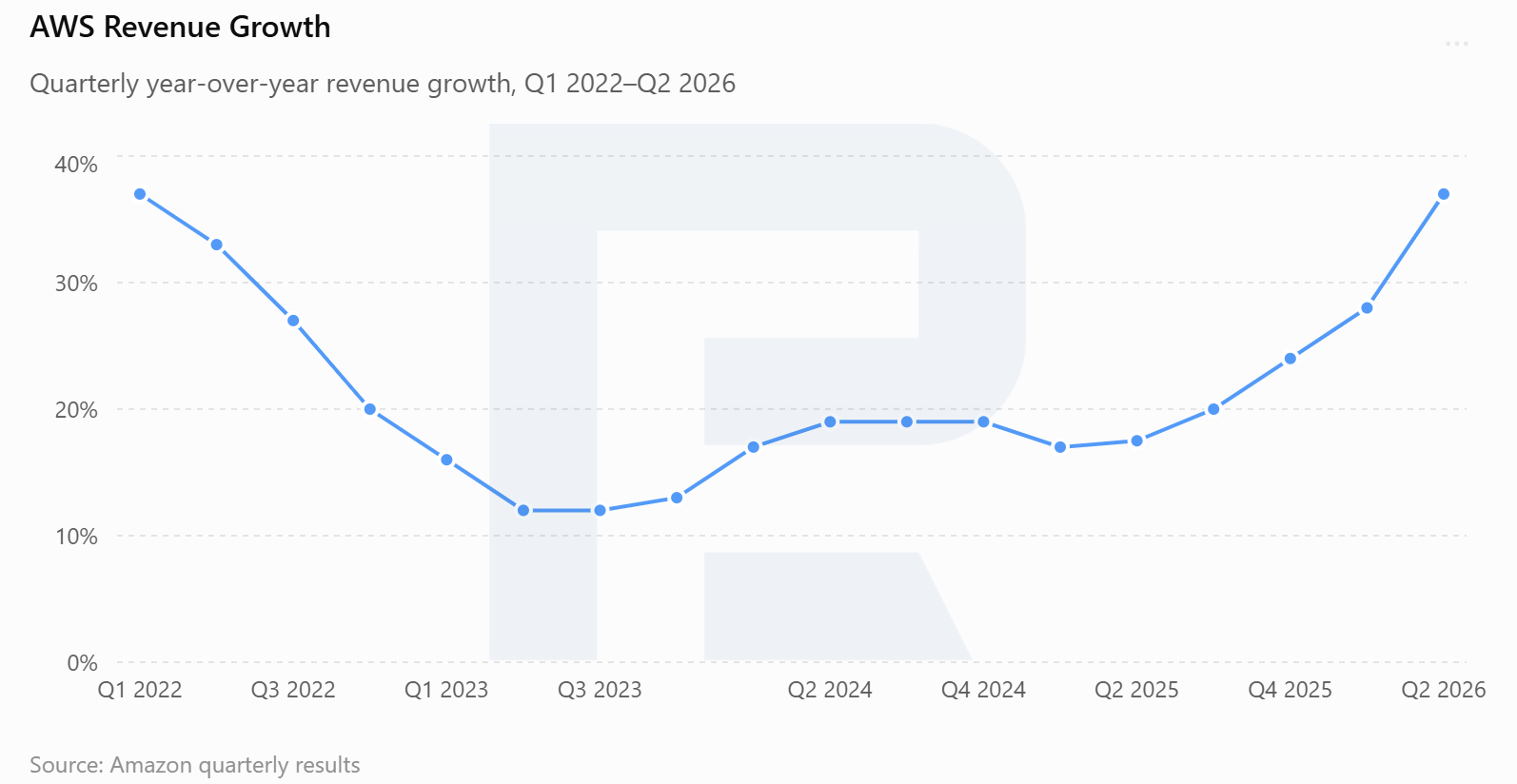
AWS growth. AWS revenue growth remains the primary driver of Amazon stock. The cloud business generates a significant share of the company's operating profit and directly benefits from rising demand for AI services and computing capacity. In Q2 2026, AWS revenue increased by 37% year-on-year to 42.2 billion USD, accelerating from 28% in the previous quarter.
Sustained growth above 30% would confirm continued strong demand for Amazon's cloud infrastructure. Conversely, a sustained slowdown could become one of the most significant negative signals for the stock.
Source: Amazon quarterly results
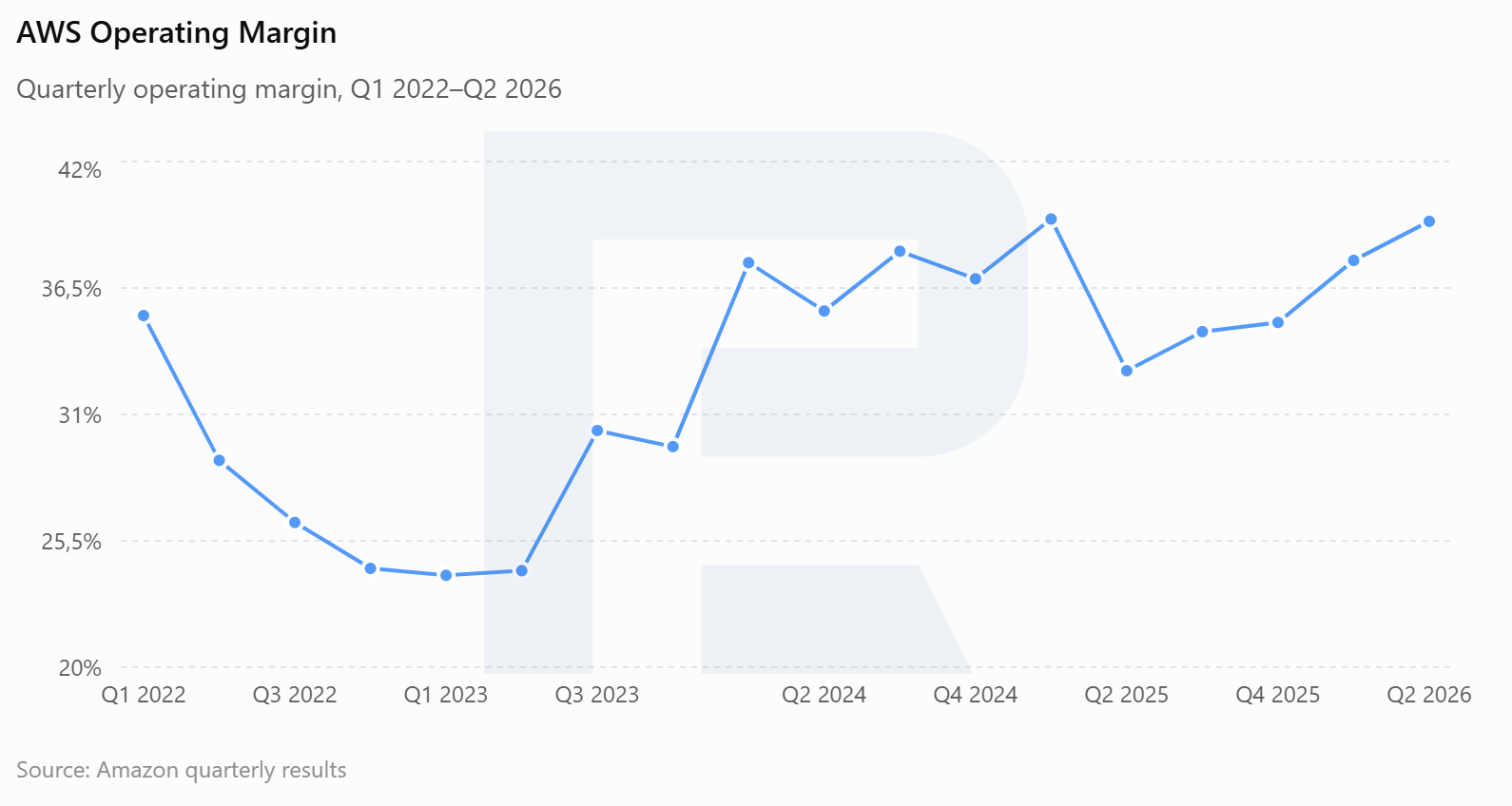
AWS operating margin. AWS growth should be assessed alongside its profitability. In Q2 2026, AWS operating income reached 16.6 billion USD, while the operating margin stood at 39%. Such a high margin allows growth in cloud revenue to translate into even faster profit growth for Amazon. Consequently, the most favourable scenario is one in which AWS continues to grow, maintains its high operating margin, and delivers operating profit growth that outpaces revenue growth.
If AWS continues to grow but its operating margin begins to decline consistently, the quality of that growth will deteriorate.
Source: Amazon quarterly results
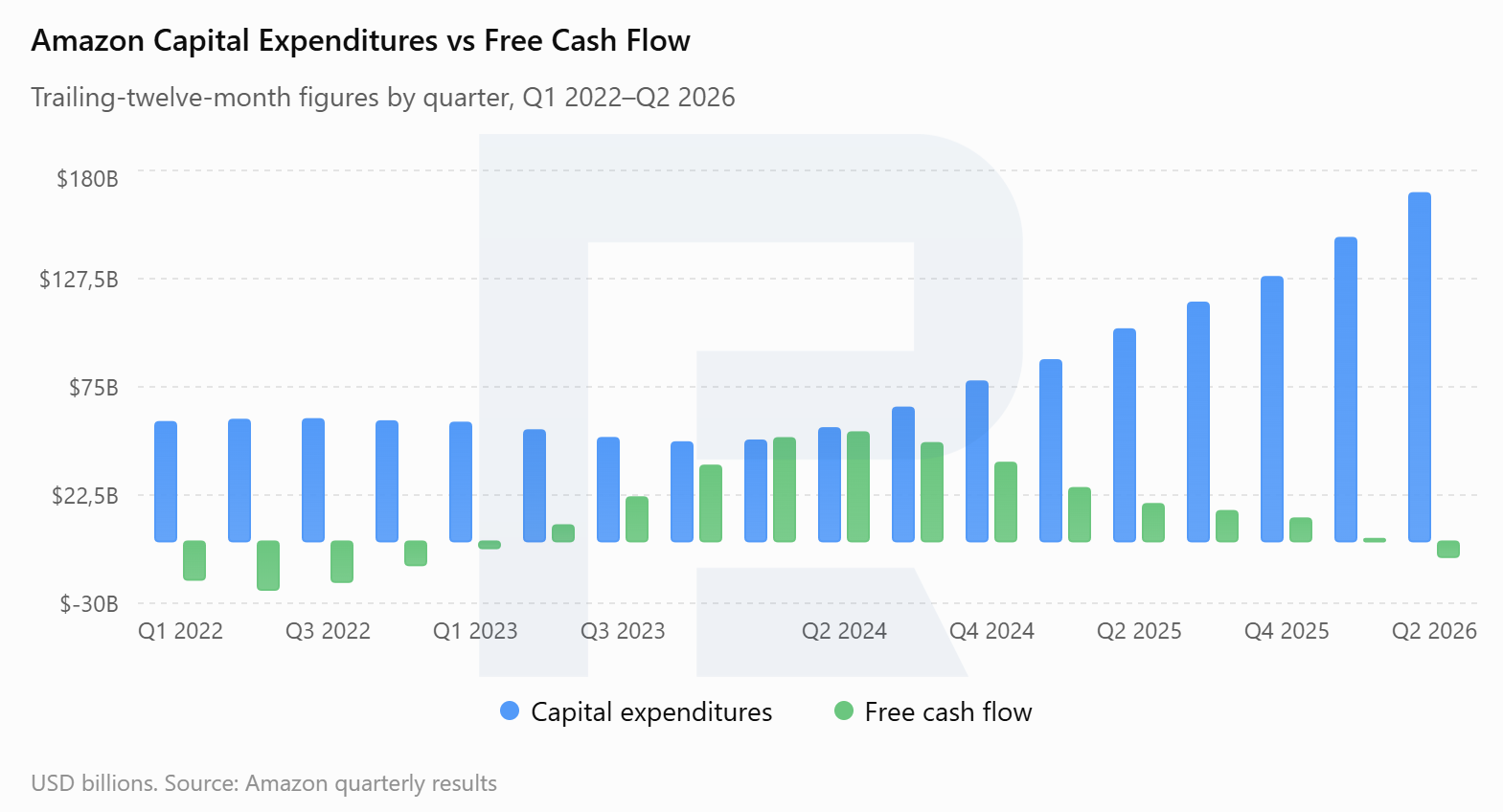
Capital expenditure and free cash flow. Amazon's main risk stems from its sharply increasing investment in data centres, servers, and AI infrastructure. The company expects capital expenditure to reach 220 billion USD in 2026. As a result of this elevated investment, free cash flow over the previous 12 months turned negative, reaching –7.6 billion USD.
If AWS continues to grow rapidly and free cash flow gradually begins to recover, this would confirm the effectiveness of Amazon's investment strategy. However, if capital expenditure continues to increase while AWS growth slows and cash flow deteriorates, this would become one of the most significant risks for AMZN stock.
Source: Amazon quarterly results
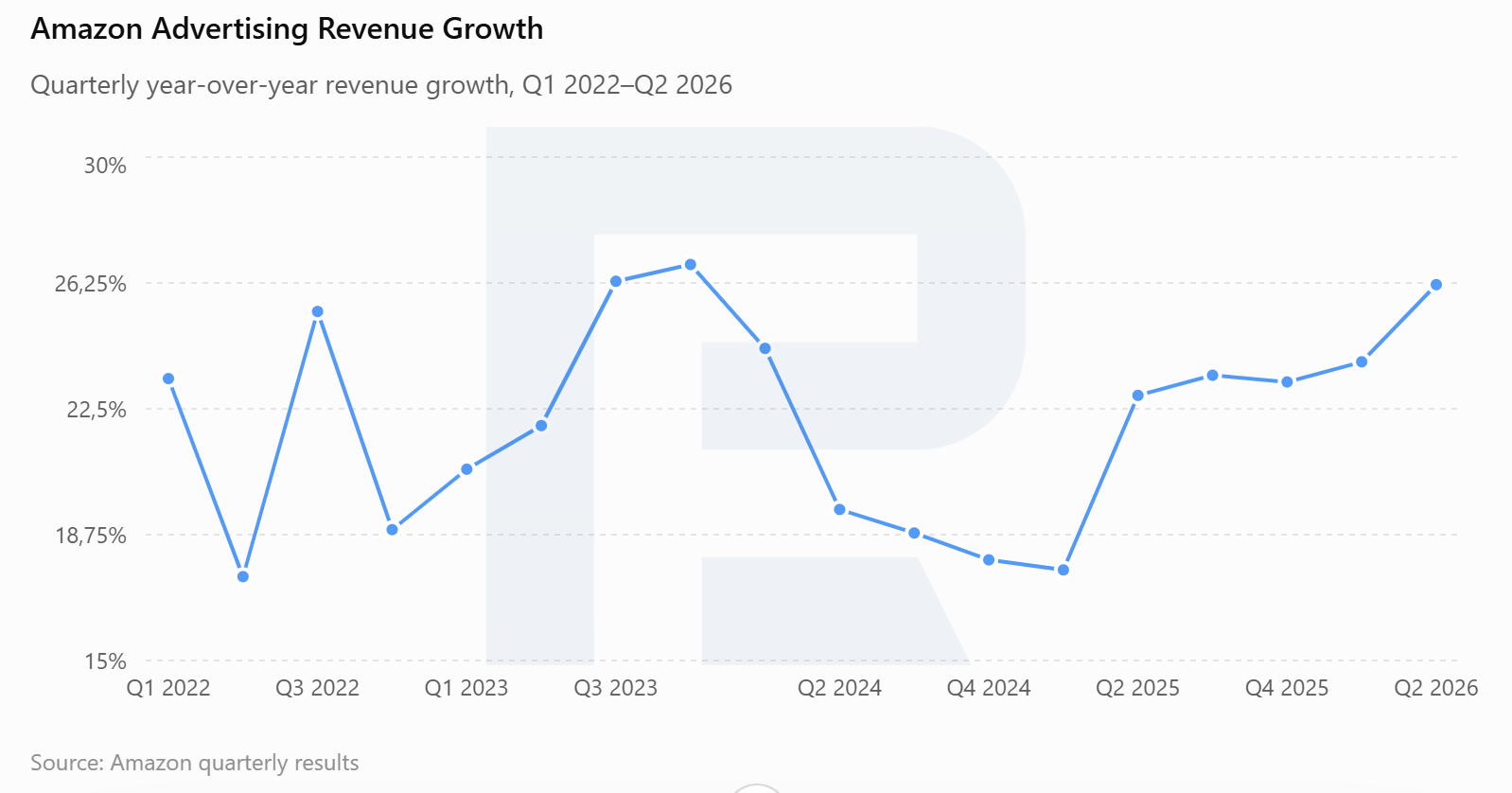
Advertising business growth. Amazon's advertising business is becoming another key growth driver, expanding much faster than its core retail operations while also delivering high margins. In Q2 2026, Amazon's advertising revenue increased by 26% year-on-year.
Amazon benefits from a vast amount of customer purchasing data, enabling it to monetise traffic across its e-commerce platform efficiently. At the same time, advertising growth does not require a comparable increase in spending on warehouses and logistics, meaning that continued expansion of this business can further enhance the company's overall profitability.
Maintaining growth above 20% would indicate the continued expansion of Amazon's second high-margin business alongside AWS. Conversely, a significant slowdown in advertising growth would weaken one of the company's key drivers of operating profit growth.
Source: Amazon quarterly results
Conclusion based on the analysis of key growth drivers
The data suggest that the operational side of Amazon's investment case currently remains very strong. AWS growth accelerated to 37% year-on-year in Q2 2026, returning close to levels seen in early 2022, while AWS operating margin simultaneously increased to 39.4%, close to its highest level over the period under review. This is particularly significant because it means Amazon is generating substantially more profit from each additional dollar of revenue.
The advertising business is providing further support. After slowing during 2024 and early 2025, its growth recovered to 26%, establishing a second fast-growing, high-margin source of profit.
The main cause for concern lies in cash flow. Capital expenditure increased to 169 billion USD over the previous 12 months, while free cash flow declined to –7.6 billion USD.
As a result, Amazon is currently in an aggressive investment cycle. AWS and the advertising business continue to provide compelling evidence of business growth. However, the stock's further upside will depend on whether the company can translate its record investment in AI infrastructure into a recovery in free cash flow.
For now, Amazon's fundamental growth drivers continue to support further upside in AMZN stock. However, the trajectory of capital expenditure and free cash flow remains the principal risk to the company's investment case.
Expert forecasts for Amazon.com shares for 2026
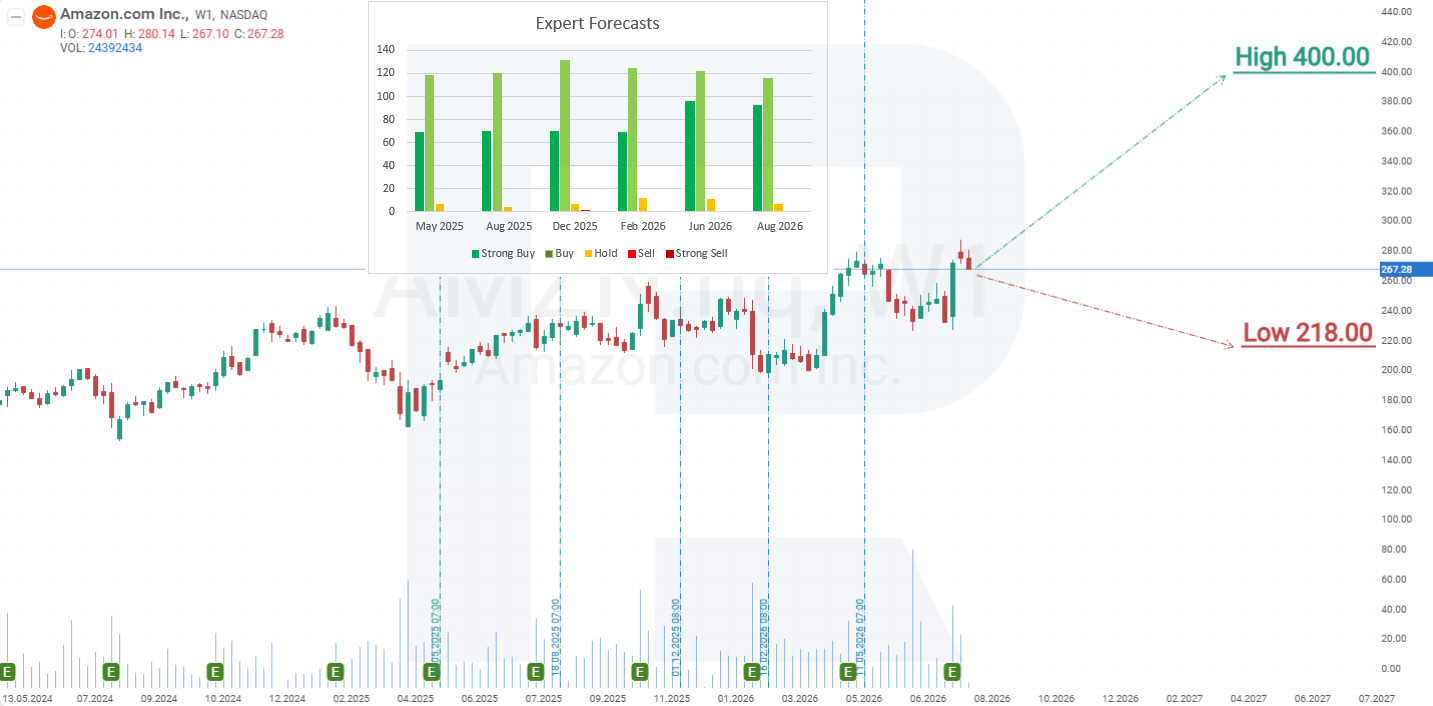
- Barchart: 49 of 57 analysts rate Amazon stock as Strong Buy, 6 as Moderate Buy, and 2 as Hold. The highest price target is 400 USD, while the lowest is 230 USD.
- MarketBeat: 57 of 59 analysts rate the stock as Buy, while 2 recommend Hold. The highest price target is 400 USD, while the lowest is 218 USD.
- TipRanks: 38 of 39 analysts rate the stock as Buy, while 1 recommends Hold. The highest price target is 400 USD, while the lowest is 250 USD.
- Stock Analysis: 43 of 60 analysts rate Amazon stock as Strong Buy, 15 as Buy, and 2 as Hold. The highest price target is 400 USD, while the lowest is 230 USD.
Analysts' forecasts for Amazon stock remain overwhelmingly bullish. Across all four platforms, the vast majority of analysts recommend buying the stock, while the highest price target reaches 400 USD. This consensus reflects expectations that AWS will maintain its strong momentum, the advertising business will continue to expand, and Amazon will successfully monetise its investment in AI infrastructure. If these trends continue, AMZN stock could have further upside.
Amazon.com, Inc. stock price forecast for 2026
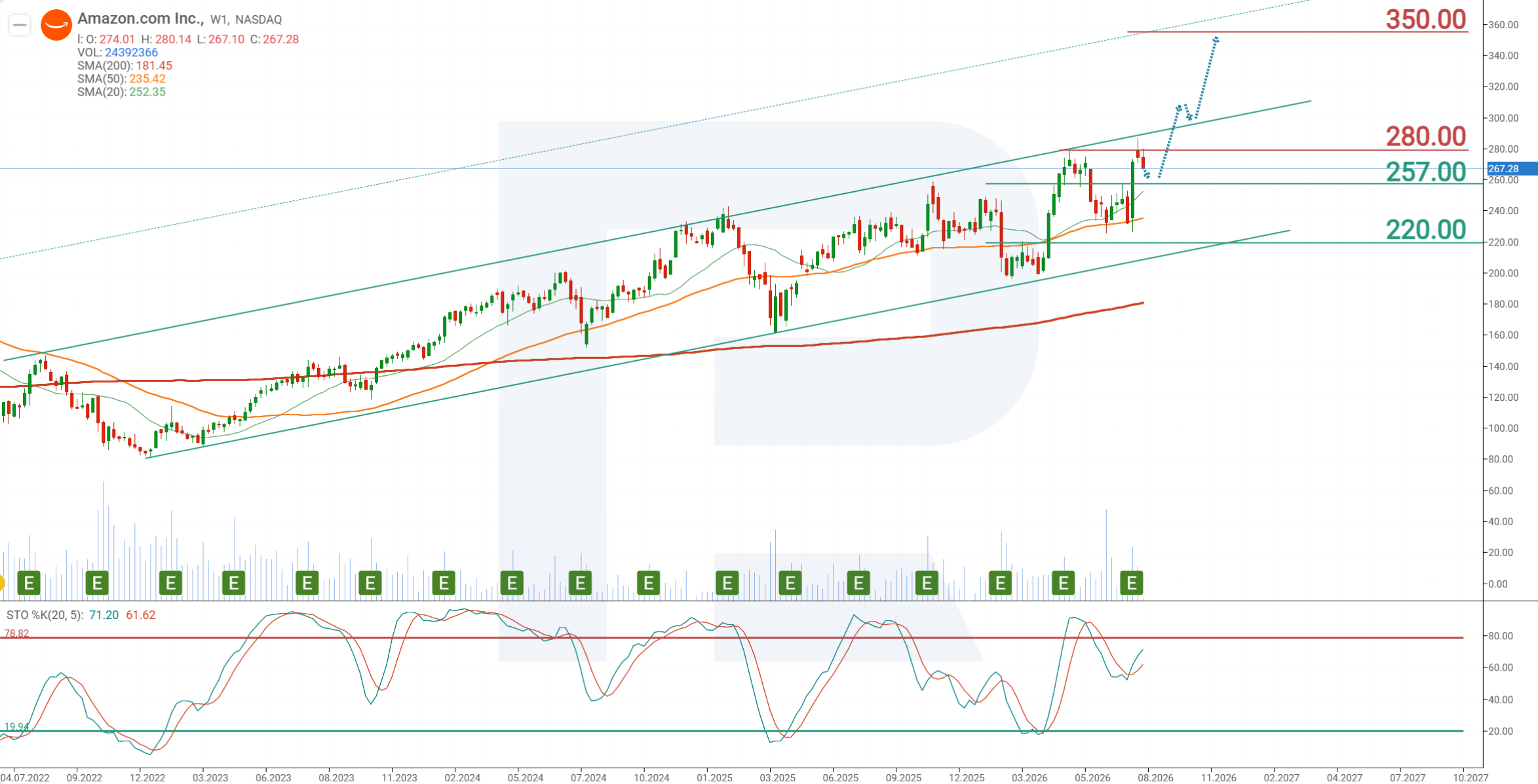
On the weekly chart, Amazon.com (AMZN) stock continues to trade above the 200-period Moving Average, indicating that the prevailing uptrend remains intact. The Stochastic indicator has moved out of overbought territory and into the neutral zone. This suggests that overbought conditions have eased following the recent rally, creating the conditions for the uptrend to resume.
Following the release of Q2 2026 results, AMZN stock rose sharply and broke above resistance at 257 USD. After such a strong advance, the stock may retrace towards this level, which now serves as support, before continuing higher. Based on the current Amazon.com stock performance, the following scenario outlines its potential movement in 2026.
The forecast for AMZN stock suggests a retest of support at 257 USD, followed by a rebound and an advance towards 350 USD. A stop-loss can be placed below the 50-day Moving Average at 224 USD.
Position management: Once the stock moves 10% in the projected direction, move the stop-loss to the entry level. The protective stop should then be trailed 10% behind the price.
Ang mga pagtataya na ipinakita sa seksyong ito ay nagpapakita lamang ng pribadong opinyon ng may-akda at hindi dapat ituring bilang gabay para sa pagtetrade. Walang pananagutan ang RoboForex para sa mga resulta ng pagtetrade batay sa mga rekomendasyon sa pagtetrade na inilarawan sa mga analytical review na ito.