
Broadcom's AI business continues to accelerate, supporting AVGO stock
Broadcom continues to benefit from rising investment in artificial intelligence, with AI revenue remaining the company's principal growth driver. At the same time, a potential decline in operating margin is becoming an important risk for AVGO stock. This article analyses Broadcom stock and provides a forecast for Broadcom for the second half of 2026.
Broadcom Inc. (NASDAQ: AVGO) reported its Q3 2026 financial results, confirming that the company continues to deliver exceptionally strong growth. Revenue increased by 86% year-on-year to 29.59 billion USD, while AI semiconductor revenue grew by 221% to 16.7 billion USD. Free cash flow also continued to increase. These results show that artificial intelligence remains the company's principal growth driver.
For Q4 FY2026, Broadcom forecasts further growth in revenue and its AI business. At the same time, the company expects some moderation in profitability. As a result, it is particularly important for investors to assess whether Broadcom can maintain rapid earnings growth as margins begin to stabilise.
This article analyses Broadcom stock, reviews the company's latest financial results, examines the key drivers of its business, presents a fundamental analysis of AVGO, reviews Broadcom's share price performance, and provides a forecast for the second half of 2026.
About Broadcom Inc.
Broadcom Inc. is a US-based technology company specialising in developing chips for networking equipment, servers, data centres, wireless communications, and software for cloud and enterprise solutions. Founded in 1961 as a division of HP, it was spun off as Avago Technologies in 1991. In 2009, Avago Technologies went public on NASDAQ, and its shares have been traded under the ticker AVGO ever since. In 2016, Avago Technologies acquired Broadcom Corporation for 37.0 billion USD and adopted its name.
Broadcom Inc.’s main sources of revenue
Broadcom’s revenue is divided into two main segments:
- Semiconductor business: approximately 75% of revenue is derived from the sale of chips for data centres, cloud computing, AI accelerators, network processors, and chips for servers, storage, networking equipment, and wireless modules for smartphones and Wi-Fi.
- Infrastructure software: the remaining 25% of revenue comes from enterprise software for cloud computing, cybersecurity and networking solutions, VMware products, automation components, and DevOps platforms.
Broadcom Inc. Q1 2025 financial results
On 6 March, Broadcom released its Q1 2025 financial results for the quarter ended 2 February 2025. The key figures are as follows:
- Revenue: 14.9 billion USD (+25%)
- Net profit: 7.8 billion USD (+67%)
- Earnings per share (EPS): 1.60 USD (+307%)
- Operating profit (non-GAAP): 9.82 billion USD (+44%)
Net revenue by segment:
- Semiconductor solutions: 8.2 billion USD (+55%)
- Infrastructure software: 6.7 billion USD (+47%)
Broadcom reported strong financial results for Q1 of the 2025 financial year, with revenue rising by 25% year-on-year. This growth was primarily driven by a 77% increase in AI-related revenue, which reached 4.1 billion USD, and a 47% rise in infrastructure software revenue, totalling 6.7 billion USD. The successful integration of VMware, acquired in 2023, also played a significant role in this expansion, strengthening Broadcom’s position in the enterprise software market.
CEO Hock Tan highlighted the strong demand for custom AI chips from cloud computing giants, which heavily invest in AI-driven data centres.
Looking ahead to Q2 2025, Broadcom expects revenue to reach 14.9 billion USD, slightly above analysts’ estimates. The company anticipates further growth in the AI semiconductor segment, with AI-related revenue projected to increase to 4.4 billion USD in the next quarter.
Broadcom Inc. Q2 2025 financial results
On 5 June 2025, Broadcom Inc. published its Q2 2025 financial results for the quarter ended 4 May 2025. The key figures are presented below:
Revenue: 15.0 billion USD (+20%)
Net income: 7.8 billion USD (+44%)
Earnings per share (EPS): 1.58 USD (+43%)
Operating income (non-GAAP): 9.79 billion USD (+37%)
Revenue by segment:
Semiconductor Solutions: 8.4 billion USD (+17%)
Infrastructure Software: 6.6 billion USD (+25%)
Broadcom's Q2 2025 results highlighted the company's strong position in the AI and semiconductor markets. Revenue increased by 20% year on year, while AI revenue grew by 46% to 4.4 billion USD, driven by demand for custom AI chips and networking solutions. The company also repurchased 3.2 billion USD of its own shares, reflecting strong cash flow and management's confidence in the business.
For Q3, Broadcom forecast revenue of approximately 15.8 billion USD. AI semiconductor revenue was expected to increase to 5.1 billion USD, marking a tenth consecutive quarter of growth. The guidance indicated that demand for Broadcom's AI and networking products was expected to remain strong.
Despite the strong results, the stock fell by approximately 5% following the earnings release. Investors were concerned about a potential slowdown in the AI market and the stock's elevated valuation following its sharp gains in previous months. Nevertheless, analysts remained positive on Broadcom, supported by its high profitability, strong free cash flow, and continued growth in its AI business.
Broadcom Inc. Q3 2025 financial results
On 4 September 2025, Broadcom Inc. published its Q3 2025 financial results for the quarter ended 3 August 2025. The key figures are presented below:
Revenue: 15.95 billion USD (+22%)
Net income: 8.40 billion USD (+37%)
Earnings per share (EPS): 1.69 USD (+36%)
Operating income (non-GAAP): 10.45 billion USD (+31%)
Revenue by segment:
Semiconductor Solutions: 9.17 billion USD (+26%)
Infrastructure Software: 6.79 billion USD (+17%)
Broadcom's Q3 2025 results exceeded analysts' expectations. Revenue increased by 22% year on year to 15.95 billion USD, while AI revenue grew by 63% to 5.2 billion USD. The semiconductor business remained the principal growth driver, while the Infrastructure Software segment, including VMware, continued to expand, supported by its subscription-based business model and cloud solutions.
The company's financial performance also remained strong. Adjusted earnings per share reached 1.69 USD, up 36% year on year, while the EBITDA margin reached 67%.
For Q4 2025, Broadcom forecast revenue of approximately 17.4 billion USD, 24% above the previous year's level. AI revenue was expected to reach 6.2 billion USD, representing 66% year-on-year growth. An additional growth driver was a contract worth more than 10 billion USD with a new hyperscale customer to supply XPU AI accelerators.
Broadcom Inc. Q4 2025 financial results
On 11 December, Broadcom released its Q4 2025 financial results for the quarter ended 2 November 2025. The key figures are as follows:
- Revenue: 18.02 billion USD (+28%)
- Net income (non-GAAP): 9.71 billion USD (+39%)
- Earnings per share (non-GAAP): 1.95 USD (+37%)
- Operating income (non-GAAP): 12.22 billion USD (+34%)
Net revenue by segment:
- Semiconductor solutions: 11.07 billion USD (+35%)
- Infrastructure software: 6.94 billion USD (+19%)
Broadcom’s Q4 results for the 2025 financial year were strong and exceeded market expectations. Revenue amounted to 18 billion USD (+28% y/y), compared with a forecast of 17.5 billion USD, while adjusted earnings per share (non-GAAP EPS) reached 1.95 USD, above analysts’ expectations (1.87 USD). The main growth driver was AI chips: revenue from the semiconductor segment increased to 11.1 billion USD (+35% y/y), of which 6.5 billion USD came from AI-related products (+74% y/y). The infrastructure software business, including VMware, also grew to 6.90 billion USD (+19% y/y). As a result, Broadcom consistently generates earnings from both hardware solutions and software infrastructure. The company maintained high profitability, with non-GAAP EBITDA of 12.2 billion USD (68% of revenue), free cash flow of 7.5 billion USD, and a 10% dividend increase to 0.65 USD per share.
The outlook for Q1 2026 was also positive, with expected revenue at 19.1 billion USD (+28% y/y), the EBITDA margin projected at 67%, and sales of AI chips expected to rise to 8.2 billion USD. Broadcom stated that it had an order backlog for AI solutions of 73 billion USD over the next 18 months.
Broadcom Inc. Q1 2026 financial results
On 4 March 2026, Broadcom Inc. published its Q1 2026 financial results for the quarter ended 1 February 2026. The key figures are presented below:
- Revenue: 19.31 billion USD (+29%)
- Net income (non-GAAP): 10.19 billion USD (+30%)
- Earnings per share (non-GAAP): 2.05 USD (+28%)
- Operating income (non-GAAP): 12.83 billion USD (+30%)
Net revenue by segment:
- Semiconductor Solutions: 12.52 billion USD (+52%)
- Infrastructure Software: 6.80 billion USD (+1%)
Broadcom's Q1 2026 results exceeded market expectations. Revenue increased by 29% year on year to 19.31 billion USD, while non-GAAP earnings per share reached 2.05 USD. The company's AI business remained the principal growth driver, with AI revenue increasing by 106% to 8.4 billion USD. Semiconductor Solutions revenue grew by 52%, while Infrastructure Software revenue increased by just 1%.
The company's profitability remained strong. Adjusted EBITDA reached 13.13 billion USD, while free cash flow totalled 8.01 billion USD. Broadcom also announced a new 10 billion USD share repurchase program.
For Q2 2026, the company forecast revenue of approximately 22 billion USD, well above analysts' expectations, while AI chip revenue was expected to increase to 10.7 billion USD. Broadcom also stated that AI chip revenue could exceed 100 billion USD in 2027, reflecting management's confidence in continued strong demand from the world's largest data centre operators.
Broadcom Inc. Q2 2026 financial results
On 3 June 2026, Broadcom Inc. published its Q2 2026 financial results for the quarter ended 3 May 2026. The key figures are presented below:
- Revenue: 22.19 billion USD (+48%)
- Net income (non-GAAP): 12.07 billion USD (+55%)
- Earnings per share (non-GAAP): 2.44 USD (+54%)
- Operating income (non-GAAP): 14.93 billion USD (+52%)
- Free cash flow: 10.26 billion USD (+60%)
Revenue by segment:
- Semiconductor Solutions: 15.01 billion USD (+79%)
- Infrastructure Software: 7.18 billion USD (+9%)
Broadcom's Q2 2026 results maintained strong business momentum. Revenue rose 48% year on year to a record 22.19 billion USD, exceeding the company's guidance. The AI business remained the principal growth driver, with AI semiconductor revenue increasing by 143%, driven by strong demand for custom AI accelerators and networking equipment for data centres.
Infrastructure Software revenue increased by 9%, continuing to provide stable revenue and high profitability. Adjusted EBITDA reached 15.24 billion USD, equivalent to 69% of revenue, while free cash flow totalled 10.26 billion USD.
For Q3 2026, Broadcom forecast revenue of approximately 29.4 billion USD and Adjusted EBITDA of approximately 68% of revenue. AI semiconductor revenue was expected to exceed 16 billion USD, representing more than 200% year-on-year growth.
Broadcom Inc. Q3 2026 financial results
On 2 September 2026, Broadcom Inc. published its Q3 2026 financial results for the quarter ended 2 August 2026. The key figures are presented below:
- Revenue: 29.59 billion USD (+86%)
- Net income (non-GAAP): 16.37 billion USD (+95%)
- Earnings per share (non-GAAP): 3.32 USD (+96%)
- Operating income (non-GAAP): 20.10 billion USD (+92%)
- Free cash flow: 13.67 billion USD (+95%)
Revenue by segment:
- Semiconductor Solutions: 20.84 billion USD (+127%)
- Infrastructure Software: 8.75 billion USD (+29%)
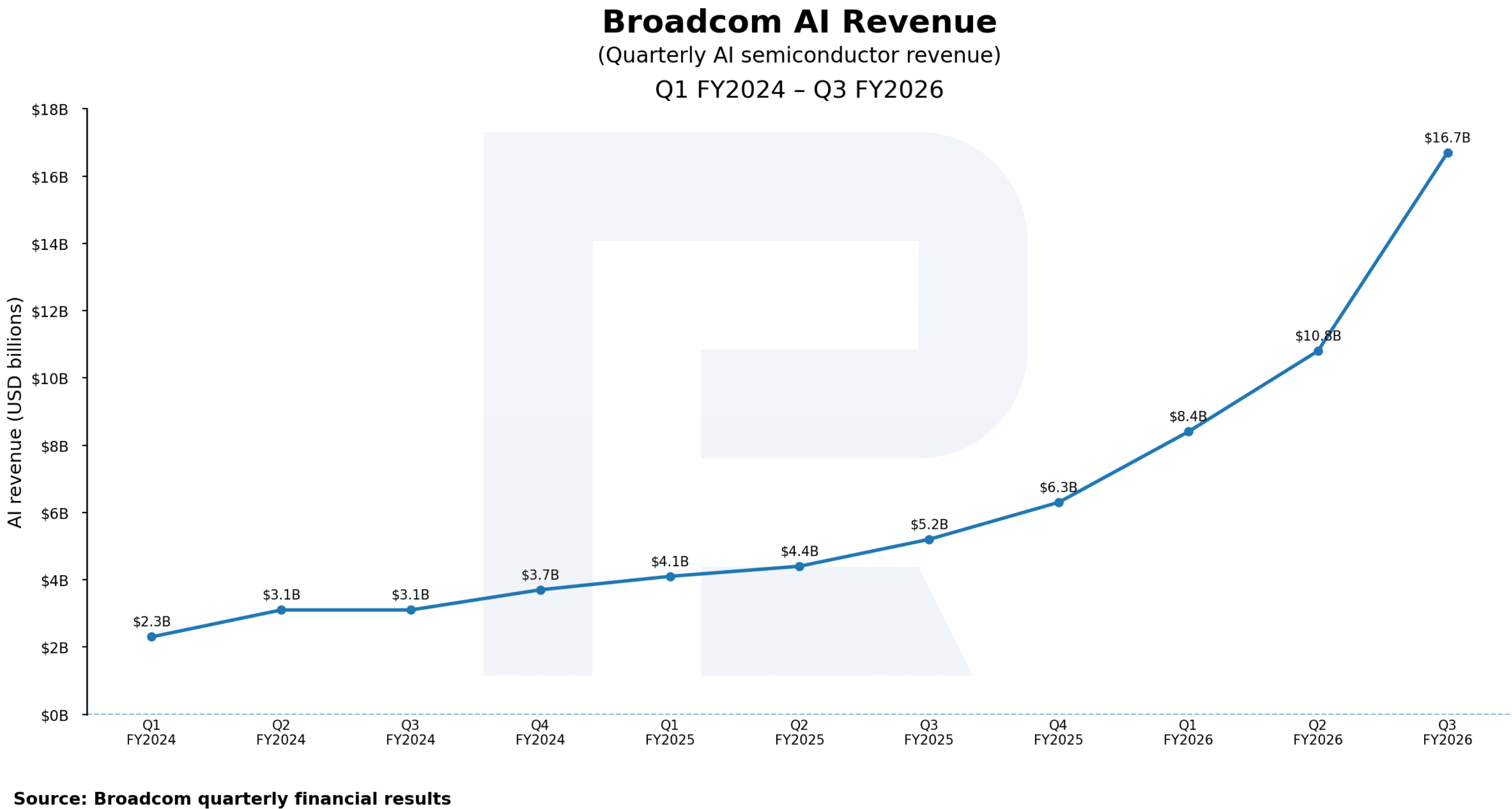
Broadcom's Q3 2026 results confirmed that the company's fundamentals remain strong, with no signs yet that revenue growth has peaked or that demand for AI solutions is weakening. Revenue reached 29.59 billion USD, increasing by 86% year on year, while AI semiconductor revenue grew by 221% to 16.7 billion USD. It was particularly encouraging that the company exceeded its own AI revenue guidance and continues to forecast further growth. For Q4, Broadcom forecasts AI revenue of 21.7 billion USD, approximately 30% higher than in the previous quarter. This indicates that the company's principal growth driver continues to gain momentum.
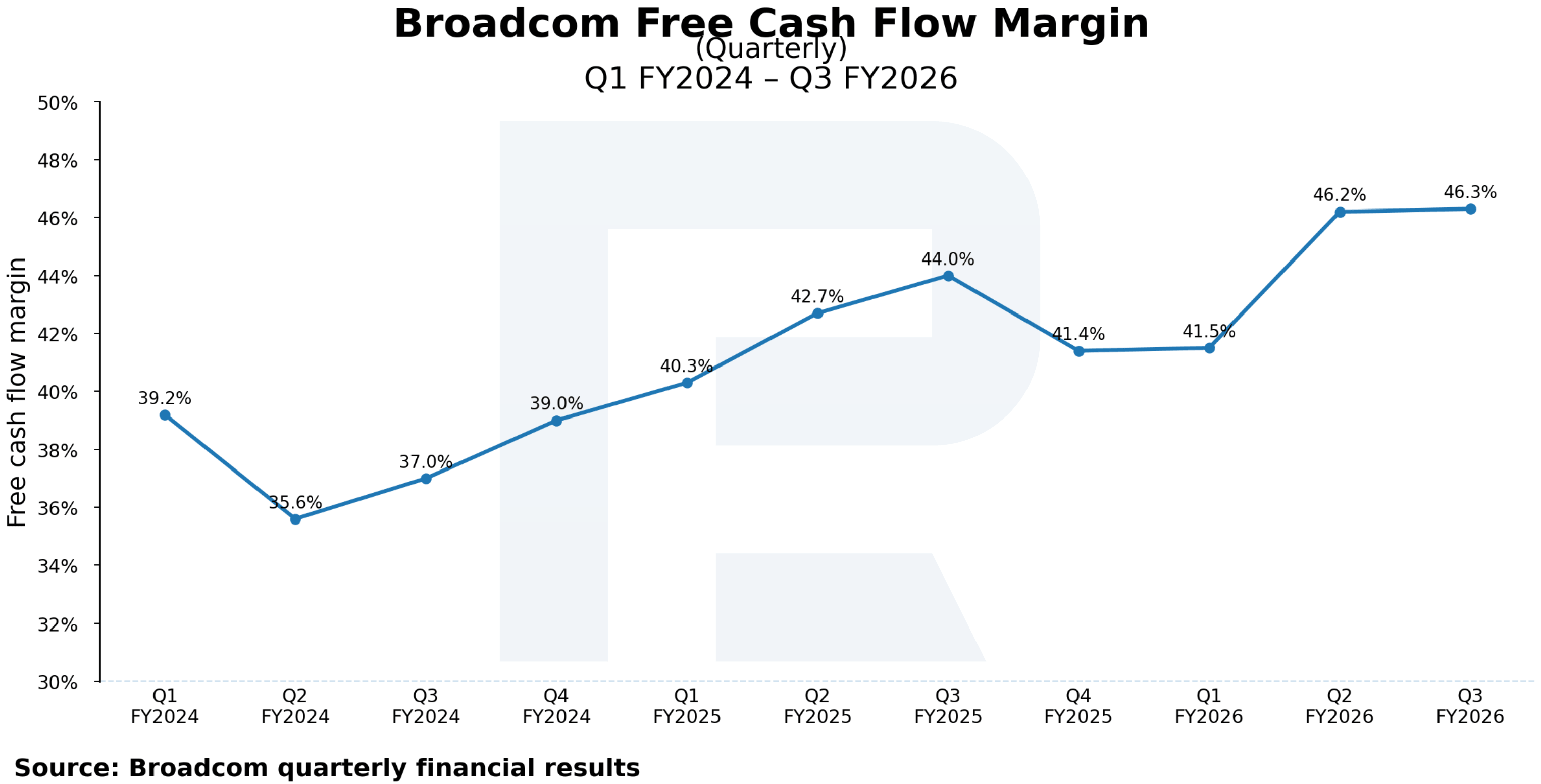
The quality of growth also remains strong. Semiconductor Solutions remains the principal source of business growth, while Infrastructure Software also delivered stronger growth, with revenue increasing by 29% year on year. Free cash flow reached 13.67 billion USD, up 95%, while the free cash flow margin reached 46%. This demonstrates that Broadcom continues to convert its rapid revenue growth into strong cash flow.
One metric in the report now warrants particularly close attention. Non-GAAP gross margin declined to 75%, and management expects it to fall further to 73% next quarter. This is due to the rapidly growing share of custom AI accelerators, which require expensive components and generate lower gross margins than some of Broadcom's traditional businesses. For now, this is being offset by the company's increasing scale and strong operating efficiency. However, a continued decline in both gross and operating margins could indicate that profitability is approaching its peak in the current cycle. A particularly negative signal would be a simultaneous decline in margins and a slowdown in AI revenue growth.
The company's outlook nevertheless remains very strong. Broadcom expects further rapid expansion of its AI business and forecasts 115 billion USD in AI revenue in FY2027. This guidance reflects management's confidence that hyperscale customers will continue to invest heavily in custom AI accelerators and networking infrastructure. However, this also represents the principal risk for Broadcom stock. Market expectations are already exceptionally high, meaning Broadcom must continue to meet or exceed its own ambitious guidance. Even a modest shortfall relative to expectations could trigger a significant share price correction without any material deterioration in the underlying business.
Overall, the current situation suggests that profitability may be approaching its peak, even as investor expectations remain exceptionally high. AI revenue continues to accelerate, the software business has returned to strong growth, and the free cash flow margin remains exceptionally high. For long-term investors, this does not yet signal that it is time to exit the stock. The principal signs of a potential change in the investment case would be a simultaneous slowdown in AI revenue growth, a sustained decline in operating profitability, and a meaningful deterioration in free cash flow margin. For now, Broadcom's financial results do not point to such a combination of negative trends, so there is insufficient evidence to conclude that the company's business has reached its peak.
Fundamental analysis of AVGO: key drivers of Broadcom stock in 2026
In 2026, Broadcom's investment case will largely depend on the continued expansion of AI infrastructure and the company's ability to convert strong product demand into sustained earnings and cash flow growth. When analysing Broadcom stock, investors should pay particular attention to four key indicators that help assess whether the company can maintain its growth momentum and continue to justify the market's high expectations.
AI revenue has become the principal driver of Broadcom's business growth. This category primarily includes custom AI accelerators for major cloud providers and networking solutions required to connect large-scale computing systems within data centres.
Growth in this metric reflects both increased investment by the world's largest technology companies in AI infrastructure and Broadcom's ability to capture a share of that spending. As long as AI revenue continues to grow rapidly, it will remain one of the strongest growth drivers among the world's largest semiconductor manufacturers.
The trend in AI revenue growth is particularly important. A sustained slowdown over several quarters could be one of the earliest signs that the current AI investment cycle is beginning to lose momentum.
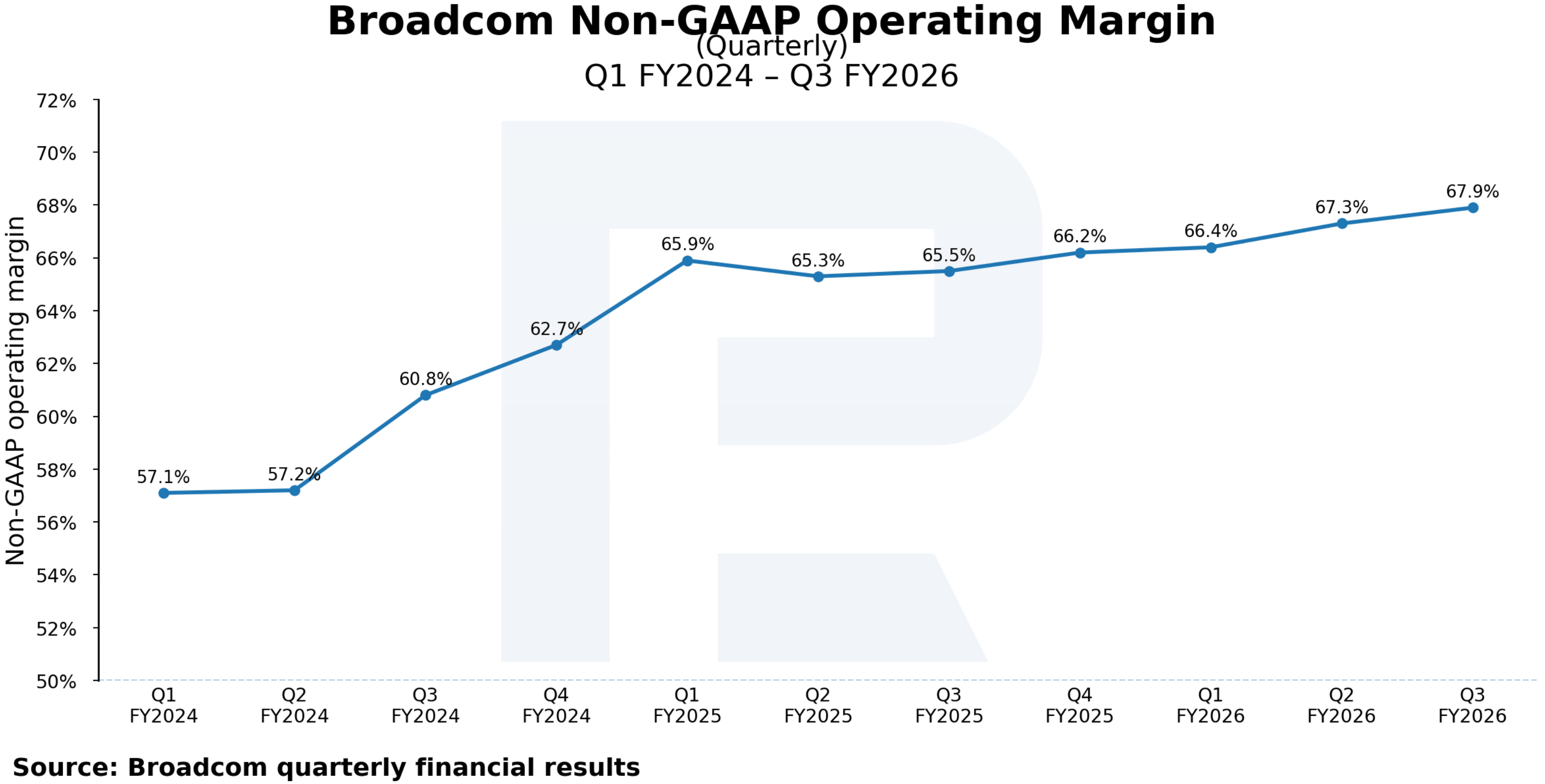
Non-GAAP operating margin is the second key indicator because strong revenue growth becomes significantly more valuable when it is accompanied by improving profitability.
This metric shows what proportion of Broadcom's revenue remains after core operating expenses, excluding certain one-off and non-cash items. Rising or consistently high operating margins indicate strong operating leverage and the company's ability to grow earnings faster than revenue.
If AI revenue continues to grow while operating margin remains high or continues to increase, this points to high-quality growth. Conversely, a sustained decline in operating margin despite continued strong revenue growth could indicate rising costs, a shift in the sales mix, or weakening pricing power.
Free cash flow margin shows what proportion of revenue Broadcom converts into free cash flow after capital expenditure. This metric is particularly important for Broadcom because of the company's strong cash generation and substantial debt burden following its major acquisitions.
A high free cash flow margin enables the company to reduce debt, pay dividends, repurchase shares, and fund future growth without becoming overly reliant on external financing.
Quarterly fluctuations in this metric may reflect seasonality and changes in working capital, making it more important to assess the trend over several quarters. A sustained decline in free cash flow margin alongside deteriorating operating margin would be a much more significant warning sign.
Infrastructure Software revenue. Following the acquisition of VMware, Infrastructure Software became Broadcom's second major business segment alongside Semiconductor Solutions. The trend in Infrastructure Software revenue therefore provides a useful indication of how successfully the company is developing its acquired assets and realising the benefits of the VMware integration.
Growth in software revenue diversifies Broadcom's business and reduces its dependence on the cyclical semiconductor market. In addition, Infrastructure Software generates a high proportion of recurring revenue and helps support the company's overall profitability.
It is particularly important that, once the initial impact of VMware's inclusion in Broadcom's financial results has passed, the software segment continues to grow. If Infrastructure Software revenue continues to increase once the effect of the exceptionally high comparison base has passed, this would confirm that VMware has become a long-term growth driver for Broadcom.
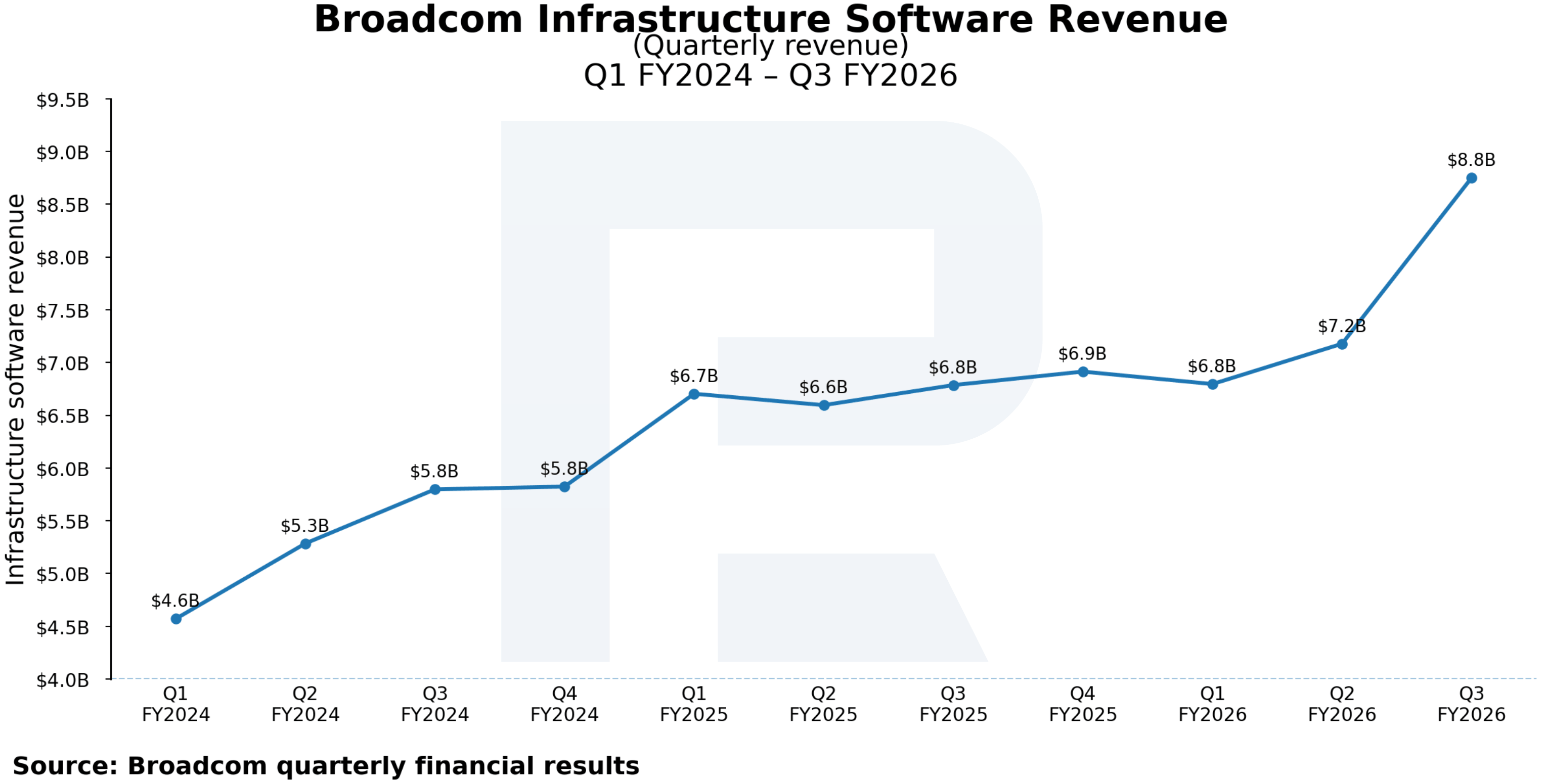
Taken together, these indicators do not yet point to any fundamental deterioration in Broadcom's business. AI revenue continues to accelerate, non-GAAP operating margin remains near its historical high, free cash flow margin remains above 46%, and the software business has returned to strong growth after a period of stabilisation. This suggests that rising demand for AI infrastructure continues to be accompanied by improving profitability and strong cash generation.
At the same time, one development warrants close attention. Non-GAAP operating margin has already approached 68%, while management expects it to decline to 66% in Q4. Gross margin is also coming under pressure as AI semiconductors account for a growing share of the business. As a result, profitability in the current cycle may be approaching its peak, even if revenue continues to grow rapidly.
The first serious warning sign would be a simultaneous slowdown in AI revenue growth, a sustained decline in operating margin, and a deterioration in free cash flow margin. For now, Broadcom's financial results do not point to such a combination of negative trends, so the fundamental outlook remains broadly positive.
Expert forecasts for Broadcom Inc. stock
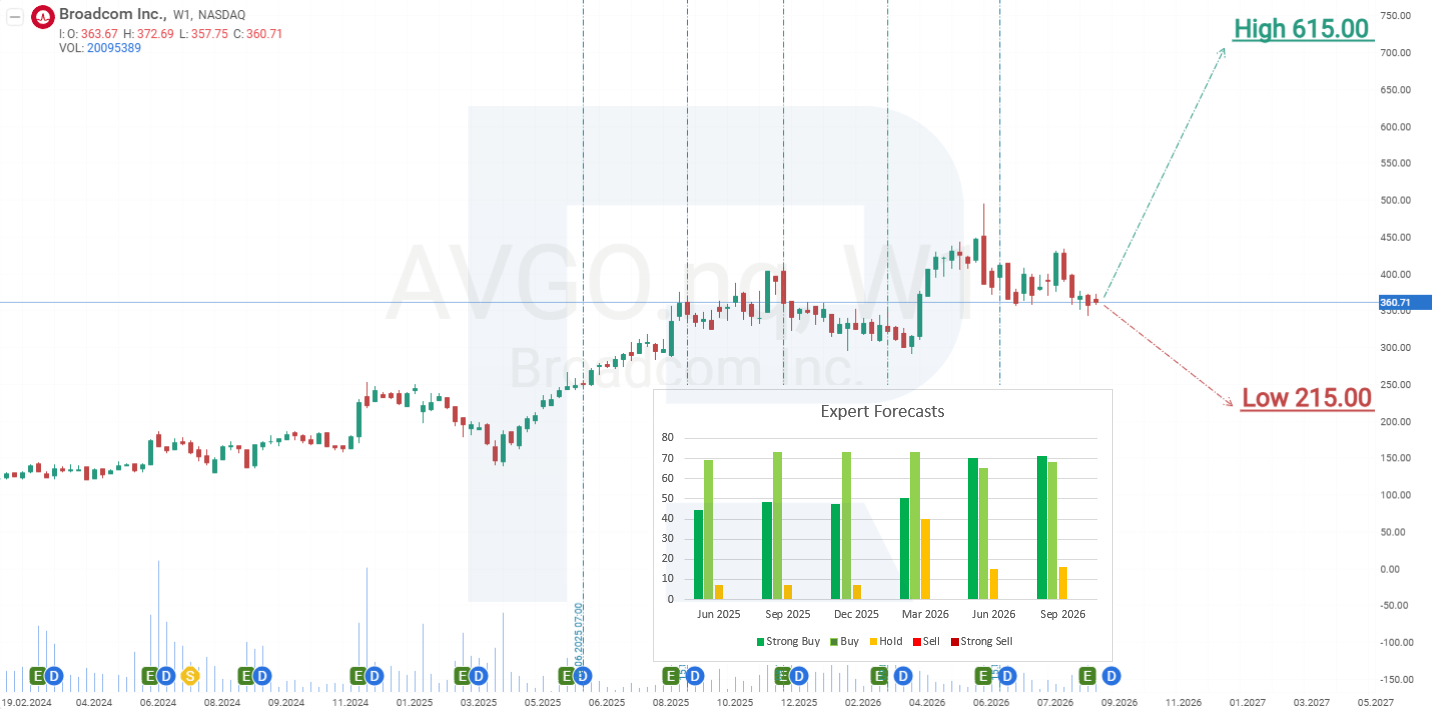
- Barchart: 34 of 42 analysts rate Broadcom stock as Strong Buy, 3 as Buy, and 5 as Hold. The highest price target is 715 USD, while the lowest is 350 USD.
- MarketBeat: 30 of 34 analysts rate the stock as Buy, while 4 recommend Hold. The highest price target is 600 USD, while the lowest is 350 USD.
- TipRanks: 27 of 30 analysts rate the stock as Buy, while 3 recommend Hold. The highest price target is 630 USD, while the lowest is 350 USD.
- Stock Analysis: 37 of 49 analysts rate Broadcom stock as Strong Buy, 8 as Buy, and 4 as Hold. The highest price target is 715 USD, while the lowest is 215 USD.
Analysts remain broadly positive on Broadcom stock. Across all four platforms, the majority recommend buying AVGO, although the wide range of price targets highlights considerable differences in estimates of the company's fair value. For this reason, analyst consensus should be considered alongside Broadcom's fundamentals and the current technical picture.
Broadcom Inc. stock price forecast for 2026
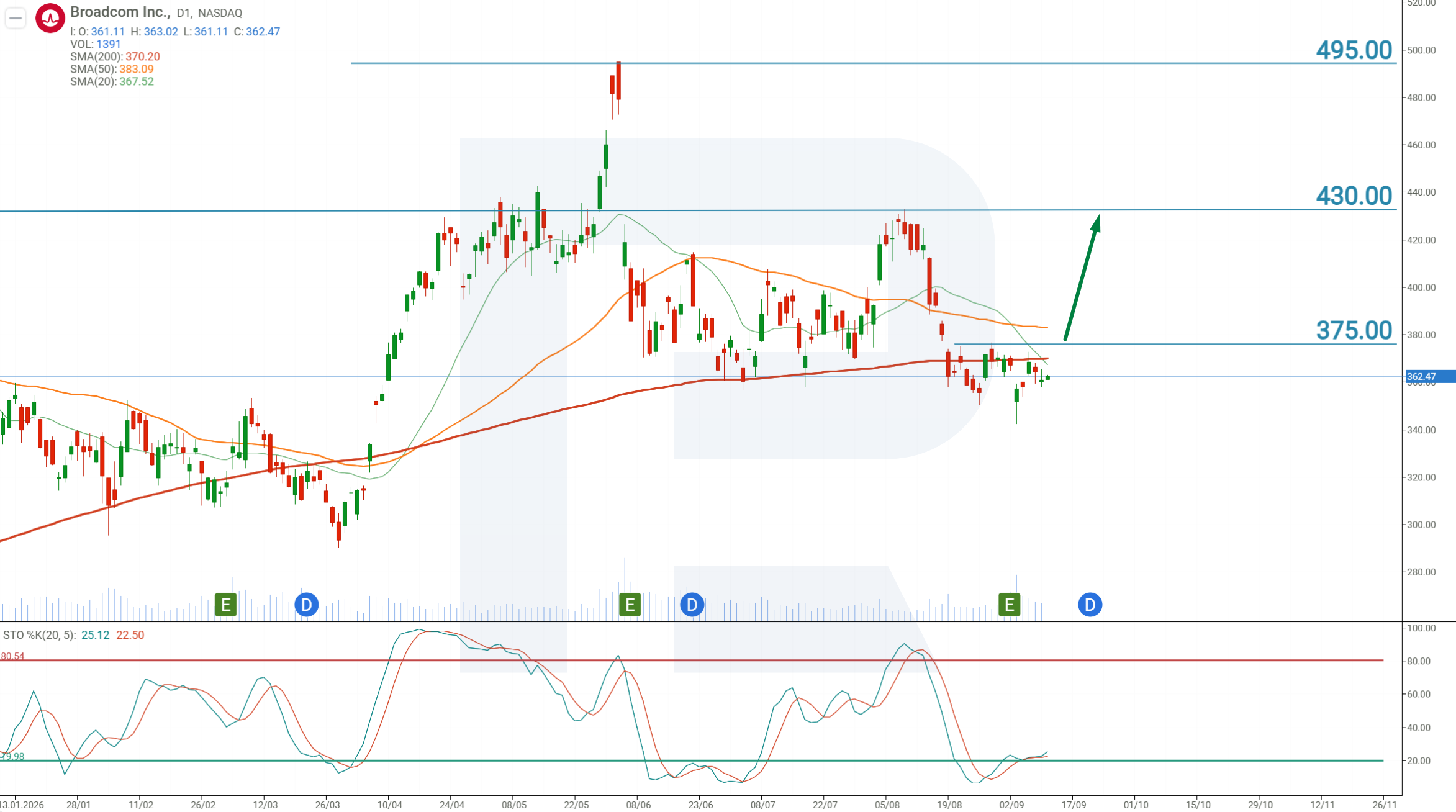
At the time of writing, AVGO stock is trading at around 362 USD.
On the daily timeframe, AVGO stock is trading close to its 200-period Moving Average. As the stock had previously been in a sustained uptrend, the recent decline towards the 200-period Moving Average and the subsequent break below it suggest that bullish momentum is weakening and increase the likelihood of either a period of sideways trading or the beginning of a downtrend.
At the same time, the fundamental analysis does not yet point to any material deterioration in Broadcom's business. One of the principal risks remains the possibility of a decline in operating margin over the coming reporting periods. The base-case scenario therefore assumes that the stock will trade within a range of 350–430 USD until either a new major growth catalyst emerges or the company demonstrates that stabilising operating margins above 65% does not prevent further earnings growth.
Under this scenario, the share price could attempt to recover from current levels towards the upper end of the range. The Stochastic indicator also provides a supportive signal, as it is close to oversold territory, increasing the probability of a short-term recovery.
Nevertheless, buying the stock at current levels remains risky, as the upcoming Fed meeting could increase volatility across the equity market. A more conservative approach would be to open a position after the stock breaks above resistance at 375 USD and consolidates above that level. In this case, Broadcom's share price performance would confirm sufficient demand to support a further advance.
Accordingly, the trading strategy for Broadcom stock is to place a Buy Stop order at 378.00 USD. A Stop Loss is recommended at 356.00 USD, while Take Profit is set near the upper boundary of the trading range at 425.00 USD.
Buy Stop – 378.00 USD
Take Profit – 425.00 USD
Stop Loss – 356.00 USD
Position management. Once the stock has moved 70% of the way towards the target, move the Stop Loss to the entry price. The protective stop should then be trailed at a distance of 10% from the price. Continue trailing the stop until the position is closed, either at the Take Profit or the Stop Loss, depending on which level is reached first.
Should you buy Broadcom stock?
An analysis of Broadcom stock suggests that the company's fundamentals remain strong. AI revenue continues to accelerate, Infrastructure Software has returned to strong growth, and free cash flow remains high. The principal change is that operating margin may be approaching its peak, making the future trend in profitability particularly important.
For long-term investors, the current financial performance does not yet indicate any deterioration in Broadcom's business. However, the company's high valuation and the prospect of declining margins make the entry price particularly important. From a technical perspective, the stock is in a transitional phase after breaking below the 200-period Moving Average. As a result, waiting for confirmation of a move above 375 USD appears to be the more conservative approach.
If Broadcom continues to deliver rapid AI revenue growth while maintaining a high operating margin and strong free cash flow, the fundamental case for further share price appreciation will remain intact. A simultaneous deterioration across several of the company's key business metrics would be a strong signal that this outlook should be reassessed.
Ang mga pagtataya na ipinakita sa seksyong ito ay nagpapakita lamang ng pribadong opinyon ng may-akda at hindi dapat ituring bilang gabay para sa pagtetrade. Walang pananagutan ang RoboForex para sa mga resulta ng pagtetrade batay sa mga rekomendasyon sa pagtetrade na inilarawan sa mga analytical review na ito.