
CrowdStrike stock forecast for 2026 following Q2 2027 earnings
CrowdStrike stock remains supported by strong financial performance. Net new ARR reached a record level, Falcon Flex continues to grow rapidly, and operating margin is improving. This article examines what these developments mean for CRWD stock and identifies potentially attractive entry levels.
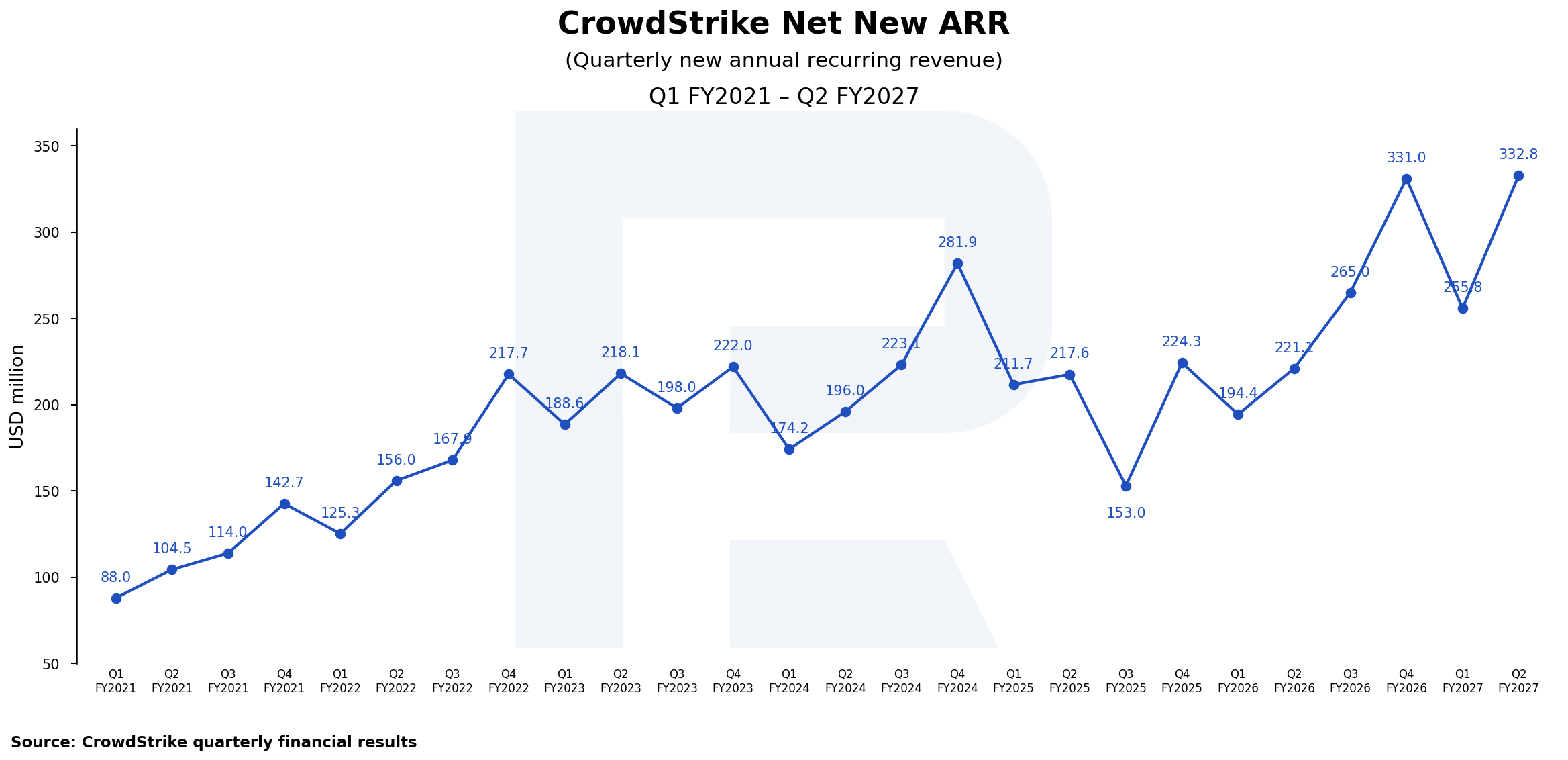
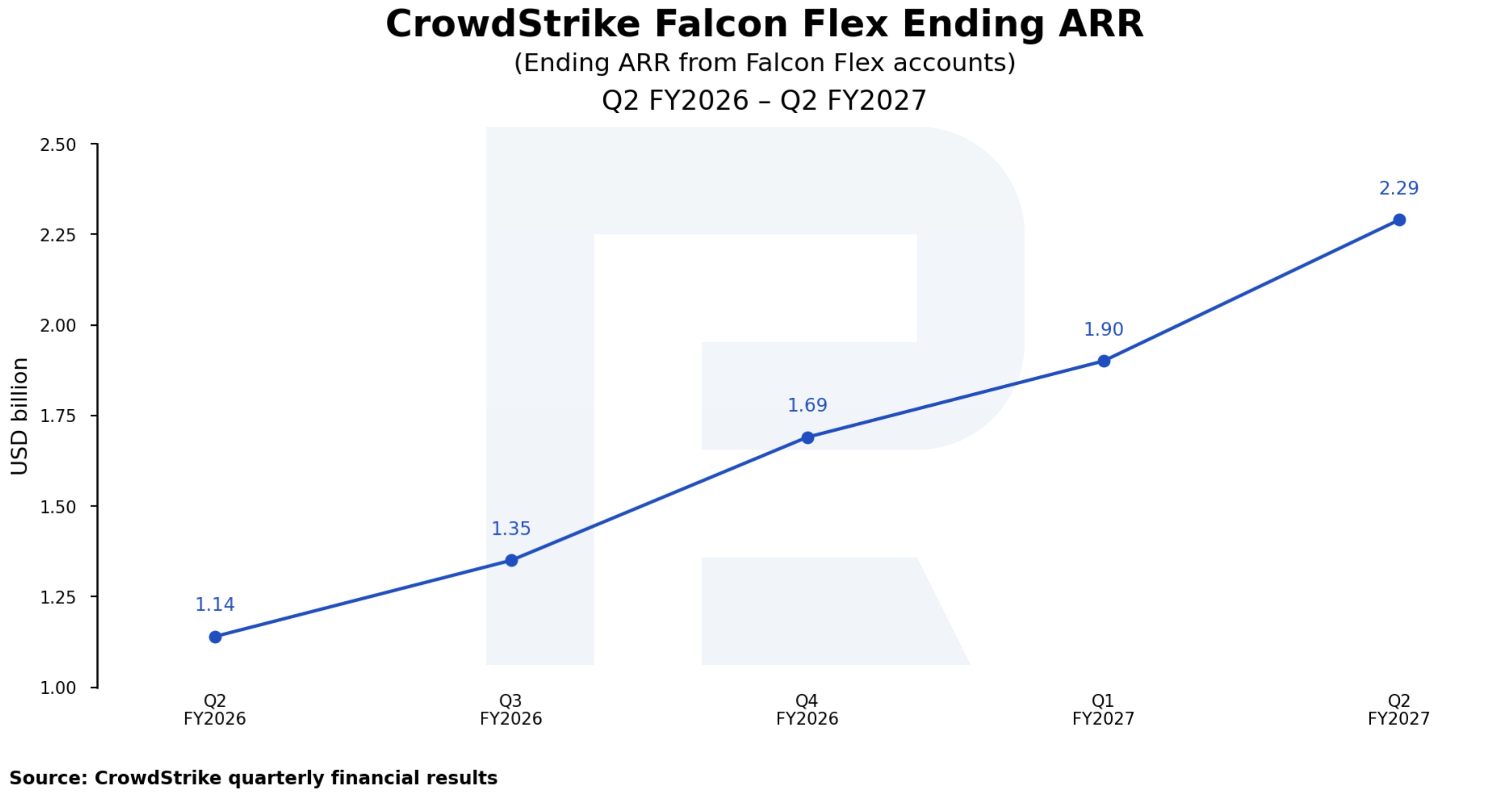
CrowdStrike Holdings, Inc. (NASDAQ: CRWD) reported stronger-than-expected results for Q2 of fiscal 2027, confirming that the company continues to deliver high growth. Revenue increased 26% year-on-year, ARR grew by 25%, and net new ARR reached a record 332.8 million USD. Falcon Flex also remains a key growth driver, with ARR increasing to 2.29 billion USD.
Management maintained a positive outlook and raised full-year guidance for both revenue and ARR. The company's financial performance does not yet point to a sustained slowdown and continues to confirm strong demand for the Falcon platform.
This article provides an analysis of CrowdStrike stock, reviews the company's financial results, examines the key drivers of its business, and presents both a fundamental analysis and technical analysis of CRWD, along with a forecast for the second half of 2026.
About CrowdStrike Holdings, Inc.
CrowdStrike Holdings, Inc., founded in 2011, is a US-based cybersecurity company. It is known for providing cloud-based solutions that protect against cyberattacks, information security threats, and e-commerce fraud.
On 12 June 2019, CrowdStrike went public on the NASDAQ exchange under the CRWD ticker symbol. Its share price surged by 70% on the first day of trading, closing at 58 USD.
The company’s flagship product is the CrowdStrike Falcon platform. This cloud-based cybersecurity solution utilises artificial intelligence (AI), machine learning, and big data analytics to detect, neutralise, and prevent cyber threats in real time.

How CrowdStrike makes money
CrowdStrike Holdings’ key lines of business include:
- Endpoint security: CrowdStrike Falcon provides security for electronic devices, including computers, servers, and mobile devices. It helps detect and prevent unauthorised intrusions such as viruses, ransomware, and other malicious software.
- Incident management and response: the company provides services for the rapid response to security incidents and detailed investigations of cyberattacks. This enables organisations to address the consequences of data breaches or system compromises.
- Threat intelligence: CrowdStrike provides information analytics and cyber threat data, helping organisations better understand attack sources, trends, and existing vulnerabilities.
- Cloud protection: the company’s solutions secure data and infrastructure across cloud environments, including platforms such as AWS, Microsoft Azure, and Google Cloud.
CrowdStrike Holdings, Inc.’s main revenue streams
The main revenues reported by CrowdStrike include:
- Software as a Service (SaaS) subscription: CrowdStrike’s primary revenue stream comes from subscriptions to the CrowdStrike Falcon platform. This allows clients to flexibly use its cloud-based solutions, paying for access based on the number of protected devices or other parameters.
- Professional services: the company also earns from consulting, incident management, and security system audits.
CrowdStrike Holdings, Inc. Q2 2025 financial results
CrowdStrike Holdings delivered strong results for Q2 2025. Below are the key figures compared to the same period last year:
- Revenue: 963.90 million USD (+32%)
- Net income: 260.76 million USD (+44%)
- Earnings per share: 1.04 USD (+40%)
- Gross margin: 75.37% (+133 basis points)
- Subscription revenue: 918.30 million USD (+33%)
- Professional services revenue: 45.60 million USD (+10%)
Compared to the previous year, the company demonstrated solid growth in revenue, profitability, and subscription revenue, confirming the strong demand for CrowdStrike’s cybersecurity solutions. Clients’ subscriptions to the company’s services remain its primary revenue stream.
Following the software incident, CrowdStrike’s management revised its 2024 revenue forecast downwards. Annual revenue was projected to range between 3.89 and 3.90 billion USD, lower than the previous forecast of 3.97–4.00 billion USD. Adjusted EPS was expected to be between 3.61 and 3.65 USD, down from the prior estimate of 3.88 USD. The company’s management explained the downward revision due to a potential negative impact from the payment of 60 million USD in compensation to clients related to the outage.
CrowdStrike Holdings, Inc. Q3 2025 financial results
On 26 November 2024, CrowdStrike Holdings, Inc. released its Q3 2025 financial results for the quarter ended 31 October 2024. Below is a summary of the report’s key data:
- Revenue: 1.01 billion USD (+29%)
- Net income: 234.25 million USD (+18)
- Earnings per share: 0.93 USD (+13)
- Gross margin: 74.75% (–79 bps)
- Subscription revenue: 962.73 million USD (+31%)
- Professional services revenue: 47.44 million USD (–9%)
In the Q3 FY2025 report, CrowdStrike’s management highlighted strong growth across key financial indicators. Notably, the incident, caused by a faulty software update that affected Microsoft Windows systems worldwide and led to significant disruptions, did not have a severe impact on the company’s revenue or profit.
Given the increased demand for cybersecurity solutions, management remains confident in CrowdStrike’s long-term growth trajectory. The revenue forecast for Q4 FY2025 has been raised to 1.02–1.03 billion USD, with income expected to be between 210.90 and 215.80 million USD.
CEO George Kurtz reaffirmed that the company remains focused on AI-driven cybersecurity innovations and on expanding its product portfolio. CrowdStrike is also expected to maintain strong momentum in attracting and retaining clients through the continued development of cloud security and personal data protection solutions.
CrowdStrike Holdings, Inc. Q4 2025 financial results
On 4 March 2025, CrowdStrike Holdings, Inc. published its Q4 2025 financial results for the quarter ended 31 January 2025. The key figures are presented below:
- Revenue: 1.06 billion USD (+25%)
- Net income: 260.95 million USD (+10%)
- Earnings per share: 1.03 USD (+8%)
- Gross margin: 74.12% (–121 basis points)
- Subscription revenue: 1.00 billion USD (+26%)
- Professional Services revenue: 50.22 million USD (+2%)
CEO George Kurtz highlighted a 23% increase in annual recurring revenue (ARR) to 4.24 billion USD, including a record 223.90 million USD in net new ARR. He said CrowdStrike delivered a strong fourth quarter and fiscal year, and that AI adoption was becoming increasingly critical to preventing cyber threats.
Chief Financial Officer Burt Podbere reported a 31% increase in subscription revenue, operating cash flow of 1.38 billion USD, and free cash flow of 1.07 billion USD, highlighting the resilience of the business and the company's operational discipline.
For fiscal 2026, CrowdStrike expected further growth, supported by continued demand for the Falcon platform. For Q1, revenue was forecast at approximately 1.05 billion USD, while full-year revenue was expected to reach 4.63–4.67 billion USD, representing growth of 23–24%. Operating income was expected to reach 1.09–1.13 billion USD, while diluted earnings per share were forecast at 4.27–4.40 USD.
CrowdStrike Holdings, Inc. Q1 2026 financial results
On 3 June 2025, CrowdStrike Holdings, Inc. published its Q1 2026 financial results for the quarter ended 30 April 2025. The key figures are presented below:
- Revenue: 1.10 billion USD (+20%)
- Net income: 184.70 million USD (–6%)
- Earnings per share: 0.73 USD (–7%)
- Gross margin: 73.80% (–177 basis points)
- Subscription revenue: 1.05 billion USD (+20%)
- Professional Services revenue: 52.66 million USD (+8%)
CrowdStrike's Q1 2026 results confirmed continued business strength. Annual recurring revenue (ARR) increased by 22% year-on-year to 4.44 billion USD, while the customer retention rate remained at 97%, reflecting continued strong demand for the Falcon platform.
Further evidence of CrowdStrike's competitive strength came from a major contract with a Fortune 100 healthcare company. Following a security incident, the customer switched from Microsoft solutions to Falcon, deploying more than 46,000 sensors and replacing several existing vendors.
For Q2, the company forecast revenue of 1.145–1.152 billion USD, while it raised its full-year revenue guidance to 4.74–4.80 billion USD, representing growth of 23–25%. Management also expected net new ARR to accelerate, supported by Falcon Flex.
At the same time, the impact of the Falcon outage on 19 July 2024 continued to affect results, resulting in 39.7 million USD in costs. Despite this, strong cash flow, ARR growth, the expansion of Falcon Flex, and partnerships with Microsoft, Alphabet, and NVIDIA continued to support CrowdStrike's investment case.
CrowdStrike Holdings, Inc. Q2 2026 financial results
On 27 August 2025, CrowdStrike Holdings, Inc. published its Q2 2026 financial results for the quarter ended 31 July 2025. The key figures are presented below:
- Revenue: 1.17 billion USD (+21%)
- Net income: 237.40 million USD (+7%)
- Earnings per share: 0.93 USD (+6%)
- Gross margin: 73.46% (–191 basis points)
- Subscription revenue: 1.10 billion USD (+20%)
- Professional Services revenue: 66.00 million USD (+45%)
CrowdStrike delivered strong Q2 2026 results. Revenue increased by 21% year-on-year to 1.17 billion USD, exceeding analysts' expectations, while adjusted earnings per share reached 0.93 USD. Subscription revenue remained the company's primary source of income, accounting for approximately 94% of total revenue.
Annual recurring revenue (ARR) increased by 20% to 4.66 billion USD, while net new ARR reached a record 221 million USD. Management expected net new ARR to accelerate in the second half of the year.
For Q3, CrowdStrike forecast revenue of 1.208–1.218 billion USD and adjusted EPS of 0.93–0.95 USD. For full-year 2026, the company forecast revenue of 4.749–4.806 billion USD and earnings per share of 3.60–3.72 USD. Management also expected free cash flow margin to increase to approximately 27% in Q4 and exceed 30% in 2027.
CrowdStrike Holdings, Inc. Q3 2026 financial results
On 2 December 2025, CrowdStrike Holdings, Inc. published its Q3 2026 financial results for the quarter ended 31 October 2025. The key figures are presented below:
- Revenue: 1.23 billion USD (+22%)
- Net income: 245.40 million USD (+29%)
- Earnings per share: 0.96 USD (+26%)
- Gross margin: 74.96% (+21 basis points)
- Subscription revenue: 1.17 billion USD (+21%)
- Professional Services revenue: 65.50 million USD (+38%)
CrowdStrike's Q3 2026 results exceeded market expectations. Revenue increased by 22% year-on-year to 1.23 billion USD, while adjusted earnings per share reached 0.96 USD. Non-GAAP operating income reached 264.6 million USD, while non-GAAP operating margin increased to 21%.
Annual recurring revenue (ARR) increased by 23% to 4.92 billion USD, while net new ARR reached a record 265 million USD, up 73% year-on-year. Operating cash flow reached 398 million USD, while free cash flow totalled 296 million USD, and cash and cash equivalents reached 4.8 billion USD.
For Q4, CrowdStrike forecast revenue of 1.29–1.30 billion USD and non-GAAP EPS of 1.09–1.11 USD. The company raised its full-year guidance to 4.80–4.81 billion USD in revenue and 3.70–3.72 USD in non-GAAP EPS. Management expected strong demand for the Falcon platform and the continued development of AI-powered cybersecurity products to drive further growth.
CrowdStrike Holdings, Inc. Q1 2027 financial results
On 3 June 2026, CrowdStrike Holdings, Inc. published its Q1 2027 financial results for the quarter ended 30 April 2026. The key figures are presented below:
- Revenue: 1.39 billion USD (+26%)
- ARR: 5.51 billion USD (+24%)
- Net new ARR: 255.8 million USD (+32%)
- Non-GAAP net income: 278.0 million USD (+48%)
- Non-GAAP earnings per share: 1.10 USD (+51%)
- Free cash flow: 468.5 million USD (+68%)
CrowdStrike's Q1 2027 results exceeded market expectations. Revenue increased by 26% year-on-year to 1.39 billion USD, non-GAAP EPS reached 1.10 USD, and the non-GAAP operating margin increased to 24%, up from 18% a year earlier.
Subscription revenue increased by 26% to 1.32 billion USD, while ARR reached 5.51 billion USD, up 24% year-on-year. Net new ARR increased by 32% to 255.8 million USD, confirming continued strong demand for the Falcon platform.
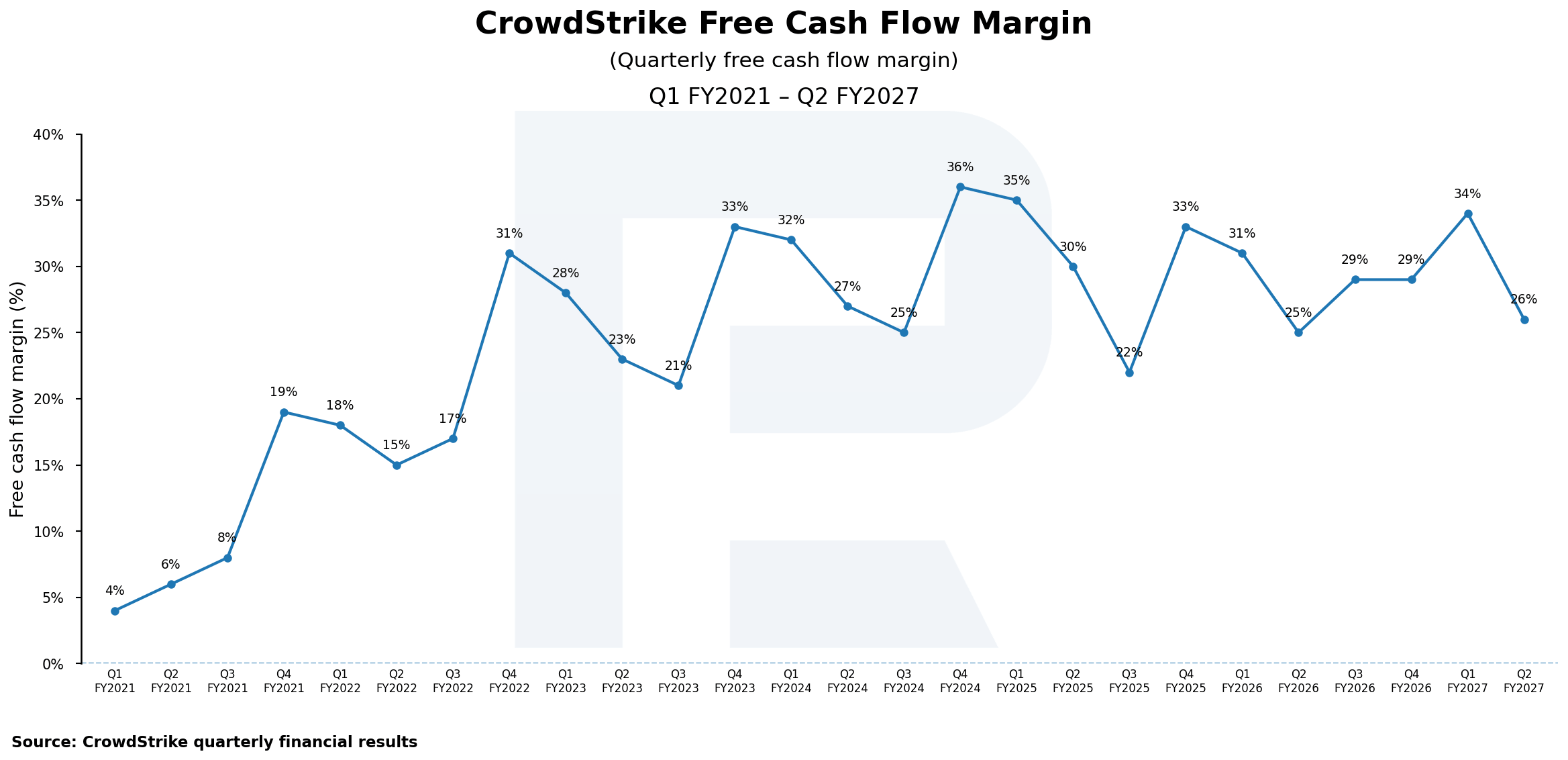
Operating cash flow reached 590.9 million USD, while free cash flow totalled 468.5 million USD, and the free cash flow margin increased to 34%.
For Q2, CrowdStrike forecast revenue of 1.436–1.442 billion USD and non-GAAP EPS of 1.16–1.17 USD. The company raised its full-year guidance to 5.91–5.96 billion USD in revenue, 6.53–6.56 billion USD in ARR, and 4.88–4.96 USD in non-GAAP EPS.
CrowdStrike Holdings, Inc. Q2 2027 financial results
On 26 August 2026, CrowdStrike Holdings, Inc. published its Q2 2027 financial results for the quarter ended 31 July 2026. The key figures are presented below:
- Revenue: 1.47 billion USD (+26%)
- ARR: 5.84 billion USD (+25%)
- Net new ARR: 332.8 million USD (+51%)
- Non-GAAP net income: 322.9 million USD (+36%)
- Non-GAAP earnings per share: 0.31 USD (following CrowdStrike's 4-for-1 stock split in July 2026, this figure is presented on a post-split basis and is therefore not directly comparable with Q2 2026)
- Free cash flow: 377.4 million USD (+33%)
CrowdStrike's Q2 2027 results confirmed that the company's growth continues to accelerate. Revenue increased by 26% year-on-year to 1.47 billion USD, while subscription revenue, which accounted for approximately 95% of total revenue, rose by 27% to 1.40 billion USD. Revenue also increased by approximately 6% compared with Q1. The reported figure also significantly exceeded CrowdStrike's own revenue guidance of 1.436–1.442 billion USD issued in the previous quarter.
Even more important is the trend in annual recurring revenue (ARR). ARR increased by 25% year-on-year to 5.84 billion USD, following 24% growth in Q1. Net new ARR reached a record 332.8 million USD, up 51% year-on-year. By comparison, the company generated 255.8 million USD in net new ARR in Q1. As a result, sequential net new ARR growth accelerated by approximately 30%. This is one of the strongest signals in the report, as ARR reflects future subscription revenue and shows that CrowdStrike's current growth remains supported by a strong inflow of new contracts.
Demand is growing from both existing customers and new customer acquisition. Management reported record net new ARR from new customers and improved customer retention compared with the previous quarter. Falcon Flex continues to expand particularly rapidly. ARR from customers using Falcon Flex exceeded 2.29 billion USD, up 101% year on year. This now represents 39% of CrowdStrike's total ARR. During the quarter, more than 935 accounts joined Flex, while existing customers migrating from traditional subscriptions typically increased their ARR by more than 40%. In addition, 34% of the quarter's net new ARR generated through Falcon Flex came from new customers. This is important because it shows that Flex serves both as a tool for increasing spending by existing customers and for attracting new ones.
CrowdStrike's Falcon platform strategy also continues to deliver results. By the end of the quarter, 51% of subscription customers were using six or more CrowdStrike modules, 35% were using seven or more, and 26% were using eight or more. The last figure stood at 25% in Q1. Growth is no longer as rapid as that of Falcon Flex. However, customers continue to expand their use of the platform, reducing the company's dependence on any single product.
The quality of growth is also improving. The subscription business generated a GAAP gross margin of 78% and a non-GAAP gross margin of 81%, compared with 77% and 80%, respectively, a year earlier. Overall non-GAAP gross margin improved from 78% to 79%. At the same time, non-GAAP operating income increased from 255 million USD to 371.6 million USD.
At the GAAP level, however, the picture remains less clear. CrowdStrike continued to report an operating loss, although it narrowed to 33.2 million USD from 105.5 million USD a year earlier. At the same time, the company reported GAAP net income of 5.3 million USD, compared with a net loss of 70.2 million USD in the previous year. However, it is important to note that GAAP net income continues to be supported in part by interest income generated from the company's substantial cash balance. In Q2, CrowdStrike generated 43.9 million USD in interest income, compared with 6 million USD in interest expense. As a result, the company's core operating business has not yet reached sustainable profitability under GAAP, although the gap has narrowed significantly.
The main driver of the large gap between GAAP and non-GAAP results remains stock-based compensation. In Q2, stock-based compensation totalled approximately 377 million USD, representing around 26% of quarterly revenue. Including related tax effects, the figure reached approximately 399 million USD. This remains one of the weaker aspects of CrowdStrike's financial model. Generous equity compensation enables the company to retain highly skilled employees and continue investing aggressively in product development. However, it also results in ongoing shareholder dilution. Despite the company's share repurchase program, the weighted average number of shares outstanding continues to increase gradually.
At the same time, costs remain well under control. Sales and marketing expenses increased by approximately 14% year on year, compared with 26% revenue growth, while general and administrative expenses remained largely unchanged. Research and development spending rose at a much faster pace, increasing by approximately 30% to 444 million USD. At this stage, this reflects CrowdStrike's continued investment in new products, AI, cloud security, and the expansion of the Falcon platform rather than any deterioration in operating efficiency. The company is effectively reallocating resources from administrative and commercial functions to research and development while continuing to expand its overall non-GAAP operating margin.
CrowdStrike's financial position remains exceptionally strong. At the end of July, the company held 5.01 billion USD in cash and cash equivalents, compared with approximately 746 million USD in long-term debt. As a result, its net cash position exceeded 4.2 billion USD. Current assets totalled 6.96 billion USD, compared with 4.43 billion USD in current liabilities, indicating that the company faces no liquidity concerns. Moreover, its debt consists primarily of 3% convertible notes totalling 750 million USD due in 2029, which represent only a modest burden given CrowdStrike's current cash position and cash generation.
The effects of the large-scale Falcon outage in July 2024 have not yet disappeared entirely. CrowdStrike continues to warn of ongoing litigation, potential customer claims, and regulatory risks in its financial filings. However, the direct impact on current expenses has declined significantly. In Q2, the company recognised a net recovery of 14.5 million USD in incident-related costs, compared with costs of 35.7 million USD a year earlier. Improving customer retention and record net new ARR also suggest that the commercial impact of the incident is gradually fading.
Management's guidance confirms that the company does not view the current quarter as a one-off surge. For Q3, CrowdStrike forecasts revenue of 1.523–1.529 billion USD and ARR of 6.184–6.188 billion USD. At the midpoint of the guidance range, revenue growth would slow modestly to 24% year-on-year, compared with 26% in Q2. However, ARR growth could accelerate to 26%. This suggests that, while recognised revenue growth may slow somewhat, the underlying momentum in new subscriptions remains strong.
Even more significant is the upward revision to the company's full-year guidance. Following Q1, CrowdStrike expected revenue of 5.915–5.959 billion USD and ARR of 6.532–6.556 billion USD. The company has now raised its guidance to 5.991–6.011 billion USD in revenue and 6.603–6.612 billion USD in ARR. Non-GAAP operating income guidance has also been raised to 1.497–1.508 billion USD. In addition, management increased its expected full-year net new ARR growth by 630 basis points, from 27.7% to 34.0%. This indicates that management now sees stronger demand than it did just three months ago.
Overall, Q2 2027 can be viewed as confirmation of a new phase of accelerating growth for CrowdStrike. Revenue continues to grow at more than 20% annually, ARR growth is accelerating, net new ARR has reached a record level, Falcon Flex continues to scale rapidly, and customer retention is improving. At the same time, operating margin and free cash flow continue to increase, while the balance sheet remains largely free of financial constraints, supported by a net cash position of more than 4 billion USD.
CrowdStrike stock analysis based on key financial indicators
Following the release of the company's financial results, it is important to assess whether the factors supporting the market's premium valuation of CrowdStrike stock remain in place. As the company operates on a subscription-based business model, its future growth depends on its ability to attract new customers, increase spending by existing ones, and gradually improve profitability as it scales.
Four key indicators can be used to assess these trends. Together, they track the path from new customer acquisition to free cash flow generation. A deterioration in a single metric over one quarter does not necessarily indicate a problem. However, a sustained weakening across several indicators could provide an early warning that business growth is beginning to slow.
Net new ARR measures the new annual recurring revenue CrowdStrike adds each quarter through new customers and the expansion of contracts with existing customers.
This metric can signal changes in demand earlier than reported revenue. Quarterly revenue is largely generated by contracts signed in previous periods, so it can continue to grow even after the pace of new customer acquisition has begun to slow.
As long as net new ARR continues to increase and maintains a strong growth rate, CrowdStrike continues to build the foundation for future revenue growth. A sustained decline over several quarters would be one of the earliest signs that the flow of new business is beginning to weaken. For this reason, net new ARR can be regarded as one of the most important leading indicators of CrowdStrike's business performance.
Falcon Flex ARR measures the annual recurring revenue generated from customers using the Falcon Flex program. Its importance lies in its ability to help CrowdStrike increase revenue from its existing customer base.
A customer may initially adopt a single cybersecurity solution and then gradually add cloud security, identity protection, data security, and other products. As a result, CrowdStrike can increase revenue from each customer without acquiring new ones.
Strong growth in Falcon Flex ARR indicates that customers are expanding their use of the platform and allocating a larger share of their cybersecurity spending to CrowdStrike. If the growth rate of this metric begins to decline consistently, it could indicate that opportunities to expand sales within the existing customer base are becoming increasingly limited.
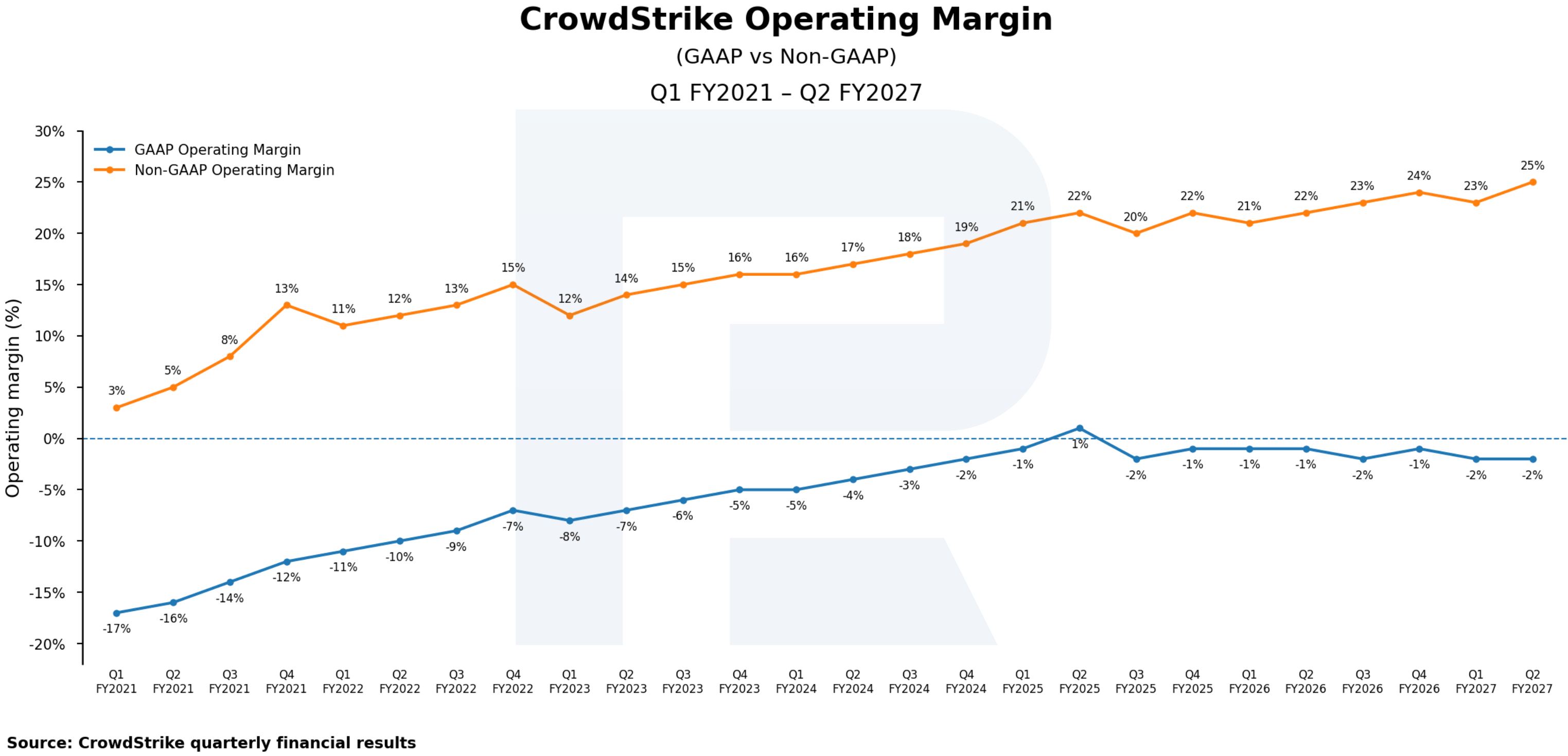
Operating margin shows how much of the company's revenue remains after its core operating expenses. For a growing business, this metric should improve over time.
As CrowdStrike grows, its spending on research and development, sales, and administration should not increase at the same pace as revenue. If revenue grows faster than expenses, operating income begins to increase even more rapidly.
When analysing CrowdStrike, it is useful to compare its GAAP and non-GAAP operating margins. The gap between the two remains significant due to the company's substantial stock-based compensation. A particularly positive signal would be continued improvement in the non-GAAP operating margin alongside a gradual strengthening of GAAP profitability.
A decline in operating margin alongside slowing business growth would be a more serious warning sign. It would indicate that the company is having to spend progressively more to generate each additional dollar of revenue.
Free cash flow margin shows what proportion of revenue ultimately becomes free cash flow that CrowdStrike can use after covering the costs required to operate and grow the business.
A high and improving free cash flow margin confirms the strength of the company's business model. It enables CrowdStrike to fund future growth, acquire other businesses, build its cash reserves, or return capital to shareholders through share repurchases.
For a growing technology company, one of the strongest combinations is rising revenue and free cash flow, with free cash flow accounting for an increasingly larger share of revenue. This indicates that the company's expanding scale is genuinely creating additional value.
If free cash flow margin begins to decline while net new ARR slows and operating margin deteriorates, it could signal a more fundamental shift in CrowdStrike's financial performance.
CRWD fundamental analysis suggests that CrowdStrike's future performance will depend primarily on its ability to maintain strong subscription growth while continuing to improve profitability. To assess these trends, investors should monitor net new ARR, Falcon Flex ARR, operating margin, and free cash flow margin.
At the same time, the financial picture remains somewhat mixed. GAAP operating margin remains around –2%. However, it continues to be weighed down primarily by substantial stock-based compensation awarded to employees and executives, which CrowdStrike excludes from its non-GAAP metrics. As a result, the large gap between GAAP and non-GAAP operating margins remains a key factor to monitor.
Free cash flow margin declined from 34% in Q1 to 26% in Q2 2027. However, such fluctuations are largely seasonal for CrowdStrike. The metric remains slightly above its level a year earlier, meaning the decline cannot yet be regarded as evidence of a sustained deterioration in the company's ability to generate free cash flow.
Overall, the analysis of CRWD does not currently point to a sustained deterioration in the business. Net new ARR remains close to a record high, Falcon Flex continues to scale rapidly, and non-GAAP operating margin has reached a record level. For the CrowdStrike stock forecast, the key question is whether these trends can be sustained over the coming quarters.
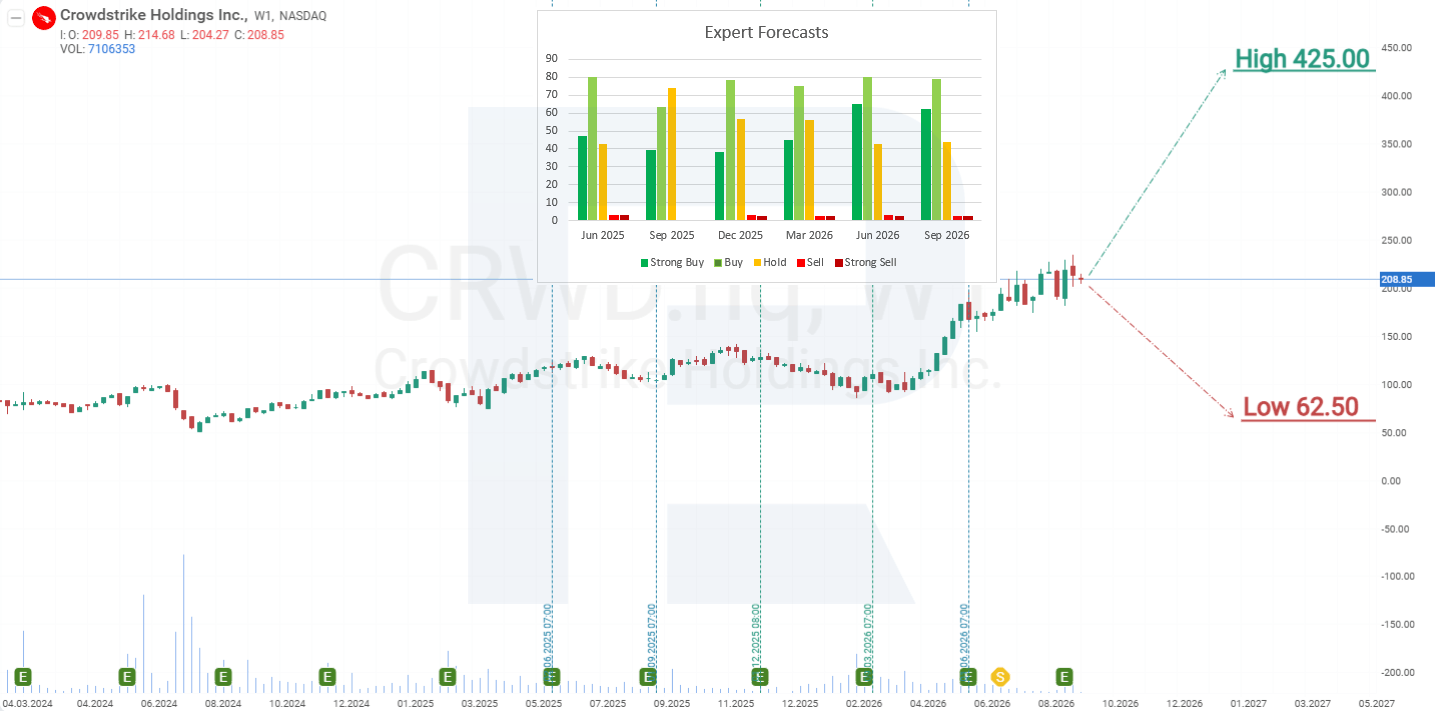
Expert forecasts for CrowdStrike Holdings, Inc. stock for 2025
- Barchart: 33 of 50 analysts rate CrowdStrike Holdings stock as Strong Buy, 3 as Buy, 12 as Hold, and 2 as Strong Sell. The highest price target is 425 USD, while the lowest is 119 USD.
- MarketBeat: 37 of 51 analysts rate the stock as Buy, 13 as Hold, and 1 as Sell. The highest price target is 425 USD, while the lowest is 112 USD.
- TipRanks: 29 of 36 analysts rate the stock as Buy, while 7 rate it as Hold. The highest price target is 425 USD, while the lowest is 119 USD.
- Stock Analysis: 29 of 52 analysts rate CrowdStrike stock as Strong Buy, 10 as Buy, 12 as Hold, and 1 as Sell. The highest price target is 300 USD, while the lowest is 62.5 USD.
Analysts' outlook for CrowdStrike stock remains predominantly positive. However, the wide range of price targets highlights considerable uncertainty about CRWD's fair value. As a result, analyst forecasts should be considered alongside the company's financial performance and the stock's technical picture.
CrowdStrike Holdings, Inc. stock price forecast for 2026
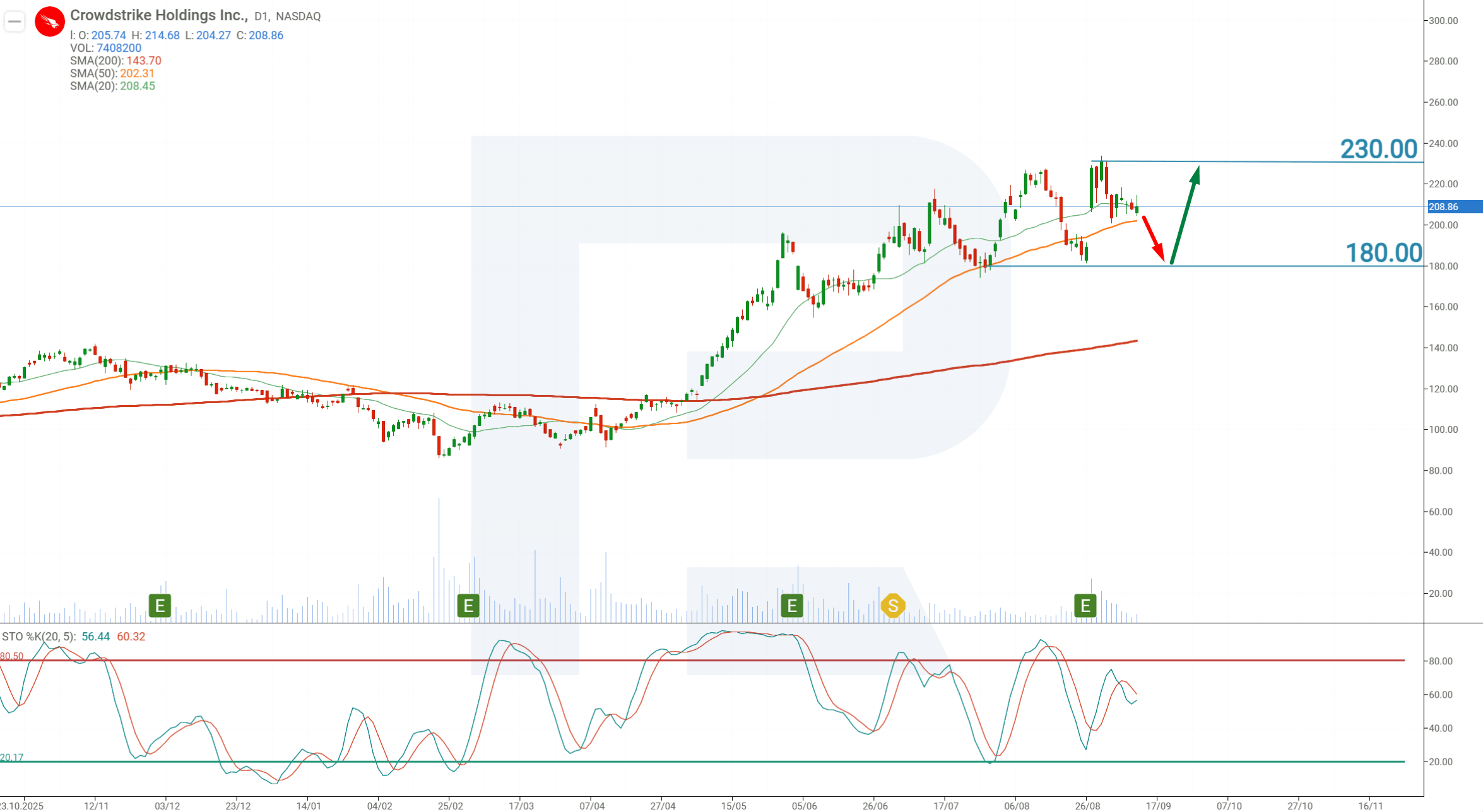
At the time of writing, CRWD stock is trading at around 209 USD.
Technical analysis of CRWD indicates that the long-term uptrend remains intact, as the stock continues to trade above its 200-period Moving Average. However, each successive rally has shown signs of weakening, making purchases near the stock's all-time high increasingly risky.
Historically, buying interest has strengthened when the share price has fallen to around 180 USD or below. As a result, the 180 USD area appears to offer a more attractive entry point from a risk-to-reward perspective. If the Stochastic indicator also approaches oversold territory, this would provide additional confirmation of a buying opportunity within the prevailing uptrend.
Based on the technical picture and the company's current business momentum, the CrowdStrike stock forecast suggests that the share price could rebound from around 180 USD before advancing towards its all-time high of 230 USD.
Accordingly, the trading strategy for CrowdStrike Holdings Inc. stock is to place a Buy Limit order at 180.00 USD. A Stop Loss is recommended at 169.00 USD, while Take Profit is recommended near the previous all-time high at 230.00 USD.
Buy Limit - 180.00
Take Profit - 230.00
Stop Loss - 169.00
Position management: Once the stock has moved 10% in the projected direction, move the Stop Loss to the entry level. The protective stop should then be trailed 10% behind the price. Continue trailing the stop until the position is closed, either at the Take Profit or the Stop Loss, depending on which level is reached first.
Should you buy CrowdStrike stock?
An analysis of CrowdStrike stock suggests that the company's fundamentals remain strong. Revenue and ARR continue to grow at rates exceeding 20%, net new ARR has reached a record level, Falcon Flex continues to scale rapidly, and non-GAAP operating margin is improving. At the same time, the recent decline in free cash flow margin appears to be more of a seasonal fluctuation than evidence of a sustained deterioration in the business.
The principal risks remain the stock's high valuation and the substantial level of stock-based compensation. As a result, the entry price is particularly important. At prices near the stock's all-time high, the risk-to-reward ratio becomes less attractive, while a pullback towards 180 USD would offer a more attractive entry point.
The base-case scenario assumes that the long-term uptrend remains intact and that CRWD stock recovers to 230 USD following a potential correction. A sustained deterioration in net new ARR, Falcon Flex ARR, operating margin, and free cash flow would warrant a reassessment of this outlook. For now, CrowdStrike's financial results do not show such a combination of negative trends.
Ang mga pagtataya na ipinakita sa seksyong ito ay nagpapakita lamang ng pribadong opinyon ng may-akda at hindi dapat ituring bilang gabay para sa pagtetrade. Walang pananagutan ang RoboForex para sa mga resulta ng pagtetrade batay sa mga rekomendasyon sa pagtetrade na inilarawan sa mga analytical review na ito.