
Walmart maintains a resilient business, but WMT stock could continue to decline
Walmart’s business remains resilient, but slowing US retail growth, weak Q3 guidance, and a high valuation create a risk of further declines. This article examines why WMT could fall towards 95 USD and whether such a correction could create an attractive long-term buying opportunity.
Walmart Inc. (NASDAQ: WMT) delivered resilient Q2 2027 financial results. Revenue rose 5.9%, adjusted earnings per share increased by 19.1%, and management raised its full-year guidance. However, growth in Walmart’s core US retail business is slowing, while strong operating income growth was partly driven by a one-off tariff refund.
For Q3, Walmart expects sales growth of 3–3.75%, adjusted operating income growth of 2–4%, and earnings per share of 0.62–0.64 USD. Results could be weaker than in the previous quarter, although this does not yet signal a significant deterioration in the business.
Against a backdrop of slowing growth, a high valuation, and a prevailing downtrend, WMT could remain under pressure until the next earnings report.
This article analyses Walmart stock following its Q2 2027 financial results and examines the company’s key business drivers and expectations for the next quarter. It also provides fundamental analysis of WMT and examines the stock from a technical perspective. This forms the basis for the Walmart stock forecast for the second half of 2026.
About Walmart Inc.
Walmart Inc. is a US retail company founded in 1962, when Sam Walton opened its first store in Rogers, Arkansas. The company went public in 1970 and adopted its current name in 2018. Its shares trade on the Nasdaq under the ticker WMT.
Walmart sells groceries, everyday essentials, clothing, electronics, and other products through its stores, Sam’s Club locations, and online platforms. The company is also expanding its delivery services, marketplace, advertising business, and Walmart+ subscription, which offers additional customer benefits. Its competitive advantage lies in the combination of low prices, an extensive store network, and the ability to fulfil online orders quickly. According to Walmart, its operations across 19 countries serve around 280 million customers and members each week.

Walmart Q2 2027 financial results
On 20 August 2026, Walmart published its Q2 2027 financial results for the quarter ended 31 July. Compared with the same quarter of the previous year, the company reported the following results:
- Revenue: 187.94 billion USD (+5.9%)
- Net income (adjusted): 6.46 billion USD (+18.6%)
- Earnings per share (adjusted): 0.81 USD (+19.1%)
- Operating income (adjusted): 9.38 billion USD (+19.1%)
- Free cash flow: 7.48 billion USD (+14.7%)
Walmart’s Q2 2027 financial results confirmed that the business remains resilient, although the report prompted a negative reaction from investors. The shares came under pressure for several reasons – slowing Walmart U.S. comparable sales, weaker Q3 guidance, and the company’s high valuation, which left little room for results below expectations. Revenue rose 5.9% to 187.9 billion USD, while adjusted earnings per share increased from 0.68 USD to 0.81 USD. Meanwhile, Walmart continues to expand rapidly in eCommerce, advertising, marketplace, and membership programs, which are gradually improving the profitability of the business.
The main reason for caution was the slowdown at Walmart U.S. Comparable sales excluding fuel rose 2.6%, compared with 4.1% in Q1 and 4.6% a year earlier. The result would have been stronger without the negative impact of lower pharmaceutical prices, so for now, this points more to slowing growth than to a significant deterioration in the business. At the same time, US eCommerce grew 24%, while advertising and marketplace continued to record strong growth.
Operating income was strong, although part of the growth was driven by refunds of tariffs previously paid. Rising inventories remain an additional risk. They increased by 6.7%, slightly faster than overall revenue. Walmart attributes this to inflation and additional inventory to support strategic initiatives, so the situation does not yet appear problematic. However, if comparable sales continue to slow while inventories grow faster than revenue, the company may need to rely more heavily on discounting, which would put pressure on margins. Walmart U.S. comparable sales and inventory trends therefore remain among the most important indicators of the health of the retail business.
Free cash flow recovered from a weak Q1 but remained under pressure for the first half of the year due to higher capital expenditure. Walmart continues to invest heavily in automation, logistics, and eCommerce, so for now, the decline in FCF appears to be driven more by the investment cycle than by a deterioration in the core business.
The company’s guidance also does not yet point to a significant deterioration. Walmart raised its full-year sales growth forecast for 2027 from 3.5–4.5% to 4–5%, its adjusted operating income growth forecast from 6–8% to 7–8.5%, and its adjusted earnings-per-share guidance from 2.75–2.85 USD to 2.80–2.87 USD. Raising the full-year outlook after the first half of the year indicates that management remains confident in continued business growth.
However, Q3 is likely to look significantly weaker than Q2. Walmart expects sales growth of 3–3.75%, adjusted operating income growth of just 2–4%, and EPS of 0.62–0.64 USD. Part of the slowdown is due to Flipkart Big Billion Days shifting from Q3 to Q4, which will reduce Q3 sales growth by more than one percentage point. Additional investment in lower prices, funded partly by tariff refunds, will put pressure on earnings. The weaker Q3 guidance therefore cannot be interpreted directly as a sharp deterioration in the business – management recommends assessing Q2 and Q3 together, as some of the higher Q2 profit is being channelled into lower prices and investment in sales growth in the following quarter.
Overall, Walmart’s fundamentals remain resilient, although the latest report did not show an acceleration in the business. Sales continue to grow, while eCommerce, advertising, marketplace, and membership programs maintain strong growth rates, but growth in eCommerce and the core retail business has slowed. Free cash flow improved compared with a weak Q1 but remained below the previous year’s level in the first half of the year due to higher capital expenditure. The upgraded full-year guidance confirms that management does not expect a significant deterioration, although Walmart still needs to demonstrate that earnings can grow consistently without one-off factors.
For the Walmart stock forecast, the key factors remain the future trajectory of US comparable sales, the pace of operating income growth, and the company’s ability to maintain free cash flow amid rising capital expenditure.
Fundamental analysis of WMT and key drivers of Walmart stock
In 2026, Walmart’s investment case largely depends on how successfully the company can transform its vast traditional retail business into a more digital, higher-margin platform. Four key indicators can be used to assess the company’s prospects:
- Global eCommerce Growth
- Global Advertising Growth
- Membership Fee Revenue Growth
- Adjusted Operating Income Growth
Global eCommerce Growth shows how quickly Walmart is increasing sales through digital channels and expanding its online audience. This matters not only for sales growth, as eCommerce expansion also creates additional demand for advertising, marketplace, delivery, and other services.
Global Advertising Growth reflects the development of one of Walmart’s highest-margin businesses. Advertising revenue growth allows the company to increase profit faster than traditional retail sales, since generating advertising revenue does not require a proportional increase in inventories or the opening of new stores.
Membership Fee Revenue Growth reflects the development of Walmart’s subscription and membership businesses through Walmart+ and Sam’s Club. Membership fees provide more predictable, higher-margin revenue while also strengthening customer loyalty to the Walmart ecosystem.
Adjusted Operating Income Growth shows whether the expansion of eCommerce, advertising, and membership programs is translating into profit growth. The strongest scenario for Walmart remains one in which operating income consistently grows faster than total revenue. This would indicate a gradual improvement in the company’s business mix and a growing contribution from more profitable businesses.
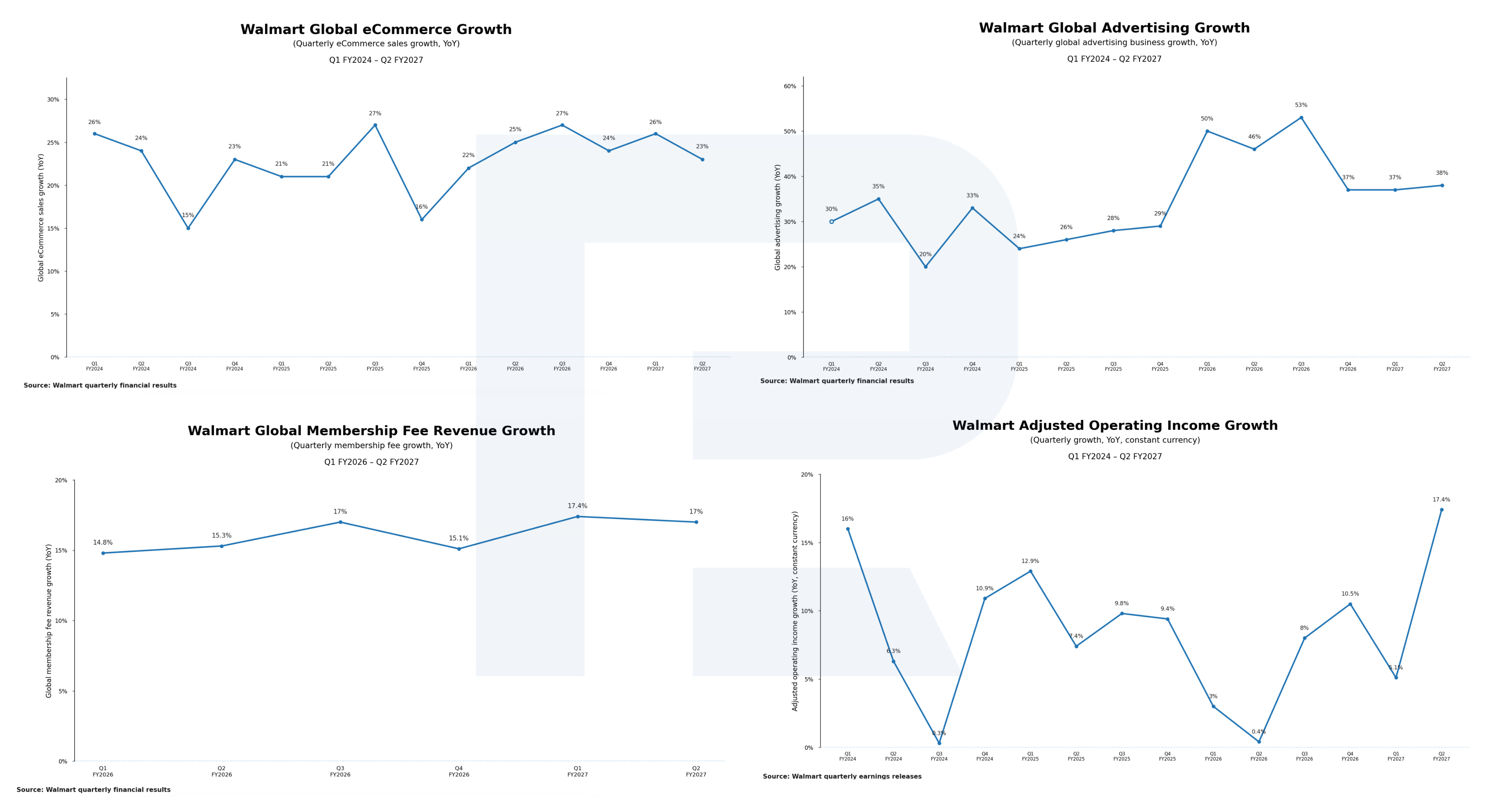
Walmart’s current stock performance suggests investors are focusing more on slowing growth and the company’s high valuation than on the resilience of its core business. Walmart remains a large, resilient, and profitable company, but its growth is gradually slowing. Online sales, advertising, and membership programmes continue to grow rapidly, although not as quickly as before. US comparable store sales are also growing more slowly. This does not yet mean Walmart faces serious problems, but the latest report provided no evidence that business growth is accelerating.
Operating income rose 17.4% in Q2, although a one-off tariff refund drove part of this growth. Excluding this effect, operating income increased by around 9.9%. For the next quarter, Walmart expects operating income growth of just 2–4%, as the company plans to use part of the funds received to lower prices. Q2 therefore looks unusually strong, while Q3 could be notably weaker. A clearer picture will emerge once the results of both quarters can be assessed together.
The main issue for investors is valuation. At around 110 USD, investors are effectively paying 38–39 USD for every dollar of Walmart’s expected annual earnings. This is a high valuation for a company forecasting operating income growth of 7–8.5%. For shares to keep rising steadily, Walmart needs to show earnings can grow consistently without one-off tariff refunds.
Overall, Walmart remains a resilient business, but its shares are not yet cheap. The post-earnings decline appears to be driven more by the high valuation and elevated investor expectations than by serious problems with the business. Existing shareholders could continue to hold the stock as long as sales, profitability, and cash flow do not begin to deteriorate at the same time. For investors considering a new position, it may be more prudent to wait for a lower share price or further earnings reports confirming sustained profit growth without one-off factors.
Analysts’ forecasts for Walmart stock in 2026
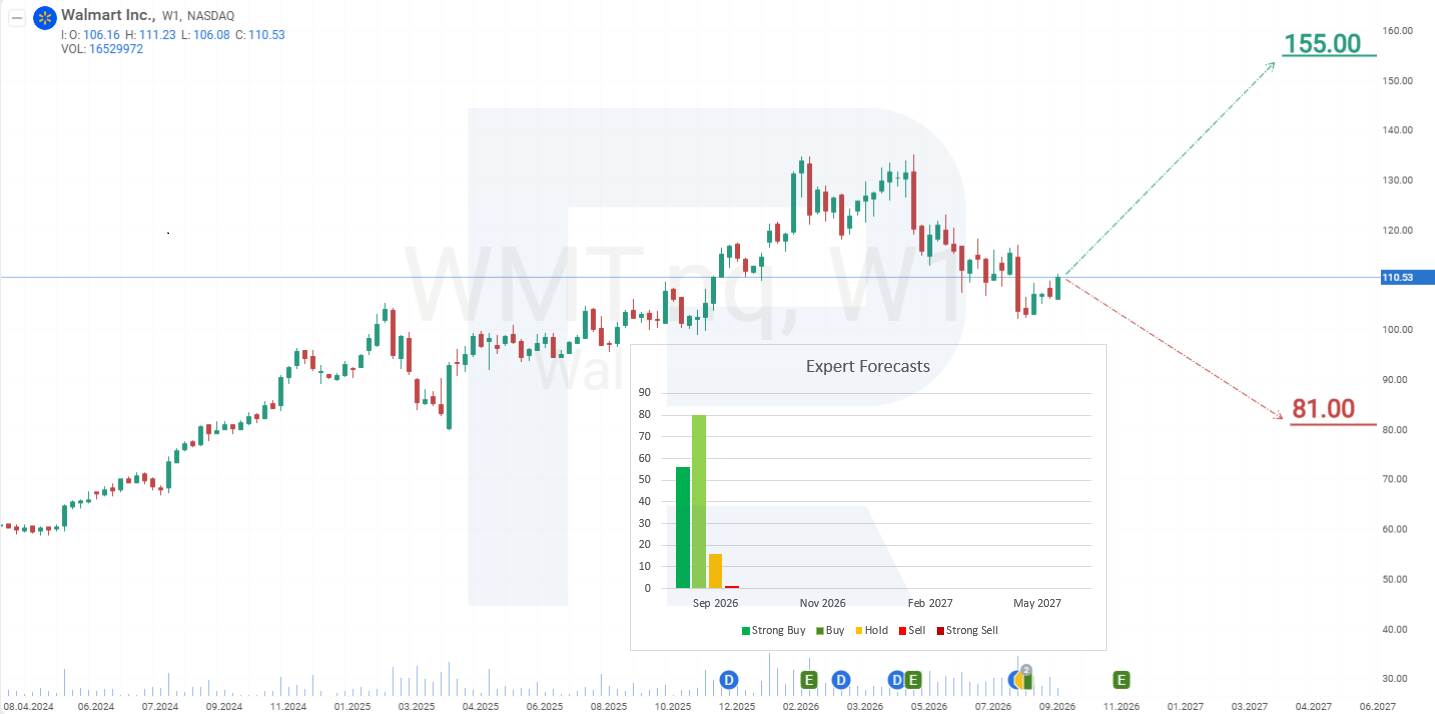
#. Barchart : 29 of 39 analysts rated Walmart Inc. stock a Strong Buy, 6 a Moderate Buy, and 4 a Hold. The highest price target is 155 USD, while the lowest is 110 USD.
#. MarketBeat : 35 of 39 analysts rated the stock a Buy and 4 a Hold. The highest price target is 155 USD, while the lowest is 113 USD.
#. TipRanks : 29 of 32 analysts rated the stock a Buy and 3 a Hold. The highest price target is 155 USD, while the lowest is 110 USD.
#. Stock Analysis : 27 of 43 analysts rated the stock a Strong Buy, 10 a Buy, 5 a Hold, and 1 a Sell. The highest price target is 155 USD, while the lowest is 81 USD.
Analyst forecasts for Walmart stock remain broadly positive over the next 12 months. Most analysts recommend buying the stock, although the wide range of price targets indicates significant differences in their assessments of WMT’s further upside potential. This is especially important given the slowdown in the company’s near-term growth and its high valuation.
Technical analysis of WMT and Walmart stock forecast for 2026
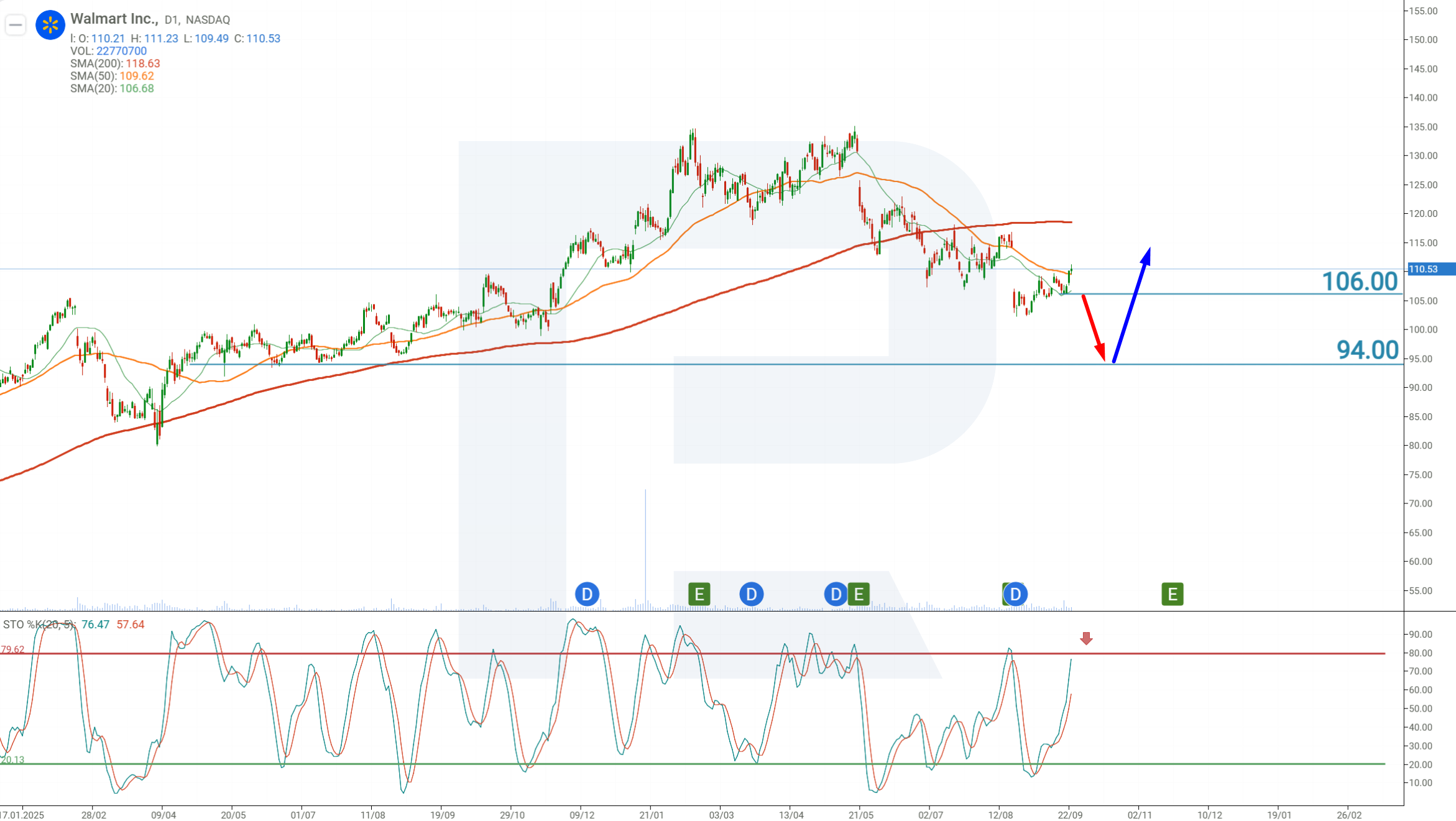
At the time of writing, WMT stock is trading at 110 USD.
On the daily chart, WMT stock is trading below the 200-period Moving Average, indicating that the downtrend remains dominant. The Stochastic oscillator is approaching overbought territory. This increases the likelihood that the corrective move higher will come to an end and the decline will resume.
Fundamental analysis also points to a risk of continued pressure on the stock. For Q3 2027, Walmart expects sales growth of 3–3.75% and adjusted operating income growth of 2–4%. These growth rates are notably lower than in Q2 and the same quarter last year. As market participants typically price in expected results in advance, the stock could begin to decline even before the earnings report is released. The technical picture and the company’s guidance therefore point to an increased risk of a short-term decline.
At the same time, there is currently no reason to expect a significant deterioration in Walmart’s business. Tighter monetary policy could lead consumers to cut spending, but in such an environment, Walmart often attracts new customers switching from more expensive retailers. A potential decline in the share price could therefore be viewed as an opportunity to build a position gradually, provided the company’s sales, margins, and cash flow remain resilient.
Under the current conditions, the WMT stock trading idea involves opening a short position if the price falls below support at 106 USD. A Sell Stop order is placed at 105 USD. Take Profit is set at 95 USD, slightly above the 94 USD support level, with Stop Loss at 109 USD.
Sell Stop – 105.00
Take Profit – 95.00
Stop Loss – 109.00
Position management rule. Once the price has moved 70% of the total target distance in the forecast direction, the Stop Loss is moved to the entry level. The protective order is then trailed behind the price, maintaining a distance of 5%. This continues until the position is closed at either Take Profit or Stop Loss, depending on which level is reached first.
Walmart stock outlook
The analysis shows that Walmart’s main issue is its high valuation, despite the decline in its share price since the beginning of the year. The company continues to grow and expand its eCommerce, advertising, and membership businesses, but the current growth rates are not yet sufficient to fully justify investor expectations.
Weaker Q3 guidance and the prevailing downtrend increase the likelihood of a decline towards 95 USD if the price breaks below support at 106 USD. However, such a scenario would not indicate the onset of serious problems at Walmart. On the contrary, a correction could make the stock more attractive from an investment perspective and provide a better entry point for long-term investors, provided the company’s sales, margins, and cash flow remain resilient.
Ang mga pagtataya na ipinakita sa seksyong ito ay nagpapakita lamang ng pribadong opinyon ng may-akda at hindi dapat ituring bilang gabay para sa pagtetrade. Walang pananagutan ang RoboForex para sa mga resulta ng pagtetrade batay sa mga rekomendasyon sa pagtetrade na inilarawan sa mga analytical review na ito.