
McDonald’s stock could recover after a break above resistance at 245 USD
Weak US traffic is weighing on McDonald’s stock despite the company’s resilient financial performance. The outlook for McDonald’s stock will depend on a recovery in customer traffic and MCD’s ability to establish a foothold above resistance at 245 USD.
McDonald’s Corporation (NYSE: MCD) Q2 2026 financial results showed that sales growth continues to slow. Comparable sales growth at restaurants open for more than a year slowed compared with the same period last year. The slowdown was even more pronounced in the US. At the same time, customer traffic at US restaurants declined, while sales increased because average spend per customer rose.
The company remains highly profitable. Revenue rose 4% to 7.10 billion USD, while earnings per share excluding one-off expenses increased 6% to 3.38 USD. Systemwide sales, including those at franchised restaurants, rose 4% excluding the impact of currency movements. However, the key question remains unanswered – when will customer traffic at US restaurants begin to recover?
The Q3 outlook does not yet point to an improvement in the US. According to management, comparable sales in July and August were slightly lower than a year earlier. The company expects growth in September but believes US comparable sales will still decline slightly for the quarter as a whole. Outside the US, management had previously expected faster growth than in Q2.
This article analyses McDonald’s stock following its Q2 2026 financial results and examines the company’s key business indicators and expectations for the next quarter. It also provides fundamental analysis of MCD and examines the stock from a technical perspective. This forms the basis for the McDonald’s stock forecast for the second half of 2026.
About McDonald's Corporation
McDonald's Corporation is the world's largest fast-food restaurant chain, founded in 1940 by brothers Richard and Maurice McDonald (McDonald Brothers) in San Bernardino, California. In 1955, Ray Kroc (Raymond Kroc) joined the company and transformed it into an international franchise. The company went public on 21 April 1965, listing on the New York Stock Exchange (NYSE: MCD).
McDonald's specialises in selling burgers, fries, beverages, and other fast-food products. The company is expanding its digital services and loyalty programs while adapting its menu to local markets.
McDonald's also owns one of the largest property portfolios in the world. A significant portion of its profits comes from leasing premises to its franchisees, making it not only a restaurant business but also a major player in commercial real estate.
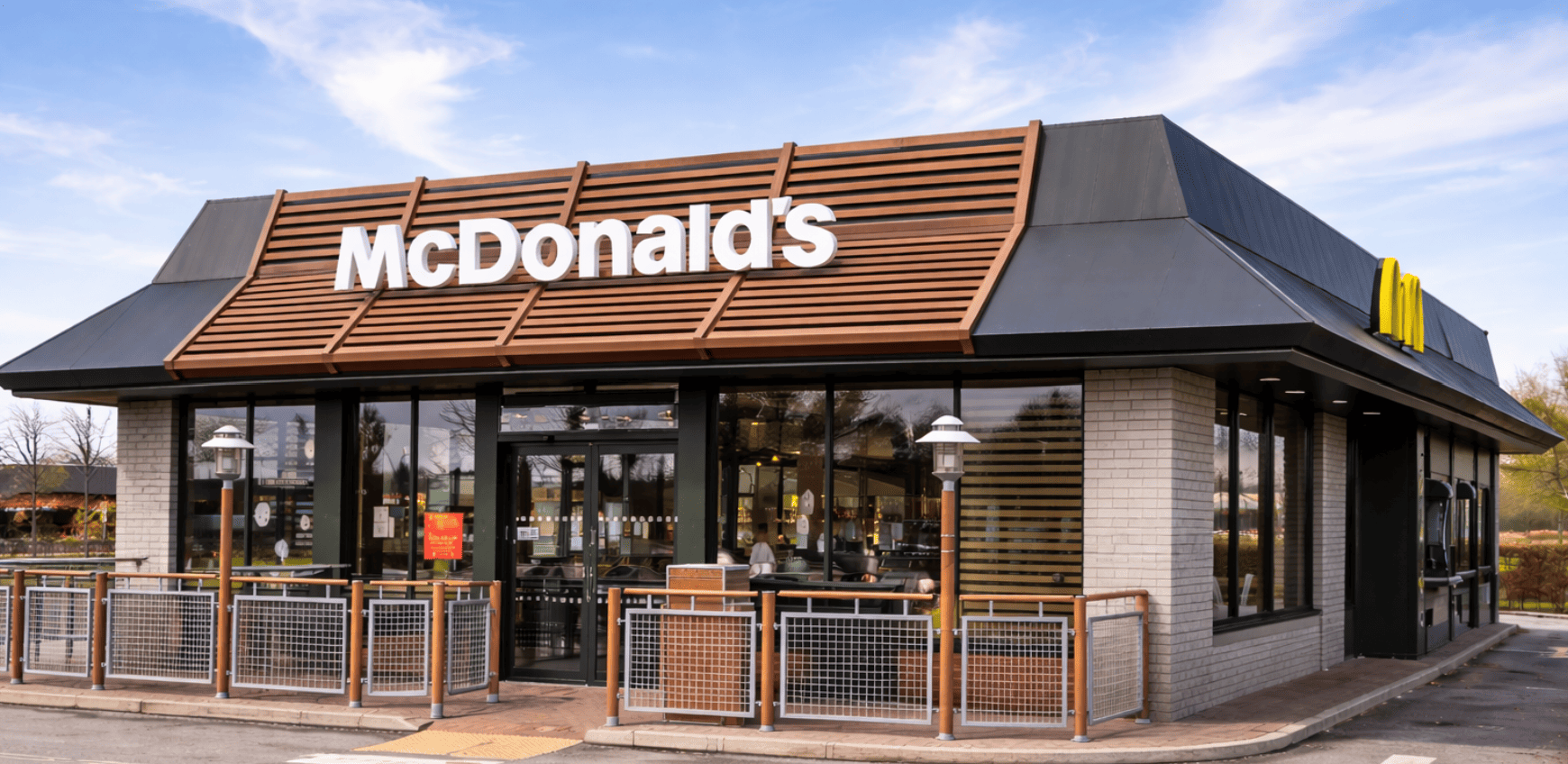
McDonald's Corporation key sources of revenue
McDonald's business model is unique, combining elements of the traditional restaurant industry with franchising and real estate management. The company's main revenue streams fall into four key categories:
- Franchising: most of McDonald's restaurants operate under the franchise model, where the company grants its partners the right to use its brand, recipes, quality standards, and other corporate guidelines. Revenue in this segment comes from an initial franchisee fee paid by partners to open a McDonald's restaurant, as well as an ongoing percentage of sales.
- Company-operated restaurants: revenue in this business comes directly from product and service sales, with the company covering all operational expenses for these locations.
- Real estate income: McDonald's owns numerous properties for operating restaurants. As the landowner or leaseholder, it earns income from leasing or subleasing the land to its franchisees. In some cases, McDonald's only owns the land, while partners build and own the buildings. This strategy enables the company to generate stable, long-term income independent of the success of specific restaurants.
- Supply chain and logistics: McDonald's often controls its franchisees' entire supply and procurement chain, generating additional income through markups on products and ingredients.
This diversified business model allows the company to sustain long-term growth and reduce reliance on a single revenue stream. In its quarterly earnings reports, McDonald's provides separate financial data for franchised and company-operated restaurants, while income from other segments is under Other Revenues.
McDonald's Corporation Q3 2024 financial results
McDonald's released its financial results for Q3 2024 on 29 October. Below is a comparison with the same period in 2023:
- Revenue: 6.87 billion USD (+3%)
- Net income: 2.25 billion USD (–3%)
- Earnings per share: 3.13 USD (–1%)
- Operating income: 3.18 billion USD (–1%)
- Revenues from franchised restaurants: 4.09 billion USD (+1%)
- Franchised restaurant occupancy expenses: 646 million USD (+3%)
- Revenues from company-owned restaurants: 2.65 billion USD (+4%)
- Company-owned restaurant expenses: 2.24 billion USD (+5%)
- Other revenues: 124 million USD (+39%)
In its commentary on the report, McDonald's management highlighted cautious consumer spending and inflationary pressures, which impacted sales and led to flat performance overall. In the US, a modest increase was recorded, with comparable sales rising by 0.3%, driven by effective promotions and menu enhancements. However, international markets saw a decline, reflecting changes in consumer preferences.
For its Q4 2024 outlook, management did not provide specific numerical forecasts but expressed a prudent stance regarding the future economic environment. They noted that they anticipated ongoing challenges related to consumer spending and potential adverse effects from currency fluctuations, particularly in emerging markets. Despite these challenges, McDonald's leadership remained optimistic about its long-term strategic initiatives, focusing on restoring consumer confidence following a recent E. coli incident in the US that affected the brand's reputation, and enhancing marketing efforts to attract customers.
McDonald's Corporation Q4 2024 financial results
On 10 February, McDonald's released its Q4 2024 report, indicating that revenue remained unchanged compared to the same period in 2023. Below are the key financial metrics:
- Revenue: 6.39 billion USD (unchanged)
- Net income: 2.02 billion USD (–1%)
- Earnings per share: 2.8 USD (unchanged)
- Operating income: 2.86 billion USD (+2%)
- Revenues from franchised restaurants: 3.96 billion USD (+2%)
- Franchised restaurant occupancy expenses: 635 million USD (unchanged)
- Revenues from company-owned restaurants: 2.31 billion USD (–7%)
- Company-owned restaurant expenses: 1.98 billion USD (–5%)
- Other revenue: 120 million USD (+88%)
According to CEO Chris Kempczinski, McDonald's faced external challenges in Q4 2024, including a decline in consumer spending and an incident involving bacterial contamination in its products, which negatively affected overall performance. He noted that while the results were generally strong, they fell short of expectations in certain international markets and in customer traffic patterns.
For 2025, the company remained optimistic about profit growth, with management forecasting that the operating margin will rise to a mid-to-high range, surpassing the adjusted margin of 46.3% achieved in 2024. In 2025, McDonald's planned to focus on expanding affordable menu options to attract price-conscious consumers, as well as on its global digital transformation, which has already become a key driver of revenue growth.
Despite flat revenue and net income in Q4 2024, investors responded positively to McDonald's optimistic outlook for 2025, leading to a 4.7% increase in its share price following the report's release.
McDonald's Corporation Q1 2025 financial results
On 1 May, McDonald’s published its Q1 2025 financial results for the quarter ended 31 March. The key figures are presented below:
- Revenue: 5.96 billion USD (–3%)
- Net income: 1.87 billion USD (–3%)
- Earnings per share: 2.60 USD (–2%)
- Operating income: 2.64 billion USD (–3%)
- Revenues from franchised restaurants: 3.66 billion USD (–2%)
- Franchised restaurant occupancy expenses: 620 million USD (–1%)
- Revenues from company-owned restaurants: 2.31 billion USD (–7%)
- Company-owned restaurant expenses: 2.13 billion USD (–9%)
- Other revenues: 162 million USD (+78%)
In Q1 2025, McDonald’s comparable sales declined 3.6% in the US and 1% globally. The main issue was declining customer traffic, as lower- and middle-income consumers increasingly cut back on eating out. However, part of the global decline reflected the comparison with 2024, when the quarter included an extra day. Sales increased in the Middle East and Japan, but this was not enough to offset weakness in other markets.
Lower sales weighed on profitability, with operating income declining 3%, while adjusted earnings per share came in at 2.67 USD, compared with 2.70 USD a year earlier. In Q2, the company expected customer traffic to improve, supported by affordable McValue offers, advertising, and new menu items, although it did not provide numerical guidance for the quarter. For 2025 as a whole, McDonald’s planned to open around 2,200 restaurants and invest 3.0–3.2 billion USD in capital expenditure. The key question for the next earnings report was whether these measures would bring customers back and restore comparable sales growth in the US.
McDonald's Corporation Q2 2025 financial results
On 6 August, McDonald’s published its Q2 2025 financial results for the quarter ended 30 June. The key figures are presented below:
- Revenue: 6.84 billion USD (+5%)
- Net income: 2.25 billion USD (+11%)
- Earnings per share: 3.19 USD (+12%)
- Operating income: 3.23 billion USD (+11%)
- Revenues from franchised restaurants: 4.21 billion USD (+7%)
- Franchised restaurant occupancy expenses: 654 million USD (+4%)
- Revenues from company-owned restaurants: 2.46 billion USD (0%)
- Company-owned restaurant expenses: 2.08 billion USD (0%)
- Other revenues: 172 million USD (+93%)
In Q2 2025, McDonald’s returned to growth after a weak start to the year. Global comparable sales rose 3.8% compared with Q2 2024, following a 1% year-on-year decline in Q1. Performance in the US also improved, with comparable sales growth rising from –3.6% in Q1 to +2.5% in Q2. Revenue increased 5% to 6.84 billion USD, while adjusted earnings per share rose 7% to 3.19 USD. However, US sales growth was driven primarily by a higher average spend per customer, so a recovery in customer traffic remains an open question.
Affordable offers, new products, and advertising helped attract customers. Systemwide sales to loyalty program members reached 9 billion USD, up from 8 billion USD in Q1. Management expected stronger results in the second half of the year but did not provide numerical guidance for Q3. The key points to watch in the next earnings report were whether US comparable sales would continue to grow and whether customer traffic would increase. The company’s full-year plan called for around 2,200 restaurant openings and an operating margin in the mid-to-high 40% range.
McDonald's Corporation Q3 2025 financial results
On 5 November, McDonald’s published its Q3 2025 financial results for the quarter ended 30 September. The key figures are presented below:
- Revenue: 7.08 billion USD (+3%)
- Net income (non-GAAP): 2.31 billion USD (–1%)
- Earnings per share (non-GAAP): 3.22 USD (0%)
- Operating income: 3.36 billion USD (+5%)
- Revenues from franchised restaurants: 4.36 billion USD (+7%)
- Franchised restaurant occupancy expenses: 666 million USD (+3%)
- Revenues from company-owned restaurants: 2.56 billion USD (–3%)
- Company-owned restaurant expenses: 2.17 billion USD (–3%)
- Other revenues: 151 million USD (+22%)
In Q3 2025, McDonald’s maintained sales growth, although momentum slowed slightly compared with Q2. Global comparable sales rose 3.6% year-on-year, compared with 3.8% in the previous quarter, while US comparable sales increased 2.4%, compared with 2.5%. Revenue rose 3% to 7.08 billion USD, while adjusted earnings per share remained unchanged from a year earlier at 3.22 USD. By comparison, adjusted earnings per share rose 7% in Q2. In the US, sales were again supported primarily by a higher average spend per customer, so a recovery in customer traffic remained an open question.
Affordable meal deals and the return of the Snack Wrap supported demand, but lower-income consumers continued to visit fast-food restaurants less frequently. For Q4, management expected US comparable sales growth to accelerate, supported by new offers and a comparison with a weak Q4 2024. At the same time, the company planned to spend around 75 million USD to support franchisee discounts. The next earnings report would show whether McDonald’s could attract more customers and translate sales growth into profit growth.
McDonald's Corporation Q4 2025 financial results
On 11 February, McDonald’s published its Q4 2025 financial results for the quarter ended 31 December. The key figures are presented below:
- Revenue: 7.01 billion USD (+10%)
- Net income (non-GAAP): 2.23 billion USD (+9%)
- Earnings per share (non-GAAP): 3.12 USD (+10%)
- Operating income: 3.16 billion USD (+10%)
- Revenues from franchised restaurants: 4.31 billion USD (+9%)
- Franchised restaurant occupancy expenses: 678 million USD (+7%)
- Revenues from company-owned restaurants: 2.54 billion USD (+10%)
- Company-owned restaurant expenses: 2.16 billion USD (+9%)
- Other revenues: 162 million USD (+35%)
In Q4 2025, McDonald’s growth accelerated and exceeded market expectations. Global comparable sales rose 5.7% year-on-year, compared with 3.6% in Q3, while US comparable sales increased 6.8%, compared with 2.4%. Importantly, US sales growth was now also supported by higher customer traffic, whereas in Q3, higher average spend per customer was the main driver. Revenue reached 7.01 billion USD, up 10%, while adjusted earnings per share rose 10% year-on-year to 3.12 USD, following no growth in Q3. Operating income increased 10%, or 13% excluding one-off expenses.
For Q1 2026, management expected US comparable sales growth to slow from the strong Q4 pace but did not provide a specific figure. For 2026 as a whole, the company planned to open around 2,600 restaurants, or 2,100 on a net basis after closures, with capital expenditure of 3.7–3.9 billion USD. The expansion will require close attention to cash flow: in 2025, free cash flow amounted to around 7.2 billion USD, almost matching the 7.1 billion USD the company returned to shareholders through dividends and share buybacks. Long-term debt reached 40.0 billion USD. The next earnings report will show whether customer traffic growth can be sustained as investment increases.
McDonald's Corporation Q1 2026 financial results
On 7 May, McDonald’s published its Q1 2026 financial results for the quarter ended 31 March. The key figures are presented below:
- Revenue: 6.52 billion USD (+9%)
- Net income (non-GAAP): 2.02 billion USD (+5%)
- Earnings per share (non-GAAP): 2.83 USD (+6%)
- Operating income: 2.95 billion USD (+12%)
- Revenues from franchised restaurants: 4.01 billion USD (+9%)
- Franchised restaurant occupancy expenses: 676 million USD (+9%)
- Revenues from company-owned restaurants: 2.32 billion USD (+9%)
- Company-owned restaurant expenses: 2.03 billion USD (+9%)
- Other revenues: 193 million USD (+19%)
In Q1 2026, McDonald’s maintained growth, although the pace slowed following a strong Q4 2025. Global comparable sales rose 3.8% year-on-year, compared with 5.7% in the previous quarter, while US comparable sales increased 3.9%, compared with 6.8%. In the US, sales were supported primarily by a higher average spend per customer. Revenue reached 6.52 billion USD, although the 6% increase in adjusted earnings per share was partly attributable to currency movements. Excluding this impact, growth was just 1%. Strong financial results therefore did not yet confirm that the recovery in customer traffic seen in Q4 had become sustainable.
At the time of the earnings release, management expected a notable slowdown in comparable sales in Q2. In April, comparable sales declined slightly year-on-year in both the US and International Operated Markets. The company attributed the weak start to the quarter partly to a challenging comparison with the successful Minecraft promotion a year earlier. Its 2026 plan remained unchanged – around 2,600 restaurant openings and capital expenditure of 3.7–3.9 billion USD. The next earnings report will show whether McDonald’s can bring customers back as sales growth slows.
McDonald's Corporation Q2 2026 financial results
On 4 August, McDonald’s published its Q2 2026 financial results for the quarter ended 30 June. The key figures are presented below, with changes shown relative to Q2 2025:
- Revenue: 7.10 billion USD (+4%)
- Net income (non-GAAP): 2.40 billion USD (+5%)
- Earnings per share (non-GAAP): 3.38 USD (+6%)
- Operating income: 3.34 billion USD (+3%)
- Revenues from franchised restaurants: 4.39 billion USD (+4%)
- Franchised restaurant occupancy expenses: 680 million USD (+4%)
- Revenues from company-owned restaurants: 2.53 billion USD (+3%)
- Company-owned restaurant expenses: 2.14 billion USD (+3%)
- Other revenues: 182 million USD (+6%)
Following a strong Q4 2025, year-on-year global comparable sales growth slowed from 5.7% to 3.8% in Q1 2026 and then to 1.3% in Q2. The trend was even weaker in the US, where growth slowed from 6.8% to 3.9% and then to 0.8% over the same three quarters. These figures compare each quarter with the corresponding period a year earlier and do not represent quarter-on-quarter changes in sales. In Q2, US restaurants saw fewer customer visits than in the same quarter a year earlier. The recovery in customer traffic seen in Q4 has therefore not yet been sustained.
Management attributed the weakness in the US to cautious consumer behaviour and the company’s own execution. A new menu featuring items priced below 3 USD attracted fewer incremental customers than expected. At the same time, McDonald’s scaled back digital promotions and discontinued its Buy One, Add One for 1 USD offer, which had been popular with regular customers. The company estimates that shortcomings in its value offerings accounted for around two-thirds of the shortfall in customer traffic relative to its expectations. Additional pressure came from slower service due to complex product launches and a FIFA advertising campaign that underperformed.
Outside the US, growth also slowed, although both international segments maintained positive momentum. Comparable sales in International Operated Markets rose 1.5%, following 3.9% growth in Q1. Germany, Australia, and the UK provided support, while France remained weak. In International Developmental Licensed Markets, comparable sales increased 1.9%, following 3.4% growth in Q1.
McDonald’s franchise model continues to underpin the company’s financial resilience. Revenues from franchised restaurants rose 4%, while segment profit after occupancy expenses also increased 4% to 3.71 billion USD. However, profit from company-owned restaurants in the US fell 6% to 91 million USD amid cost pressures. Administrative expenses rose 17%. As a result, adjusted operating income increased just 4%, despite a 6% rise in adjusted earnings per share. Higher gains from restaurant sales also supported the operating result, so earnings-per-share growth alone does not provide a complete picture of underlying demand.
The outlook for Q3 2026 deteriorated following the investor meeting on 23 September. According to the CFO, US comparable sales were slightly negative in July and August. The company expects growth in September but forecasts a slight decline for the quarter as a whole. This reinforces concerns that the recovery in demand following a weak Q2 will take longer. At the same time, McDonald’s maintains its plan to open around 2,600 restaurants in 2026 and invest 3.7–3.9 billion USD. The target of reaching 50,000 restaurants has been pushed back to 2028. A new 8.5 billion USD franchisee support program will run through 2036, while the company aims to raise its operating margin above 50% by 2030. The key sign of improvement in the coming earnings reports will therefore be a return to growth in US customer traffic and comparable sales.
Fundamental analysis of MCD and key drivers of McDonald’s stock
In 2026, McDonald’s investment case largely depends on the company’s ability to maintain sales growth at existing restaurants, expand its network without compromising efficiency, and translate this growth into profit and free cash flow. Four key indicators can be used to assess the company’s prospects:
- Comparable Sales Growth
- Systemwide Sales Growth
- Operating Margin
- Free Cash Flow
Comparable Sales Growth measures sales performance at restaurants that have been operating for an extended period and is therefore one of the best indicators of organic demand for McDonald’s. For investors, US performance is particularly important, as it is the company’s largest and most profitable market. Accelerating comparable sales growth indicates higher customer traffic, higher average spend per customer, or both. A sustained slowdown, particularly in the US, could be an early sign of weakening consumer demand.
Systemwide Sales Growth reflects changes in sales across the entire McDonald’s system in constant currencies, including the impact of new restaurant openings. This indicator provides a broader measure of growth across the system. Even with moderate comparable sales growth, the company can maintain stronger systemwide growth by expanding its restaurant network. A sustained decline in Systemwide Sales Growth would indicate that neither organic growth nor new restaurant openings are maintaining the previous pace of growth.
Operating Margin shows how efficiently McDonald’s converts revenue into operating income. Given the high proportion of franchised restaurants, the company’s business model should maintain high profitability, so a stable or rising margin would confirm the quality of growth. If sales continue to increase while the operating margin begins to decline, this could indicate rising costs, pressure on franchisees, or a deterioration in the business mix.
Free Cash Flow shows how much cash McDonald’s generates after capital expenditure. This cash flow allows the company to pay dividends, repurchase shares, reduce debt, and fund further network expansion. For a mature company such as McDonald’s, sustainable FCF is particularly important because it confirms that sales and profit growth are translating into actual cash generation.
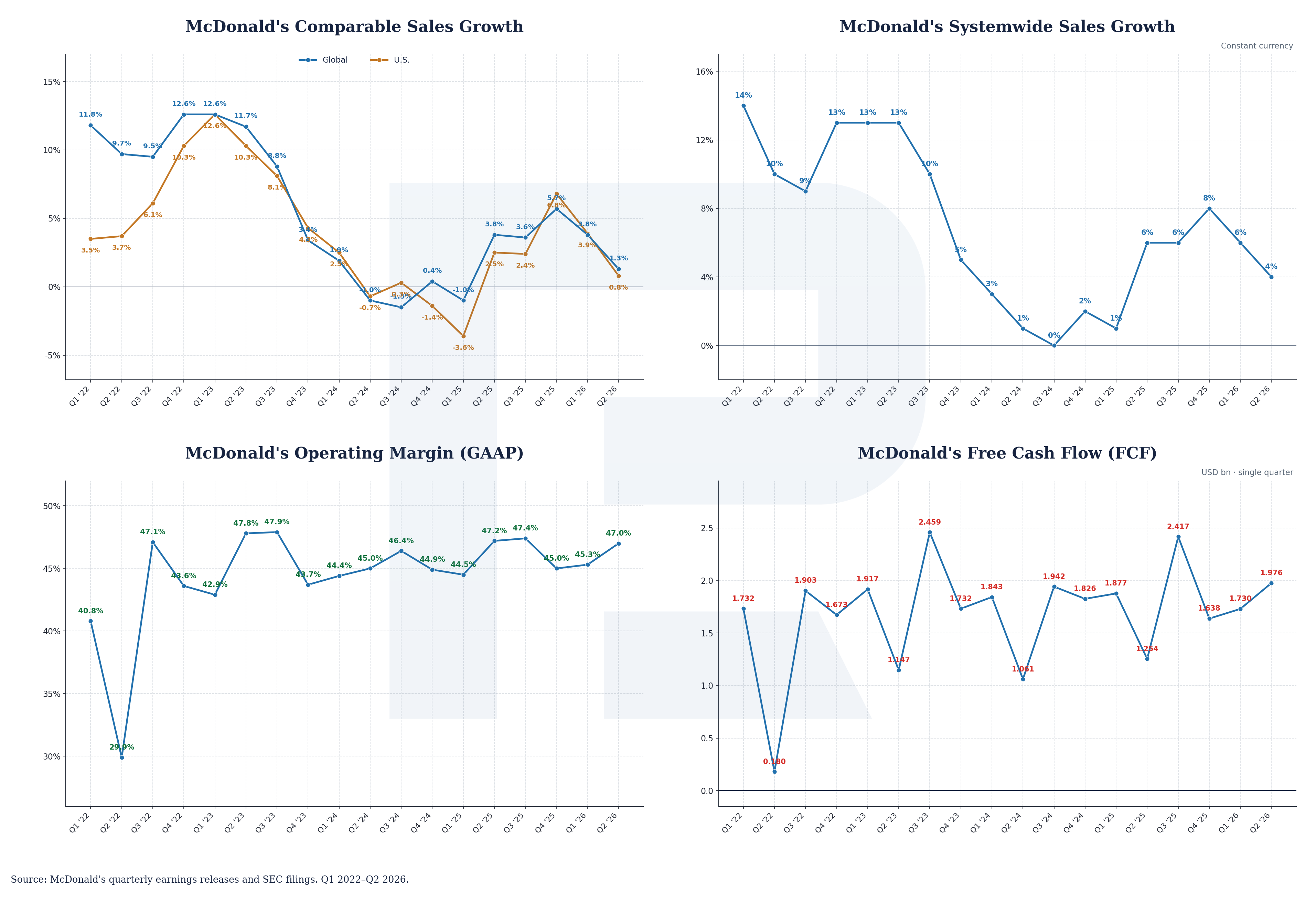
The four indicators show that McDonald’s remains highly profitable, but demand at existing restaurants is weakening. In Q2, comparable sales rose 1.3% globally and just 0.8% in the US. Systemwide sales increased 4%, supported in part by new restaurant openings. At the same time, US restaurants saw fewer customer visits than in the same period last year. Management expects US comparable sales to decline in Q3.
The company’s financial position remains resilient for now. McDonald’s continues to maintain high profitability, while free cash flow for the first half of the year reached 3.71 billion USD, compared with 3.13 billion USD a year earlier. However, part of the cash flow improvement was driven by changes in working capital, so it will be important to see whether this can be sustained in the coming quarters. In addition, the announced NEXT program provides for 8.5 billion USD in franchisee support through 2036, including rent relief and contributions towards capital expenditure. It will therefore be important to monitor how these additional costs affect free cash flow in future earnings reports.
McDonald’s stock has been declining since the beginning of 2026, with the decline accelerating following management’s latest comments. Investors are concerned that US restaurants are losing customer traffic and that the company expects comparable sales to decline in Q3. New restaurant openings and high profitability have not yet changed this picture. For MCD’s outlook to improve, it will be important to see whether customers return and how much cash the company retains after spending on restaurant upgrades.
Analysts’ forecasts for McDonald’s stock in 2026
#. Barchart : 17 of 36 analysts rated McDonald’s stock a Strong Buy, 2 a Moderate Buy, and 17 a Hold. The highest price target is 390 USD, while the lowest is 268 USD.
#. MarketBeat : 17 of 28 analysts rated the stock a Buy and 11 a Hold. The highest price target is 390 USD, while the lowest is 282 USD.
#. TipRanks : 14 of 25 analysts rated the stock a Buy and 11 a Hold. The highest price target is 390 USD, while the lowest is 280 USD.
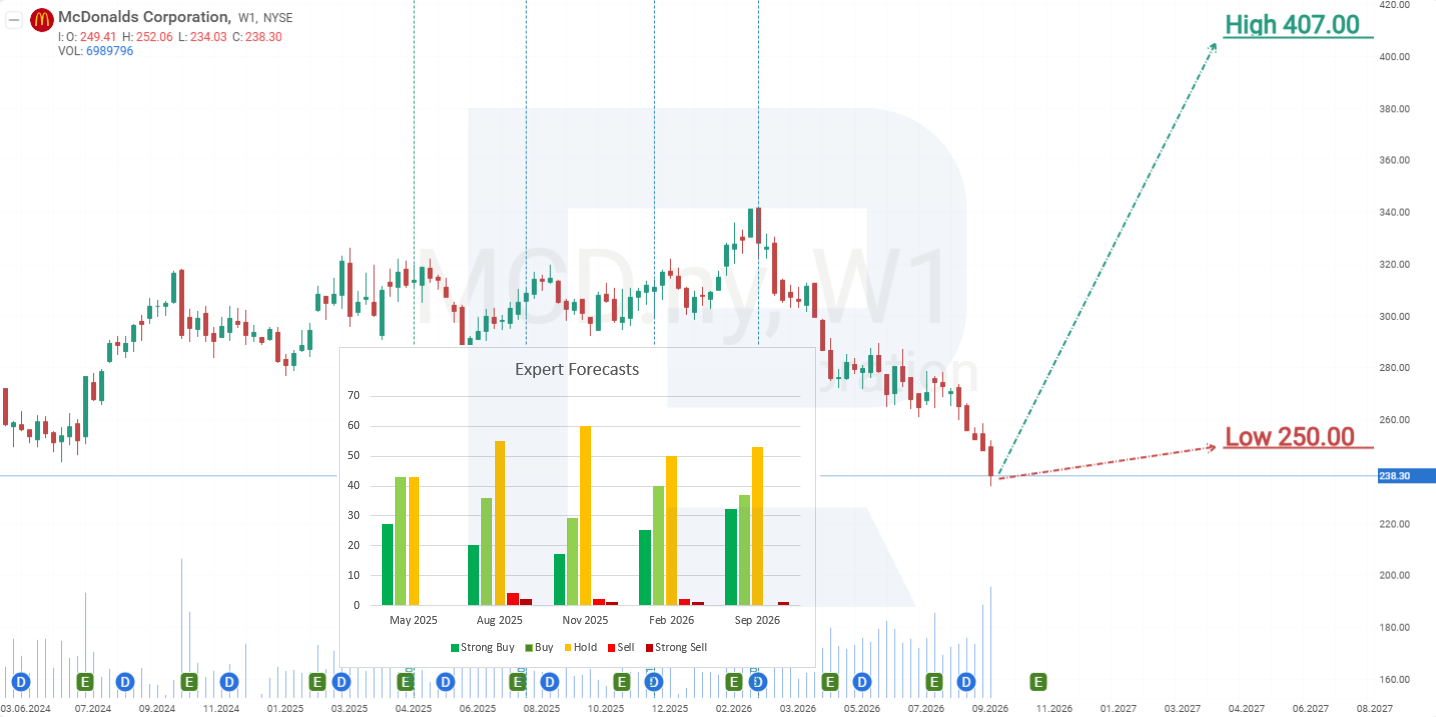
#. Stock Analysis : 15 of 34 analysts rated the stock a Strong Buy, 4 a Buy, 14 a Hold, and 1 a Strong Sell. The highest price target is 407 USD, while the lowest is 250 USD.
Analyst forecasts for McDonald’s stock remain predominantly positive. One notable feature of the current forecasts is that even the lowest price targets across the major platforms are above the current share price of 239 USD. The lowest targets range from 250 USD to 282 USD, while the highest range from 390 USD to 407 USD. This suggests that analysts generally view the current decline in MCD as temporary pressure on the share price rather than evidence of a significant deterioration in the company’s long-term business prospects.
Technical analysis of MCD and McDonald’s stock forecast for 2026
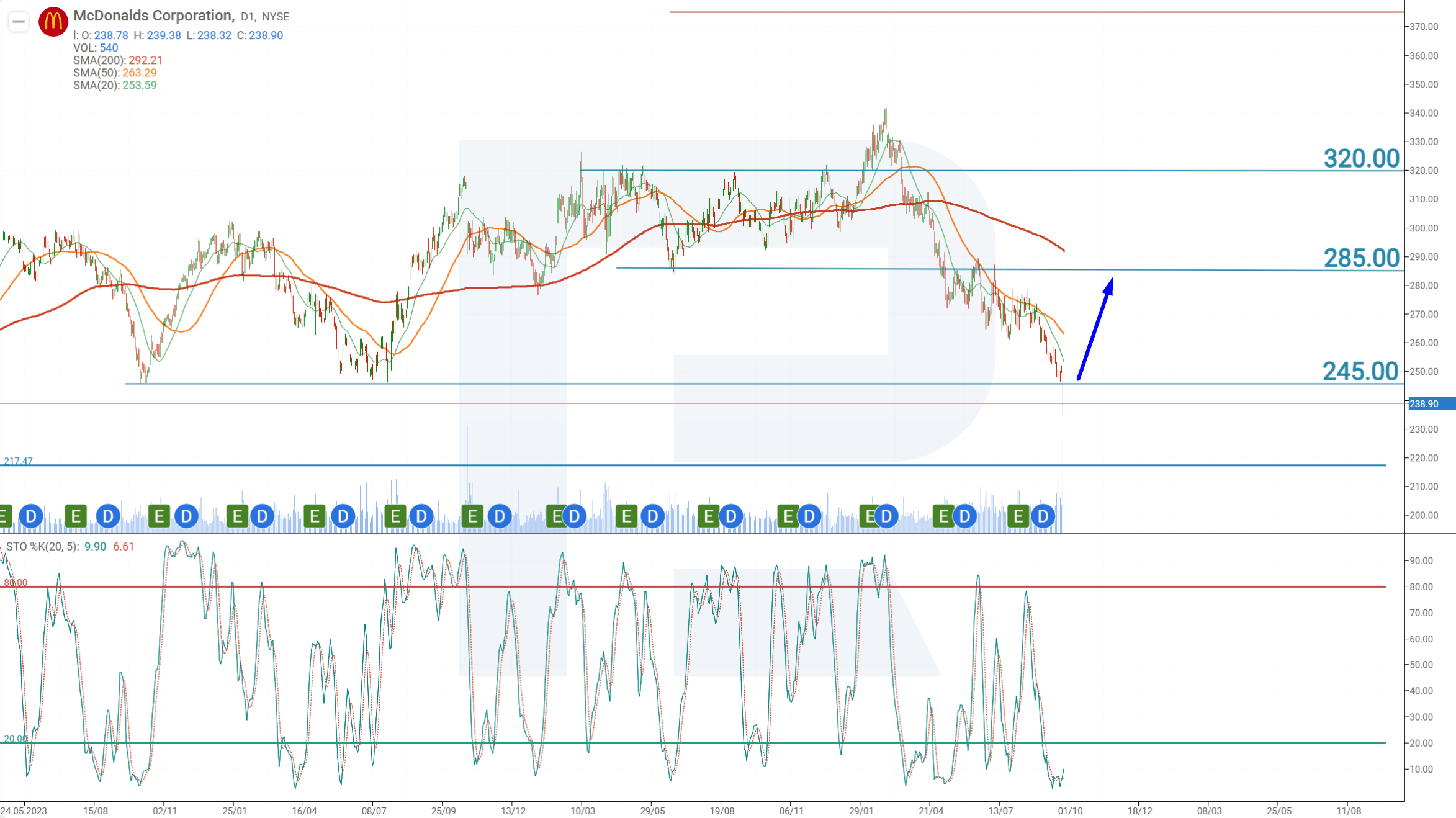
At the time of writing, MCD stock is trading at 239 USD.
On the daily chart, McDonald’s stock is trading below the 200-period Moving Average, indicating that the downtrend remains dominant. The Stochastic oscillator is in deeply oversold territory. This leaves room for a corrective move higher in MCD stock.
Following management’s comments about a possible decline in comparable sales for Q3 as a whole, market participants are already pricing a negative scenario into the stock. In these circumstances, trying to ‘catch a falling knife’ in search of a reversal point is too risky. However, given the oversold conditions, selling the stock at current levels would also be unwise.
A more cautious approach would therefore be to wait for a break above the nearest resistance at 245 USD and for the price to establish a foothold above this level. McDonald’s resilient business model, stable stream of revenue from franchising, and strong fundamentals protect the stock from a prolonged decline. Given that the current share price is even below analysts’ most pessimistic price targets, the return of large-scale capital to the stock is only a matter of time.
The MCD stock trading idea therefore involves placing a Buy Stop order at 246 USD. Take Profit is set at 280 USD, slightly below resistance at 285 USD, with Stop Loss at 234 USD.
Buy Stop – 246.00
Take Profit – 280.00
Stop Loss – 234.00
Position management rule. Once the price moves 70% of the total target distance in the forecast direction, the Stop Loss is moved to the entry level. The protective order is then trailed behind the price, maintaining a distance of 10%. This continues until the position is closed at either Take Profit or Stop Loss, depending on which level is reached first.
Risks of investing in McDonald's Corporation stock
When investing in McDonald's Corporation stock, it is essential to consider the risks the company may face in 2025. Below are the key risks:
- Food safety issues: the discovery of E. coli in McDonald's products in October 2024 resulted in a 0.3% decrease in revenue in Q4, affecting consumer trust. Although the FDA confirmed no current food safety issues with McDonald's products, this incident highlighted the risks associated with foodborne illnesses, impacting both sales and the brand's reputation.
- Increased competition and shifting consumer preferences: with a growing number of competitors and a consumer shift towards healthier food options, McDonald's plans to expand its chicken menu, including the return of popular items like the Snack Wrap, to meet evolving consumer expectations.
- Operational challenges: while the introduction of the Snack Wrap to the menu aims to boost US sales, it could lead to operational issues due to longer preparation times, potentially affecting service speed and overall customer satisfaction.
- Economic factors: inflation continues to strain consumer spending. CEO Chris Kempczinski forecasts a challenging 2025 and notes that low-income customers will likely continue facing financial difficulties, which could reduce their dining-out spending.
Ang mga pagtataya na ipinakita sa seksyong ito ay nagpapakita lamang ng pribadong opinyon ng may-akda at hindi dapat ituring bilang gabay para sa pagtetrade. Walang pananagutan ang RoboForex para sa mga resulta ng pagtetrade batay sa mga rekomendasyon sa pagtetrade na inilarawan sa mga analytical review na ito.