
Meta stock forecast: META shares could climb as investment in AI accelerates
Meta is generating higher revenue, but almost all of its free cash flow is being directed towards investment in artificial intelligence. Following a 10% decline, META stock is approaching a key resistance level, while analysts' forecasts point to upside potential towards 1,000 USD.
Meta Platforms, Inc. (NASDAQ: META) reported mixed results for Q2 2026. The company increased revenue by 28% to 60.80 billion USD, while Family daily active people (DAP) grew to 3.60 billion, confirming the resilience of its advertising platform and user base. However, profitability deteriorated: net income declined by 14%, EPS fell by 13%, and expenses increased by 55% due to legal costs, workforce reductions, and investment in AI infrastructure.
The guidance for the next reporting period remained the main factor weighing on the stock. After Q1, Meta expected Q2 revenue in the range of 58–61 billion USD, and the actual result came in at the upper end of its guidance. Following the Q2 results, the company expects Q3 revenue of 61–64 billion USD, but it also raised the lower end of its full-year expense and capital expenditure (CapEx) guidance. This shows that the advertising business continues to grow, but investment in AI is becoming increasingly capital-intensive.
Investor reaction to the results was negative: following the earnings release, Meta shares fell by 10%. The market reacted to the decline in EPS, lower margins, the sharp reduction in free cash flow, and higher AI-related spending. However, by 5 August, the stock had recovered its losses and returned to pre-earnings levels. This suggests that investors have not abandoned the long-term investment case for Meta, but will now be paying closer attention to how quickly investment in AI begins to support earnings and free cash flow.
This article examines Meta Platforms' business model, explains how the company generates revenue, reviews its quarterly financial results, and provides a fundamental analysis of META. It also presents analysts' forecasts for Meta stock in 2026 and examines the performance of META stock through technical analysis, which forms the basis for the forecast for Meta Platforms stock in 2026.
About Meta Platforms, Inc.
Meta Platforms, formerly known as Facebook, was founded in 2004 by Mark Zuckerberg and his Harvard classmates Eduardo Saverin, Andrew McCollum, Dustin Moskovitz, and Chris Hughes. It was initially a social network for Harvard students, but soon expanded to become one of the world’s largest communication platforms. Meta’s core operations include developing social networks such as Facebook, Instagram, and WhatsApp, as well as advancing virtual and augmented reality technologies through its Reality Labs division. The company puts a significant focus on developing the metaverse, as reflected in its 2021 rebranding. Meta went public on 18 May 2012, and its IPO ranked among the most prominent tech IPOs in history.

Meta Platforms, Inc.’s main financial flows
Meta Platforms’ revenue mainly comes from the following sources:
- Advertising: this segment accounts for approximately 98.5% of the company’s total revenue. Meta generates advertising revenue through its platforms (Facebook, Instagram, Messenger, and WhatsApp), allowing advertisers to target audiences based on various criteria, including demographic data, user interests, and behaviour.
- Reality Labs: this division generates a smaller portion of the company’s revenue through hardware sales under the Meta Quest (previously Oculus VR) brand and related software products, including content.
- Other revenue: this comprises fees for using Meta’s payment systems (for example, on Marketplace platforms or apps), paid subscriptions for special features or products, and income from other services. While these sources are less significant than advertising, they still contribute to the company’s financial performance.
Thus, Meta Platforms’ primary source of revenue is advertising on its social platforms, followed by income from virtual reality sales and services, as well as additional proceeds from other sources.
Meta Platforms, Inc. Q2 2024 financial results
Meta announced solid financial results for Q2 2024. Below are the figures compared with the same period in 2023:
- Revenue: 39.74 billion USD (+22%)
- Net income: 13.46 billion USD (+73%)
- Earnings per share: 5.16 USD (+73%)
- Operating margin: 38% (+900 basis points)
- Advertising revenue: 38.20 billion USD (+21%)
- Revenue from Reality Labs: 353 million USD (+27%)
- Loss from Reality Labs: 4.50 billion USD (+21%)
- Number of daily active users: 3.27 billion (+7%)
- Costs and expenses: 24.22 billion USD (+7%)
Advertising remains the primary revenue stream, contributing 96% of the company’s total revenue. The Reality Labs division, which specialises in developing virtual and augmented reality (VR and AR) technologies, has so far only generated losses. By the end of Q2 2024 results, Reality Labs’ loss reached 4.50 billion USD, a 21% increase.
Meta Platforms, Inc. Q3 2024 financial results
On 30 October, Meta released its Q3 2023 financial results. Below are the key figures compared with the same period in 2023:
- Revenue: 40.58 billion USD (+19%)
- Net income: 15.68 billion USD (+35%)
- Earnings per share: 6.03 USD (+37%)
- Operating margin: 43% (+300 basis points)
- Advertising revenue: 39.88 billion USD (+18%)
- Reality Labs revenue: 270 million USD (+28%)
- Reality Labs loss: 4.40 billion USD (+20%)
- Number of daily active users: 3.279 billion (+5%)
- Costs and expenses: 23.24 billion USD (+14%)
CEO Mark Zuckerberg explained that revenue growth was driven by advancements in artificial intelligence (AI), which are actively integrated into the company’s applications and business processes. He highlighted Meta AI’s significant success, the rollout of the Llama AI model, and the development of AI-powered smart glasses.
CFO Susan Li shared the company’s forecast, expecting Q4 2024 revenue to range between 45.00 billion and 48.00 billion USD. She also revised the company’s total expense forecast for 2024, lowering it to the 96.00–98.00 billion USD range, down from the previous estimate of 96.00–99.00 billion USD. Li emphasised that the operating losses of the Reality Labs division, which focuses on virtual and augmented reality (VR and AR), would significantly increase year-on-year due to ongoing development and investments aimed at scaling the ecosystem. Additionally, Li mentioned that Meta expects substantial capital expenditure growth in 2025, including increased spending on infrastructure.
Both Zuckerberg and Li also noted the growing number of legal and regulatory challenges, particularly in the European Union and the US, which could significantly affect Meta’s business and financial results.
Meta Platforms, Inc. Q4 2024 financial results
On 29 January 2025, Meta published its Q4 2024 financial results. Below are the key figures compared with the same period in 2023:
- Revenue: 48.38 billion USD (+21%)
- Net income: 20.83 billion USD (+49%)
- Earnings per share: 8.02 USD (+50%)
- Operating margin: 48% (+700 basis points)
- Advertising revenue: 46.78 billion USD (+20%)
- Reality Labs revenue: 1.08 billion USD (+1%)
- Reality Labs loss: 4.96 billion USD (+6%)
- Number of daily active users: 3.35 billion (+5%)
- Costs and expenses: 25.02 billion USD (+5%)
In his comments accompanying the earnings release, Mark Zuckerberg highlighted Meta's progress in artificial intelligence and expressed optimism about scaling these technologies throughout 2025. The company continued to focus on personalised AI assistants, developing models capable of writing and deploying code, and making significant investment in computing infrastructure.
Zuckerberg also highlighted the AI glasses business, noting that 2025 could prove to be an important year for assessing its commercial potential.
Commenting on DeepSeek, he acknowledged the Chinese company's innovative developments but emphasised that it was still too early to assess their impact on Meta's infrastructure plans. He added that the company's strategy of making substantial investment in AI infrastructure remained unchanged, as Meta viewed it as a long-term competitive advantage. Additionally, a decline in demand for GPUs did not appear likely, as AI models operating at Meta's scale continued to require substantial computing resources.
Meta Platforms, Inc. Q1 2025 financial results
On 30 April, Meta published its Q1 2025 financial report for the quarter ended 31 March. Key figures compared with the same period in 2024 are as follows:
- Revenue: 42.31 billion USD (+16%)
- Net income: 16.64 billion USD (+35%)
- Earnings per share: 6.43 USD (+37%)
- Operating margin: 41% (+300 basis points)
- Advertising revenue: 41.39 billion USD (+16%)
- Reality Labs revenue: 0.41 billion USD (-9%)
- Reality Labs loss: 4.21 billion USD (+16%)
- Family daily active people (DAP): 3.43 billion (+6%)
- Costs and expenses: 24.76 billion USD (+9%)
Meta made a strong start to 2025, exceeding analysts' expectations. Revenue increased by 16%, while earnings per share rose by 35%. The advertising business remained the main growth driver, with advertising revenue increasing by 16.2% due to higher ad prices and more ad impressions. Meta's user base also continued to expand, reaching 3.43 billion daily active people (DAP).
The company continued to invest heavily in artificial intelligence. Meta raised its 2025 capital expenditure (CapEx) guidance to 64–72 billion USD from the previous 60–65 billion USD, with the additional investment directed towards data centres and infrastructure for AI projects.
For Q2 2025, Meta projected revenue in the range of 42.5–45.5 billion USD, in line with analysts' expectations. At the same time, management highlighted potential short-term risks, including weaker advertising demand from Asian companies and broader macroeconomic uncertainty.
Meta Platforms, Inc. Q2 2025 financial results
On 30 July, Meta released its Q2 2025 financial results for the quarter ended 30 June. Below are the key figures compared with the same period in 2024:
- Revenue: 47.52 billion USD (+22%)
- Net income: 18.34 billion USD (+36%)
- Earnings per share: 7.14 USD (+38%)
- Operating margin: 43% (+500 basis points)
- Advertising revenue: 46.56 billion USD (+16%)
- Revenue from Reality Labs: 0.37 billion USD (+5%)
- Loss from Reality Labs: 4.53 billion USD (–1%)
- Family daily active people (DAP): 3.48 billion (+6%)
- Costs and expenses: 27.07 billion USD (+12%)
Meta Platforms reported revenue of 47.52 billion USD in Q2 2025, up 22% year-on-year, while adjusted earnings per share came in at 7.14 USD – 38% higher than the same period last year and well above analyst expectations of 5.85–5.89 USD. Operating profit rose to 20.44 billion USD, with an operating margin of approximately 43%, up five percentage points from 38% a year earlier.
Meta issued revenue guidance for Q3 2025 in the 47.5–50.5 billion USD range, anticipating a slowdown in growth in Q4 due to a high base of comparison. At the same time, it raised its full-year capital expenditure forecast to 66–72 billion USD, hinting at even higher investment in 2026 to support the expansion of its AI infrastructure and the hiring of specialised talent.
Meta Platforms, Inc. Q3 2025 financial results
On 29 October 2025, Meta published its Q3 2025 financial results for the quarter ended 30 September. The key figures, compared with the same period in 2024, are as follows:
- Revenue: 51.24 billion USD (+26%)
- Net income: 2.71 billion USD (–83%)
- Earnings per share: 1.05 USD (–83%)
- Operating margin: 40% (–300 basis points)
- Advertising revenue: 50.08 billion USD (+26%)
- Reality Labs revenue: 0.47 billion USD (+74%)
- Reality Labs loss: 4.43 billion USD (0%)
- Family daily active people (DAP): 3.54 billion (+8%)
- Costs and expenses: 30.71 billion USD (+32%)
Meta reported record revenue of 51.2 billion USD for Q3 2025, 26% higher than a year earlier and above market expectations. Operating profit increased by 18%, while the operating margin remained high at 40%. GAAP net income declined due to a one-off tax charge of almost 16 billion USD, but excluding this item, the quarter was very strong.
The Family of Apps segment once again was the main growth driver. Revenue and advertising revenue both increased by 26%, ad impressions rose by 14%, the average price per ad increased by 10%, and the number of daily active people (DAP) reached 3.54 billion. Reality Labs increased revenue by 74% to 470 million USD, although the segment remained loss-making.
The main risk continued to be rising costs. Meta raised its full-year expense guidance to 116–118 billion USD and its capital expenditure (CapEx) guidance to 70–72 billion USD due to investment in AI infrastructure and data centres.
Meta's management provided a confident outlook for Q4 2025, pointing to continued strong business momentum. The company expects revenue of 56–59 billion USD, representing year-on-year growth of 18–22%. This pace of growth suggests a continued recovery in the advertising market along with sustained demand from both large brands and small businesses.
At the same time, the company expects the Reality Labs segment to report a slight decline in revenue in the fourth quarter compared with Q3. This is because Quest headset sales peaked in Q3, when distribution channels were being stocked, and new models were launched. Meta expects sales to stabilise in Q4, although the segment is not expected to become a key growth driver.
Meta Platforms, Inc. Q4 2025 financial results
On 28 January, Meta released its Q4 2025 results for the quarter ended 31 December. Below are the key figures compared with the same period in 2024:
- Revenue: 59.89 billion USD (+24%)
- Net income: 22.76 billion USD (+9%)
- Earnings per share: 8.88 USD (+11%)
- Operating margin: 41% (–700 basis points)
- Advertising revenue: 58.14 billion USD (+24%)
- Reality Labs revenue: 0.96 billion USD (–12%)
- Reality Labs loss: 6.21 billion USD (–12%)
- Family daily active people (DAP): 3.58 billion (+7%)
- Costs and expenses: 35.15 billion USD (+40%)
Meta Platforms' Q4 2025 results exceeded analysts' expectations. Revenue increased by 24% year-on-year to 59.89 billion USD, driven by a stronger advertising business, higher engagement across Reels and Instagram, and improved monetisation through AI algorithms.
Earnings per share reached 8.88 USD, compared with the consensus forecast of 8.2 USD, while net income increased by 9% year-on-year to 22.8 billion USD. This demonstrated that Meta was able to maintain the high profitability of its core business despite increasing investment in infrastructure and artificial intelligence.
For Q1 2026, management projected revenue of 53.5–56.5 billion USD. Full-year 2026 expenses were expected to total 162–169 billion USD, primarily due to investments in infrastructure, cloud services, and AI. At the same time, the company expected operating income to exceed the 2025 level.
Legal and regulatory issues in the EU and the US remained an additional source of risk, including changes to its offering of less personalised advertising, as agreed with the European Commission.
Meta Platforms, Inc. Q1 2026 financial results
On 29 April, Meta published its Q1 2026 results for the quarter ended 31 March. The key figures compared with the same period in 2025 are as follows:
- Revenue: 56.31 billion USD (+33%)
- Net income: 26.77 billion USD (+61%)
- Earnings per share: 10.44 USD (+62%)
- Operating margin: 41% (0 basis points)
- Advertising revenue: 55.02 billion USD (+33%)
- Revenue Reality Labs: 0.40 billion USD (-2%)
- Loss Reality Labs: 4.03 billion USD (compared with a 4.21 billion USD loss a year earlier)
- Family daily active people (DAP): 3.56 billion (+4%)
- Costs and expenses: 33.44 billion USD (+35%)
Meta Platforms' Q1 2026 results were stronger than expected. Revenue increased by 33% to 56.31 billion USD, exceeding analysts' consensus forecast of 55.45 billion USD. The advertising business remained the main growth driver, with advertising revenue reaching 55.02 billion USD, ad impressions increasing by 19%, and the average price per ad rising by 12%.
Artificial intelligence also supported the results. More than 8 million advertisers were already using Meta's AI tools to create advertisements, while early testing of its video generation technology showed a 3% increase in conversion rates. At the same time, net income was partially supported by a one-off tax benefit of 8.03 billion USD, meaning the increase in EPS cannot be regarded as entirely operational.
For Q2 2026, Meta forecast revenue of 58–61 billion USD. The company's 2026 expense guidance remained unchanged at 162–169 billion USD, while its capital expenditure (CapEx) guidance was raised to 125–145 billion USD due to higher component costs and increased spending on data centres.
Meta Platforms, Inc. Q2 2026 financial results
On 29 July, Meta Platforms published its Q2 2026 financial results for the quarter ended 30 June. The key figures are presented below, compared with the corresponding period of 2025:
- Revenue: 60.80 billion USD (+28%)
- Net income: 15.85 billion USD (–14%)
- Earnings per share: 6.18 USD (–13%)
- Operating margin: 31% (–1200 basis points)
- Free cash flow: 784 million USD (–91%)
Revenue by segment:
- Advertising revenue: 59.36 billion USD (+27%)
- Family of Apps: 60.37 billion USD (+28%)
- Reality Labs: 431 million USD (+16%)
- Other revenue: 1.01 billion USD (+73%)
- Family daily active people (DAP): 3.60 billion (+3%)
- Costs and expenses: 42.03 billion USD (+55%)
Meta Platforms' Q2 2026 results were mixed. Revenue increased by 28% year-on-year to 60.8 billion USD, slightly exceeding the market consensus of 60.3 billion USD. However, diluted earnings per share came in at 6.18 USD, 14% below the consensus forecast and 13% lower than a year earlier. Following the earnings release, Meta shares fell by 9.2% as investors focused on the sharp increase in expenses, lower margins, and weak free cash flow.
Compared with the guidance issued after Q1, management raised the lower end of both its expense and capital expenditure (CapEx) guidance ranges. Meta now expects 2026 expenses of 165–169 billion USD, compared with the previous guidance of 162–169 billion USD, while its capital expenditure guidance was revised from 125–145 billion USD to 130–145 billion USD. In addition, the expected tax rate for the remainder of the year increased from 13–16% to 15–17%. At the same time, the company maintained its expectation that operating income for the full year would exceed the 2025 level.
The increase in expense guidance was partly driven by one-off items, including 2.4 billion USD in legal costs and 1.2 billion USD in severance payments for approximately 8,000 employees. Excluding these items, operating profit would have been considerably stronger. However, the market focuses on the reported figures, where expenses increased by 55% while revenue grew by 28%. As a result, the operating margin declined from 43% to 31%.
The upward revision to capital expenditure also shows that Meta intends to continue investing aggressively in artificial intelligence infrastructure. During Q2 alone, the company invested 31.1 billion USD in servers, equipment, and data centres. Its Q3 revenue guidance of 61–64 billion USD points to continued double-digit growth, but this was not strong enough to offset investors' concerns about further increases in spending. The advertising business remains Meta's primary growth driver.
Advertising revenue increased by 27% to 59.4 billion USD. Ad impressions rose by 14%, while the average price per ad increased by 12%. The company continues to integrate large language models (LLMs) into Instagram and Facebook recommendation systems, improving content recommendations, ad targeting, and advertising efficiency. The Advantage+ platform is also expanding, with tools that use generative AI to create advertising content. The number of small businesses using these solutions reached 9 million.
At the same time, Meta is gradually expanding the monetisation of WhatsApp. Non-advertising revenue within the Family of Apps segment exceeded 1 billion USD for the first time, increasing by 73% year-on-year, driven by paid messaging and subscriptions. Threads reached 500 million monthly active users, while growing sales of smart glasses partly offset weaker demand for Quest headsets. These businesses are not yet comparable in scale to Meta's advertising operations, but over time, they could reduce the company's dependence on traditional advertising.
The main weakness in the report was the deterioration in cash flow. Free cash flow declined by 91%, from 9 billion USD to 784 million USD, as capital expenditure increased significantly faster than operating cash flow. This does not mean that Meta's core business has ceased to generate cash. Rather, it shows that almost all the cash flow generated by the company is now being directed towards the development of AI infrastructure.
Reality Labs also remains a source of pressure. The division recorded an operating loss of 4.6 billion USD during the quarter, while cumulative losses have now exceeded 90 billion USD. Rising sales of smart glasses are an encouraging sign, but they are not yet sufficient to materially improve the segment's financial performance. Legal risks related to the potential impact of social media on young people also remain. During the quarter, Meta set aside 2.4 billion USD to cover these costs.
User growth is also gradually slowing. The number of Family daily active people (DAP) increased by 3% to 3.6 billion, compared with 4% growth in the previous quarter. Given the company's already vast user base, further expansion is becoming increasingly difficult. As a result, Meta's future growth will depend increasingly on higher revenue per user, advertising efficiency, and the development of new monetisation channels.
The company's balance sheet remains strong, with cash and liquid investments of 90.3 billion USD exceeding debt of 83.7 billion USD. Nevertheless, rising debt levels and the involvement of external partners in financing infrastructure projects highlight how capital-intensive Meta's AI strategy is becoming.
Overall, the report confirmed the strength of Meta's core business while also highlighting the growing cost of its AI strategy. Advertising algorithms continue to improve monetisation, WhatsApp is beginning to generate meaningful revenue, and Threads and smart glasses provide additional avenues for growth. However, rising expenses, lower operating margins, and the near-elimination of free cash flow make the company's financial performance less predictable.
In the short term, Meta shares may remain under pressure as the market awaits clearer evidence that record investment in artificial intelligence can translate into sustainable growth in earnings and cash flow. Over the medium term, the key factor will be the company's ability to monetise its new infrastructure through advertising tools, enterprise AI agents, and other paid products.
For long-term investors, Meta retains an attractive investment case thanks to its user base of 3.6 billion people, strong advertising business, and proprietary AI ecosystem. However, the current results point to elevated volatility and the risk of further pressure on margins. Until there are clearer signs of a recovery in free cash flow and stabilisation in expenses, maintaining existing positions without significantly increasing exposure appears to be the most prudent approach.
Analysis of key valuation multiples for Meta Platforms, Inc.
The table below presents Meta Platforms' key valuation multiples as of the end of Q2 2026, calculated using a stock price of 565 USD.
| Multiple | What it indicates | Value | Commentary |
|---|---|---|---|
| P/E (TTM) | Price paid for 1 USD of earnings over the past 12 months | 21.13 | ⬤ The valuation appears attractive relative to earnings for a company delivering this level of earnings growth. |
| P/S (TTM) | Price paid for 1 USD of annual revenue | 6.30 | ⬤ The valuation remains elevated relative to revenue, although strong sales growth partly justifies the premium. |
| EV/Sales (TTM) | Enterprise value to sales, accounting for debt | 6.28 | ⬤ After accounting for the company's net cash position, the valuation appears reasonable for a company with strong growth prospects. |
| P/FCF (TTM) | Price paid for 1 USD of free cash flow | 37.99 | ⬤ The valuation appears expensive relative to free cash flow due to the sharp increase in capital expenditure. |
| FCF Yield (TTM) | Free cash flow yield to shareholders | 2.63% | ⬤ The free cash flow yield remains moderate. |
| EV/EBITDA (TTM) | Enterprise value to operating profit before depreciation and amortisation | 13.06 | ⬤ The valuation appears moderate relative to EBITDA for a company with high margins and strong growth. |
| EV/EBIT (TTM) | Enterprise value to operating profit | 16.48 | ⬤ The valuation appears reasonable relative to operating profit. |
| P/B | Price to book value | 5.51 | ⬤ The premium to book value remains high, but this is justified by Meta's strong profitability. |
| Forward P/E | Forward price-to-earnings (P/E) ratio | 17.42 | ⬤ The valuation appears attractive based on forward earnings. |
| Net Debt/EBITDA | Debt burden relative to EBITDA | –0.06 | ⬤ The company has a net cash position and a very strong balance sheet. |
| Interest Coverage (TTM) | Ability to cover interest expenses with operating profit | 50.08 | ⬤ Interest expense is covered with a very comfortable margin. |
Conclusion from Meta Platforms' valuation multiples
Following its Q2 2026 results, Meta continues to represent a strong growth story with a moderate earnings valuation. A P/E ratio of around 21x, an EV/EBIT multiple of approximately 16.5x, and a forward P/E of around 17.4x appear attractive from a valuation perspective. The main weakness is free cash flow: the company is sharply increasing investment in AI infrastructure, which is already having a noticeable impact on cash generation.
For investors with a higher risk tolerance, Meta's current valuation appears attractive. The advertising business continues to grow rapidly, its user base remains vast, the balance sheet is strong, and debt does not place significant pressure on the business. However, the investment case now depends on whether Meta can demonstrate that its increased capital expenditure on AI will translate into faster revenue growth, higher earnings, and additional monetisation opportunities. If this is confirmed, the current valuation multiples appear justified. If not, the market may continue to put pressure on the stock due to continued weakness in free cash flow.
Expert forecasts for Meta Platforms, Inc. stock for 2026
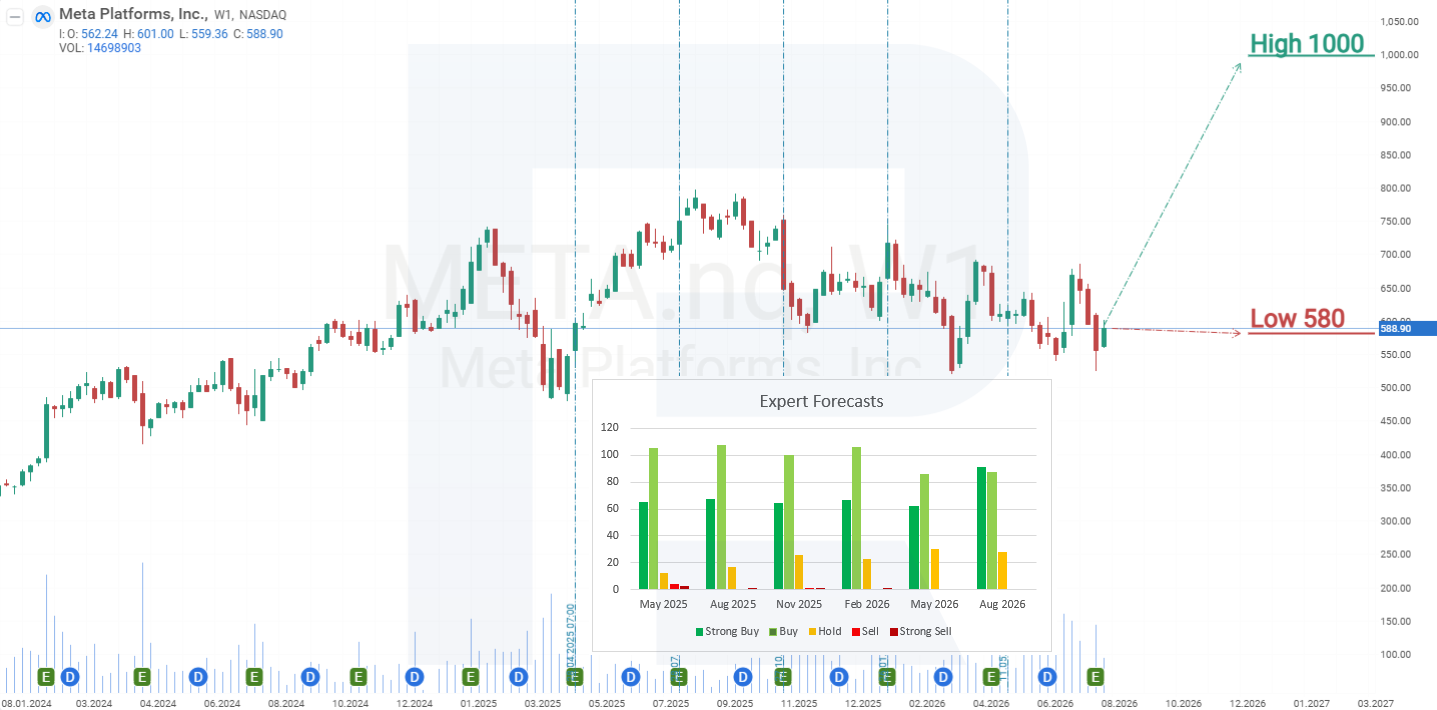
- Barchart: 44 of 54 analysts rate Meta Platforms’ stock as Strong Buy, 2 as Buy, and 8 as Hold. The highest price target is 1,000 USD, while the lowest is 580 USD.
- MarketBeat: 38 of 46 analysts rate the stock as Buy, and 8 as Hold. The highest price target is 1,000 USD, while the lowest is 595 USD.
- TipRanks: 39 of 44 analysts rate the stock as Buy, and 5 as Hold. The highest price target is 1,000 USD, while the lowest is 580 USD.
- Stock Analysis: 47 of 62 analysts rate Meta Platforms’ stock as Strong Buy, 8 as Buy, and 7 as Hold. The highest price target is 1,000 USD, while the lowest is 580 USD.
Meta Platforms, Inc. stock price forecast for 2026
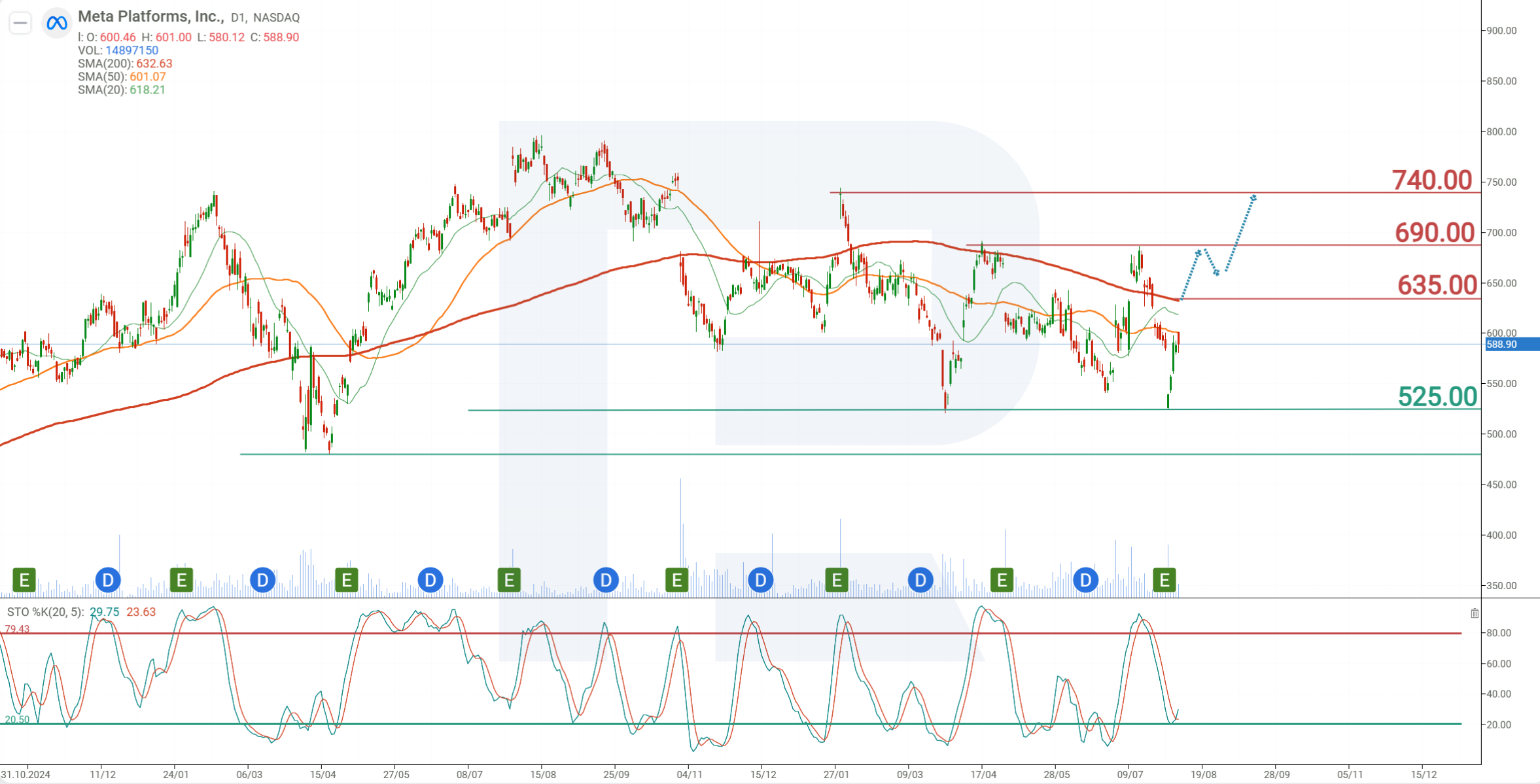
Since October 2025, META stock has traded below the 200-period Moving Average, indicating that the prevailing downtrend remains intact. However, after bottoming near 525 USD in March 2026, the stock has not revisited this level. Each subsequent decline towards support at 525 USD has been followed by a recovery, indicating resilient buying interest and strong demand for the stock around this level.
META stock's advance between 25 June and 15 July resulted in a temporary break above the 200-period Moving Average, providing the first indication of strengthening buying momentum. As of 6 August, the stock is once again approaching this level. A sustained break above it could confirm that the downtrend is weakening and increase the likelihood of a continued recovery. An additional positive signal comes from the Stochastic indicator, which is approaching oversold territory, further increasing the likelihood of a recovery in the stock price. Based on the current META stock performance, the following scenario outlines its potential movement in 2026.
The forecast for Meta Platforms stock suggests a break above the 200-period Moving Average at 635 USD, followed by an advance towards resistance at 690 USD. If this level is broken, the stock could extend its gains towards 740 USD.
Position management: once the stock has moved 6% in the projected direction, the Stop Loss should be moved to the entry level. The protective stop should then be adjusted to remain 6% behind the price.
Ang mga pagtataya na ipinakita sa seksyong ito ay nagpapakita lamang ng pribadong opinyon ng may-akda at hindi dapat ituring bilang gabay para sa pagtetrade. Walang pananagutan ang RoboForex para sa mga resulta ng pagtetrade batay sa mga rekomendasyon sa pagtetrade na inilarawan sa mga analytical review na ito.