
Micron stock could continue to rise after strong Q4 results
Micron continues to set new records amid strong demand for memory used in AI and data centres. Revenue, earnings, and margins remain at historically high levels, while technical analysis of MU points to further upside potential if the stock breaks above the nearest resistance level.
Micron Technology, Inc. (NASDAQ: MU) ended Q4 of the 2026 financial year with record results. Revenue rose to 54.23 billion USD, adjusted earnings reached 33.42 USD per share, and non-GAAP gross margin climbed to 87%. Demand for memory used in data centres and AI infrastructure remained the main growth driver, while DRAM and NAND prices continued to rise, although the pace of these increases had already begun to slow.
The company’s outlook for the next quarter remains strong: Micron expects revenue to continue growing and gross margin to remain around current levels. At the same time, investors should monitor the rapid increase in capital expenditure, as expanding production capacity could increase the risk of higher memory supply over the longer term.
This article provides a Micron Technology stock analysis following the company’s record Q4 2026 financial results, examining its main growth drivers and key business indicators. It also provides a fundamental and technical analysis of MU, which forms the basis for the Micron stock forecast for the second half of 2026.
About Micron Technology, Inc.
Founded in 1978, Micron Technology Inc. is a US-based company that develops and manufactures memory chips (DRAM, NAND) and provides technology solutions for data storage. Micron is one of the world’s largest producers of electronic memory, with its products used in cars, computers, mobile devices, servers, and other electronic equipment. The company was listed on the New York Stock Exchange in 1984 and trades under the ticker MU.
Today, Micron continues to develop and deploy advanced memory modules and data storage technologies for the artificial intelligence, 5G networks, autonomous vehicle, and cloud computing markets.
Micron Technology, Inc.’s main revenue sources
Micron’s business model centres on developing, producing, and selling semiconductor memory modules and data storage solutions. The company’s segments are categorised by the product markets listed below:
- Personal computers and devices: this includes revenue from the sale of memory used in PCs, laptops, and workstations.
- Mobile devices: memory chips for smartphones and tablets, where Micron competes against companies producing comparable products for high-performance devices.
- Storage devices: products and solutions for NAND flash memory-based data storage.
- Embedded systems: memory components and modules for integration into systems used in the automotive and healthcare sectors, as well as the manufacturing industry.
The company provides detailed data for each segment and aggregates them into two major sectors in its report. The first sector is DRAM (Dynamic Random-Access Memory), which accounts for a substantial share of the company’s revenues (about 70%). DRAM is used in personal computers, servers, smartphones, graphics cards and other devices. The second sector, NAND (flash memory), accounts for about 25-30% of revenues. NAND products are used in SSDs (solid-state drives), mobile devices, data storage systems and other products that require rapid and reliable access to information.
Micron Technology Inc. Q4 2024 financial results
On 25 September 2024, Micron released its Q4 2024 financial results, which covered the period ended 25 August. The company’s financial performance surprised investors and exceeded forecasts. Below is the reported data:
- Revenue: 7.75 billion USD (+93%)
- Net income: 1.34 billion USD compared to a loss of 1.17 billion USD
- Earnings per share: 1.18 USD compared to a loss of 1.07 USD
- Operating profit: 1.74 billion USD compared to a loss of 1.20 billion USD
Revenue by segment:
- DRAM: 5.33 billion USD (+69%)
- NAND: 2.36 billion USD (+31%)
- Compute and Networking: 3.01 billion USD (+152%)
- Mobile: 1.87 billion USD (+55%)
- Storage: 1.68 billion USD (+127%)
- Embedded: 1.17 billion USD (+36%)
After announcing the Q4 2024 financial results, Micron’s management underscored an impressive 93% revenue growth from the previous year, driven by strong demand for DRAM products for data centres and record NAND sales, which exceeded 1 billion USD per quarter for the first time.
Micron’s CEO, Sanjay Mehrotra, noted that Micron has the best competitive positioning in its entire history and forecasted record revenue and profitability figures in Q1 2025. He also emphasised the importance of demand for artificial intelligence solutions, which helps strengthen the company’s position in the market.
Micron expects record revenue in Q1 2025, forecasting income of 8.70 billion USD (plus or minus 200 million USD) and a gross margin of 39.5%. The anticipated earnings per share will amount to 1.74 USD. These figures are considerably higher than in previous quarters, indicating growth in demand for the company’s products, particularly in the artificial intelligence and cloud computing segments.
Micron also noted that it continues to benefit from rising prices in memory and data storage markets related to increased demand for AI servers.
Micron Technology Inc. Q1 2025 financial results
On 18 December 2024, Micron published its Q1 2025 financial results, covering the period ended 28 November. Below are the report highlights:
- Revenue: 8.70 billion USD (+84%)
- Net income: 2.04 billion USD versus a loss of 1.05 billion USD
- Earnings per share: 1.79 USD versus a loss of 0.95 USD
- Operating profit: 2.39 billion USD versus a loss of 0.95 billion USD
Revenue by segment:
- DRAM: 6.40 billion USD (+73%)
- NAND: 2.32 billion USD (+26%)
- Compute and Networking: 4.40 billion USD (+153%)
- Mobile: 1.50 billion USD (+16%)
- Storage: 1.70 billion USD (+160%)
- Embedded: 1.10 billion USD (+6%)
Sanjay Mehrotra noted that data centres accounted for over 50% of revenue for the first time in the company’s history, driven by strong demand for AI memory chips. He also acknowledged the weakness in consumer segments such as PCs and smartphones but expressed confidence that growth would resume in the second half of the fiscal year.
For Q2 2025, Micron issued guidance below Wall Street expectations, forecasting revenue of 7.90 billion USD (± 200 million USD) and EPS of 1.43 USD (± 0.10 USD). This forecast reflects the anticipated decline in DRAM and NAND revenue due to oversupply and sluggish consumer demand.
Investors reacted negatively to the outlook, with Micron’s stock falling by over 13% after the report results were published.
Micron Technology Inc. Q2 2025 financial results
On 20 March 2025, Micron published its Q2 2025 financial results for the quarter ended 27 February. The key figures are presented below:
- Revenue: 8.05 billion USD (+38%)
- Net income (non-GAAP): 1.78 billion USD (+273%)
- Earnings per share (non-GAAP): 1.56 USD (+323%)
- Operating profit (non-GAAP): 2.01 billion USD (+800%)
Revenue by segment:
- DRAM: 6.12 billion USD (+47%)
- NAND: 1.85 billion USD (+18%)
- Compute and Networking: 4.60 billion USD (+153%)
- Mobile: 1.10 billion USD (+16%)
- Storage: 1.40 billion USD (+160%)
- Embedded: 1.00 billion USD (+6%)
Sanjay Mehrotra noted that data centre DRAM revenue reached a new record, and revenue from high-bandwidth memory (HBM) rose more than 50% from the previous quarter, exceeding 1 billion USD.
For Q3 2025, Micron forecast revenue of 8.6–9.0 billion USD and earnings per share of 1.47–1.67 USD. Gross margin was also expected to decline to 36.5%, down 1.5 percentage points from the previous quarter. This decline was attributed to increased sales of lower-margin products in the consumer segment and continued oversupply in the NAND market, which was pressuring prices.
Overall, demand for memory used in AI was growing rapidly, but profitability declined compared with the previous quarter despite strong year-on-year growth.
Micron Technology, Inc. Q3 2025 financial results
On 25 June 2025, Micron published its Q3 2025 financial results for the quarter ended 29 May. The key figures compared with the same period of the previous financial year are presented below:
- Revenue: 9.30 billion USD (+37%)
- Net income (non-GAAP): 2.18 billion USD (+210%)
- Earnings per share (non-GAAP): 1.91 USD (+208%)
- Operating profit (non-GAAP): 2.49 billion USD (+164%)
Revenue by segment:
- DRAM: 7.07 billion USD (+51%)
- NAND: 2.15 billion USD (+4%)
- Compute and Networking: 5.06 billion USD (+97%)
- Mobile: 1.55 billion USD (–2%)
- Storage: 1.45 billion USD (+7%)
- Embedded: 1.22 billion USD (–5%)
Micron delivered strong Q3 2025 results, significantly exceeding market expectations. Revenue reached 9.3 billion USD, up 15% from the previous quarter and 37% year-on-year. Adjusted earnings per share increased from 1.56 USD to 1.91 USD. Revenue from HBM for AI applications rose by nearly 50% quarter-on-quarter, while data centre sales more than doubled year-on-year.
Profitability also improved, with gross margin reaching 39%, above the upper end of the company’s guidance range. A further increase to 42% ±1% was expected in Q4.
The Q4 outlook reflected management’s optimistic view. Revenue was expected to reach 10.7 billion USD (+38% year-on-year), while earnings per share were forecast at 2.50 USD (+111% year-on-year), significantly above analysts’ consensus estimates.
Overall, Micron’s position improved following Q3: demand for memory used in AI continued to grow, while revenue and profitability increased. Concerns about a further decline in margins had not materialised at that stage.
Micron Technology, Inc. Q4 2025 financial results
On 23 September 2025, Micron published its Q4 2025 financial results for the quarter ended 28 August. The key figures compared with the same period of the previous financial year are presented below:
- Revenue: 11.32 billion USD (+46%)
- Net income (non-GAAP): 3.47 billion USD (+158%)
- Earnings per share (non-GAAP): 3.03 USD (+156%)
- Operating profit (non-GAAP): 3.96 billion USD (+126%)
Revenue by segment:
- Cloud Memory Business Unit: 4.54 billion USD (+213%)
- Core Data Center Business Unit: 1.58 billion USD (–23%)
- Mobile and Client Business Unit: 3.76 billion USD (+25%)
- Automotive and Embedded Business Unit: 1.43 billion USD (+17%)
In Q4 2025, Micron continued to improve its results. Revenue rose to 11.32 billion USD, up 22% from the previous quarter and 46% year-on-year. Adjusted earnings reached 3.03 USD per share, compared with 1.91 USD in Q3. Memory for data centres was the main growth driver, accounting for 56% of the company’s revenue for the full financial year.
Higher sales of more expensive memory for servers and AI applications helped increase non-GAAP gross margin from 39.0% to 45.7%. Despite substantial spending on production expansion, quarterly non-GAAP free cash flow remained positive at 803 million USD.
For Q1 2026, Micron forecast revenue of around 12.5 billion USD, non-GAAP earnings of 3.75 USD per share, and a further increase in gross margin to 51.5%. The outlook pointed to continued improvement, although the company would need to increase investment to expand production.
Micron Technology, Inc. Q1 2026 financial results
On 17 December 2025, Micron published its Q1 2026 financial results for the quarter ended 27 November. The key figures, compared with the same period of the previous financial year, are presented below:
- Revenue: 13.64 billion USD (+57%)
- Net income (non-GAAP): 5.48 billion USD (+169%)
- Earnings per share: 4.78 USD (+167%)
- Operating profit: 6.42 billion USD (+168%)
Revenue by segment:
- Cloud Memory Business Unit: 5.28 billion USD (+100%)
- Core Data Center Business Unit: 2.38 billion USD (+4%)
- Mobile and Client Business Unit: 4.26 billion USD (+63%)
- Automotive and Embedded Business Unit: 1.72 billion USD (+49%)
In Q1 2026, Micron’s revenue reached 13.64 billion USD, up 57% year-on-year and 21% from Q4. Adjusted net income reached 5.48 billion USD, or 4.78 USD per share. Revenue and earnings per share exceeded the company’s own guidance.
Demand for memory used in AI and higher prices supported growth. DRAM sales rose 69% year-on-year, while NAND sales increased 22%. Non-GAAP gross margin increased from 45.7% to 56.8% quarter-on-quarter, meaning Micron earned more profit per dollar of revenue.
For Q2, the company forecast revenue of around 18.7 billion USD, a non-GAAP gross margin of 68%, and earnings of 8.42 USD per share. To meet growing demand, Micron planned to invest around 20 billion USD in expanding production during the 2026 financial year.
Micron Technology, Inc. Q2 2026 financial results
On 18 March 2026, Micron published its Q2 2026 financial results for the quarter ended 26 February. The key figures, compared with the same period of the previous financial year, are presented below:
- Revenue: 23.86 billion USD (+196%)
- Net income (non-GAAP): 14.02 billion USD (+686%)
- Earnings per share: 12.20 USD (+682%)
- Operating profit: 16.46 billion USD (+720%)
Revenue by segment:
- Cloud Memory Business Unit: 7.75 billion USD (+163%)
- Core Data Center Business Unit: 5.69 billion USD (+211%)
- Mobile and Client Business Unit: 7.71 billion USD (+245%)
- Automotive and Embedded Business Unit: 2.71 billion USD (+162%)
In Q2 2026, Micron’s revenue reached a record 23.86 billion USD, up 196% year-on-year and 75% from the previous quarter. Adjusted net income rose to 14.02 billion USD, or 12.20 USD per share. The results exceeded the company’s own guidance.
Strong demand for memory used in AI, combined with limited supply, allowed Micron to raise prices. Non-GAAP gross margin rose from 56.8% last quarter to 74.9%, while operating margin reached 69%.
For Q3, Micron forecast further growth, with revenue of around 33.5 billion USD, a gross margin of approximately 81%, and adjusted earnings of 19.15 USD per share.
Micron Technology, Inc. Q3 2026 financial results
On 24 June 2026, Micron published its Q3 2026 financial results for the quarter ended 28 May. The key figures, compared with the same period of the previous financial year, are presented below:
- Revenue: 41.46 billion USD (+346%)
- Net income (non-GAAP): 28.86 billion USD (+1223%)
- Earnings per share: 25.11 USD (+1215%)
- Operating profit (non-GAAP): 33.68 billion USD (+1252%)
- Gross margin (non-GAAP): 84.9% (+45.9 percentage points)
- Operating margin (non-GAAP): 81.2% (+54.4 percentage points)
- Free cash flow: 18.30 billion USD (+839%)
Revenue by segment:
- Cloud Memory: 13.77 billion USD (+307%)
- Core Data Center: 11.52 billion USD (+653%)
- Mobile and Client: 11.52 billion USD (+254%)
- Automotive and Embedded: 4.63 billion USD (+311%)
In Q3 2026, Micron’s revenue rose 74% from the previous quarter to a record 41.46 billion USD. Adjusted earnings increased from 12.20 USD to 25.11 USD per share, while gross margin rose from 74.9% to 84.9%. The results exceeded the company’s own guidance.
Growth was driven by demand for memory used in AI and sharp price increases: DRAM prices rose more than 60% during the quarter, while NAND prices increased by around 85%, whereas shipment volumes grew much more slowly. This improved Micron’s profitability but made it dependent on the memory shortage continuing.
Micron entered into 16 multi-year agreements with customers. The minimum value of future shipments under 14 of these agreements is estimated at around 100 billion USD. These agreements make future revenue more predictable.
For Q4, the company forecast revenue of around 50 billion USD, a gross margin of 86%, adjusted earnings of 31 USD per share, and further growth in free cash flow.
Micron Technology, Inc. Q4 2026 financial results
On 30 September 2026, Micron published its financial results for the quarter ended 3 September. The key figures compared with Q4 of the previous financial year are as follows:
- Revenue: 54.23 billion USD (+379%)
- Net income (non-GAAP): 38.40 billion USD (+1007%)
- Earnings per share (non-GAAP): 33.42 USD (+1003%)
- Operating profit (non-GAAP): 44.64 billion USD (+1029%)
- Gross margin (non-GAAP): 87.0% (+41.3 percentage points)
- Operating margin (non-GAAP): 82.3% (+47.3 percentage points)
- Free cash flow (adjusted): 33.20 billion USD (+4034%)
Revenue by segment
- Cloud Memory: 16.28 billion USD (+258%)
- Core Data Center: 18.00 billion USD (+1042%)
- Mobile and Client: 13.11 billion USD (+249%)
- Automotive and Embedded: 6.82 billion USD (+376%)
Micron ended Q4 2026 with another record. Revenue reached 54.23 billion USD, up 31% from Q3 and 379% year-on-year. Adjusted earnings increased from 25.11 USD to 33.42 USD per share. The company exceeded its own guidance for revenue, margin, and earnings.
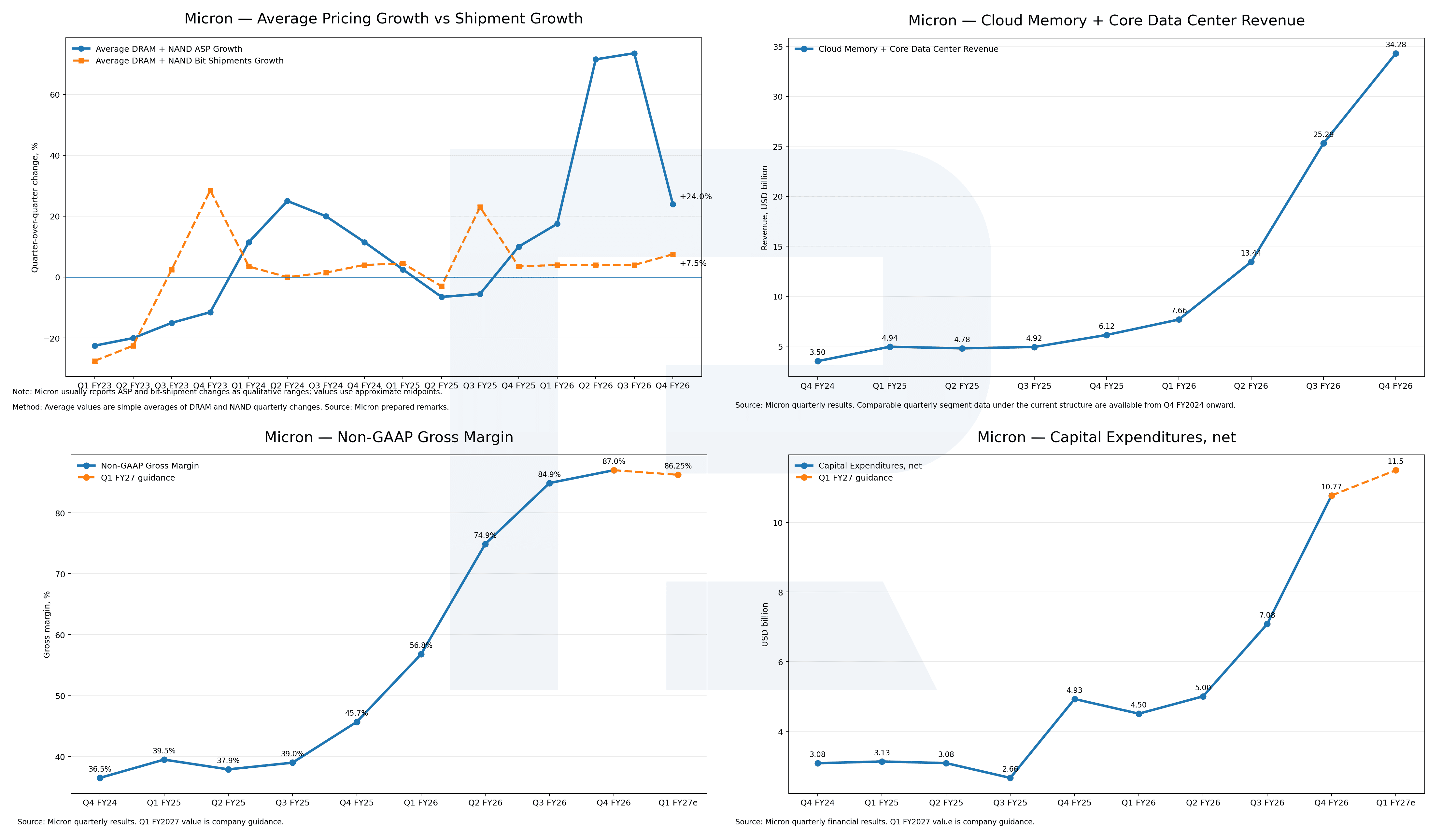
Memory for data centres was the main growth driver. Combined revenue from the Cloud Memory and Core Data Center segments rose from 25.29 billion USD in Q3 to 34.29 billion USD in Q4. Micron also reported that sales of HBM for AI applications grew faster than the company’s overall revenue, while sales of storage products for data centres approached 10 billion USD. Growth was therefore driven by a broader range of server products.
High prices continued to play an important role. During the quarter, average DRAM prices rose 15–20%, while NAND prices increased by around 30%. This helped non-GAAP gross margin rise from 84.9% to 87.0%. However, prices were already rising more slowly than in Q3. If the memory shortage eases, it will be harder for the company to increase earnings at the same pace.
Cash flow also improved. After investing in production, Micron generated 33.20 billion USD in adjusted free cash flow, up from 18.30 billion USD in the previous quarter. In addition, the number of multi-year customer agreements increased to 26. These agreements make future shipments more predictable.
For Q1 2027, Micron forecasts further revenue growth to 61.5 billion USD and adjusted earnings of 38.15 USD per share.
Fundamental analysis of MU and key drivers of Micron Technology stock
In 2026, the investment case for Micron is largely driven by a combination of strong demand for memory used in AI infrastructure and sharp increases in DRAM and NAND prices. For the stock to continue rising, however, it will be important to assess how long the company can maintain high prices and margins while remaining disciplined in expanding production. Four key indicators can be used to assess Micron’s prospects:
- DRAM and NAND Pricing & Shipment Growth
- Cloud Memory + Core Data Center Revenue
- Non-GAAP Gross Margin
- Capital Expenditures
DRAM and NAND Pricing & Shipment Growth shows what is driving changes in Micron’s results – higher memory prices or increased shipment volumes. As long as DRAM and NAND prices rise faster than shipments, Micron can rapidly increase revenue and earnings even without an increase in shipment volumes. However, if ASP growth begins to slow consistently and shipment volumes do not accelerate, this could indicate that the memory shortage is easing and that the current period of exceptionally high profitability is approaching its peak.
Cloud Memory + Core Data Center Revenue shows how quickly demand for Micron’s memory from cloud service providers and data centres is growing. This is particularly important now, as cloud companies and data centre operators require increasing amounts of memory for AI servers, including HBM and server DRAM.
If this business continues to grow faster than the other segments, it would indicate that Micron’s results are supported not only by higher memory prices but also by genuine demand growth from AI infrastructure. This would be a positive sign that the business could continue growing even after memory price increases begin to slow.
Non-GAAP Gross Margin shows how much of Micron’s revenue remains after the main costs of producing memory. This metric has risen significantly in recent quarters, supported by high DRAM and NAND prices and a greater share of more expensive HBM and server memory.
If gross margin remains high, it would indicate that demand continues to exceed supply and that Micron is maintaining a favourable sales mix. However, if memory prices and gross margin both begin to decline, this could indicate that the company’s current period of exceptionally high profitability is coming to an end.
Capital Expenditures shows how much Micron spends on building and expanding production capacity. When memory prices are high, manufacturers have an incentive to increase DRAM and NAND output. However, expanding production too quickly could eventually lead to excess memory supply and lower prices.
It is therefore important to monitor both capital expenditure and how quickly Micron expands production relative to demand. If CAPEX rises sharply while demand begins to slow, this could be an early sign of future oversupply and deteriorating memory prices.
The most favourable scenario for Micron is continued growth in memory prices and data centre revenue, with gross margin staying high and production capacity expanding at a moderate pace. This would indicate that demand remains strong and the company continues to increase earnings without excessively increasing supply.
However, if growth in DRAM and NAND prices and data centre revenue slows, gross margin declines, and Micron simultaneously increases capital expenditure sharply, this could indicate that the current cycle is approaching its peak and that the risk of a decline in MU stock is increasing.
Micron Technology’s current stock performance reflects strong fundamentals and expectations of continued growth in demand for AI memory. However, following the significant rise in the stock price, it is particularly important to watch for signs that the current cycle may be approaching its peak.
Micron’s key indicators suggest the company’s fundamentals remain strong for now. Cloud Memory and Core Data Centre revenue continues to grow rapidly, gross margin remains near record levels, and higher shipment volumes partly offset the slowdown in DRAM and NAND price growth. This means that both high memory prices and genuine demand from data centres and AI infrastructure are supporting the company’s current growth.
At the same time, the rapid increase in capital expenditure is becoming the main risk. For now, Micron is increasing investment in response to strong demand. Over the longer term, however, new production capacity could increase memory supply. If demand growth slows by then, this could put additional pressure on prices and margins.
Overall, Micron’s fundamentals continue to clearly support further business growth. As long as strong demand, rising prices, and high margins persist, the outlook for Micron stock remains favourable. A clear signal to reassess this outlook would be a simultaneous decline in memory prices and gross margin while capital expenditure remains high.
Expert forecasts for Micron Technology, Inc
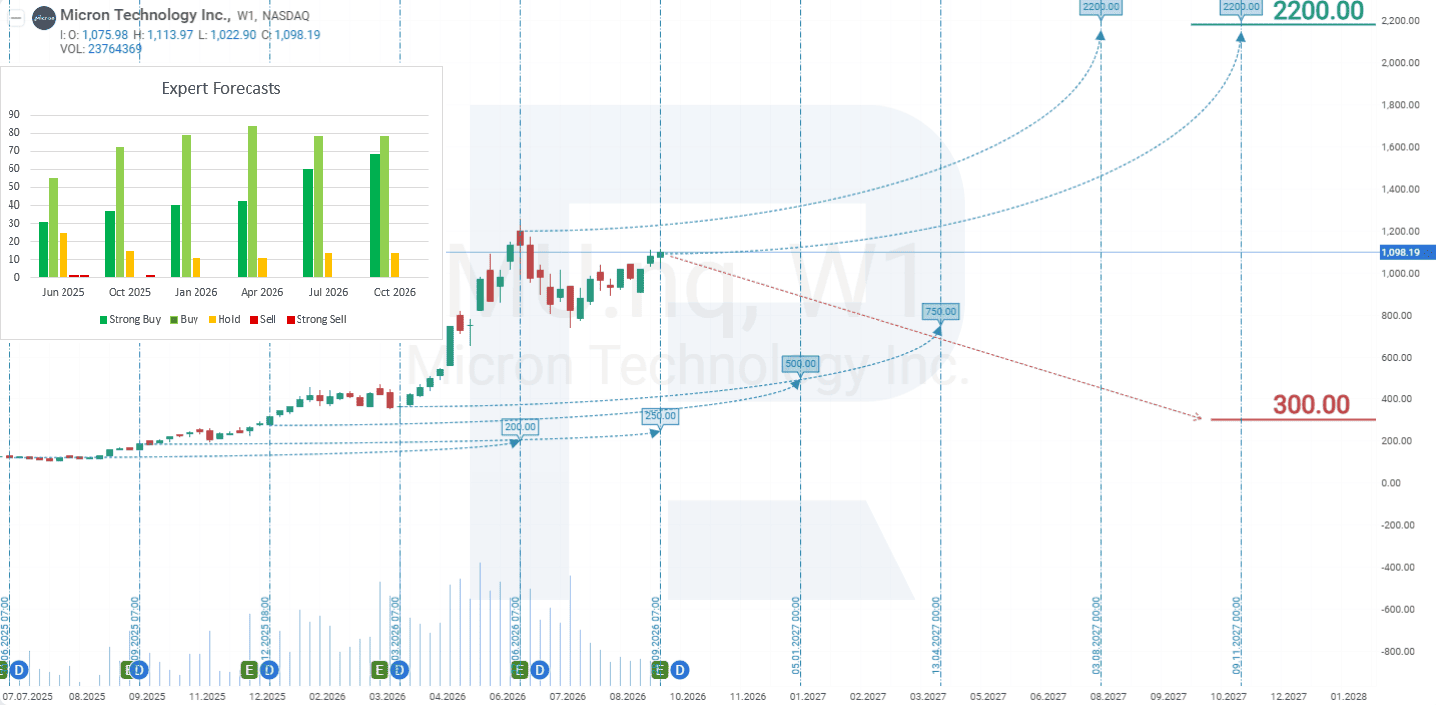
The analyst forecasts below cover a 12-month period. The upper and lower ends of the ranges represent Micron stock price targets over this horizon.
#. Barchart : 32 of 40 analysts rated Micron Technology stock a Strong Buy, 4 a Moderate Buy, and 4 a Hold. The highest price target is 2,000 USD, and the lowest is 852 USD.
#. MarketBeat : 40 of 45 analysts rated the stock a Buy, and 5 a Hold. The highest price target is 2,100 USD, and the lowest is 300 USD.
#. TipRanks : 25 of 26 analysts rated the stock a Buy, and 1 a Hold. The highest price target is 2,200 USD, and the lowest is 1,200 USD.
#. Stock Analysis : 36 of 49 analysts rated the stock a Strong Buy, 9 a Buy, and 4 a Hold. The highest price target is 2,200 USD, and the lowest is 361 USD.
Technical analysis of MU and the outlook for Micron shares in 2026
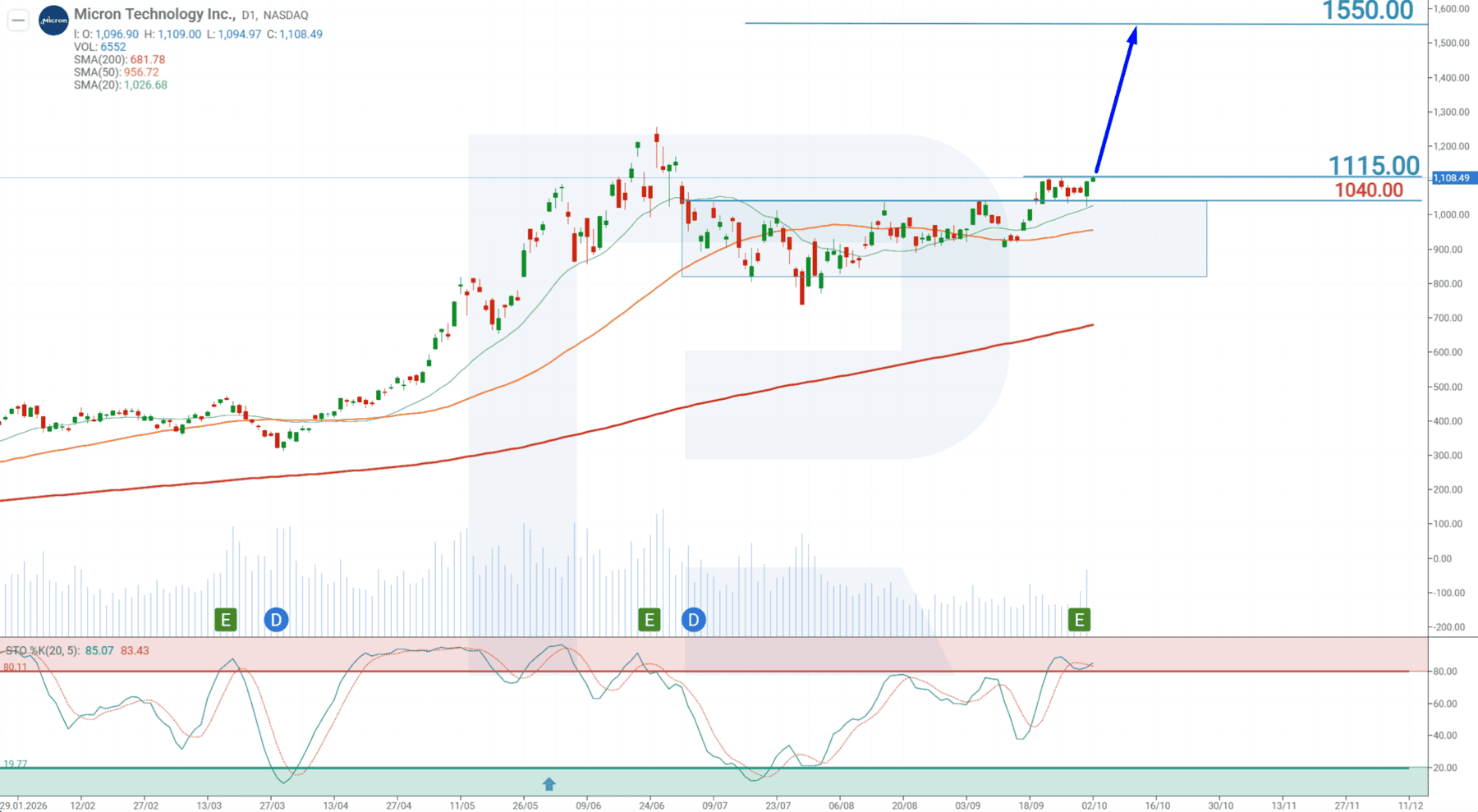
At the time of writing, MU stock is trading at 1,108 USD.
On the daily timeframe, MU stock is trading above the 200-period Moving Average, indicating that the uptrend remains intact. Since July 2026, the price has repeatedly tested resistance around 1,040 USD but has been unable to break above it. In September, the stock broke above this level and consolidated above it, which can be viewed as a signal that the corrective phase has ended, and a new wave of growth is developing within the prevailing uptrend.
Micron’s fundamental analysis also remains favourable for MU stock. Micron’s key indicators do not currently point to any deterioration in the company’s financial position: demand from data centres remains strong, shipment volumes are rising, and gross margin remains near record levels.
The MU stock trade idea therefore involves placing a Buy Stop order at 1,120 USD following a break above the nearest resistance level around 1,115 USD. Take Profit can be set at 1,550 USD – a target calculated using Fibonacci levels. Stop Loss can be placed at 1,015 USD, below the previously broken resistance zone.
Buy Stop - 1120.00
Take Profit - 1550.00
Stop Loss - 1015.00
Position management rule. Once the price moves 70% of the total distance towards the forecast target, the Stop Loss is set at the entry level. The protective order is then adjusted as the price advances, maintaining a distance of 10%. Position management continues until the position is closed at either Take Profit or Stop Loss – whichever level is reached first.
Risks of investing in Micron Technology, Inc. stock
Investing in Micron Technology’s stock involves several risks that may adversely impact the company’s income and revenue:
- Memory market cyclicality: the semiconductor industry, particularly the memory segment, is highly cyclical, experiencing periods of fluctuating demand and pricing. A prolonged downturn in segments such as NAND and DRAM could lead to overstocking, falling prices, and reduced profitability.
- Intense competition in the industry: Micron faces fierce competition from major players like Samsung Electronics and SK Hynix. Constant investment in technology and innovation is vital in such a highly competitive environment. If the company fails to keep pace with industry developments, it may lose market share, leading to lower profitability.
- Geopolitical tensions and trade restrictions: Micron operates in the global market, generating significant revenue outside the US. Geopolitical tensions, trade disputes, and cybersecurity compliance checks may restrain sales and operations. For example, Micron’s products have been scrutinised in China, highlighting the risks tied to international markets.
Investors must carefully consider these risks when evaluating an investment in Micron Technology, as they could significantly impact the company’s financial performance and stock price.
Ang mga pagtataya na ipinakita sa seksyong ito ay nagpapakita lamang ng pribadong opinyon ng may-akda at hindi dapat ituring bilang gabay para sa pagtetrade. Walang pananagutan ang RoboForex para sa mga resulta ng pagtetrade batay sa mga rekomendasyon sa pagtetrade na inilarawan sa mga analytical review na ito.