
Microsoft stock forecast: MSFT shares are poised for a new rally as AI investment begins to pay off
Microsoft is beginning to reap the rewards of its multi-billion-dollar investment in AI. Accelerating Azure growth and the expanding adoption of Copilot are creating the conditions for a continued rally in MSFT stock towards 550 USD and beyond.
Microsoft Corporation (NASDAQ: MSFT) reported stronger-than-expected results for Q4 2026. During the quarter, the company's revenue increased by 18% to 90.0 billion USD, net income rose by 31% to 35.8 billion USD, while its core cloud business, Azure, delivered 43% growth, exceeding management's guidance. Another positive development was the rapid adoption of Microsoft 365 Copilot, with the number of paid licences surpassing 30 million.
Despite record capital expenditure of 41 billion USD, Microsoft continues to generate strong cash flow and expects Azure growth to accelerate to 45% in Q1 2027.
The strong results and guidance eased market concerns about the return on Microsoft's large-scale AI investment, triggering a sharp rise in MSFT shares following the earnings release.
This article examines Microsoft Corporation, provides a fundamental analysis of Microsoft Corporation's financial results, reviews the performance of MSFT stock through technical analysis, and presents a forecast for Microsoft stock for 2026.
About Microsoft Corporation
Microsoft Corporation is one of the world’s largest technology companies, specialising in software development, computer hardware, cloud services, and other technologies. The company was founded on 4 April 1975 by Bill Gates and Paul Allen. Microsoft is renowned for its flagship products, including the Windows operating system, the Microsoft Office suite, the Bing search engine, the Azure cloud platform, Xbox gaming consoles, and various other innovations. It is actively expanding its initiatives in artificial intelligence, corporate solutions, and software development. Microsoft’s initial public offering (IPO) took place on 13 March 1986, when its shares were listed on the NASDAQ under the ticker MSFT. Today, Microsoft holds a leading position in the global technology industry.

Microsoft Corporation Q1 2025 financial results
Microsoft released its Q1 2025 financial results on 30 October 2024. Below are the key figures:
- Revenue: 65.6 billion USD (+16%)
- Net income: 24.7 billion USD (+10%)
- Earnings per share: 3.3 USD (+10%)
- Operating profit: 30.6 billion USD (+13%)
Revenue by segment:
- Productivity and Business Processes: 28.3 billion USD (+12%)
- Intelligent Cloud: 24.1 billion USD (+20%)
- More Personal Computing: 13.2 billion USD (+16%)
Microsoft’s management expressed a positive outlook on the Q1 fiscal 2025 results. Chairman and CEO Satya Nadella highlighted the company’s focus on AI transformation and its impact on business operations and workflows. Overall, AI revenue is on track to exceed 10.0 billion USD in annual revenue next quarter, marking the fastest growth in Microsoft’s history. He also noted that the company continues to expand its capabilities and attract new clients, enabling them to leverage AI platforms and tools for business development.
Looking ahead to Q2 fiscal 2025, Microsoft projected the trends observed in the previous quarter to continue. Robust growth was expected from commercial clients driven by long-term contracts, alongside a projected increase in capital expenditure on AI.
Microsoft Corporation Q2 2025 financial results
On 29 January 2025, Microsoft published its financial results for Q2 2025. The key figures are presented below:
- Revenue: 69.6 billion USD (+12%)
- Net income: 24.1 billion USD (+10%)
- Earnings per share: 3.2 USD (+10%)
- Operating profit: 31.7 billion USD (+17%)
Revenue by segment:
- Productivity and Business Processes: 29.3 billion USD (+14%)
- Intelligent Cloud: 25.5 billion USD (+19%)
- More Personal Computing: 14.6 billion USD (unchanged)
Investors were particularly interested in management's response to DeepSeek, whose rapid rise was reshaping the AI landscape. Satya Nadella addressed the impact of the company's recent advances in artificial intelligence, stating that although DeepSeek's innovations were noteworthy, Microsoft remained focused on developing comprehensive AI solutions that integrate seamlessly into its cloud and productivity services.
Chief Financial Officer Amy Hood emphasised that capital expenditure on AI remained strategically justified and was primarily directed towards expanding data centres for AI model training and cloud infrastructure. At the same time, she stressed that Microsoft would continue to manage costs carefully while maintaining operational efficiency.
Overall, Microsoft reaffirmed its confidence in its AI strategy despite intensifying competition. However, investors reacted negatively due to concerns about slower Azure growth and higher capital expenditure.
Microsoft Corporation Q3 2025 financial results
On 30 April 2025, Microsoft published its Q3 2025 financial results for the quarter ended 31 March. The key figures are presented below, compared with the corresponding period of the 2024 financial year:
- Revenue: 70.1 billion USD (+13%)
- Net income: 25.8 billion USD (+18%)
- Earnings per share: 3.46 USD (+18%)
- Operating profit: 32.0 billion USD (+16%)
Revenue by segment:
- Productivity and Business Processes: 29.9 billion USD (+10%)
- Intelligent Cloud: 26.8 billion USD (+21%)
- More Personal Computing: 13.4 billion USD (+6%)
Microsoft's Q3 2025 results exceeded market expectations and reaffirmed the company's strong position in cloud computing and artificial intelligence. The main growth driver was Azure, whose revenue increased by 35% year-on-year, with AI services contributing 16 percentage points of that growth.
Satya Nadella stated that Microsoft's AI business could soon generate annual revenue of 10 billion USD. Microsoft 365 Copilot also continued to see rapid adoption, with approximately 70% of Fortune 500 companies using the platform.
Total revenue increased by 16%, while net income rose by 18%. Following the earnings release, Microsoft shares rose by more than 10%, marking one of their strongest post-results reactions in recent years. Investment banks also raised their price targets, citing the growth prospects for Azure and generative AI.
For the following quarter, Microsoft expected Azure growth of 31–32% at constant currency. Chief Financial Officer Amy Hood noted that further acceleration would be supported by continued investment in AI infrastructure.
At the same time, investors needed to consider the stock's premium valuation. A forward P/E of around 33x and a free cash flow yield below 2.5% indicated that the stock was trading at a premium valuation. Additional risks included competition from Alphabet and Amazon, as well as potential antitrust pressure.
Overall, Microsoft continued to demonstrate the strength of its core business, Azure's rapid growth, and the successful scaling of its AI products. For long-term investors, Microsoft stock remained an attractive investment opportunity, albeit at a premium valuation.
Microsoft Corporation Q4 2025 financial results
On 30 July 2025, Microsoft published its Q4 2025 financial results for the quarter ended on 30 June. The key figures are outlined below, compared to the same period in the 2024 financial year:
- Revenue: 76.4 billion USD (+18%)
- Net income: 27.3 billion USD (+24%)
- Earnings per share: 3.65 USD (+24%)
- Operating profit: 34.3 billion USD (+23%)
Revenue by segment:
- Productivity and Business Processes: 33.1 billion USD (+16%)
- Intelligent Cloud: 29.9 billion USD (+26%)
- More Personal Computing: 13.5 billion USD (+9%)
In Q4 2025, Microsoft returned 9.4 billion USD to shareholders through dividends and share repurchases.
On a full-year basis, revenue reached 281.7 billion USD (+15%), operating profit totalled 128.5 billion USD (+17%), net income was 101.8 billion USD (+16%), and EPS stood at 13.64 USD (+16%).
The forecast for Q1 2026 anticipated strong growth in revenue and profit driven by Azure, Copilot, and enterprise AI solutions. It was projected that capital expenditure could reach a record 30 billion USD, required for expanding AI infrastructure across the US and Europe. Over the longer term, Microsoft envisaged a shift in revenue composition towards high-margin AI software and enterprise solutions. The forecast also projected growth in Microsoft 365 subscriptions, LinkedIn’s user base, and advertising revenue, fuelled by AI integration. Synergy with GPT models remained a key strategic asset.
Microsoft’s management emphasised continued expansion of its cloud business and strengthening of its AI position. Satya Nadella stated that cloud technologies and AI are the key drivers of digital transformation, with Azure becoming the platform for the next phase of business development, surpassing 75 billion USD in annual revenue (+34%). The active adoption of Copilot and OpenAI models is strengthening customer retention and increasing average spend.
Chief Financial Officer Amy Hood highlighted a 37% increase in commercial bookings and a rise in long-term contracts. High capital investment in AI infrastructure will continue, exerting pressure on margins but laying the groundwork for future growth.
Microsoft Corporation Q1 2026 financial results
On 29 October 2025, Microsoft published its Q1 2026 financial results for the quarter ended 30 September. The key figures are presented below, compared with the corresponding period of the 2025 financial year:
- Revenue: 77.7 billion USD (+18%)
- Net income: 30.8 billion USD (+22%)
- Earnings per share: 4.13 USD (+23%)
- Operating profit: 38.0 billion USD (+24%)
Revenue by segment:
- Productivity and Business Processes: 33.0 billion USD (+17%)
- Intelligent Cloud: 30.9 billion USD (+28%)
- More Personal Computing: 13.8 billion USD (+4%)
Microsoft began the 2026 financial year with strong Q1 results. Revenue increased by 18% year-on-year, operating profit rose by 24%, while non-GAAP earnings per share, excluding losses related to OpenAI, reached 4.13 USD. The main growth driver remained Microsoft Cloud: cloud revenue increased by 26%, Azure and other cloud services grew by 40%, while commercial remaining performance obligation (RPO) increased to 392 billion USD.
Growth was evident across all key business segments. Productivity and Business Processes increased revenue by 17%, driven by Microsoft 365 and Dynamics 365; Intelligent Cloud grew by 28%, while More Personal Computing recorded 4% growth. The gross margin remained high at approximately 69%, while the operating margin expanded to 49% thanks to the continued scaling of Microsoft's cloud and software businesses.
Microsoft continued to integrate AI across its business. According to management, approximately 900 million users per month used AI-powered features; more than 150 million people used Copilot each month, while Microsoft 365 Copilot, GitHub Copilot, and new AI agents continued to drive AI adoption across productivity software, software development, cybersecurity, and other areas.
Capital expenditure increased to a record 34.9 billion USD driven by GPU purchases and the construction of data centres. At the same time, Microsoft generated 45.1 billion USD in operating cash flow. It maintained a strong balance sheet, with approximately 102 billion USD in cash and short-term investments compared with 43 billion USD in debt. This enabled the company to finance its AI investment, continue its share buyback program, and pay dividends.
For Q2 2026, Microsoft expected revenue of 79.5–80.6 billion USD, representing year-on-year growth of 14–16%. Productivity and Business Processes was expected to generate 33.3–33.6 billion USD, Intelligent Cloud 32.25–32.55 billion USD, and More Personal Computing 13.95–14.45 billion USD. Management also noted that demand for cloud capacity continued to outpace supply.
Microsoft Corporation Q2 2026 financial results
On 28 January 2026, Microsoft released its Q2 2026 financial results for the quarter ended 30 December. Below are the key figures compared to the same period in the 2025 financial year:
- Revenue: 81.3 billion USD (+17%)
- Net income (non-GAAP): 30.9 billion USD (+23%)
- Earnings per share: 4.14 USD (+24%)
- Operating profit: 38.3 billion USD (+21%)
Revenue by segment:
- Productivity and Business Processes: 34.1 billion USD (+16%)
- Intelligent Cloud: 32.9 billion USD (+29%)
- More Personal Computing: 14.3 billion USD (–3%)
Microsoft Corporation’s Q2 2026 financial report exceeded analysts’ expectations across key financial metrics: revenue reached 81.3 billion USD, surpassing forecasts (around 80.2–80.3 billion USD), and earnings per share of 4.14 USD also exceeded consensus estimates (around 3.92–3.93 USD). The 17% year-on-year revenue growth was primarily driven by strong contributions from cloud services and AI integration, with the Intelligent Cloud segment growing by 29%, and Azure and related cloud services revenue increasing by 39% – the key driver behind the company’s accelerating growth.
During this quarter, the company saw a significant rise in expenses, particularly capital expenditures (CapEx), which reached a record level of 37.5 billion USD (+66% year-on-year), driven by infrastructure investment in AI and data centre expansion. Operating and R&D expenses also increased, though operating costs rose more moderately, which helped improve margins in high-margin areas.
Microsoft management expects total revenue for Q3 2026 to be in the range of 80.65–81.75 billion USD (+15–17% year-on-year). Revenue from the Productivity and Business Processes segment is expected to be in the range of 34.25–34.55 billion USD (+14–15% year-on-year), from Intelligent Cloud 34.10–34.40 billion USD (+27–28% year-on-year), and from More Personal Computing 12.3–12.8 billion USD (–9–5% year-on-year).
The quarter showed mixed results across the divisions: Productivity and Business Processes and Intelligent Cloud remained strong growth drivers, while More Personal Computing declined, partly due to a fall in gaming and hardware sales. However, efforts to diversify revenue streams (such as the growth in advertising and cloud subscriptions) helped offset this decline.
Microsoft Corporation Q3 2026 financial results
On 29 April 2026, Microsoft published its Q3 2026 financial results for the quarter ended 31 March 2026. The key figures are presented below, compared with the corresponding period of the previous financial year:
- Revenue: 82.88 billion USD (+18%)
- Net income (non-GAAP): 31.79 billion USD (+20%)
- Earnings per share: 4.27 USD (+20%)
- Operating profit: 38.40 billion USD (+20%)
Revenue by segment:
- Productivity and Business Processes: 35.01 billion USD (+17%)
- Intelligent Cloud: 34.68 billion USD (+30%)
- More Personal Computing: 13.19 billion USD (–1%)
Microsoft's Q3 2026 results exceeded market expectations. The company outperformed its own guidance for revenue, operating profit, and earnings per share, while the cloud business and AI products once again were the company’s primary growth drivers. Microsoft Cloud revenue increased to 54.5 billion USD, while Azure and related cloud services grew by 40% year-on-year.
Growth remained broad-based across Microsoft's key businesses. Productivity and Business Processes increased revenue by 17%, Intelligent Cloud by 30%, LinkedIn by 12%, and Dynamics 365 by 22%. At the same time, investment in AI infrastructure continued to rise, with capital expenditure reaching 31.9 billion USD. Operating cash flow totalled 46.7 billion USD, while free cash flow reached 15.8 billion USD.
Overall, the quarter confirmed Microsoft's resilient growth, with the cloud business and AI continuing to serve as its primary growth drivers. For Q4 2026, Microsoft expected revenue of 86.7–87.8 billion USD and Azure growth of 39–40% at constant currency. However, capacity constraints were expected to persist until at least the end of 2026.
Microsoft Corporation Q4 2026 financial results
On 29 July 2026, Microsoft published its Q4 2026 financial results for the quarter ended 30 June 2026. The key figures are presented below, compared with the corresponding period of the previous financial year:
- Revenue: 90.01 billion USD (+18%)
- Net income (non-GAAP): 35.29 billion USD (+22%)
- Earnings per share: 4.74 USD (+23%)
- Operating profit: 40.60 billion USD (+18%)
Revenue by segment:
- Productivity and Business Processes: 37.85 billion USD (+14%)
- Intelligent Cloud: 39.31 billion USD (+32%)
- More Personal Computing: 12.85 billion USD (–4%)
Microsoft reported strong Q4 2026 results, exceeding both its own guidance and market expectations. The results came in well above the company's guidance issued following its Q3 2026 results. Microsoft had expected revenue of 86.7–87.8 billion USD, while the reported figure exceeded the upper end of the guidance range by more than 2 billion USD. The cloud business once again remained Microsoft's primary growth driver.
Revenue from Azure and other cloud services increased by 43%, exceeding the company's guidance of 39–40%. Moreover, Microsoft expects Azure growth of approximately 45% at constant currency in Q1 2027. This is one of the most important signals for investors in MSFT stock, as it demonstrates that demand for cloud computing and AI infrastructure remains exceptionally strong despite the company's large-scale infrastructure expansion.
For the 2026 financial year, Azure revenue exceeded 100 billion USD for the first time, while quarterly Microsoft Cloud revenue reached 59.3 billion USD, up 27%. Demand continues to exceed available computing capacity, allowing newly deployed data centres and servers to contribute to cloud revenue growth almost immediately.
Microsoft 365 Copilot also continued to gain traction. The number of paid licences exceeded 30 million, compared with more than 20 million in the previous quarter. The number of large customers with more than 50,000 licences increased more than sevenfold year-on-year. This confirms that Microsoft is gradually transforming artificial intelligence from a major cost centre into a meaningful source of revenue.
Another positive signal was Microsoft's commercial remaining performance obligation (RPO), which increased by 84% to 678 billion USD. Even excluding OpenAI, the figure increased by 25%. Such a substantial backlog of contracted business provides greater visibility into Microsoft's future cloud revenue growth.
At the same time, the company's largest challenge remains its substantial investment in AI infrastructure. Capital expenditure reached 41 billion USD in Q4, compared with 31.9 billion USD in the previous quarter. Approximately two-thirds of this investment was allocated to CPUs, GPUs, and other assets with relatively short, useful lives. Nevertheless, operating cash flow increased by 30% to 55.4 billion USD, while free cash flow reached 19.6 billion USD. This demonstrates that Microsoft remains capable of funding its rapidly expanding AI investment program through its own cash generation.
The lower guidance for calendar-year 2026 capital expenditure from 190 billion USD to 175 billion USD does not indicate a reduction in the company's underlying investment program. Instead, the revision primarily reflects a new approach to the classification of data centre leases. Microsoft continues to expand its computing capacity and expects infrastructure investment to increase further during the 2027 financial year.
Microsoft's guidance also remained strong. For Q1 2027, the company expects revenue of 89.85–90.95 billion USD, representing year-on-year growth of 16–17%. Intelligent Cloud revenue is expected to reach 40.95–41.25 billion USD, while Azure is forecast to grow by 45% at constant currency. Microsoft also expects double-digit growth in both revenue and operating profit for the 2027 financial year.
Investors reacted positively to Microsoft's results. Following the earnings release, MSFT shares rose sharply as Azure's strong growth and the company's optimistic guidance eased concerns about the effectiveness of its substantial AI investment. The results confirmed that Microsoft's investment in data centres, GPUs, and AI infrastructure is already supporting faster growth in its cloud business.
Key growth drivers for Microsoft stock in 2026
In 2026, Microsoft's investment thesis is centred on how successfully the company can translate its substantial investment in artificial intelligence and data centres into faster growth in its cloud business and stronger cash flow generation. Therefore, following the release of future earnings reports, investors should pay particular attention to several key indicators:
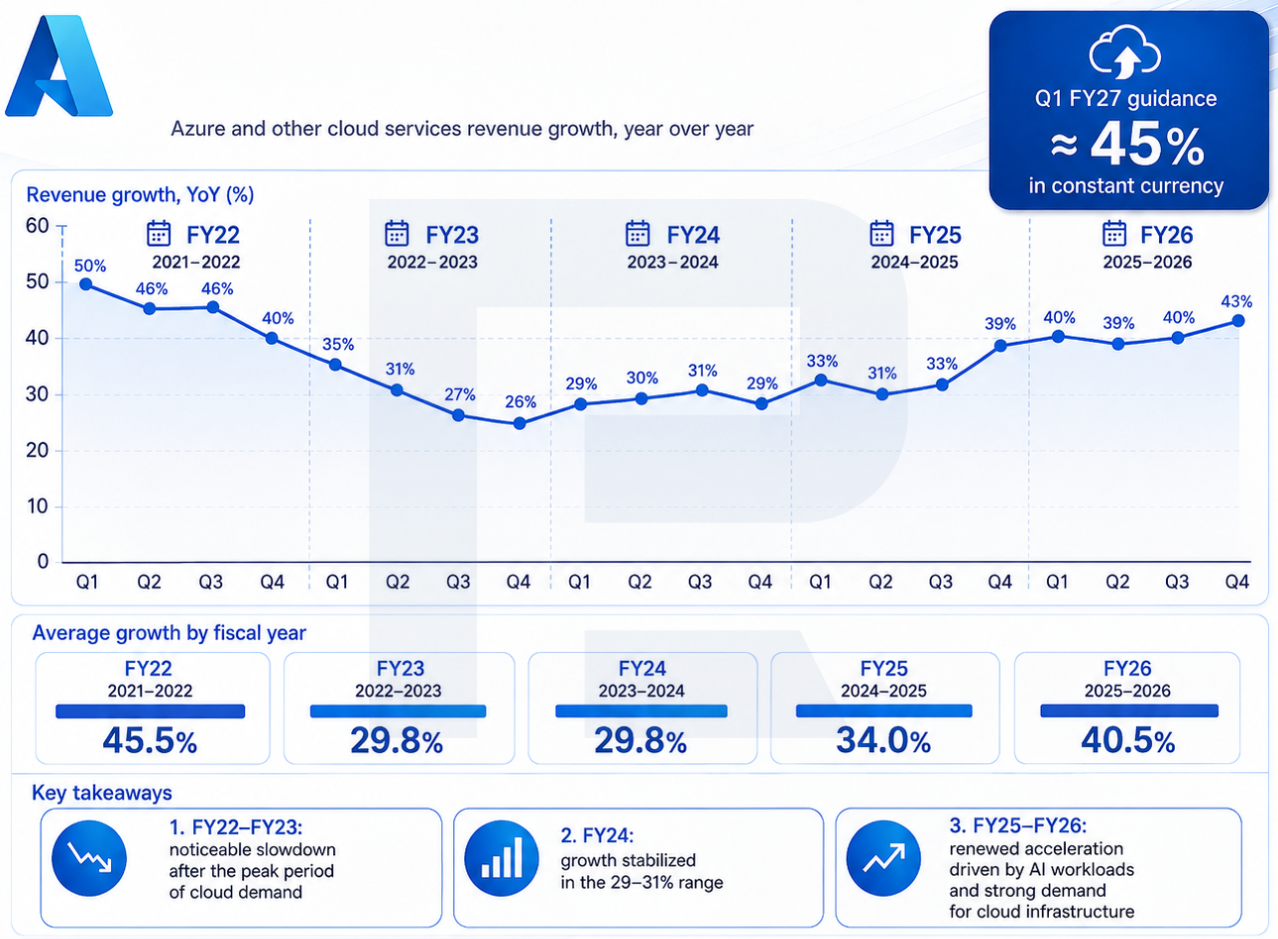
Azure growth. Azure remains Microsoft's primary growth driver in 2026. In Q4 2026, revenue from Azure and other cloud services increased by 43%, accelerating from the previous quarter. At the same time, demand continued to exceed available computing capacity, while newly deployed infrastructure began generating revenue almost immediately. For Q1 2027, management expects Azure growth to accelerate to approximately 45% at constant currency. If Microsoft can sustain Azure growth of around 40–45%, or accelerate it further, this would confirm continued strong demand for cloud and AI services and support further upside in MSFT stock.
Source: Microsoft Quarterly Reports & Earnings Releases
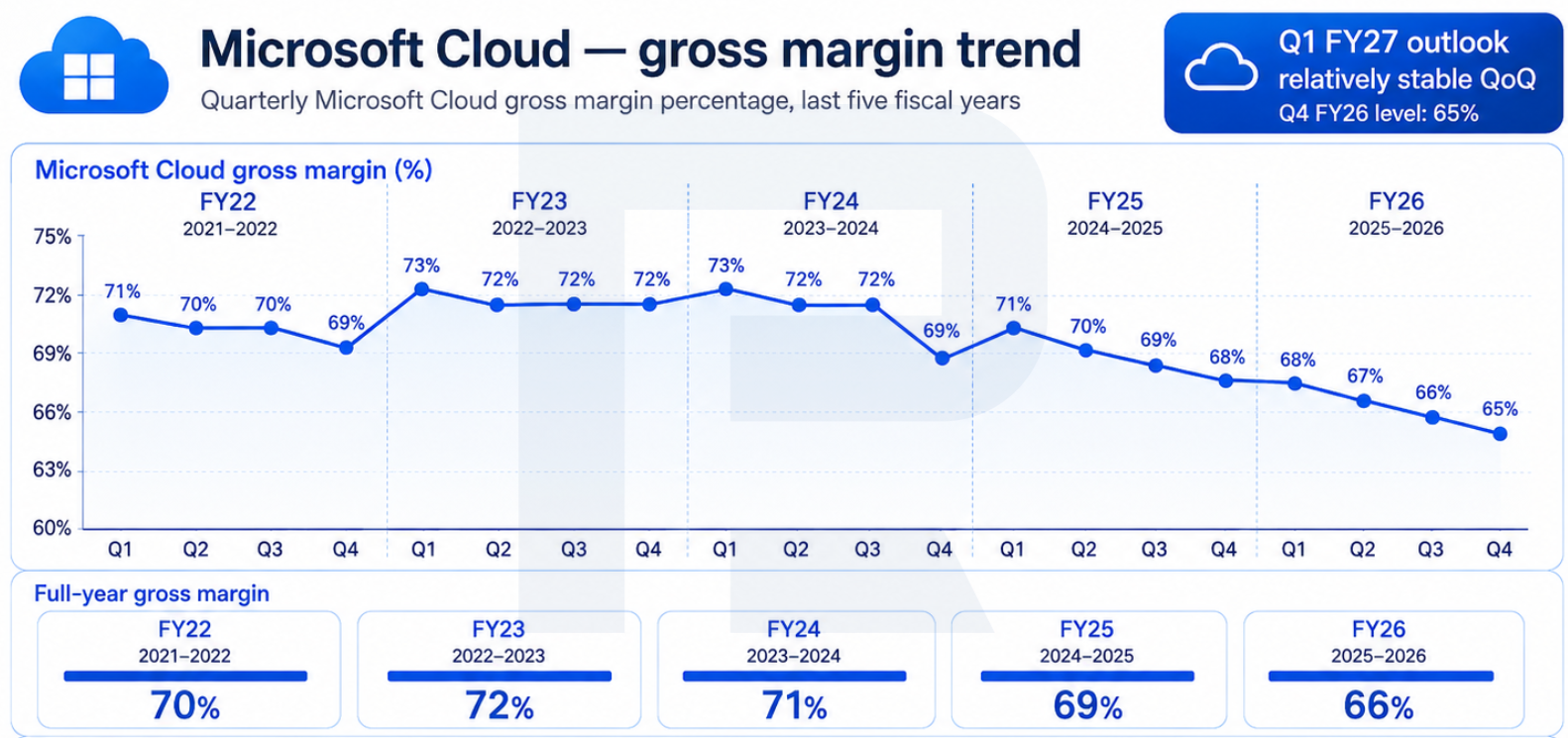
Microsoft Cloud gross margin. In Q4 2026, the gross margin stood at 65%, exceeding the company's own expectations. Management expects the margin to remain stable in the following quarter. This metric is becoming increasingly important due to the high cost of AI infrastructure. If Microsoft can continue expanding AI adoption while maintaining or improving its cloud gross margin, it would indicate that the additional revenue generated by Azure, Microsoft 365 Copilot, and other AI services is sufficient to offset the rising cost of computing infrastructure.
Source: Microsoft Quarterly Reports & Earnings Releases
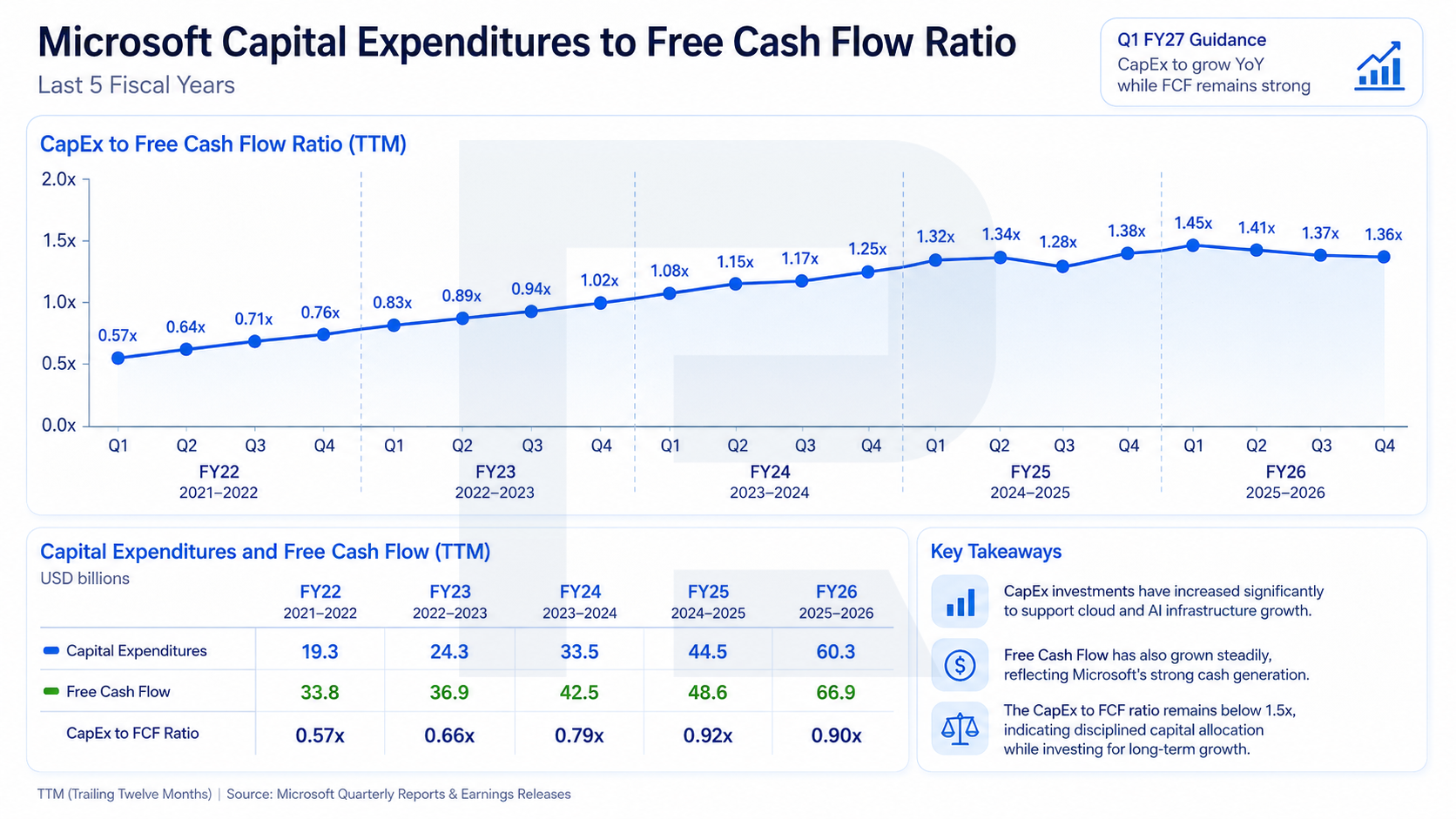
Capital expenditure relative to free cash flow. In Q4 2026, Microsoft's capital expenditure reached 41 billion USD. For Q1 2027, the company expects capital expenditure to exceed 50 billion USD. At the same time, operating cash flow totalled 55.4 billion USD, while free cash flow reached 19.6 billion USD in the latest quarter. As long as Azure continues to grow rapidly, these investments can be viewed as funding Microsoft's future growth. However, if capital expenditure continues to increase while Azure growth begins to slow, the market may start to question the return on Microsoft's AI investment.
Source: Microsoft Quarterly Reports & Earnings Releases
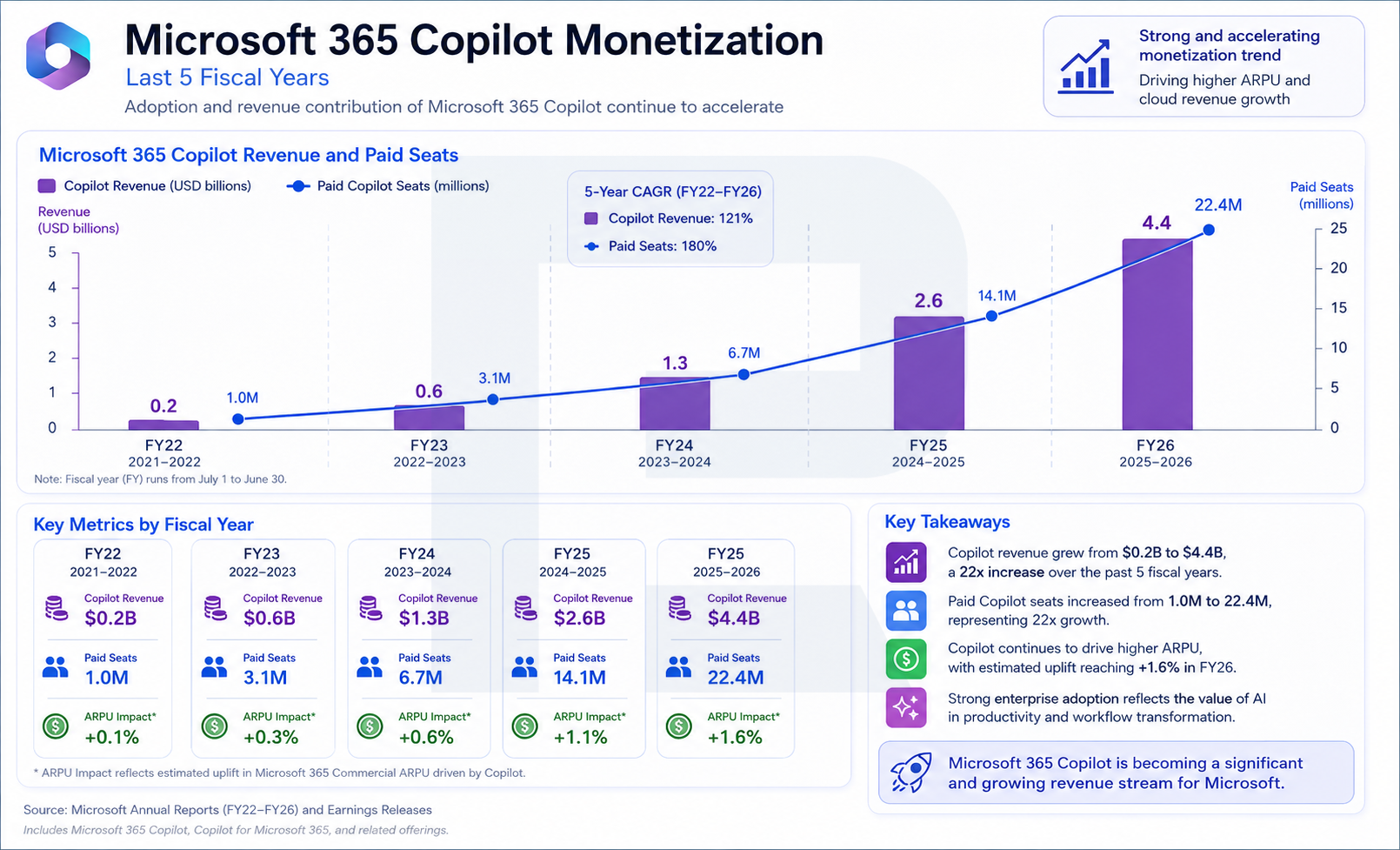
Monetisation of Microsoft 365 Copilot. The monetisation of Microsoft 365 Copilot is gradually becoming an increasingly important growth driver. The number of paid Copilot licences has already exceeded 30 million, while the number of customers with more than 50,000 licences has increased more than sevenfold year-on-year. Microsoft also noted that Copilot, together with its premium Microsoft 365 E5 and E7 offerings, is helping to increase the average revenue per Microsoft 365 user. The successful rollout of Copilot across Microsoft's existing Microsoft 365 customer base could become another source of high-margin revenue. Therefore, faster growth in paid licences and higher average revenue per customer would be a positive signal for MSFT stock.
Source: Microsoft Quarterly Reports & Earnings Releases
Taken together, the key growth drivers discussed above present a positive investment case for Microsoft, although the company's growth is becoming significantly more capital-intensive. The strongest signal supporting further upside in MSFT stock is the renewed acceleration in Azure. After slowing to 26% in the 2023 financial year, Azure growth recovered to 43% in Q4 2026, while Microsoft's guidance for Q1 2027 points to approximately 45% growth, indicating that demand for cloud computing and AI infrastructure remains exceptionally strong.
At the same time, the monetisation of Microsoft 365 Copilot continues to accelerate. The number of paid licences and the product's contribution to average revenue per user are both increasing rapidly, creating another growth driver alongside Azure.
The main weakness in Microsoft's investment case is the deteriorating economics of its cloud infrastructure. Microsoft Cloud gross margin has declined steadily from a peak of 73% to 65% in Q4 2026, while capital expenditure has increased sharply.
For now, Microsoft's free cash flow remains sufficient to fund these investments internally, while Azure's accelerating growth suggests that they are already generating returns. As a result, these growth drivers continue to support further upside in MSFT stock, although the balance between investment and profitability is becoming increasingly delicate.
The main warning signs to monitor in future earnings reports are:
Slowing Azure growth
A further decline in Microsoft Cloud gross margin
Persistently high capital expenditure growth
Such a combination would call into question the return on Microsoft's AI investment and could trigger a downward revaluation of MSFT stock.
Expert forecasts for Microsoft Corporation stock in 2026
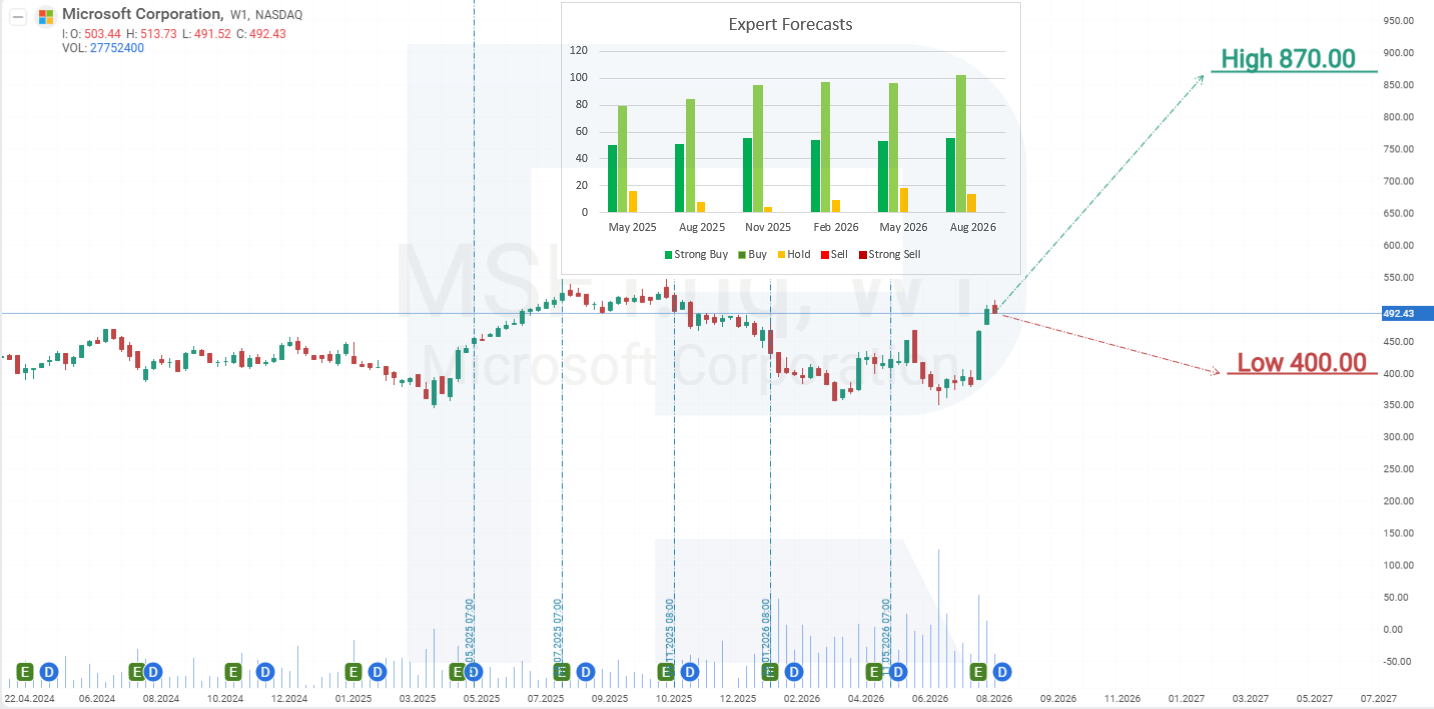
- Barchart: 41 of 51 analysts rate Microsoft stock as Strong Buy, 6 as Moderate Buy, and 4 as Hold. The highest price target is 690 USD, while the lowest is 400 USD.
- MarketBeat: 42 of 47 analysts rate the stock as Buy, and 5 as Hold. The highest price target is 870 USD, while the lowest is 400 USD.
- TipRanks: 33 of 35 analysts rate the stock as Buy, and 2 as Hold. The highest price target is 680 USD, while the lowest is 400 USD.
- Stock Analysis: 14 of 38 analysts rate Microsoft stock as Strong Buy, 21 as Buy, and 3 as Hold. The highest price target is 680 USD, while the lowest is 415 USD.
Analysts' forecasts for Microsoft stock remain strongly bullish. Across all four platforms, the overwhelming majority of analysts recommend buying the stock, while the highest price target is 870 USD. This consensus suggests that the market expects Azure’s growth to continue accelerating and Microsoft to successfully monetise its AI investments. If the cloud business maintains its current growth trajectory, MSFT stock could continue setting new all-time highs. The main risk is that Microsoft's substantial AI investment may no longer deliver an adequate return.
Technical analysis and 2026 forecast for Microsoft Corporation stock
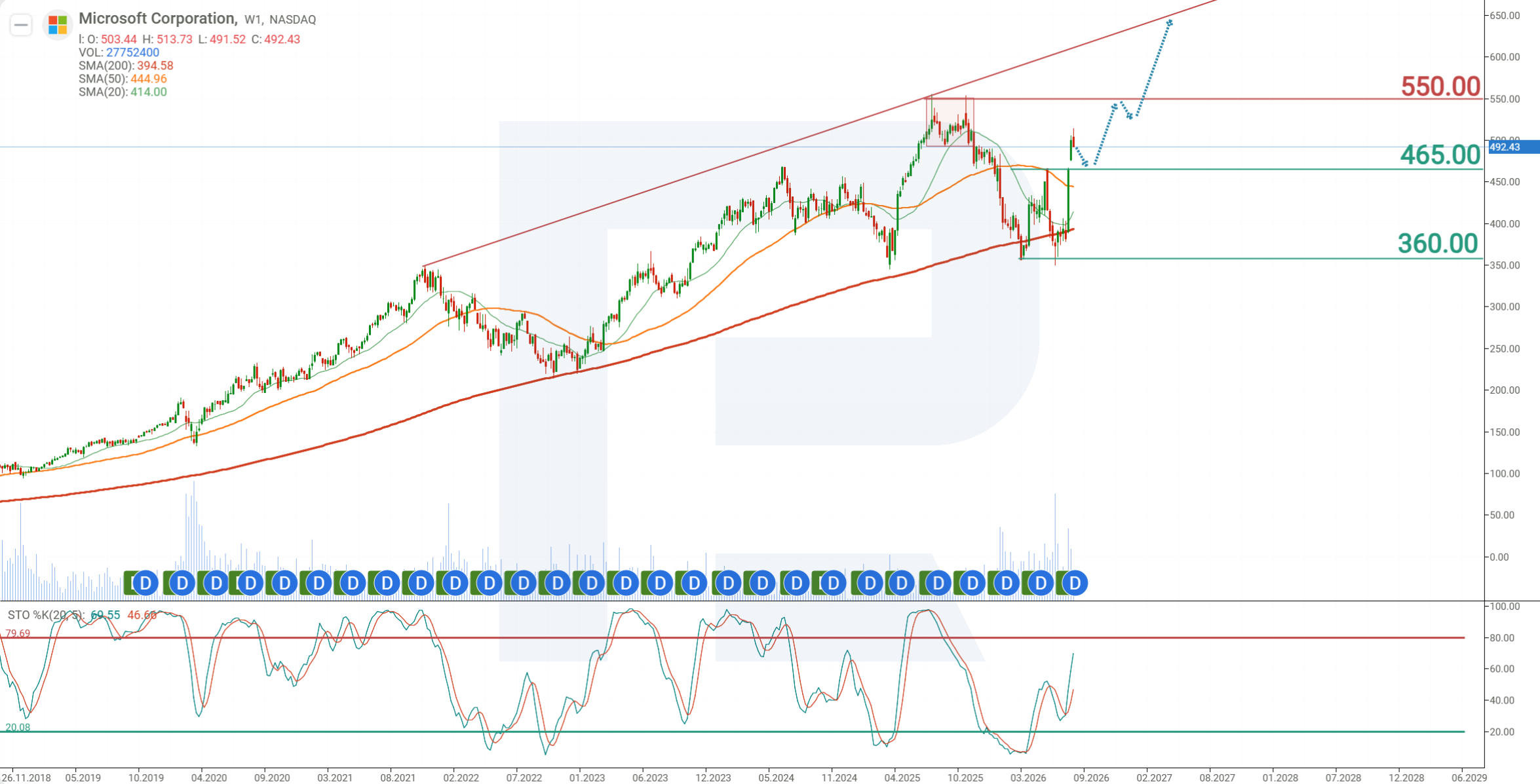
On the weekly chart, Microsoft Corporation stock continues to trade above the 200-period Moving Average, indicating that the prevailing uptrend remains intact. The Stochastic indicator has moved out of oversold territory and is now in the neutral zone. This suggests that the recent correction may have come to an end and that MSFT stock could resume its upward trend. Following the publication of its Q4 2026 results, MSFT shares rose sharply and broke above resistance at 465 USD. After such a strong advance, the stock may retrace to this level, which now serves as support, before continuing higher. Based on the current Microsoft Corporation stock performance, the following scenarios outline its potential movement in 2026:
The primary forecast for Microsoft Corporation stock suggests a retest of support at 465 USD, followed by a rebound and an advance towards the previous all-time high near 550 USD. A breakout above this level, followed by a sustained move higher, could act as a catalyst for a further advance in MSFT stock towards resistance at 650 USD.
A decline below 400 USD, accompanied by a break below the 200-period Moving Average, would invalidate the primary bullish scenario and significantly increase the likelihood of a deeper correction.
Position management: Once the stock has moved 8% in the projected direction, the Stop-Loss should be moved to the entry level. The protective stop should then be trailed 8% behind the price.
Ang mga pagtataya na ipinakita sa seksyong ito ay nagpapakita lamang ng pribadong opinyon ng may-akda at hindi dapat ituring bilang gabay para sa pagtetrade. Walang pananagutan ang RoboForex para sa mga resulta ng pagtetrade batay sa mga rekomendasyon sa pagtetrade na inilarawan sa mga analytical review na ito.