
Super Micro Computer – is SMCI stock a buy now?
Super Micro Computer delivered a strong Q4 and expects further sales growth. We examine the company’s results, expectations for the next earnings report, and the conditions needed for SMCI stock to rise towards 55 USD.
Super Micro Computer, Inc. (NASDAQ: SMCI) reported a significant improvement in profitability in its latest published Q4 2026 financial results. Revenue rose 93% to 11.12 billion USD, net income reached 1.18 billion USD, and gross margin increased to 17.5%.
For Q1 2027, revenue is expected to reach 14.5–15.5 billion USD, representing an increase of 189–209% compared with the same period a year earlier, when sales stood at 5.02 billion USD. The non-GAAP gross margin is forecast at 10.4–10.8%, compared with 9.5% a year earlier – an increase of 0.9–1.3 percentage points. However, compared with the previous quarter, the margin is expected to decline from 17.6%. It will therefore be important to assess whether the company can fulfil its large orders and translate sales growth into positive cash flow.
This article provides a Super Micro Computer stock analysis, combining fundamental analysis of SMCI with an assessment of the price chart. It examines the company’s revenue sources, recent quarterly results, key drivers and risks, expectations for the next earnings report, analyst forecasts, and the outlook for Super Micro Computer stock in 2026.
About Super Micro Computer, Inc.
Super Micro Computer was founded in 1993 by Charles Liang. The company designs and manufactures server hardware, including motherboards, servers, data storage solutions, GPU systems, and other computing technologies. Proprietary manufacturing facilities in the Netherlands, the US, and Taiwan allow it to tailor its products to the specific demands of different markets.
Super Micro employs a modular approach to deliver customised solutions for data centres, cloud services, and enterprise clients. The company went public on 29 March 2007, listing on the NASDAQ under the ticker SMCI.
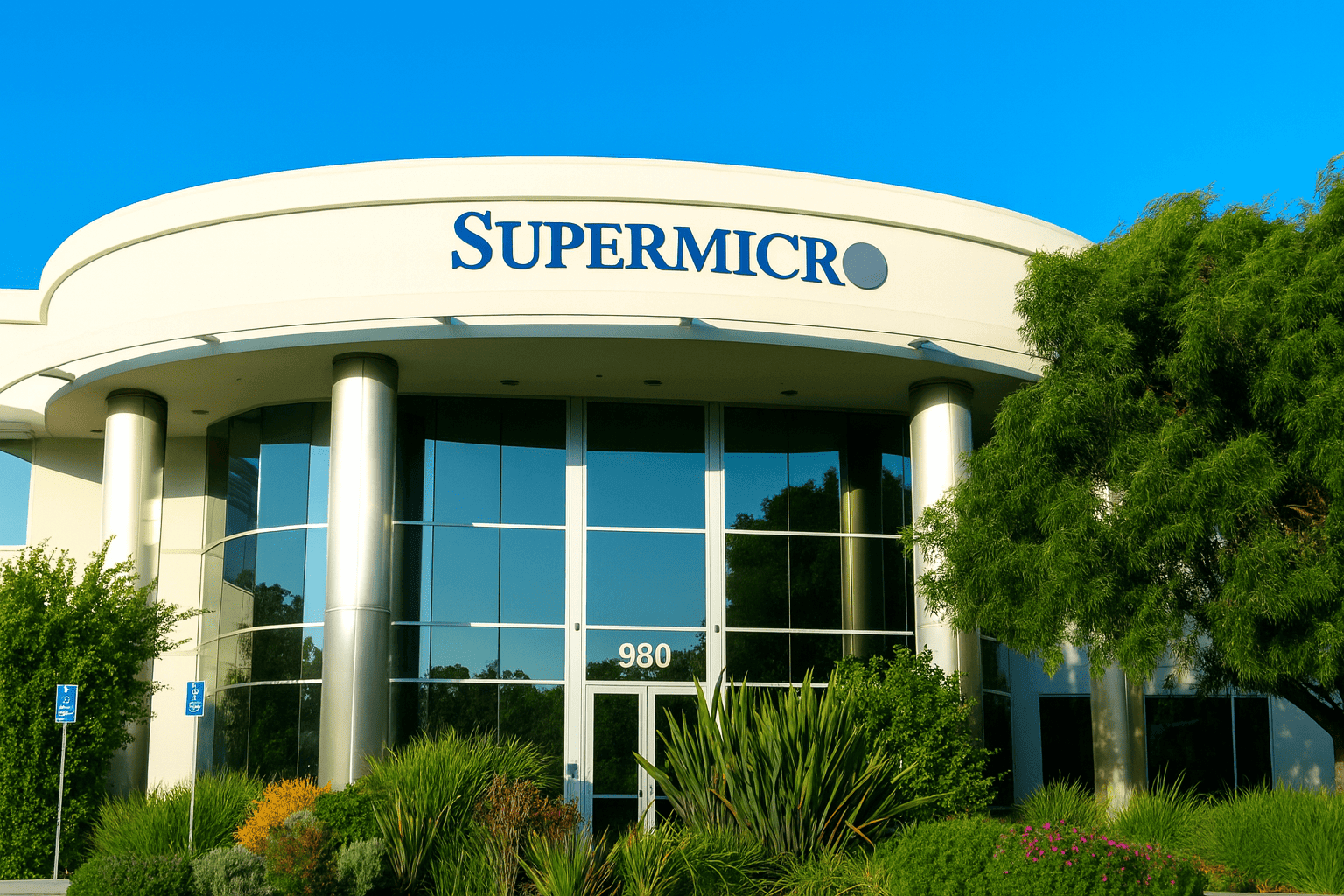
Super Micro Computer’s main revenue sources
Super Micro Computer generates revenue from the following sources:
- Server systems – the largest revenue segment, which includes:
- Rackmount servers – high-performance servers designed for data centres, cloud computing, and AI workloads.
- GPU-optimised systems – servers built for artificial intelligence (AI), machine learning, and deep learning applications.
- Blade and multi-module servers – high-density solutions for enterprises and hyperscale environments.
- Data storage systems – this segment includes all-flash and hybrid storage solutions, as well as software-defined storage (SDS) architectures.
- Embedded and IoT systems – encompasses revenue from industrial and edge computing products, including IoT and edge servers used in smart cities, automation, and real-time data processing. It also includes industrial computing solutions for healthcare, telecommunications, and manufacturing.
- Networking and power technologies – this segment comprises:
- High-performance networking equipment – Ethernet switches, network adapters, and interconnects for data centres.
- Power supply units (PSUs) and cooling systems – modular, energy-efficient, and redundant power supplies, along with air and liquid cooling solutions.
- Components and accessories – revenue from individual hardware components, such as motherboards, chassis, processors, memory, storage devices, and accelerators.
Super Micro’s business model centres on modular and customisable computing systems for enterprises, cloud providers, and the artificial intelligence industry.
Super Micro Computer, Inc. Q2 2025 financial results
On 25 February, amid delisting threats, Super Micro Computer published its Q2 2025 financial results for the quarter ended 31 December 2024. The key figures are presented below:
- Revenue: 5.68 billion USD (+55%)
- Net income: 320.59 million USD (+8%)
- Earnings per share: 0.51 USD (unchanged)
- Gross profit: 670.02 million USD (+19%)
In Q2 2025, Super Micro maintained strong growth, driven by high demand for artificial intelligence servers. Revenue increased 55% year-on-year. Demand for AI platforms remained an important growth driver. At the same time, the company was already beginning to transition from NVIDIA Hopper-based solutions to the new Blackwell generation, which was expected to support further shipment growth.
Profitability remained a weak point. Gross margin declined from 13.1% in Q1 to 11.8%, reflecting changes in the mix of customers and equipment sold. Weak cash flow and delays in financial reporting added pressure and weighed on investor sentiment.
For Q3, management forecast revenue of 5.0–6.0 billion USD and expected shipments of Blackwell systems to increase. Over the longer term, Super Micro was banking on further growth in the AI infrastructure market, expansion of its manufacturing capacity, and direct liquid cooling technology. The company expected demand for these systems to grow rapidly as new data centre capacity increased.
Super Micro Computer, Inc. Q3 2025 financial results
On 6 May, Super Micro Computer published its Q3 2025 financial results for the quarter ended 31 March 2025. The key figures are presented below:
- Revenue: 4.60 billion USD (+19%)
- Net income: 108.77 million USD (–73%)
- Earnings per share (non-GAAP): 0.31 USD (–53%)
- Gross profit: 440.22 million USD (–26%)
- Gross margin: 9.6% (–590 basis points)
In Q3 2025, Super Micro’s results deteriorated significantly compared with the previous quarter, although revenue was still 19% higher year-on-year. Sales reached 4.60 billion USD, compared with 5.68 billion USD in Q2 and 3.85 billion USD a year earlier. Adjusted earnings per share fell to 0.31 USD, compared with 0.59 USD in the previous quarter and 0.66 USD in Q3 2024. Gross margin also declined to 9.6%, from 11.8% and 15.5%, respectively. Management attributed the deterioration to delays in customer orders and additional costs associated with the transition to a new generation of products.
At the same time, demand for AI infrastructure remained the main long-term growth driver. Super Micro continued to develop liquid-cooled server systems, although its reliance on the AI segment also increased risks: stronger competition or a slowdown in data centre investment could put further pressure on margins.
For Q4, the company forecast revenue of 5.6–6.4 billion USD and non-GAAP earnings per share of 0.40–0.50 USD, indicating that it expected a recovery following a weak Q3. However, the full-year revenue forecast was lowered from 23.5–25.0 billion USD to 21.8–22.6 billion USD, confirming that growth was slowing relative to initial expectations.
Super Micro Computer, Inc. Q4 2025 financial results
On 5 August, Super Micro Computer published its Q4 2025 financial results for the quarter ended 30 June 2025. The key figures are presented below:
- Revenue: 5.76 billion USD (+8%)
- Net income: 195.15 million USD (–34%)
- Earnings per share (non-GAAP): 0.41 USD (–24%)
- Gross profit: 544.10 million USD (0%)
- Gross margin: 9.5% (–70 basis points)
In Q4 2025, Super Micro partially recovered from a weak Q3, although revenue came in at the lower end of the company’s own guidance range. Revenue rose to 5.76 billion USD, up 25% from the previous quarter and 8% year-on-year. Adjusted earnings per share reached 0.41 USD, up from 0.31 USD in Q3 but still below 0.54 USD a year earlier.
Margins remained the main concern. Non-GAAP gross margin declined to 9.6%, down from 9.7% in the previous quarter and 10.3% in Q4 2024. On a GAAP basis, the gross margin was 9.5%, compared with 10.2% a year earlier. This showed the company was again increasing sales but generating less profit per dollar of revenue. At the same time, operating cash flow improved significantly to 864 million USD, up from 627 million USD in Q3 and negative a year earlier.
Demand for AI servers remained the main growth driver, although component supply delays and the company’s high dependence on large customers continued to constrain growth. For Q1 2026, management forecast revenue of 6.0–7.0 billion USD and non-GAAP earnings per share of 0.40–0.52 USD, while for the full 2026 financial year, it expected revenue of at least 33 billion USD. Following the Q3 slowdown, the company expected growth to accelerate again, although declining margins remained the main risk to further earnings growth.
Super Micro Computer, Inc. Q1 2026 financial results
On 4 November, Super Micro Computer published its Q1 2026 financial results for the quarter ended 30 September 2025. The key figures are presented below:
- Revenue: 5.02 billion USD (–15%)
- Net income: 239.90 million USD (–50%)
- Earnings per share (non-GAAP): 0.35 USD (–52%)
- Gross profit: 467.37 million USD (–40%)
- Gross margin: 9.3% (–380 basis points)
In Q1 2026, Super Micro reported another weak quarter. Revenue fell 15% year-on-year and about 13% versus Q4 2025, while non-GAAP earnings per share came in at 0.35 USD, down from 0.73 USD a year earlier. Gross margin also fell to 9.3% from 13.1%, meaning the company continued to face not only slowing sales but also deteriorating profitability.
Some large shipments of AI systems were pushed into the following quarter, meaning that orders already received had not yet translated into revenue. Operating cash flow was negative at 918 million USD, as Super Micro continued to build up inventories and accounts receivable.
Despite the weak quarter, management expected a sharp recovery in Q2. Guidance called for revenue of 10.0–11.0 billion USD and non-GAAP earnings per share of 0.46–0.54 USD. The full-year 2026 revenue forecast was also raised to at least 36 billion USD, from the previous target of around 33 billion USD. The large order backlog remained the main reason for optimism, including more than 13 billion USD in systems based on NVIDIA Blackwell Ultra.
Super Micro Computer, Inc. Q2 2026 financial results
On 3 February 2026, Super Micro Computer published its Q2 2026 financial results for the quarter ended 31 December 2025. The key figures are presented below:
- Revenue: 12.68 billion USD (+123%)
- Net income: 400.56 million USD (+25%)
- Earnings per share (non-GAAP): 0.69 USD (+17%)
- Gross profit: 798.57 million USD (+19%)
- Gross margin: 6.3% (–550 basis points)
In Q2 2026, Super Micro rebounded sharply following a weak Q1. Revenue surged from 5.02 billion USD to 12.68 billion USD, more than 2.5 times the previous quarter’s level and up 123% year-on-year. GAAP earnings per share increased from 0.26 USD to 0.60 USD and also exceeded the year-earlier figure. Revenue came in above the company’s own guidance range of 10.0–11.0 billion USD.
The main drivers were the fulfilment of previously delayed orders and demand for AI servers. AI systems remained the company’s main source of sales. Dependence on large customers remained high, with one customer accounting for around 63% of quarterly revenue.
Margins were the main concern. Despite the sharp increase in sales, gross margin fell to 6.3%, down from 9.3% in Q1 and 11.8% a year earlier. In other words, the company sold significantly more equipment but earned less per dollar of revenue. Cash flow improved, with operating cash flow rising from negative 918 million USD to negative 24 million USD, although it remained below zero.
Management expected strong demand to continue and forecast Q3 revenue of at least 12.3 billion USD and non-GAAP earnings per share of at least 0.60 USD. The full-year 2026 revenue forecast was raised from 36 billion USD to 40 billion USD. Q2 therefore confirmed that the previous quarter’s weakness largely stemmed from delayed shipments. However, the key question now was whether Super Micro could maintain its high sales volume while also restoring margins.
Super Micro Computer, Inc. Q3 2026 financial results
On 5 May 2026, Super Micro Computer published its Q3 2026 financial results for the quarter ended 31 March 2026. The key figures are presented below:
- Revenue: 10.24 billion USD (+123%)
- Net income: 483.39 million USD (+344%)
- Earnings per share (non-GAAP): 0.84 USD (+171%)
- Gross profit: 1.02 billion USD (+131%)
- Gross margin: 9.9% (+30 basis points)
In Q3 2026, Super Micro maintained very strong growth versus the previous year, although momentum slowed after a record Q2. Revenue reached 10.24 billion USD, up 123% year-on-year but down 19% from the previous quarter and well below the company’s previous guidance of at least 12.3 billion USD. Meanwhile, net income and earnings per share continued to grow as margins recovered.
The main improvement was in gross margin, which rose from 6.3% in Q2 to 9.9%, while non-GAAP gross margin increased from 6.4% to 10.1%. This showed that, after the sharp decline in profitability in the previous quarter, the company began earning more per dollar of revenue. At the same time, the largest customer’s share of revenue fell from around 63% to 27%. This is a comparison of customer concentration and does not necessarily refer to the same customer.
Lower-than-expected revenue was due to shipment delays caused by insufficient readiness at customers’ data centres and constraints affecting certain components. Despite this, AI systems remained the company’s main business segment and an important source of demand.
Cash flow was the main weakness. Operating cash flow fell to negative 6.6 billion USD, while free cash flow was approximately negative 6.7 billion USD, partly due to higher inventories and working capital changes. After a strong sales recovery in Q2, the company improved margins and customer diversification but faced a new problem: very high cash consumption.
For Q4, management forecast revenue of 11.0–12.5 billion USD and non-GAAP earnings per share of 0.65–0.79 USD, indicating that it expected sales to grow again. The key question remained whether Super Micro could simultaneously maintain strong demand, keep margins at around 10%, and return cash flow to positive territory.
Super Micro Computer, Inc. Q4 2026 financial results
On 11 August 2026, Super Micro Computer published its Q4 2026 financial results for the quarter ended 30 June 2026. The key figures are presented below:
- Revenue: 11.12 billion USD (+93%)
- Net income: 1.18 billion USD (+504%)
- Earnings per share (non-GAAP): 1.70 USD (+315%)
- Gross profit: 1.94 billion USD (+257%)
- Gross margin: 17.5% (+800 basis points)
In Q4 2026, Super Micro’s results improved significantly compared with the previous quarter. Revenue rose from 10.24 billion USD to 11.12 billion USD, up 93% year-on-year. The main improvement, however, was in profitability: net income rose to 1.18 billion USD, earnings per share to 1.62 USD, and gross margin increased from 9.9% in Q3 to 17.5%. Compared with the previous year, gross margin increased by 800 basis points.
This improvement was particularly significant following weak profitability in Q2 and only a partial recovery in Q3. The company attributed the margin surge to a more favourable customer and product mix, as well as certain one-off positive factors, including reductions in tariff costs and inventory reserves. At the same time, demand for AI infrastructure remained strong: Super Micro received more than 60 billion USD in new orders during the quarter, while its order backlog reached a record high. These orders are intended for future quarters, and some may be delayed or cancelled.
Cash flow also improved sharply. Following negative operating cash flow of 6.6 billion USD in Q3, it returned to positive territory at 747 million USD. Free cash flow was around 719 million USD, calculated as operating cash flow less cash capital expenditure on property, plant and equipment. However, inventories continued to rise to 12.90 billion USD, so working capital pressure remained high.
Fundamental analysis of SMCI and key drivers of Super Micro Computer, Inc. stock
In 2026, Super Micro Computer’s outlook largely depends on demand for artificial intelligence servers and how effectively the company can profit from this growth. Four key indicators can be used to assess the company’s prospects:
- Net Sales Growth
- Gross Margin
- Inventory Growth / Inventory-to-Revenue
- Operating Cash Flow / Free Cash Flow
Net Sales Growth shows how quickly Super Micro is increasing sales of servers and data centre equipment. Strong revenue growth indicates rising sales. To assess demand sustainability, consider new orders and delivery times. If growth slows significantly for several consecutive quarters, this could be an early sign of weakening demand.
Gross Margin shows how much the company earns from each dollar of sales after the direct costs of producing its equipment. This metric is particularly important for Super Micro because the company operates in a relatively low-margin business. If revenue grows rapidly while margins decline, it could mean the company is lowering prices or selling more lower-margin equipment. A stronger scenario would be sales growth accompanied by stable or rising margins.
Inventory-to-Revenue shows the size of Super Micro’s inventories relative to quarterly revenue. For a rapidly growing company, rising inventories are not necessarily a problem – Super Micro may purchase expensive components in advance and prepare for future AI server shipments. Therefore, it is more important to consider inventories relative to revenue than inventories alone.
There is no universally safe level for this ratio. A value above 1.0 means that the balance-sheet value of inventories exceeds quarterly revenue. This compares values, not the number of servers or the time required to sell them. It is more important to assess how the ratio changes over time alongside the absolute level of inventories, sales growth, order fulfilment, and cash flow.
If Inventory-to-Revenue declines, inventories account for a smaller proportion of quarterly revenue. The ratio can fall as sales increase even if inventories themselves continue to rise. However, if it rises while sales growth slows and cash flow deteriorates, this increases the risk of shipment delays, excess inventory, or weakening demand.
Free Cash Flow shows how much cash Super Micro has left after operating expenses and capital expenditure. Rapid growth requires the company to purchase components in advance and build up inventories, so it may generate a profit while spending more cash than its operations generate. A sustained improvement in FCF would indicate that the company can increasingly fund its growth from internally generated cash.
The most favourable scenario for Super Micro Computer would combine rapid growth in sales and orders with a stable gross margin and improving cash flow. However, if new orders and revenue slow, margins decline, and cash flow remains weak, this could signal deteriorating business conditions and an increased risk of a decline in SMCI stock.
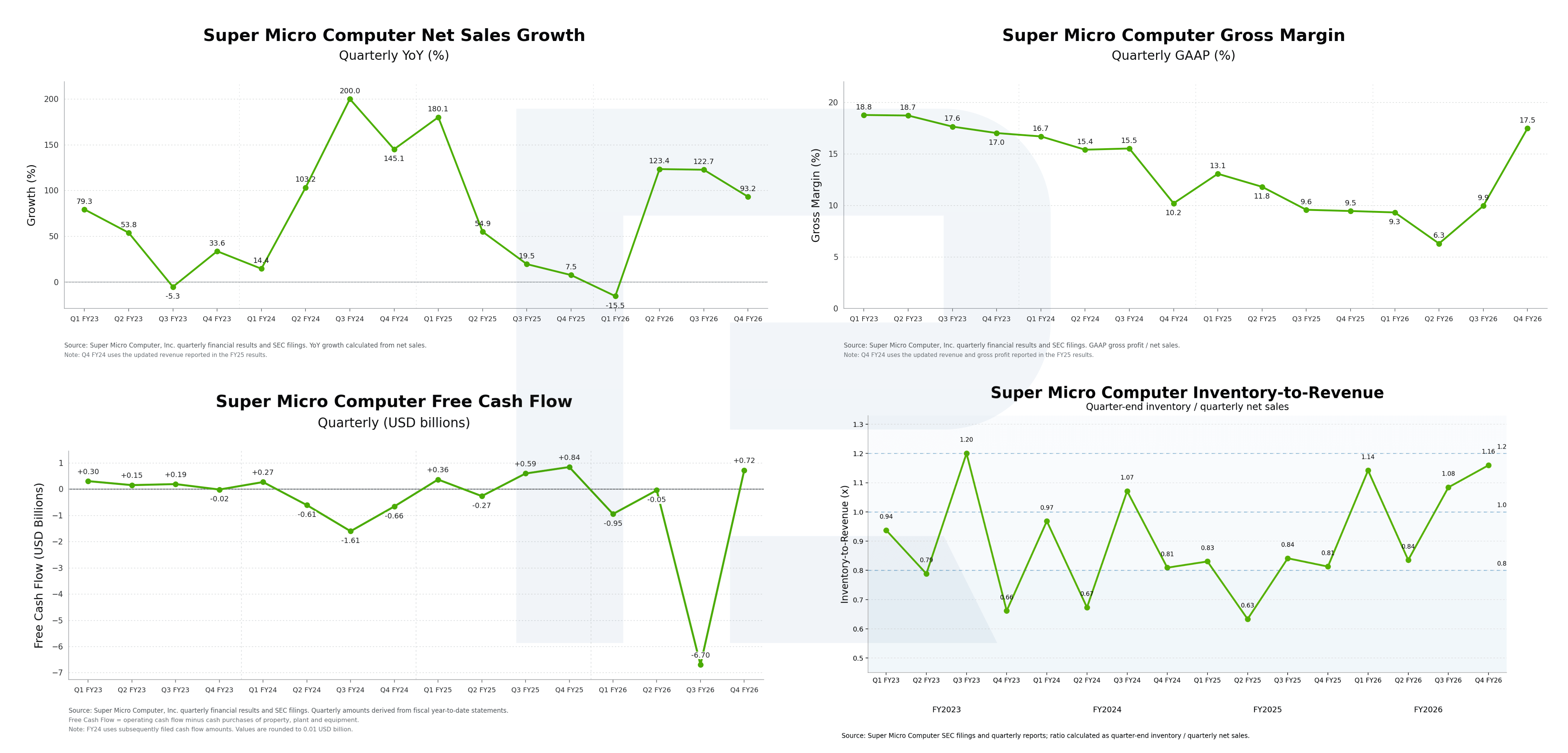
The charts show that Super Micro’s growth remains strong, but the quality of that growth has changed significantly. In 2023–2024, revenue grew very rapidly, while gross margin declined. This meant that the company was selling more but earning less per dollar of revenue. As a result, the market gradually became more cautious about SMCI stock.
The situation improved in the 2026 financial year. Revenue growth accelerated again, Gross Margin recovered to 17.5%, and Free Cash Flow returned to positive territory. This is a positive sign because the company’s rapid growth is again generating higher profits and more cash.
The main risk now relates to inventories. Inventory-to-Revenue rose to 1.16, meaning the value of inventories now exceeds quarterly revenue. As long as sales remain high, this is not critical. However, if revenue growth slows while inventories continue to rise, this could signal weakening demand.
The outlook for Super Micro Computer stock therefore depends on the quality of the next earnings report. Positive signals would include revenue meeting guidance, margins within or above the expected range, positive FCF, and a decline in inventories relative to sales. Weak shipments, margins below guidance, and deteriorating cash flow could put further pressure on the stock.
Supermicro Q1 2027 financial results – forecast and expectations
The outlook for Super Micro Computer stock largely depends on whether the Q1 2027 financial results confirm the company’s ability to fulfil large orders and turn sales growth into actual cash flow. Beyond revenue, investors will want to assess gross margin, inventories, and free cash flow.
- Earnings release date: the Q1 2027 financial results for the quarter ended 30 September 2026 are expected around 3–4 November.
- Revenue growth and order fulfilment: Super Micro forecasts revenue of 14.5–15.5 billion USD, almost three times the year-earlier figure. The company reported more than 60 billion USD in new orders. The key question is whether it can manufacture the equipment and deliver it to customers on time.
- Profitability: management expects gross margin to decline from 17.5–17.6% to 10.4–10.8%. This means that for every 100 USD in revenue, around 10–11 USD will remain after equipment costs to cover other expenses and profit. This decline is expected. The more important question will be whether margins can recover in subsequent quarters.
- Inventories relative to sales: the company has accumulated large inventories of expensive components. Ideally, sales should grow faster than inventories. A decline in Inventory-to-Revenue to 1.0 or below would be a positive signal – the value of inventories would then be approximately equal to or lower than quarterly revenue.
- Free Cash Flow: it will be important for free cash flow, or FCF, to remain positive. This means that Super Micro has cash left after covering its operating expenses and investments in equipment and production capacity.
Ideal earnings scenario:
- Revenue – around 15 billion USD or higher
- Gross margin – around 10–11% or higher
- Inventories relative to revenue – declining
- Free cash flow – positive
This combination of indicators could support SMCI stock. If sales come in below guidance, gross margin falls below 10%, inventories continue to grow faster than revenue, and cash flow turns negative, the risk of a stock price decline will increase.
Analyst forecasts for Super Micro Computer, Inc. stock and SMCI price targets
- Barchart : 4 of 20 analysts rated Super Micro Computer stock a Strong Buy, 2 a Moderate Buy, 11 a Hold, 1 a Sell, and 2 a Strong Sell. The highest price target is 60 USD, and the lowest is 15 USD.
- MarketBeat : 5 of 18 analysts rated the stock a Buy, 11 a Hold, and 2 a Sell. The highest price target is 64 USD, and the lowest is 34 USD.
- TipRanks : 2 of 16 analysts rated the stock a Buy, 11 a Hold, and 3 a Sell. The highest price target is 51 USD, and the lowest is 15 USD.
- Stock Analysis : 3 of 19 analysts rated the stock a Strong Buy, 2 a Buy, 11 a Hold, 1 a Sell, and 2 a Strong Sell. The highest price target is 60 USD, and the lowest is 15 USD.
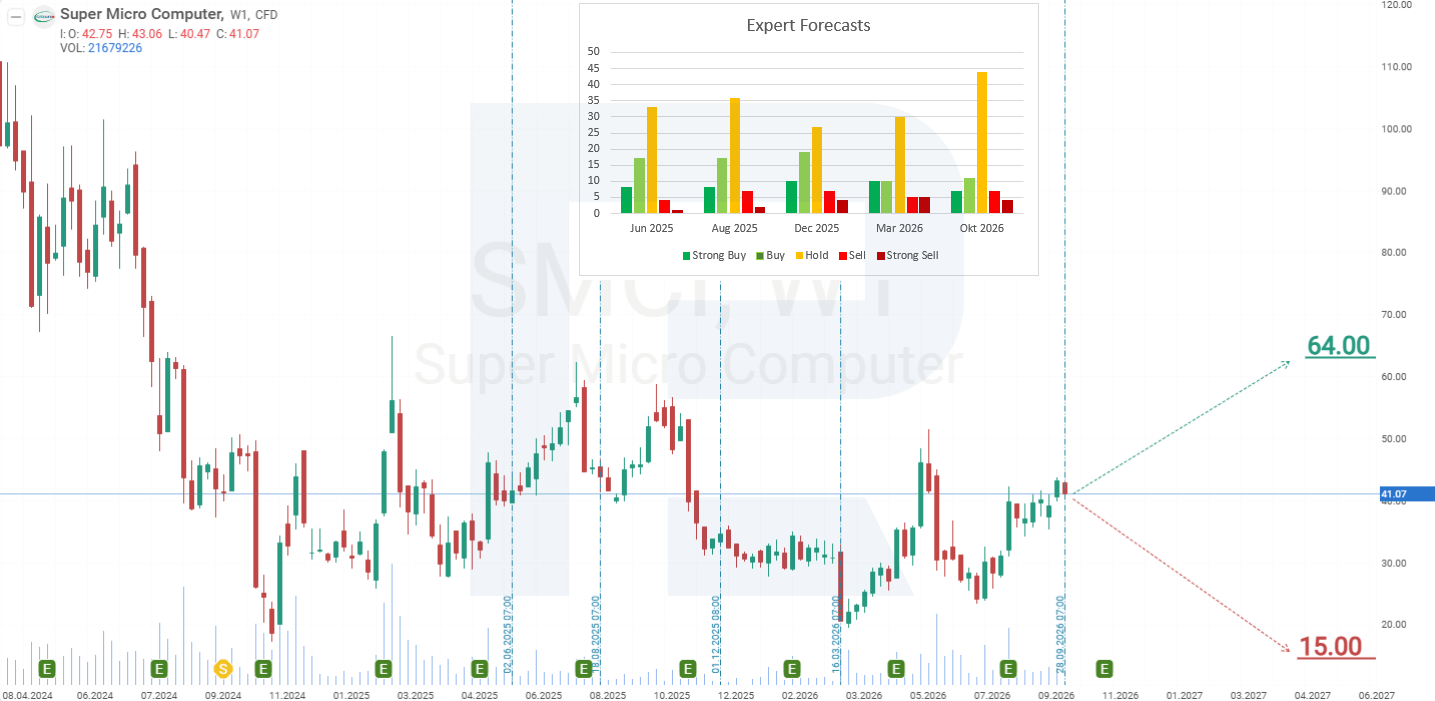
Super Micro Computer, Inc. stock price forecast for 2026
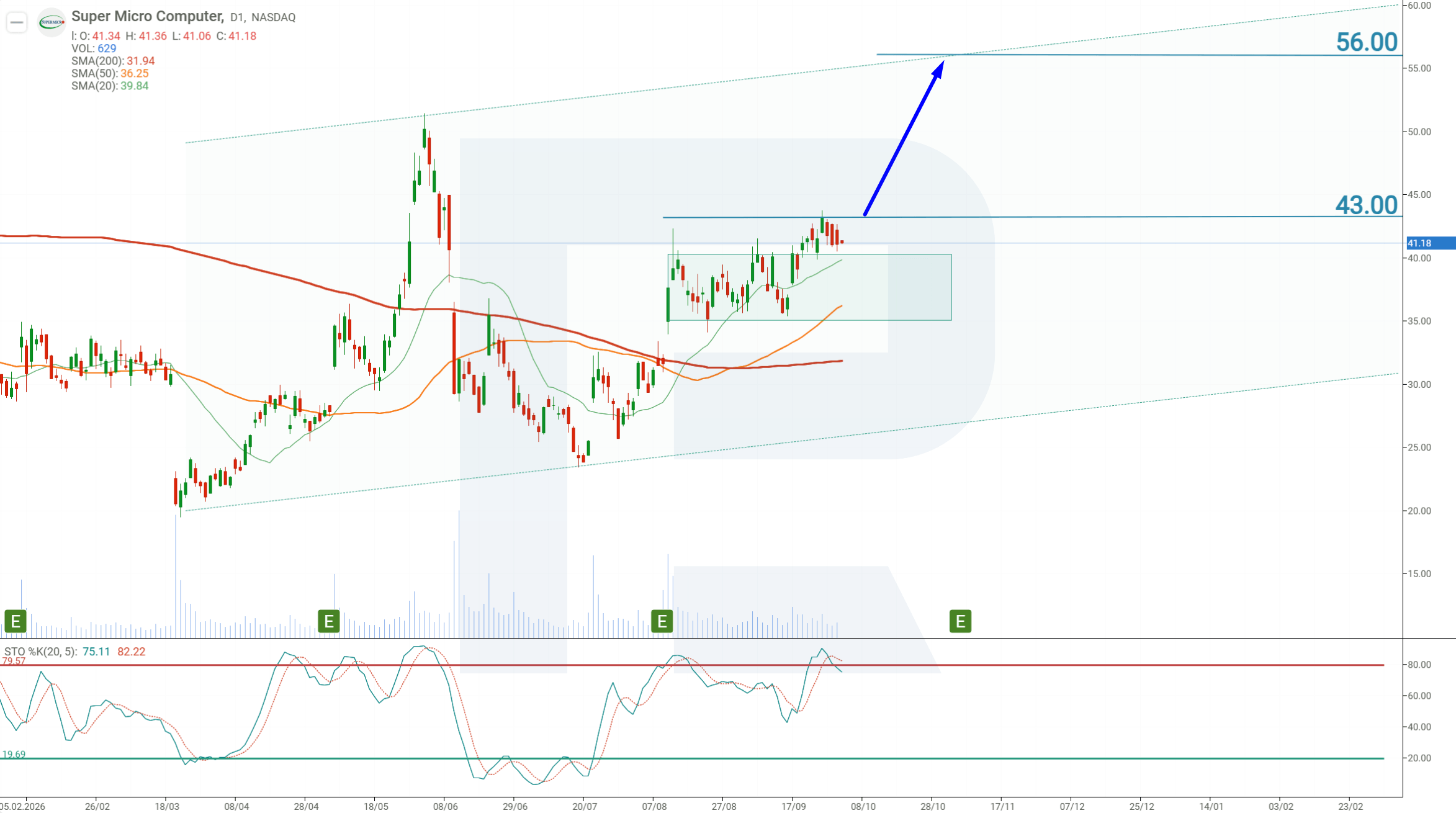
At the time of writing, SMCI stock is trading at 41 USD.
SMCI is trading above the 200-period Moving Average, indicating that the upward trend remains dominant. However, the Stochastic oscillator is in overbought territory, so investors should account for the risk of a short-term correction. Under these conditions, buying at the current market price appears premature – the stock could decline towards 35 USD as part of a correction.
Revenue expectations for Q1 2027 remain positive, which could support interest in the stock ahead of the earnings release. At the same time, a buy could reasonably be considered after a break above resistance at 43 USD.
The Super Micro Computer stock forecast for 2026 therefore envisages a rise towards 55 USD, provided the price breaks above resistance at 43 USD. The trade idea involves placing a Buy Stop order at 44 USD, Take Profit at 55 USD, and Stop Loss at 39 USD.
Buy Stop - 44.00
Take Profit - 55.00
Stop Loss - 39.00
Position management rule. Once the price moves 70% of the total distance towards the forecast target, the Stop Loss is set at the entry level. The protective order is then adjusted as the price advances, maintaining a distance of 10%. Position management continues until the position is closed at either Take Profit or Stop Loss – whichever level is reached first.
Ang mga pagtataya na ipinakita sa seksyong ito ay nagpapakita lamang ng pribadong opinyon ng may-akda at hindi dapat ituring bilang gabay para sa pagtetrade. Walang pananagutan ang RoboForex para sa mga resulta ng pagtetrade batay sa mga rekomendasyon sa pagtetrade na inilarawan sa mga analytical review na ito.