
Tesla shares test support after a muted response to earnings
Tesla increased revenue in Q2 2026, but a sharp decline in margins and negative free cash flow intensified pressure on the shares. However, oversold conditions on the Stochastic indicator and a test of the lower boundary of the descending channel point to a potential rebound despite the unfavourable news flow.
Tesla (NASDAQ: TSLA) reported mixed results for Q2 2026. Revenue increased by 26% to 28.24 billion USD, driven by record second-quarter vehicle deliveries, growth in the energy business, and expansion of the services segment. However, profitability deteriorated: operating profit fell by 57% to 398 million USD, while the operating margin narrowed to 1.4%.
Free cash flow turned negative at –1.09 billion USD, compared with +146 million USD a year earlier. The primary reason was a sharp increase in capital expenditure (CapEx), which rose to 5.79 billion USD. Tesla also expects CapEx to exceed 25 billion USD in 2026, with investment remaining elevated over the next two to three years due to the development of Robotaxi, Optimus, AI infrastructure, and new manufacturing projects.
Investors reacted negatively to the earnings report. Following the release of the results, Tesla shares fell by 15% to 320 USD. The sell-off continued over the following days, with the stock declining to 298 USD and closing below 300 USD for the first time since July 2025.
The primary reason for this reaction was weak profitability, highlighting that the company's growth is being accompanied by significant pressure on margins. An additional negative factor was that free cash flow turned negative. Investors were also concerned by Tesla's sharp increase in capital expenditure. An additional negative factor was negative free cash flow. Investors were also concerned by Tesla's sharp increase in capital expenditure. The market interpreted this as a signal that Robotaxi, Optimus, AI infrastructure, and new manufacturing facilities will require substantial investment before these projects begin generating sustainable financial returns.
This article examines Tesla, explains its business model and main sources of revenue, and discusses the key risks associated with investing in the company's shares. It also reviews the company's quarterly financial results, presenting the key metrics that enable investors to compare its performance across different reporting periods. In addition, the article provides a technical analysis of TSLA stock, forming the basis for a Tesla stock forecast for 2026.
About Tesla, Inc.
Tesla was founded in 2003 by Martin Eberhard and Marc Tarpenning. In 2004, Elon Musk joined the co-founders and became the largest investor, assuming the role of Chairman of the Board. In 2008, Musk became the CEO of the company.
Initially, Tesla focused exclusively on electric vehicle production, but new business areas eventually emerged. The first electric car, the Tesla Roadster, was introduced in 2008, marking the beginning of the electric vehicle manufacturing era. In 2014, the company introduced a driver assistance system, which later evolved into a fully autonomous driving system, known as Full Self-Driving.
In 2016, Tesla acquired SolarCity, a company specialising in solar panel installations, which led to the creation of Tesla Energy – a division focused on manufacturing solar panels and energy storage devices. In the coming years, the company plans to launch robotaxi services with autonomous vehicles, enter the freight transport market with its Tesla Semi electric trucks, complete the development of the Optimus humanoid robot, and create the world’s largest AI cluster for the Dojo supercomputer.
Tesla, Inc.’s main revenue streams
Tesla, Inc. generates revenue from various sources, reflecting the diversity of its products and services. The main revenue streams include:
- Vehicle sales: covers both direct sales to consumers and leasing.
- Regulatory credits: regulatory credits sold to other automakers that need them to comply with environmental regulations.
- Energy generation and storage: manufacturing and selling solar energy systems and energy storage devices – Powerwall (for residential use), Powerpack (for commercial applications), and Megapack (for large-scale energy needs).
- Services and other revenues: maintenance and repair centres, the Supercharger network, and insurance services for Tesla vehicle owners.
- Software and autonomous driving: fees for advanced driver assistance systems (Autopilot), the Full Self-Driving (FSD) package, and software updates.
- Battery and powertrain sales: supplying other companies with electric batteries, power units, and drivetrains.
- Renewable energy projects: contracts with utility companies and large energy consumers for deploying Tesla’s energy storage solutions.
Tesla, Inc. Q3 2024 financial results
Tesla released its Q3 2024 earnings report on 23 October, highlighting the following key figures:
- Total revenue: 25.18 billion USD (+8%)
- Net profit: 2.17 billion USD (+17%)
- Earnings per share (EPS): 0.62 USD (+17%)
- Operating margin: 10.8% (+323 basis points)
- Capital expenditures: 3.51 billion USD (+43%)
Revenue breakdown by segment:
- Vehicle sales: 20.02 billion USD (+2%)
- Energy generation and storage: 2.38 billion USD (+52%)
- Services and other revenue: 2.79 billion USD (+29%)
In its commentary on the report, Tesla’s management noted that, despite revenue falling short of Wall Street’s consensus estimate (25.18 billion USD vs. 25.47 billion USD), the company beat profit forecasts, reporting EPS of 0.72 USD compared with the expected 0.60 USD. This was achieved through higher gross margins, supported by reduced per-unit production costs. Tesla delivered a record 462,890 electric vehicles in Q3 2024, its highest quarterly total to date.
Tesla plans to introduce more affordable vehicle models in H1 2025, expecting sales growth of 20-30% for the year. Mass production of the Cybercab is scheduled for 2026, with a target output of at least two million units. Additionally, Tesla announced that its 4680-battery cell technology is approaching cost competitiveness, which could significantly shift the economics of battery production.
Management expressed confidence in the company’s strategic initiatives and its leading position in both the automotive and energy sectors.
Tesla, Inc. Q4 2024 financial results
On 29 January, Tesla released its Q4 2024 earnings report, showing a 71% decline in net profit. The key figures from the report are as follows:
- Total revenue: 25.70 billion USD (+2%)
- Net profit: 2.12 billion USD (–71%)
- Earnings per share (EPS): 0.60 USD (–71%)
- Operating margin: 6.2% (–204 basis points)
- Capital expenditures: 2.78 billion USD (+21%)
Revenue breakdown by segment:
- Vehicle sales: 19.80 billion USD (–8%)
- Energy generation and storage: 3.06 billion USD (+113%)
- Services and other revenue: 2.84 billion USD (+31%)
Tesla set a new record for electric vehicle deliveries in Q4 2024, with 495,570 units sold. The Tesla Model Y was the best-selling car worldwide in 2024. Elon Musk highlighted the successful production ramp-up at the Berlin and Texas Gigafactories, which played a key role in achieving these figures.
Tesla’s energy storage business also showed significant growth, driven by increased demand for products such as Megapack and Powerwall. Musk emphasised that this segment is essential to Tesla’s automotive business.
The Full Self-Driving (FSD) technology continues to evolve, with the Beta program now available to more users, helping collect valuable data. Musk expressed confidence that Tesla will achieve full vehicle autonomy soon. Looking ahead, the company aims to increase vehicle deliveries by approximately 50% year-on-year while expanding its model lineup and boosting production capacity at existing factories. Tesla also focuses on cost reduction and improving operational efficiency.
A notable remark from Elon Musk concerned the Optimus robots. He stated that by the end of 2025, several thousand Optimus units will be capable of performing practical tasks, initially tested and deployed at Tesla’s factories. Musk outlined Tesla’s ambition to rapidly scale Optimus production, projecting that even with a 50% annual growth rate, production could reach 100 million units per year within a few years. He underscored the importance of robotics and AI for Tesla’s future, seeing them as part of the company’s strategy to lead not only in electric vehicles but also in AI and robotics – a vision that could make Tesla the most valuable company in the world.
Tesla, Inc. Q1 2025 financial results
On 22 April, Tesla released a weaker-than-expected Q1 2025 report. Its highlights are outlined below:
- Total revenue: 19.34 billion USD (–9%)
- Net income: 0.93 billion USD (–39%)
- Earnings per share: 0.27 USD (–40%)
- Operating margin: 2.1% (–343 basis points)
- Operating expenses: 2.75 billion USD (+9%)
- Capital expenditures: 1.49 billion USD (–46%)
Revenue by segment:
- Vehicle sales: 13.97 billion USD (–20%)
- Energy generation and storage: 2.73 billion USD (+67%)
- Services and other revenue: 2.63 billion USD (+15%)
Tesla’s Q1 2025 report reflected a challenging period for the company. Financial performance was lower than expected, with EPS (non-GAAP) at 0.27 USD, below the forecast of 0.42 USD. The automotive segment, the company’s primary revenue source, contracted by 20%, driven by a 13% decline in deliveries and lower average selling prices. These results highlight the impact of the temporary suspension of Model Y production, an aggressive pricing policy, and a reliance on regulatory credit revenues (595 million USD), without which the automotive division would have posted a loss. Macroeconomic factors, uncertainty surrounding trade policy, and reputational risks associated with Elon Musk’s public activity further complicated the company’s position.
Nevertheless, Tesla’s energy business posted an impressive 67% increase in revenue, reaching 2.73 billion USD and delivering a record gross profit, confirming the company’s success in the energy storage segment. Free cash flow turned positive, reaching 664 million USD compared with a deficit of 2.53 billion USD a year earlier, indicating effective capital management despite significant AI investments.
The strategic focus on autonomous technology remains the company’s key growth driver. The launch of Full Self-Driving (FSD) as a paid service was planned for June, with millions of autonomous vehicles projected to be deployed by the end of 2025.
The Optimus humanoid robot project, with a target production of one million units per year by 2029, underscored Tesla’s ambition to expand beyond the automotive sector.
The market reacted positively to the report, with the stock gaining over 7% following the release, reflecting confidence in these initiatives, particularly in light of Musk’s statements about prioritising Tesla. However, short-term risks remain considerable. The withdrawal of the growth forecast for deliveries in 2025 signalled demand uncertainty, exacerbated by potential tariffs and competition from Chinese manufacturers such as BYD. A 9% increase in operating expenses and the lack of clarity regarding the launch of more affordable models heightened this uncertainty.
Tesla’s management provided no specific forecasts for Q2 2025, stating instead that they would revise the 2025 outlook after the Q2 2025 results, citing ongoing uncertainty in the automotive and energy markets amid shifting trade policies and macroeconomic conditions. Analysts forecast Q2 2025 revenue of around 24.45 billion USD, although Tesla has not confirmed or revised this figure.
Given these factors, Tesla remains a highly risky investment. The energy segment, AI development, and long-term strategic vision offer substantial growth potential. However, delivering on these ambitions will require Elon Musk to return to active management of the company, as he promised. His involvement in US politics negatively affected Tesla’s reputation, and the company now faces the challenge of restoring trust among both consumers and investors.
Tesla, Inc. Q2 2025 financial results
Tesla released its Q2 2025 earnings report on 23 July. The key figures compared with the same period in 2024 are as follows:
- Total revenue: 22.49 billion USD (–12%)
- Net income: 1.39 billion USD (–23%)
- Earnings per share: 0.40 USD (–23%)
- Operating margin: 4.1% (–220 basis points)
- Operating expenses: 2.95 billion USD (–1%)
- Capital expenditures: 2.39 billion USD (+5%)
Revenue by segment:
- Automotive sales: 16.66 billion USD (–16%)
- Energy generation and storage: 2.78 billion USD (–7%)
- Services and other revenue: 3.04 billion USD (+17%)
Tesla’s Q2 2025 results were disappointing, with revenue down 12% year-on-year to 22.5 billion USD, and net income falling to 1.39 billion USD – the company’s weakest quarterly performance in a decade. The primary factor behind the decline was a 17% decrease in automotive sales revenue, totalling 16.66 billion USD. Operating profit dropped by 42%, while free cash flow totalled just 146 million USD. Overall liquidity also declined, reaching 36.8 billion USD at the end of the quarter. Tesla delivered 384,122 vehicles during the period, representing a 14% year-on-year decrease.
Overall, Q2 revealed serious challenges for Tesla, including a decline in global demand for electric vehicles, intensified competition (particularly from Chinese manufacturers), aggressive pricing, and the withdrawal of subsidies in the US. Taken together, these factors put pressure on margins and profitability. Notably, around 37% of Tesla’s quarterly profit came from the sale of regulatory credits (439 million USD). Additional negative factors included trade barriers and Elon Musk’s political activity, which drew criticism and weakened demand in Europe.
Despite this, Tesla still has several growth drivers. One of them is the planned launch of a fully autonomous robotaxi, which could create a new subscription-based model and scalable robotaxi fleet. Another is the affordable electric vehicle priced at approximately 25,000 USD, which could significantly expand the customer base. The development of energy storage and robotics platforms also promises growth over the next two years.
For Q3 2025, Tesla did not provide formal guidance for key indicators. Elon Musk warned that the upcoming quarters could be challenging, citing macroeconomic headwinds, the expiry of US incentives, new tariffs on Chinese-made components, and regulatory uncertainty in autonomous driving. The CFO added that production of the latest affordable model was expected to begin gradually.
Tesla, Inc. Q3 2025 financial results
On 22 October, Tesla released its Q3 2025 report. The key figures compared with the same period in 2024 are as follows:
- Total revenue: 28.10 billion USD (+12%)
- Net profit: 1.77 billion USD (–29%)
- Earnings per share: 0.50 USD (–31%)
- Operating margin: 5.8% (–501 basis points)
- Operating expenses: 3.43 billion USD (+50%)
- Capital expenditure: 2.25 billion USD (–36%)
Revenue by segment:
- Automotive sales: 21.21 billion USD (+6%)
- Energy generation and storage: 3.42 billion USD (+44%)
- Services and other income: 3.48 billion USD (+25%)
In Q3 2025, Tesla delivered a record 497,099 electric vehicles (+7% y/y), supported by a surge in US demand ahead of the expiry of the 7,500 USD tax credit. The energy business also reached a record high, with 12.5 GWh of installed energy storage systems.
Revenue rose to a record level, but profit declined due to higher costs and changes in the revenue mix. The margin contracted as vehicle production costs increased, income from regulatory credit sales decreased, and, unlike last year, there was no one-off gain from FSD. Meanwhile, research and administrative expenses increased, resulting in a 40% year-on-year decline in operating profit. A key positive in the quarter was the record free cash flow of 3.99 billion USD and an increase in cash reserves to 41.6 billion USD.
The automotive segment increased revenue but saw lower profitability – rising component prices and tariffs offset the benefit of higher volumes. The energy business became the main growth driver, with Megapack and Powerwall contributing more revenue and profit. The services segment (including maintenance, charging stations, etc.) continued to grow at a double-digit rate.
The company did not provide specific figures for the next quarter, noting risks related to tariffs, trade policy, and changes in government support. Tesla is betting that over time, a greater share of profit will come from software, artificial intelligence, and services. The company has sufficient financial reserves to support its plans, including the launch of robotaxis in California and the expansion of its energy business.
Tesla, Inc. Q4 2025 financial results
Tesla released its Q4 2025 report on 28 January. Below are the key figures compared to the same period in 2024:
- Total revenue: 24.90 billion USD (–3%)
- Net income: 1.76 billion USD (–16%)
- Earnings per share: 0.50 USD (–17%)
- Operating margin: 5.7% (–50 basis points)
- Operating expenses: 3.60 billion USD (+39%)
- Capital expenditures: 2.39 billion USD (–14%)
Revenue by segment:
- Vehicle sales: 17.69 billion USD (–11%)
- Energy generation and storage: 3.84 billion USD (+25%)
- Services and other revenue: 3.37 billion USD (+18%)
For Q4 2025, Tesla reported earnings per share of 0.50 USD and revenue of 24.9 billion USD, exceeding market expectations. Gross margin reached a two-year high of 20.1%. For the full year 2025, revenue totalled 94.8 billion USD, declining slightly compared with 2024.
The company disclosed the number of active Full Self-Driving (FSD) subscribers for the first time, which reached 1.1 million, significantly higher than a year earlier. At the same time, the energy business maintained strong growth, with revenue increasing by 25% year-on-year despite a decline in vehicle sales.
During Q4, Tesla did not change its Bitcoin holdings and retained 11,509 BTC. Due to the decline in cryptocurrency prices, the company recorded an unrealised loss of approximately 239 million USD. However, it neither bought nor sold any Bitcoin, continuing to view it as a long-term reserve asset.
Tesla did not provide specific guidance on revenue or vehicle deliveries for Q1 2026. However, the company outlined an ambitious strategy for the full year 2026 focused on capital investment and a shift in its manufacturing priorities. Capital expenditure (CapEx) was expected to exceed 20 billion USD in 2026 (compared with 9 billion USD in 2025), with the funds allocated to AI infrastructure, new production lines, and the Optimus project. The company also officially announced the discontinuation of the Model S and Model X, while the Fremont factory would be reconfigured for the mass production of Optimus robots, with the goal of reaching an annual production capacity of 1 million units. In addition, Tesla plans to launch its Robotaxi service in seven US cities during the first half of 2026, while serial production of the Cybercab and large-scale production of Optimus robots is scheduled to begin by the end of 2026.
Tesla, Inc. Q1 2026 financial results
Tesla reported its Q1 2026 financial results on 23 April. The key figures compared with the same period in 2025 are as follows:
- Total revenue: 22.39 billion USD (+16%)
- Net income: 0.48 billion USD (+17%)
- Earnings per share: 0.13 USD (+8%)
- Operating margin: 4.2% (+214 basis points)
- Operating expenses: 3.78 billion USD (+37%)
- Capital expenditure: 2.49 billion USD (+67%)
Revenue by segment:
- Automotive sales: 16.23 billion USD (+16%)
- Energy generation and storage: 2.41 billion USD (–12%)
- Services and other revenue: 3.75 billion USD (+42%)
Following weaker revenue in Q4 2025, Tesla improved its year-on-year performance in Q1 2026. Revenue increased to 22.39 billion USD, operating profit reached 941 million USD, and free cash flow totalled 1.44 billion USD. At the end of the quarter, the company held 44.74 billion USD in cash and short-term investments, supporting its investment capacity.
The automotive segment also delivered stronger results. Automotive revenue increased by 16% to 16.23 billion USD, while vehicle deliveries rose by 6% to 358,023 units.
At the same time, software continued to play a more significant role. The number of active Full Self-Driving (FSD) subscribers increased to 1.28 million, up from 1.10 million in Q4 2025 and 0.85 million a year earlier. This showed that Tesla was gradually increasing the share of higher-margin services within its business.
The energy segment temporarily weakened. Revenue declined by 12%, while energy storage deployments fell to 8.8 GWh, compared with 14.2 GWh in the previous quarter.
Overall, Tesla continued its transition towards a more capital-intensive business model. The company expanded its AI infrastructure and continued preparations for the production of the Cybercab, Tesla Semi, Megapack 3, and Optimus. As a result, future profitability became increasingly dependent on how quickly these new projects would begin generating revenue.
Tesla also lowered its cash flow outlook for the remainder of 2026 due to the expansion of its investment program. The company expected capital expenditure (CapEx) to reach approximately 25 billion USD for the year, up from the previously projected 20 billion USD. Chief Financial Officer Vaibhav Taneja also warned that free cash flow would likely remain negative during the remaining quarters of 2026. This means that Tesla is expected to spend more on new production capacity, AI infrastructure, and future projects than it generates from its current business operations.
Tesla, Inc. Q2 2026 financial results
On 22 July, Tesla published its Q2 2026 financial results. The key figures are presented below, compared with the corresponding period of 2025:
Revenue: 28.24 billion USD (+26%)
Net income: 1.11 billion USD (–5%)
Earnings per share: 0.32 USD (–3%)
Operating margin: 1.4% (–270 basis points)
Operating profit: 398 million USD (–57%)
Free cash flow: –1.09 billion USD (compared with +146 million USD a year earlier)
Capital expenditure (CapEx): 5.79 billion USD (+142%)
Revenue by segment:
Automotive: 20.52 billion USD (+23%)
Energy generation and storage: 3.14 billion USD (+13%)
Services and other revenue: 4.58 billion USD (+50%)
Following the improvement in year-on-year performance during Q1 2026, Tesla's Q2 results confirmed continued revenue growth but also highlighted a deterioration in profitability. Revenue increased by 26%, driven by higher vehicle deliveries, expansion of the energy business, and strong growth in the services segment. However, the operating margin narrowed to 1.4%, while operating profit fell by 57% due to a sharp increase in spending on research and development, personnel, AI infrastructure, and new manufacturing projects.
The automotive business was stronger than a year earlier, with segment revenue increasing by 23% and vehicle deliveries reaching 480,126 units. At the same time, the automotive gross margin declined to 16.9%, as higher sales volumes were accompanied by pricing pressure, lower regulatory credit revenue, and rising costs. The energy business also expanded, although its gross margin declined due to higher costs and changes in the product mix.
Overall, Tesla delivered mixed results for Q2 2026. The company continues to increase revenue while advancing its initiatives, including Robotaxi, Full Self-Driving (FSD), Optimus, Megapack 3, Cybercab, and the Tesla Semi. However, the business is becoming more capital-intensive. Free cash flow turned negative, while profitability weakened, indicating that the coming quarters will reveal whether Tesla can translate its growing investment in AI and new products into sustainable financial performance.
Tesla's outlook for the coming quarters remains investment-intensive. The company expects capital expenditure (CapEx) to exceed 25 billion USD in 2026, with investment remaining elevated over the next two to three years as it expands Robotaxi, Optimus, its semiconductor business, solar manufacturing, and AI infrastructure.
Tesla is also considering raising up to 30 billion USD in debt financing to accelerate these projects. This outlook reinforces the company's long-term ambitions while also indicating that pressure on free cash flow and margins is likely to persist in the coming quarters.
Tesla, Inc. key valuation multiples analysis
The table below presents Tesla's key valuation multiples as of the end of Q2 2026, calculated using a stock price of 307 USD.
| Multiple | What it indicates | Value | Commentary |
|---|---|---|---|
| P/E (TTM) | Price paid for 1 USD of earnings over the past 12 months | 284.26 | ⬤ Extremely expensive. The average for high-growth technology companies and automakers typically ranges between 20x and 30x |
| P/S (TTM) | Price paid for 1 USD of annual revenue | 11.72 | ⬤ The valuation remains exceptionally high relative to revenue |
| EV/Sales (TTM) | Enterprise value to sales, accounting for debt | 11.39 | ⬤ Even after accounting for its substantial cash position, the business remains very highly valued |
| P/FCF (TTM) | Price paid for 1 USD of free cash flow | 210.69 | ⬤ The valuation appears very high relative to free cash flow |
| FCF Yield (TTM) | Free cash flow yield to shareholders | 0.5% | ⬤ Low free cash flow yield |
| EV/EBITDA (TTM) | Enterprise value to operating profit before depreciation and amortisation | 108.75 | ⬤ The valuation remains exceptionally high on an EBITDA basis |
| EV/EBIT (TTM) | Enterprise value to operating profit | 269.86 | ⬤ The company trades at a very high multiple of operating profit. |
| P/B | Price to book value | 13.98 | ⬤ The average for the technology sector is around 3x–5x. Tesla appears significantly overvalued based on this multiple |
| Forward P/E | Forward price-to-earnings (P/E) ratio | 168.98 | ⬤ Even based on expected earnings, the stock remains very highly valued |
| Net Debt/EBITDA | Debt burden relative to EBITDA | -3.15 | ⬤ The balance sheet remains very strong, with the company holding a substantial net cash position |
| Interest Coverage (TTM) | Ability to cover interest expenses with operating profit | 13.09 | ⬤ An excellent ratio, indicating that the company can comfortably cover its interest expense with operating profit |
Conclusion from Tesla's valuation multiples
Based on its Q2 2026 results, Tesla remains a financially resilient company, but its stock trades at very demanding valuation levels across almost all key multiples. The company's main strength is its balance sheet. Tesla has a substantial net cash position, low leverage, and comfortable interest coverage, which reduces its financial risk.
The primary challenge for investors is not the company's debt but the stock's valuation relative to its current earnings and cash flow. A P/E ratio above 280x, P/FCF above 200x, EV/EBITDA above 100x, and EV/EBIT of around 270x indicate that the market values Tesla not as an automaker based on its current financial performance, but as a technology platform with significant long-term growth potential.
Another important consideration is that free cash flow over the past 12 months remains weak relative to the company's market capitalisation. This is particularly significant because such a high valuation should be supported not only by future growth prospects but also by sustainably strong cash flow.
Overall, Tesla can currently be viewed as a strong company with an exceptionally robust balance sheet, but not as a conservative investment based on its valuation multiples. For investors who prioritise valuation discipline, the stock appears too demanding at current levels. An investment in the stock is justified only with a high degree of confidence that long-term earnings growth will be driven by autonomous driving, Robotaxi, energy, AI infrastructure, and other businesses beyond Tesla's traditional automotive operations.
Expert forecasts for Tesla, Inc. shares for 2026
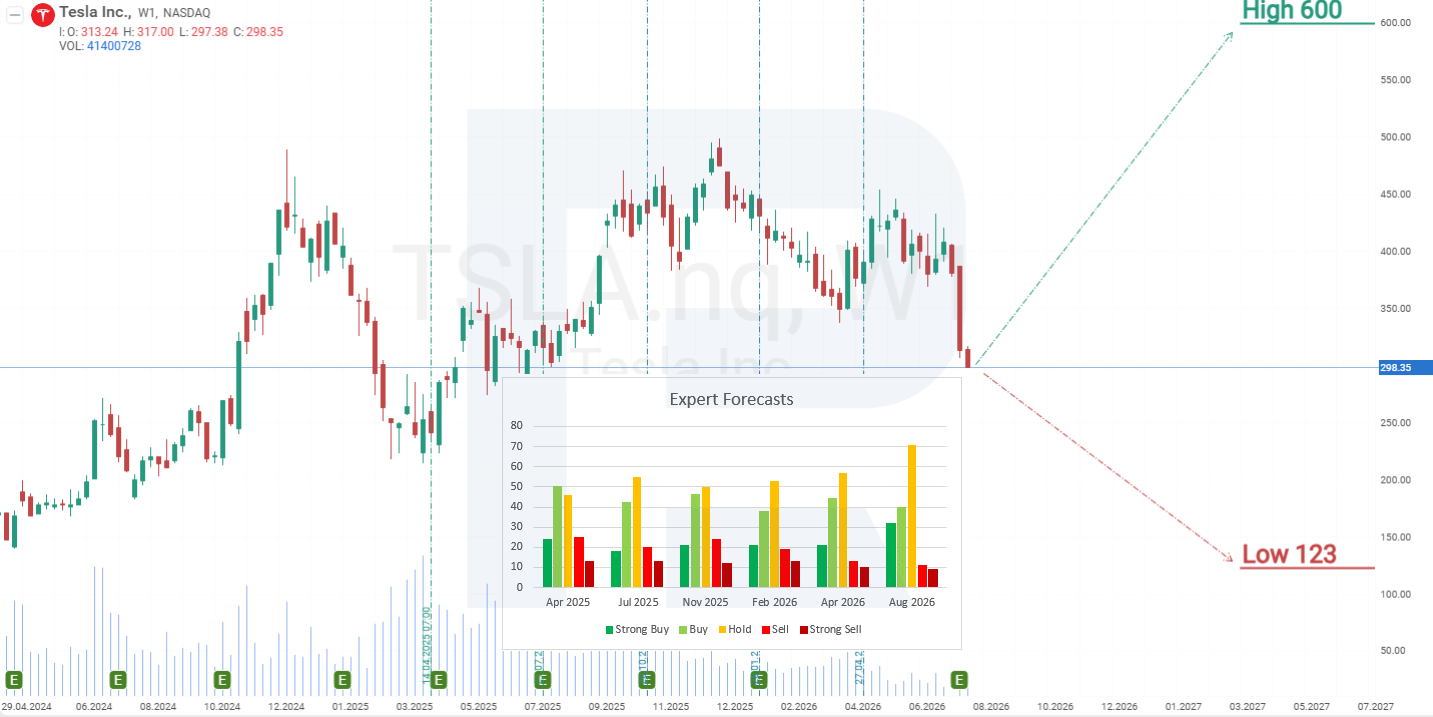
- Barchart: 15 of 42 analysts rate Tesla stock as Strong Buy, 2 as Buy, 20 as Hold, and 5 as Strong Sell. The highest price target is 600 USD, while the lowest is 123 USD.
- MarketBeat: 22 of 45 analysts rate the stock as Buy, 19 as Hold, and 4 as Sell. The highest price target is 600 USD, while the lowest is 25 USD.
- TipRanks: 10 of 28 analysts rate the stock as Buy, 15 as Hold, and 3 as Sell. The highest price target is 508 USD, while the lowest is 25 USD.
- Stock Analysis: 17 of 46 analysts rate Tesla stock as Strong Buy, 6 as Buy, 17 as Hold, 2 as Sell, and 4 as Strong Sell. The highest price target is 600 USD, while the lowest is 125 USD.
Tesla, Inc. stock price forecast for 2026
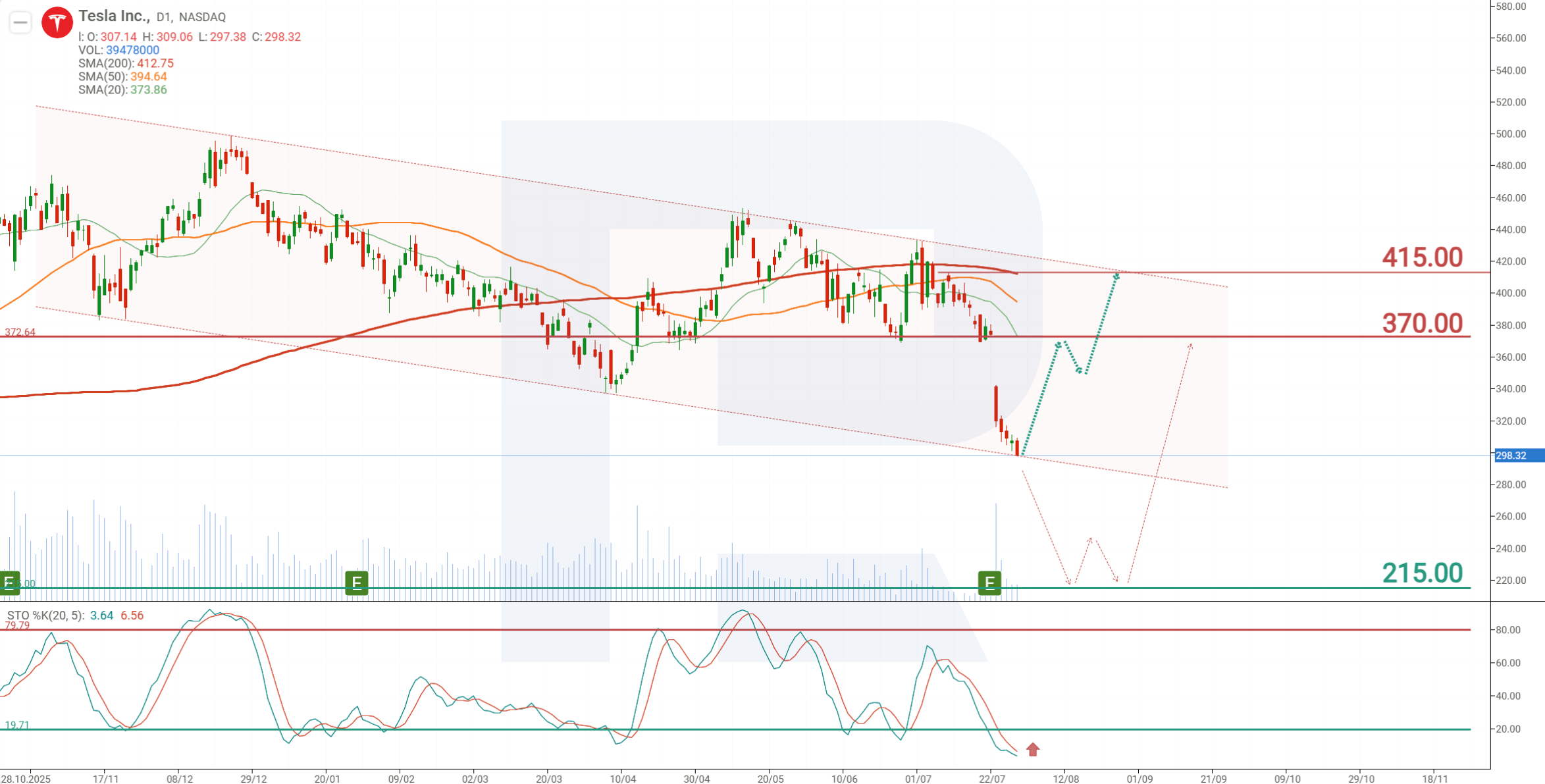
On the daily timeframe, Tesla stock continues to trade within a descending channel and has reached its lower boundary, which is acting as support. At the same time, the Stochastic indicator has entered oversold territory, increasing the likelihood of a rebound. Based on the current TSLA stock performance, the following scenarios outline its potential movement in 2026.
The base-case forecast for TSLA stock projects a rebound from the lower boundary of the channel, followed by an advance towards resistance at 370 USD. If this level is broken, the stock could extend its gains towards 415 USD.
If the price breaks below the lower boundary of the channel, the bullish scenario will be invalidated, and Tesla shares could decline towards support at 215 USD.
Risks of investing in Tesla, Inc. shares
Considering the factors that could negatively impact the company’s future earnings is crucial when investing in Tesla, Inc. shares. Below are the main risks:
- Increased competition: Tesla faces growing competition from both traditional automakers, such as Volkswagen, General Motors, and Ford, as well as newer players, including BYD, Rivian, and Lucid. The competition is particularly fierce in China, where BYD has already surpassed Tesla in total electric vehicle production, including hybrid vehicles. Increased competition could lead to a loss of market share and price wars, reducing Tesla’s profitability.
- Economic conditions: elevated interest rates and economic downturns can impact consumer spending on expensive goods, such as electric vehicles. If interest rates remain high or increase further, the cost of financing a new Tesla could deter potential buyers.
- Policy changes: changing government policy, such as the cancellation or reduction of tax incentives for electric vehicles, could affect demand for Tesla cars. State-level policies, such as a potential new credit system in California, where Tesla may not meet the criteria, could also further impact sales.
- Manufacturing and supply chain issues: delays or inefficiencies in ramping up production of new models could prevent Tesla from meeting market demand. Supply chain disruptions, chip shortages, or factory shutdowns could also affect production capabilities.
- Technological challenges: if Tesla’s advancements in autonomous driving or battery technology fail to meet expectations, or if competitors outpace Tesla in these areas, it could result in a loss of competitive advantage and investor confidence.
- Global Market Dynamics: fluctuations in exchange rates, trade tensions (especially with China, where Tesla has significant sales and production), or new tariffs could impact Tesla’s international revenues.
These factors in combination could influence Tesla’s revenue trajectory in 2026, creating a challenging environment where the company will need to navigate both internal and external challenges to maintain or improve its market position.
Ang mga pagtataya na ipinakita sa seksyong ito ay nagpapakita lamang ng pribadong opinyon ng may-akda at hindi dapat ituring bilang gabay para sa pagtetrade. Walang pananagutan ang RoboForex para sa mga resulta ng pagtetrade batay sa mga rekomendasyon sa pagtetrade na inilarawan sa mga analytical review na ito.