
Gold (XAUUSD) weekly forecast: the price has recovered, but forecasts have not
Gold (XAUUSD) enters the week of 22–26 June above 4,300 USD per ounce after recovering from lows around 4,020. News of an interim agreement between the US and Iran and expectations of the opening of the Strait of Hormuz supported the market. However, high inflation in the US and hawkish Fed signals continue to limit gold’s upside potential.
The baseline scenario for the week assumes consolidation with a moderately negative bias. Despite the rebound from the 4,020–4,050 support area, XAUUSD remains in a downward trend and trades below the key resistance zone of 4,300–4,460. While the price holds below this area, the risks of renewed decline remain. To improve the technical picture, buyers need to consolidate above 4,300–4,460. A loss of the 4,020–4,050 support will again open the way to a deeper decline.
XAUUSD forecast for this week: quick overview
- Weekly dynamics: Gold (XAUUSD) ended the week above 4,300 USD per ounce after a sharp sell-off towards the 4,020 area. News of an interim agreement between the US and Iran supported the market. The agreement provides for the opening of the Strait of Hormuz and the gradual return of Iranian oil to the global market. Lower geopolitical tension removed part of the inflation risks, although investor interest in safe-haven assets did not disappear completely.
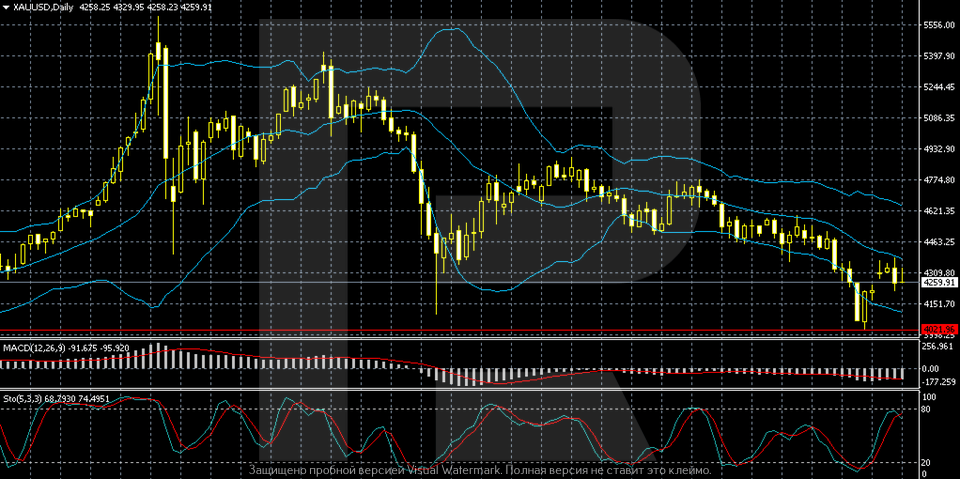
- Support and resistance: on the daily chart, gold maintains a downward trend after the correction from all-time highs around 5,500. After rebounding from the 4,020–4,050 support, quotes returned to the 4,250–4,300 area, but remain below the middle Bollinger Band. The nearest resistance is located in the 4,300–4,460 zone, where an important support area previously stood. The key support remains the 4,020–4,050 area.
- Fundamentals and forecast: the Fed meeting became the key event of the week. The regulator left the rate unchanged, but raised its inflation forecasts and maintained a hawkish tone regarding further policy. New Fed Chair Kevin Warsh did not provide clear signals on the timing of the next rate decisions, increasing market uncertainty. The baseline scenario assumes consolidation within the 4,020–4,460 range with a moderately negative bias. High inflation, a strong dollar, and expectations of prolonged high rates continue to limit gold’s upside potential. Further XAUUSD dynamics will depend on the implementation of the US-Iran agreement, oil prices, and new signals from the Fed.
Gold (XAUUSD) fundamental analysis
Gold (XAUUSD) ended the week above 4,300 USD per troy ounce as part of a recovery after the sharp sell-off seen shortly before. News of an interim agreement between the US and Iran supported the market: it provides for the opening of the Strait of Hormuz and the gradual return of Iranian oil to the global market.
According to preliminary data, the agreement provides for the removal of some restrictions on Iranian oil exports and the continuation of negotiations on the nuclear programme. Lower geopolitical tension eased inflation risks to some extent, although interest in safe-haven assets did not disappear completely.
The Fed meeting became the key event of the week for gold. The regulator left the rate unchanged, but gave more hawkish signals regarding the monetary policy outlook. Updated forecasts showed higher inflation expectations, while some FOMC members still allow for a further rate hike.
The market paid particular attention to the first speech by new Fed Chair Kevin Warsh. However, instead of clear guidance, investors received only confirmation that inflation has remained above target for several years and that restoring price stability remains the regulator’s main priority. Warsh gave no specific signals on the timing of the next rate decision, increasing uncertainty in financial markets.
In the new week, investors will continue to assess the consequences of the US-Iran agreement, oil price dynamics, and further comments from Fed officials. For now, high inflation and expectations that the US regulator will maintain a restrictive policy stance remain the key factors limiting gold’s upside potential.
XAUUSD technical analysis
On the daily chart, Gold (XAUUSD) maintains a pronounced downward trend after forming an all-time high around 5,500. Over the past several weeks, quotes have declined consistently, forming a sequence of lower highs and lower lows. After the sharp sell-off, the market tested support near 4,020, followed by a technical rebound towards the current 4,250–4,300 area. However, the price still remains below the middle Bollinger Band, which indicates pressure from sellers.
The technical picture remains moderately negative. The nearest resistance is located in the 4,300–4,460 zone, where the middle Bollinger Band passes and where an important support area previously stood. To improve the medium-term structure, buyers need to consolidate above this zone. Support remains in the 4,020–4,050 area, which has already stopped the decline several times and now acts as a key level for the entire market.
Indicators give mixed signals. MACD remains in negative territory, confirming the preservation of the bearish trend, although the depth of the decline is gradually narrowing. The Stochastic has moved into the overbought area, indicating weaker recovery momentum and increasing the likelihood of a new wave of consolidation or correction after the recent rebound. The baseline scenario for now remains trading within the 4,020–4,460 range, with sellers retaining the advantage as long as the price holds below 4,460.
XAUUSD trading scenarios
The fundamental background for Gold (XAUUSD) is mixed. The US-Iran agreement supported the market. However, the Fed meeting became the key event of the week. The regulator left the rate unchanged but raised its inflation forecasts, while some FOMC members still allow for further policy tightening. New Fed Chair Kevin Warsh did not provide clear signals on future steps, maintaining a high degree of uncertainty for markets.
Technically, Gold remains in a downward trend after the correction from all-time highs. After declining to 4,020, quotes recovered above 4,300, but are moving below the key resistance zone of 4,300–4,460. Support remains around 4,020–4,050.
- Buy scenario
Consolidation above 4,300–4,460 will increase the chances of a recovery move developing.
- Sell scenario
A return below 4,050–4,020 will confirm the continuation of the downward trend and open the way to new lows.
Bottom line: Gold (XAUUSD) has partially recovered after the June sell-off, but remains under pressure from high rates and uncertainty around further Fed policy. While the price is below 4,460, sellers retain the advantage.
Summary
Gold (XAUUSD) ended the week above 4,300 USD per ounce, recovering after the recent sell-off. News of the agreement between the US and Iran supported the market, but Fed policy remains the main factor.
The US regulator left the rate unchanged but raised its inflation forecasts. The new Fed Chair did not give the market clear signals on the next rate steps, increasing uncertainty.
Technically, XAUUSD remains in a downward trend. After rebounding from 4,020, quotes returned to 4,300, but still remain below resistance at 4,300–4,460. The baseline scenario assumes consolidation with a moderately negative bias while the price holds below 4,460.
Editors’ picks

EURUSD forecast 2026–2027: technical analysis, price levels & predictions
The ECB holds rates at 2.15% while the Fed stays at 3.75% — and that divergence is the central driver of EURUSD in 2026. The pair is range-bound between 1.1400 and 1.1915, with Deutsche Bank targeting 1.2500 and Morgan Stanley calling for 1.3000 by year-end. We analyse the technicals, break down the macro factors, and outline three trading scenarios with specific entry levels.

Gold (XAUUSD) forecast 2026: predictions based on fundamental and technical analysis
Where is gold headed after pulling back from the all-time high of 5,597 USD? XAUUSD is consolidating near 4,518 USD between key levels 4,220 USD and 4,855 USD, with major banks targeting 5,243–6,200 USD by year-end. Read our comprehensive gold forecast: technical analysis across three timeframes, trading scenarios with specific entry levels, Fed policy and central bank demand outlook, and institutional predictions for 2026 and beyond.
Ang mga pagtataya na ipinakita sa seksyong ito ay nagpapakita lamang ng pribadong opinyon ng may-akda at hindi dapat ituring bilang gabay para sa pagtetrade. Walang pananagutan ang RoboForex para sa mga resulta ng pagtetrade batay sa mga rekomendasyon sa pagtetrade na inilarawan sa mga analytical review na ito.