
Gold (XAUUSD) weekly forecast: the sell-off has paused, but what comes next
Gold (XAUUSD) enters the week of 6–10 July near 4,059 USD per ounce after falling to eight-month lows. Softer comments from Federal Reserve Chairman Warsh, weak ADP employment data, and lower inflation risks thanks to the recovery of oil supplies through the Strait of Hormuz supported the market. The market still estimates the likelihood of a Fed rate hike in September at more than 60%, which limits gold’s upside potential.
The baseline scenario for the week remains neutral-to-negative. XAUUSD maintains its downward momentum despite signs of stabilisation after rebounding from the 3,940 support level. The nearest resistance lies in the 4,235–4,405 zone. As long as prices hold below this range, sellers have the upper hand, and the risks of another test of the 3,940 support level and a renewed downward movement remain.
XAUUSD forecast for this week: quick overview
- Weekly performance: gold (XAUUSD) ended the week near 4,059 USD per troy ounce after falling to eight-month lows. Comments from Federal Reserve Chairman Warsh on lower inflation expectations and no need for an immediate interest rate hike supported quotes. At the same time, the Fed remains committed to fighting inflation, which continues to limit the precious metal’s upside potential. Lower oil prices amid the recovery of supplies through the Strait of Hormuz and progress in indirect talks between the US and Iran added another positive factor
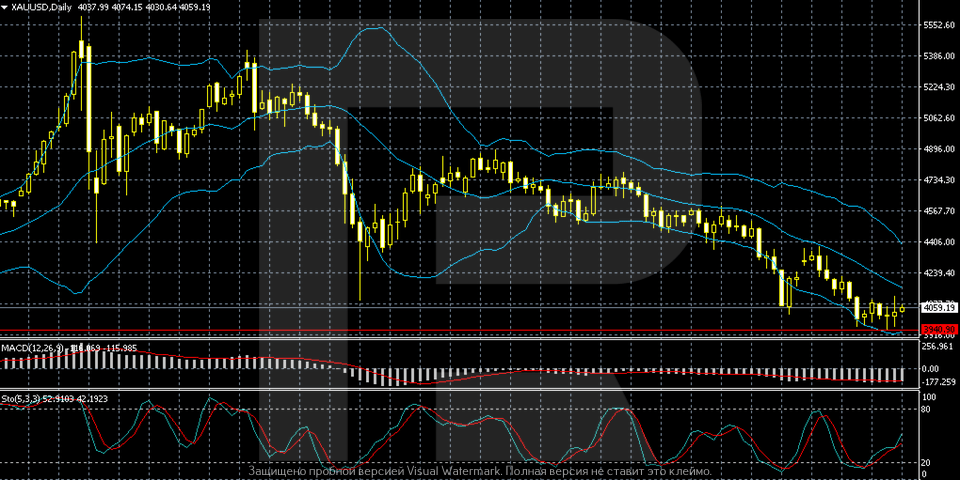
- Support and resistance: on the daily chart, gold maintains a sustained downtrend. Quotes remain below the middle Bollinger Band, while the bands themselves retain a downward slope, confirming the dominance of sellers. The nearest resistance level is located in the 4,235–4,405 area, where the upper boundary of the current descending channel passes. The key support level remains at 3,940. Until prices consolidate above 4,235, it is premature to talk about a change in the medium-term trend
- Fundamentals and forecast: market attention is shifting towards new macroeconomic data from the US, which may adjust expectations regarding Fed policy. Weak ADP statistics somewhat reduced pressure on gold, but the market still estimates the likelihood of a September rate hike at more than 60%. Technical indicators signal a weakening downward momentum: MACD remains in negative territory, but selling pressure is gradually easing. The Stochastic Oscillator has turned upwards, reflecting a recovery in short-term demand. The baseline scenario for the coming week remains consolidation within the 3,940–4,235 range, with risks of a renewed decline if the key support level breaks
Gold (XAUUSD) fundamental analysis
Gold closed the week near 4,059 USD, indicating stabilisation after falling to eight-month lows. Market sentiment improved after comments from Federal Reserve Chairman Kevin Warsh, who noted easing inflation expectations and said that there was no need for an immediate interest rate hike. At the same time, the Federal Reserve remains committed to fighting inflation. This continues to limit the precious metal’s upside potential.
ADP data showed weaker-than-expected private sector employment growth. The market still estimates the probability of a September rate hike at more than 60%.
Lower inflation risks provide additional support for gold. The recovery of oil supplies through the Strait of Hormuz and signs of progress in indirect talks between the US and Iran pushed oil prices lower. This somewhat reduced concerns about a new round of inflation.
In the coming days, gold price movements will be determined by a combination of US macroeconomic statistics and expectations regarding Federal Reserve policy. For now, the market remains cautious. Gold will likely continue to trade within a wide range in anticipation of new fundamental signals.
XAUUSD technical analysis
On the daily chart, gold (XAUUSD) maintains sustained downward momentum, although the market moved into a stabilisation phase after reaching a local low around 3,940. Quotes are holding slightly above 4,050 but remain below the middle Bollinger Band, while the bands themselves point downwards. This suggests that the current rise appears to be merely a technical rebound within a broader bearish movement.
The technical picture remains moderately negative. The nearest resistance level is located in the 4,235–4,405 area, where the upper boundary of the current descending channel lies and where selling activity has repeatedly intensified. The key support level remains at 3,940 – this is where buyers are currently holding the market back from further decline. Until prices consolidate above 4,235, it is premature to talk about a full-fledged uptrend.
Indicators point to a gradual weakening of the downward momentum. MACD remains below the zero line, but the histogram is reducing its negative values, signalling weaker selling pressure. The Stochastic Oscillator has turned upwards from the neutral zone, reflecting a recovery in short-term demand, but it does not yet confirm the start of sustained growth.
In the medium term, the baseline scenario remains consolidation within the 3,940–4,235 range, with risks of a renewed downward movement. To improve the technical picture, gold needs to consolidate above the 4,235 resistance level. A breakout below the 3,940 support level would open the way for a new downward wave.
XAUUSD trading scenarios
The fundamental backdrop for gold (XAUUSD) remains restrained. Gold ended the week near 4,059 USD per troy ounce after falling to eight-month lows. The market was buoyed by comments from Federal Reserve Chairman Kevin Warsh regarding the decline in inflation expectations and the lack of any need for an immediate interest rate hike. However, the Fed remains committed to fighting inflation, while the market still estimates the probability of a September rate hike at more than 60%. Weaker ADP employment data and lower inflation risks amid higher oil supplies through the Strait of Hormuz and progress in US-Iran talks provide additional support for quotes.
Technically, gold maintains a sustained downtrend. Prices remain below the middle Bollinger Band, and the bands themselves are pointing downwards, confirming the persistence of the broader bearish trend. MACD remains in negative territory, although selling pressure is gradually losing strength, while the Stochastic Oscillator has turned upwards, reflecting a recovery in short-term demand without confirming a full-fledged reversal.
- Buy scenario
Consolidation above resistance at 4,235–4,405 would signal a more sustained upward correction and improve the medium-term technical picture.
- Sell scenario
A breakout below the 3,940 support level would confirm a renewed downtrend and open the way to a deeper decline.
Conclusion: gold (XAUUSD) has entered a consolidation phase after a strong downward wave, but the overall picture remains bearish. While prices hold below the 4,235–4,405 resistance zone, sellers retain the advantage, with the next direction dependent on US labour market statistics and new signals from the Federal Reserve.
Summary
Gold (XAUUSD) ended the week near 4,059 USD per ounce, stabilising after falling to eight-month lows. Softer comments from Federal Reserve Chairman Kevin Warsh, weak ADP employment data, and lower inflation risks amid the recovery of oil supplies through the Strait of Hormuz supported the market. However, the probability of a Fed rate hike in September still exceeds 60%, capping gold’s upside potential.
Technically, gold maintains a downtrend despite local stabilisation. Prices hold above the 3,940 support level but remain below key resistance at 4,235–4,405 and the middle Bollinger Band. Until quotes consolidate above 4,235, the baseline scenario remains consolidation with the risk of a renewed decline if the 3,940 level breaks.
Editors’ picks

EURUSD forecast 2026–2027: technical analysis, price levels & predictions
The ECB holds rates at 2.15% while the Fed stays at 3.75% — and that divergence is the central driver of EURUSD in 2026. The pair is range-bound between 1.1400 and 1.1915, with Deutsche Bank targeting 1.2500 and Morgan Stanley calling for 1.3000 by year-end. We analyse the technicals, break down the macro factors, and outline three trading scenarios with specific entry levels.

Gold (XAUUSD) forecast 2026: predictions based on fundamental and technical analysis
Where is gold headed after pulling back from the all-time high of 5,597 USD? XAUUSD is consolidating near 4,518 USD between key levels 4,220 USD and 4,855 USD, with major banks targeting 5,243–6,200 USD by year-end. Read our comprehensive gold forecast: technical analysis across three timeframes, trading scenarios with specific entry levels, Fed policy and central bank demand outlook, and institutional predictions for 2026 and beyond.
Ang mga pagtataya na ipinakita sa seksyong ito ay nagpapakita lamang ng pribadong opinyon ng may-akda at hindi dapat ituring bilang gabay para sa pagtetrade. Walang pananagutan ang RoboForex para sa mga resulta ng pagtetrade batay sa mga rekomendasyon sa pagtetrade na inilarawan sa mga analytical review na ito.