
Gold (XAUUSD) weekly forecast: the market favours the US dollar
Gold (XAUUSD) enters the week of 13–17 July near 4,070 USD per ounce, under pressure from a strong dollar. Despite the escalation in the Middle East and demand for safe-haven assets, investors favour the US currency. The market continues to price in at least one Federal Reserve rate hike before the end of 2026, limiting gold’s upside potential.
The baseline scenario for the week remains moderately negative. Gold maintains a sustained downtrend, remaining below the 50-period moving average and the key resistance level at 4,388, with the nearest support located at 3,945. While prices trade below 4,388, sellers have the upper hand, and the most likely scenario is consolidation with the risk of a retest of the 3,945 level in the absence of new upside drivers.
XAUUSD forecast for this week: quick overview
- Weekly performance: gold (XAUUSD) ended the week near 4,070 USD per troy ounce, pressured by a strengthening dollar. Despite the escalation of the conflict in the Middle East and growing demand for safe-haven assets, investors favour the US currency. The minutes of the June Federal Reserve meeting showed that most policymakers remain concerned about inflation risks, while the market expects at least one rate hike before the end of 2026
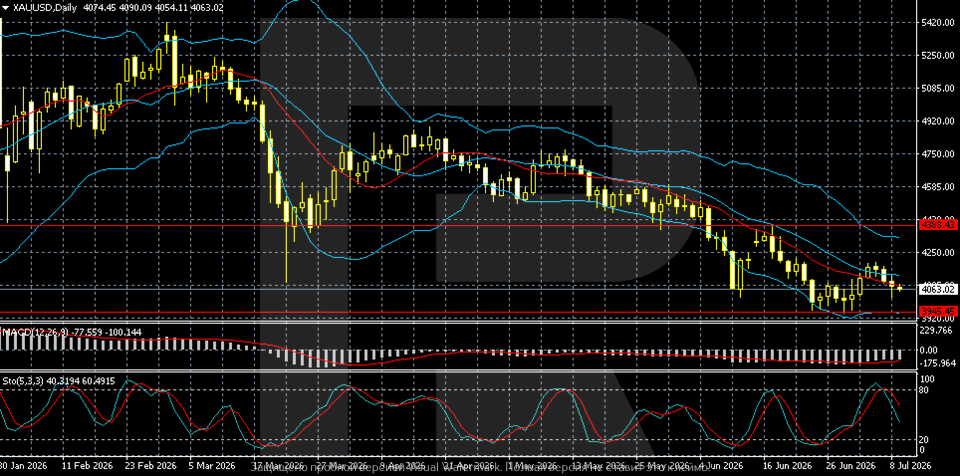
- Support and resistance: on the daily chart, gold continues a steady downward momentum after the reversal from the March highs. Prices remain below the 50-period moving average and hold in the lower half of Bollinger Bands, confirming sellers’ advantage. The nearest resistance level lies around 4,388, where the upper boundary of the current correction passes. The key support level remains at 3,945. Until quotes consolidate above 4,388, it is premature to discuss the end of the medium-term downtrend
- Fundamentals and forecast: the market remains focused on further developments in the conflict around the Strait of Hormuz and new Federal Reserve signals. Rising oil prices intensify inflation risks and support expectations that the US will maintain a restrictive monetary policy stance, which remains a negative factor for gold. MACD remains in negative territory, although selling pressure is gradually weakening, while the Stochastic Oscillator has turned downwards after leaving overbought territory. The baseline scenario for the coming week remains consolidation within the 3,945–4,388 range with a moderately negative bias
Gold (XAUUSD) fundamental analysis
Gold (XAUUSD) fell to 4,070 USD per troy ounce. Despite geopolitical tensions, investors prefer the dollar as the main safe-haven asset.
The main event of last week was the renewed escalation of the conflict in the Middle East. The US carried out strikes on facilities in Iran, citing the need to protect shipping through the Strait of Hormuz. In response, Tehran promised large-scale retaliatory measures against US military facilities in the region. US President Donald Trump said that the ceasefire had effectively ended and warned of possible new strikes and a more complicated maritime blockade.
Higher oil prices increased concerns about a new surge in inflation, changing market participants’ expectations regarding Federal Reserve policy. The minutes of the June Fed meeting, published last week, showed that only a small number of policymakers favoured an immediate rate hike, with most participants still viewing inflation risks as a serious threat.
The market is pricing in at least one Federal Reserve rate hike before the end of 2026. As a result, the combination of more hawkish monetary policy expectations and a stronger dollar limits gold’s upside potential, despite strong demand for safe-haven assets amid geopolitical uncertainty.
XAUUSD technical analysis
On the daily chart, gold (XAUUSD) maintains a sustained downtrend that developed after the March high. After failing to recover towards the 4,200–4,220 area, sellers regained the initiative and pushed prices down to 4,060. Quotes remain below the 50-period moving average and hold in the lower half of Bollinger Bands, indicating continued pressure on buyers.
The technical picture remains moderately negative. The nearest support level lies around 3,945 – the local low from late June, which remains a key support for the market. The nearest resistance level is located at 4,388, where the previous selling zone and the upper boundary of the current correction pass. As long as gold trades below this level, it is premature to talk about the end of the medium-term downtrend.
Indicators confirm sellers’ dominance, although they signal a weakening downward momentum. MACD remains in negative territory, but the histogram is gradually reducing the depth of decline, indicating that the bears are losing momentum. The Stochastic Oscillator has turned downwards after leaving overbought territory, suggesting a continued short-term correction. The baseline scenario remains movement within the 3,945–4,388 range, with the risk of a retest of the lower boundary in the absence of new upside drivers.
XAUUSD trading scenarios
The fundamental backdrop for gold (XAUUSD) remains mixed. Gold closed the week near 4,070 USD per troy ounce, under pressure from a strengthening dollar. The renewed escalation of the conflict in the Middle East and threats of disruptions to oil supplies fuelled inflation concerns. The market is pricing in at least one interest rate hike before the end of 2026, which limits gold’s upside potential even amid elevated demand for safe-haven assets.
Technically, gold maintains a sustained downward momentum. Prices remain below the 50-period moving average and hover in the lower half of Bollinger Bands, confirming continued selling pressure. MACD remains in negative territory, although the decline is gradually slowing, while the Stochastic Oscillator has turned downwards after leaving overbought territory, indicating the probability of a continued short-term correction.
- Buy scenario
Consolidation above the 4,388 resistance level would signal a more sustained recovery and improve the medium-term technical picture.
- Sell scenario
A breakout below the 3,945 support level would confirm a resumption of the downtrend and open the way to a deeper decline.
Conclusion: gold (XAUUSD) remains under pressure amid a stronger dollar and expectations that the Federal Reserve will maintain a restrictive policy stance. While quotes hold below the 4,388 resistance level, sellers retain the advantage, with further price moves dependent on developments in the Middle East and new signals from the Federal Reserve.
Summary
Gold (XAUUSD) closed the week near 4,070 USD per troy ounce, pressured by a strong dollar. Despite the renewed escalation of the conflict in the Middle East and robust demand for safe-haven assets, investors opt for the US currency. Higher oil prices fuelled inflation concerns, while the minutes of the June Fed meeting confirmed that most policymakers remain concerned about inflation. The market expects at least one Federal Reserve rate hike before the end of 2026, limiting gold’s upside potential.
Technically, gold maintains a steady downtrend. Prices remain below the 50-period moving average and in the lower half of Bollinger Bands, confirming sellers’ advantage. The nearest support level lies at 3,945, while key resistance is located at 4,388. As long as quotes remain below this level, the baseline scenario remains consolidation with a moderately negative bias and the risk of a retest of the 3,945 support level.
Editors’ picks

EURUSD forecast 2026–2027: technical analysis, price levels & predictions
The ECB holds rates at 2.15% while the Fed stays at 3.75% — and that divergence is the central driver of EURUSD in 2026. The pair is range-bound between 1.1400 and 1.1915, with Deutsche Bank targeting 1.2500 and Morgan Stanley calling for 1.3000 by year-end. We analyse the technicals, break down the macro factors, and outline three trading scenarios with specific entry levels.

Gold (XAUUSD) forecast 2026: predictions based on fundamental and technical analysis
Where is gold headed after pulling back from the all-time high of 5,597 USD? XAUUSD is consolidating near 4,518 USD between key levels 4,220 USD and 4,855 USD, with major banks targeting 5,243–6,200 USD by year-end. Read our comprehensive gold forecast: technical analysis across three timeframes, trading scenarios with specific entry levels, Fed policy and central bank demand outlook, and institutional predictions for 2026 and beyond.
Ang mga pagtataya na ipinakita sa seksyong ito ay nagpapakita lamang ng pribadong opinyon ng may-akda at hindi dapat ituring bilang gabay para sa pagtetrade. Walang pananagutan ang RoboForex para sa mga resulta ng pagtetrade batay sa mga rekomendasyon sa pagtetrade na inilarawan sa mga analytical review na ito.