
DE 40 forecast: the index lacks a directional trend
The DE 40 stock index entered a medium-term sideways channel. The DE 40 forecast for today is negative.
DE 40 forecast: key takeaways
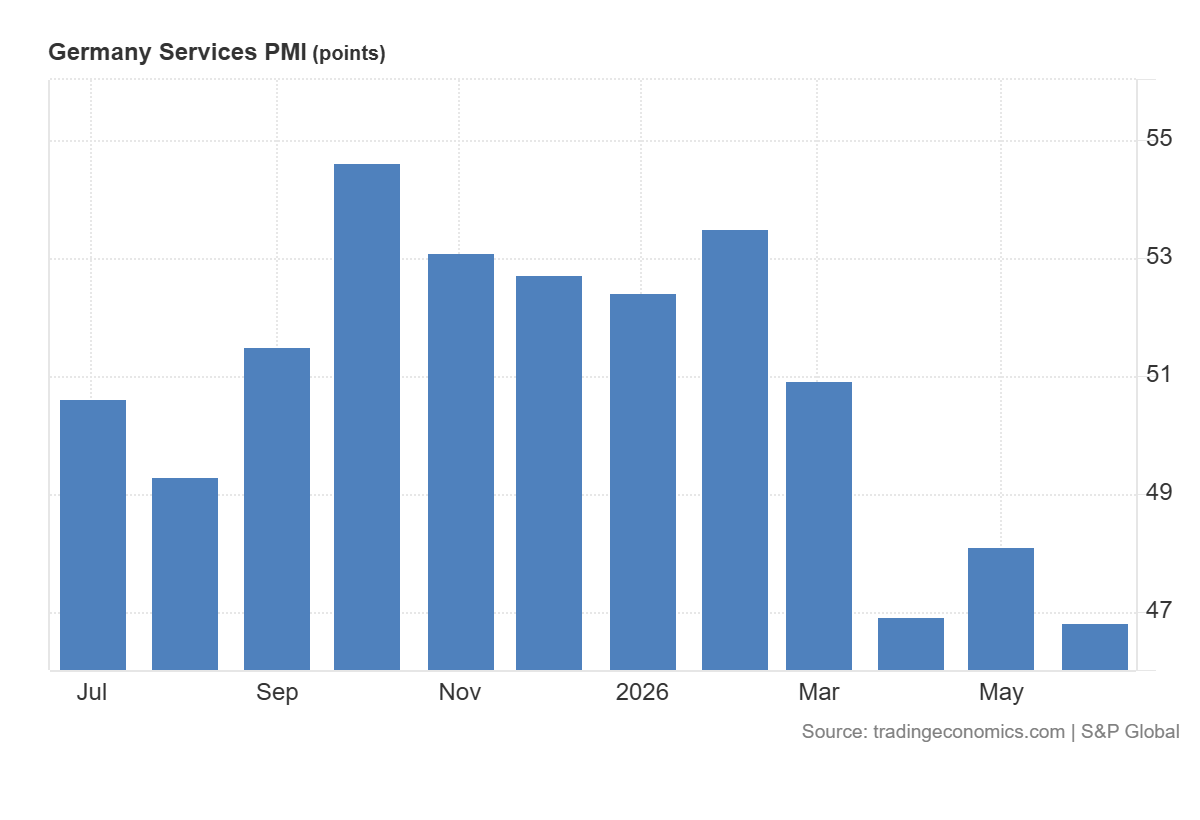
- Recent data: Germany’s preliminary services PMI came in at 46.8 in June
- Market impact: the data creates a positive backdrop for the German stock market
DE 40 fundamental analysis
Germany’s services PMI data looks negative for the DE 40 index, with the actual reading coming in at 46.8 points, below the forecast of 49.0 and the previous 48.1. Since a reading below 50.0 points indicates a contraction in business activity, the market may interpret this publication as a signal of deterioration in the German economy, particularly in domestic demand and the services sector.
For the DE 40 index, this news creates pressure, all else being equal. Investors may revise expectations for revenue and earnings at German companies, especially those whose businesses depend on consumer spending, corporate services, lending, and domestic economic activity. A weaker PMI reading also increases concerns that the German economy remains vulnerable and that the recovery may prove slower than previously expected. In the short term, this may reduce demand for German equities and increase caution among market participants.
DE 40 technical analysis
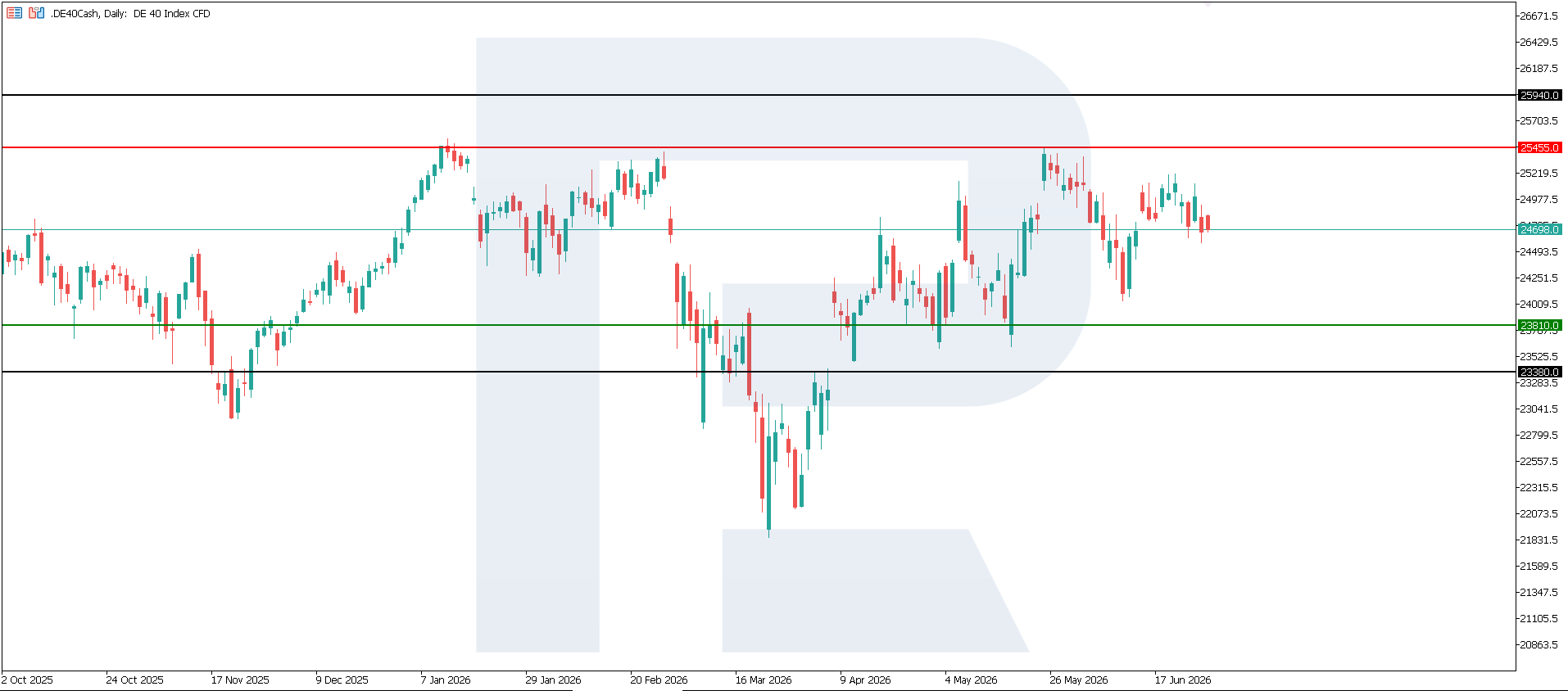
For the DE 40 index, the nearest resistance level has formed at 25,455.0, while the key support level is located near 23,810.0. Quotes continue to move within a sideways range, indicating persistent uncertainty among market participants. However, the medium-term uptrend remains in place, as the index is holding above significant support levels. If demand from buyers resumes and quotes consolidate above the current resistance level, the index may move into a new growth phase, with the nearest upside target at 25,940.0.
The DE 40 price forecast outlines the following scenarios:
- Pessimistic DE 40 scenario: a breakout below the 23,810.0 support level could send the index down to 23,380.0
- Optimistic DE 40 scenario: a breakout above the 25,455.0 resistance level could boost the index to 25,940.0
Summary
Overall, Germany’s services PMI release is a negative signal for the DE 40 and the German stock market. It indicates weakening business activity, worsening expectations for economic growth, and potential risks to corporate earnings. The main pressure may affect cyclical and consumer sectors, while defensive companies may appear relatively more resilient. However, the final market reaction will depend on which factor investors consider more important: fear of an economic slowdown or expectations of a more accommodative ECB policy. The nearest upside target remains 25,940.0.
Editors’ picks

EURUSD forecast 2026–2027: technical analysis, price levels & predictions
The ECB holds rates at 2.15% while the Fed stays at 3.75% — and that divergence is the central driver of EURUSD in 2026. The pair is range-bound between 1.1400 and 1.1915, with Deutsche Bank targeting 1.2500 and Morgan Stanley calling for 1.3000 by year-end. We analyse the technicals, break down the macro factors, and outline three trading scenarios with specific entry levels.

Gold (XAUUSD) forecast 2026: predictions based on fundamental and technical analysis
Where is gold headed after pulling back from the all-time high of 5,597 USD? XAUUSD is consolidating near 4,518 USD between key levels 4,220 USD and 4,855 USD, with major banks targeting 5,243–6,200 USD by year-end. Read our comprehensive gold forecast: technical analysis across three timeframes, trading scenarios with specific entry levels, Fed policy and central bank demand outlook, and institutional predictions for 2026 and beyond.
Ang mga pagtataya na ipinakita sa seksyong ito ay nagpapakita lamang ng pribadong opinyon ng may-akda at hindi dapat ituring bilang gabay para sa pagtetrade. Walang pananagutan ang RoboForex para sa mga resulta ng pagtetrade batay sa mga rekomendasyon sa pagtetrade na inilarawan sa mga analytical review na ito.