
EURUSD Forecast 2026–2027: Technical Analysis, Price Levels & Predictions
Disclaimer: This article is prepared on the basis of reputable financial sources and analytical data from RoboForex specialists. It reflects the conclusions of thorough research; however, economic changes may significantly affect market conditions and alter the EURUSD forecast. We recommend conducting your own research and consulting with professionals before making financial decisions.
EUR/USD is trading near 1.1220 as of 21 October 2026, below both the 65 and 200 moving averages on the daily chart. After a sharp decline the pair has spent the last week in a corrective phase. The two central banks are moving in the same direction at different levels: the Federal Reserve raised its rate to 4.00% on 16 September, its first hike since 2023, while the European Central Bank raised its rate to 2.65% on 10 September. Eurozone inflation reached 3.8% in September and US CPI rose to 3.7%. Both central banks meet next week, the Fed on 27-28 October and the ECB on 28-29 October. The main support is 1.1000. A close below it would extend the decline toward 1.0505 and then parity at 1.0000. A close above 1.1500 would be the first sign that buyers are returning.
Key takeaways: EURUSD forecast
- Market structure: Downward trend with a corrective phase. Price is near 1.1220.
- Key resistance: 1.1500 (R1), then 1.1805 (R2). A close above 1.1500 is the first signal of a recovery.
- Key support: 1.1000 (S1), then 1.0505 (S2). The recent low near 1.1111 is the first level to watch.
- Active scenario: Bearish. Price can continue the downward wave and test 1.1000. A break above 1.1500 opens the way to 1.1805 and 1.1915.
- Main risk: Tougher Fed rhetoric and a stronger US dollar. Escalation in the Middle East would also push energy prices and inflation higher.
| Horizon | Min | Max | Bias |
|---|---|---|---|
| This week | 1.1185 | 1.1234 | Sideways |
| This month | 1.1111 | 1.1336 | Bearish |
| End of 2026 (long-term view) | 1.1000 | 1.2500 | Bullish |
| 2027 (long-term view) | 1.1000 | 1.3000 | Bullish |
EURUSD technical analysis
EURUSD fell from about 1.17 in August to a low near 1.1111 in October and has since moved into a corrective phase around 1.1220. On the daily chart price sits below both moving averages, and both averages slope down. The weekly chart shows price at the lower Bollinger band, which can produce a rebound, while the monthly timeframe stays on Sell. Short-term indicators are turning up from oversold levels, which makes the next move a test of the 1.1500 resistance or of the 1.1000 support.
Indicator summary
| Indicator | Daily (D) | Weekly (W) | Monthly (M) |
|---|---|---|---|
| MA 65 / 200 | Sell | Neutral | Neutral |
| RSI (14) | Buy | Neutral | Sell |
| MACD (12/26/9) | Buy | Buy | Sell |
| Stochastic (20/15/15) | Buy | Buy | Sell |
| Overall signal | Buy | Neutral | Sell |
Daily timeframe (D1)
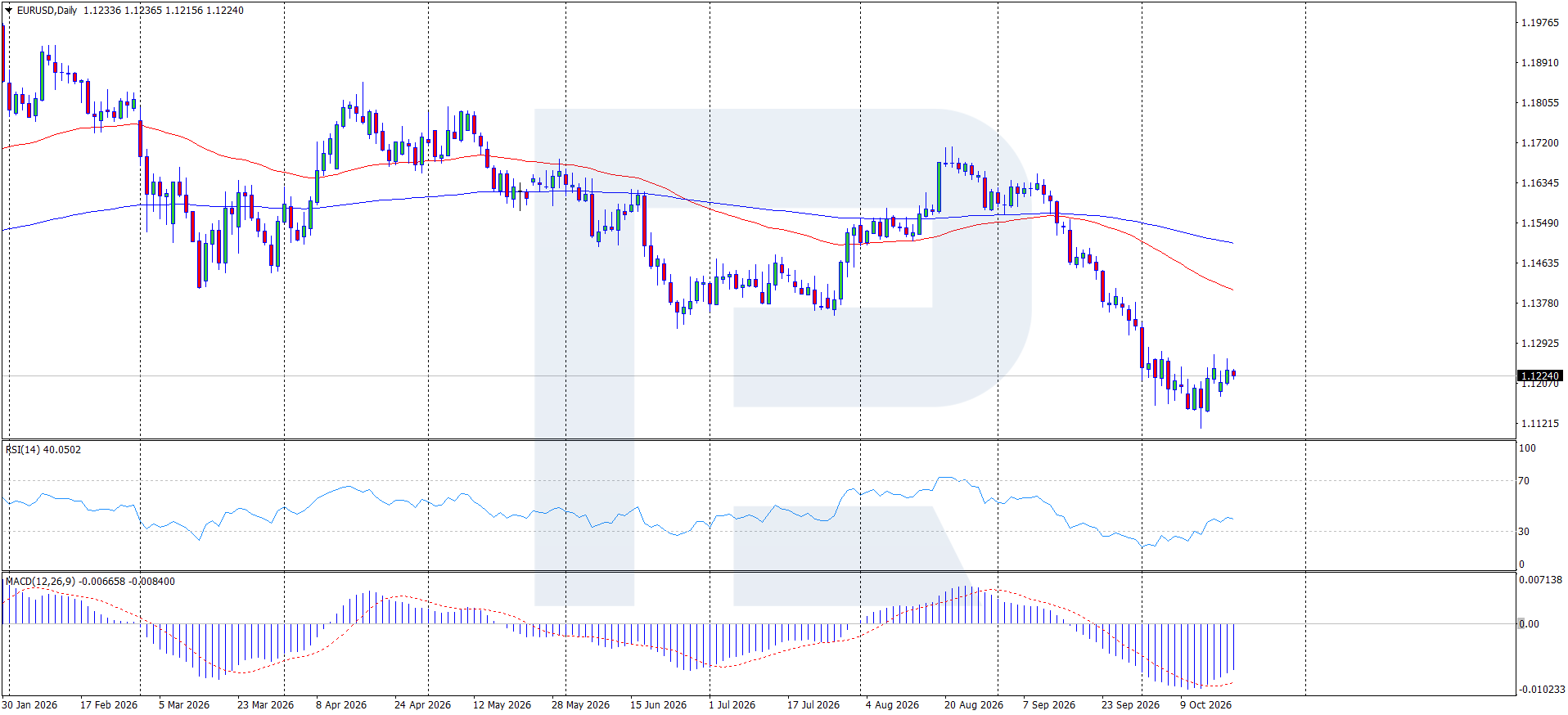
On the D1 chart, EURUSD forms a correction after breaking below the EMA65 and EMA200. Both averages have sloped down since the EMA65 crossed below the EMA200, and price has stayed under them. Over the last week price has been correcting after the fall. RSI(14) is near 41 and keeps moving up from the 30 level, which points to a possible start of an upward move. The MACD histogram is below zero and shrinking, and the signal line has left the histogram zone and is also moving toward zero.
The trend is still down with periodic corrections, but two indicators already signal a possible change. A cross of the EMA65 above the EMA200 would be the confirmation for long positions. Until then the bounce stays a correction inside the downward structure.
H4 timeframe
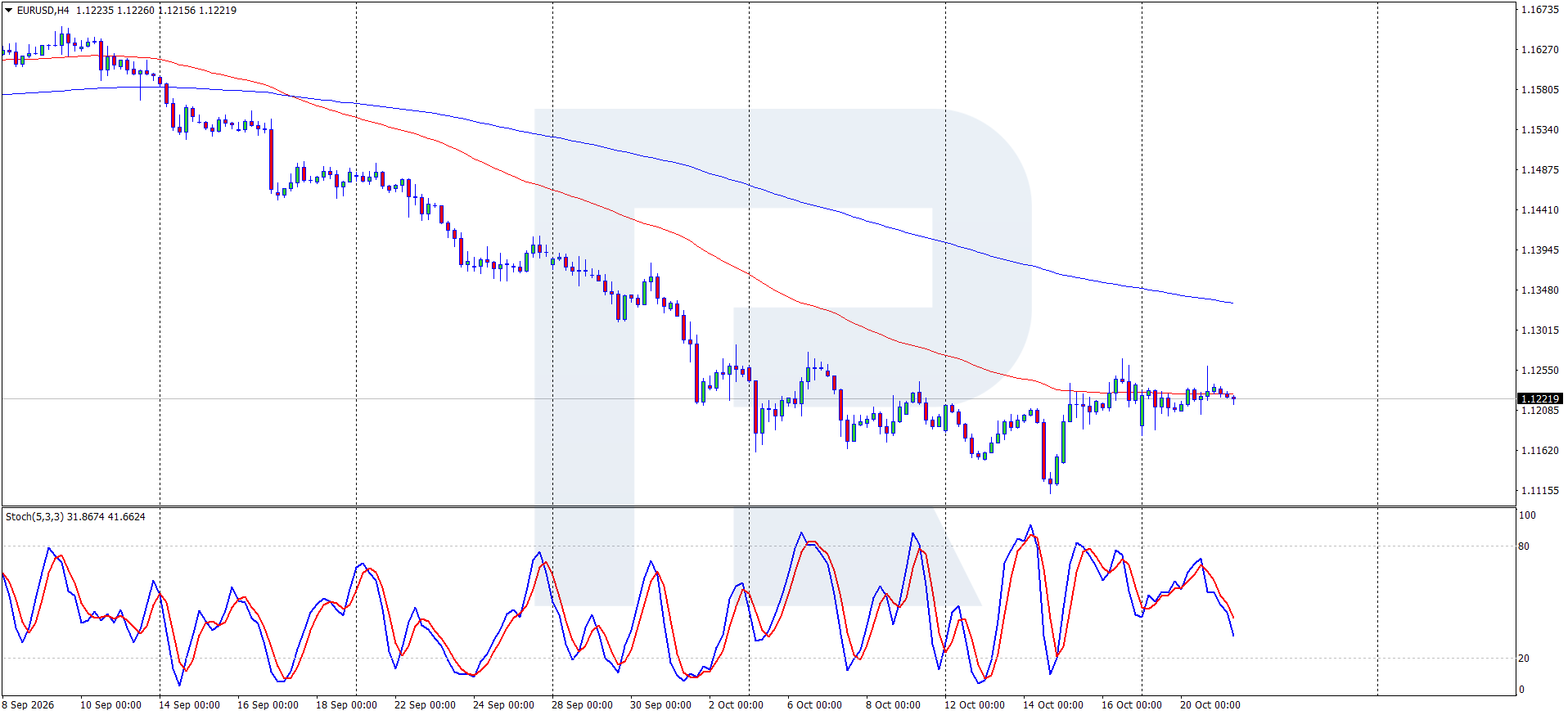
On the H4 chart, EURUSD trades near 1.1220, around the EMA65 and below the EMA200. The averages have stopped falling together: the EMA65 is flattening under the price, and the pair is consolidating while it waits for a trigger. The Stochastic oscillator is falling toward the 20 level, a signal for a possible decline in the near term.
The first target for a decline is support at 1.1180. From there the pair can bounce and form an upward wave toward 1.1500. A deeper correction toward 1.1000 cannot be ruled out before any rise starts.
Weekly timeframe (W)
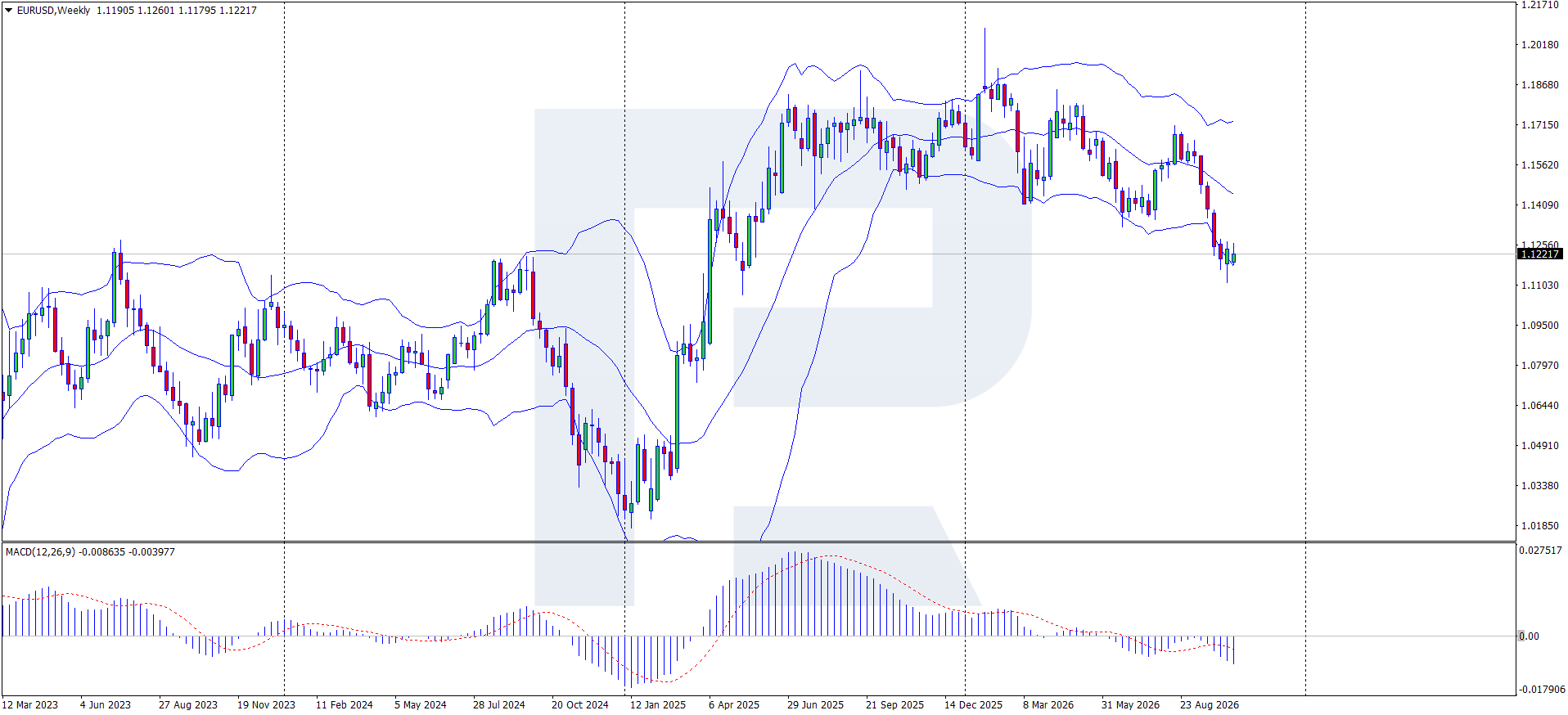
On the weekly chart, EURUSD is testing 1.1220 at the lower Bollinger band, which points to a possible rebound as an upward wave. For now price is forming a corrective wave. The weekly MACD histogram is below the zero level, and the signal line sits near the histogram, also below zero.
In the long term price can form a growth wave. A return to 1.1500 and a weekly close above it would be the signal for a new upward move.
Trading scenarios
Bullish scenario
A break above the 1.1500 resistance and a hold over it show that buyers prevail. Price can then continue the upward move and test 1.1805 and 1.1915.
| Entry trigger | Close above 1.1500 |
| Invalidation | Close below 1.1500 |
| Target 1 | 1.1805 |
| Target 2 | 1.1915 |
Bearish scenario
A break of the recent low shows that sellers are gaining strength and the US dollar is firming. After a test of 1.1000, EURUSD can continue the decline toward 1.0000.
| Entry trigger | Close below 1.1100 |
| Invalidation | Close above 1.1500 |
| Target 1 | 1.1000 |
| Target 2 | 1.0000 |
Sideways scenario
If price keeps moving in a sideways range, a buy on a pullback to support is an option, targeting the upper part of the range.
| Entry trigger | Bounce from 1.1111 low |
| Invalidation | Close below 1.1100 |
| Target 1 | 1.1500 |
| Target 2 | 1.1800 |
Key EURUSD price levels
The levels below come from structural analysis of the Daily and Weekly charts: swing highs and lows, Bollinger band references and round numbers. 1.1500 is the first barrier above the price, and 1.1805 is the level the bull case needs to reach next.
| Type | Level | Significance |
|---|---|---|
| Resistance 3 (R3) | 1.1915 | Price has bounced off this level several times, changing direction each time. |
| Resistance 2 (R2) | 1.1805 | Upper Bollinger band. It has repeatedly acted as resistance, and price bounced from it. |
| Resistance 1 (R1) | 1.1500 | Round psychological level. Price stopped here in the past and bounced. The first barrier above the current price. |
| Pivot (P) | 1.1200 | Test of the middle Bollinger band, a psychological level where price bounced several times. |
| Support 1 (S1) | 1.1000 | Former key resistance that price broke through on the third attempt. Now the main support. |
| Support 2 (S2) | 1.0505 | Round psychological level. Price stopped here in the past and bounced. |
| Support 3 (S3) | 1.0000 | Parity between the euro and the US dollar. |
Psychological levels: round numbers 1.0000, 1.1200, 1.1400 and 1.1500 have a history of stopping price several times before it breaks through. When a round level fails to break, it often becomes the point where the trend changes direction.
What drives the EURUSD exchange rate
ECB policy
The European Central Bank raised its key rate to 2.65% on 10 September, its second hike of 2026. The Governing Council added 25 basis points unanimously. It said the Middle East conflict keeps generating inflation pressure and that inflation will stay well above target for a long time. President Christine Lagarde stressed that decisions will be taken meeting by meeting, with no commitment on the rate path. The next meeting is on 28-29 October 2026.
The ECB returned to tightening after eight rate cuts in 2024 and 2025. Eurozone inflation reached 3.8%, and as of 5 October markets priced about a 20% chance of a hike in October and about 80% in December. Markets now expect another hike in December, although the decision is not set. The talk of easing is over, and the debate has moved to how many hikes the ECB will deliver.
Fed policy
The Federal Reserve rate is 4.00%. On 16 September the FOMC voted 12-0 to raise it by 25 basis points, the first hike since 2023. The statement said inflation remains elevated and that the decision supports a more timely return to the 2% goal. The minutes showed that 16 of the 18 FOMC members see at least one more hike before the end of the year. Under Chair Kevin Warsh the Fed has moved from waiting to active tightening, and markets that discussed cuts in August now price further hikes. The next meeting is on 27-28 October 2026.
The gap with the ECB, whose rate is 2.65%, supports the dollar. Expectations became less clear after inflation accelerated. According to CME FedWatch on 20 October, the probability of a 25 basis point hike at the October meeting was about 50.4%, and the probability of no change about 49.6%. These are market expectations, not a Fed decision.
Inflation gap
Eurozone inflation accelerated from 3.2% to 3.8%, mainly because of higher energy prices. This adds pressure on the ECB and raises the chance of further tightening. In the US, CPI rose from 3.4% to 3.7%, and core inflation rose to 2.6%. Higher gasoline prices increase inflation risks and may keep the Fed rate high for longer, or lead the Fed to consider another hike.
The gap in headline inflation is about 0.1 percentage point, with eurozone inflation slightly higher. US CPI and eurozone HICP use different methodologies, so the comparison is approximate. The inflation gap does not give EURUSD a clear edge. Faster price growth in the eurozone can support the euro if markets expect a tougher ECB, while high US inflation limits the room for Fed easing and can support the dollar. The direction of the pair depends on which central bank markets expect to hike more and for longer.
Growth gap
Forecasts for the third quarter point to US GDP growth above 4% annualised, or above 1% quarter on quarter, while BNP Paribas estimates eurozone growth at about 0.4% quarter on quarter. These are forecasts, since third-quarter GDP is not published yet. The most recent published figures are 0.5% for the eurozone and 2.2% for the US. US growth is about 2.5 times faster than European growth in the narrow quarterly view.
A stronger US economy supports the dollar in two ways. Yield spreads favour the US, where growth is stronger and the Fed rate is 4.00% against 2.65% at the ECB. The energy shock and geopolitical tension also hit the eurozone harder than the US, which makes the dollar the safer holding in portfolios. The US economy is also supported by AI investment spending, and private final sales show steady momentum. The eurozone economy is growing, only too slowly and unevenly to compete with US growth, so a strong quarterly eurozone print does not automatically weaken the dollar's advantage.
Dollar index and geopolitics
The US Dollar Index (DXY) is near 101.85. After rising to 18-month highs it pulled back slightly, but it remains at an elevated level. Expensive energy and the conflict around Iran support demand for safe-haven assets and the dollar. For EURUSD, political and budget instability in France is an extra negative factor, because it raises French government bond yields and puts pressure on the euro. US trade tariffs also keep inflation risks alive and support expectations of tougher Fed policy. In the short term the balance of risks stays tilted toward the dollar, although lower geopolitical tension could weaken this effect.
What could push EURUSD lower
| Risk | Why it matters now |
|---|---|
| Fed tightening (rates staying high for longer) | A further Fed hike makes USD assets more attractive and pushes EURUSD lower. The euro stays at a disadvantage with its lower rate. |
| Sustained dollar strength (DXY above 105) | A DXY above 105.00 would draw investors into USD, since a strong dollar offers high yields. |
| Slowdown in the eurozone or recession risk | The eurozone is losing ground to the US. If energy prices keep rising, weakening industry could slide into losses and tip the region into recession. |
| ECB cutting faster than the Fed | A rate cut by the ECB would weaken the euro against the dollar. In this scenario EURUSD could reach parity. |
| Geopolitical escalation and lower risk appetite | Further escalation in the Middle East supports the dollar as a safe haven and pulls capital out of riskier assets. |
Bank forecasts
Major banks published their EURUSD targets for the end of 2026 in September and October. The targets range from 1.1000 to 1.1700, and the latest revisions by ING and Nordea moved lower. Targets older than three months are not included.
| Bank | Target | Horizon | Date of forecast |
|---|---|---|---|
| Deutsche Bank | 1.1700 | End of 2026 | September 2026 |
| Bank of America | 1.1500 | End of 2026 | September 2026 |
| UBS | 1.1600 | End of 2026 | October 2026 |
| ING | 1.1300 | Q4 2026 | October 2026 |
| Nordea | 1.1000 | End of 2026 | October 2026 |
Trade EURUSD with tight spreads on MobileTrader and MetaTrader 5.
Open an accountFAQ
What is the EURUSD forecast for the next week?
EURUSD trades near 1.1220 and moves sideways. A test of 1.1500 and a hold above it would show buyers gaining strength and open the way to 1.1805. If sellers take control, price can fall toward 1.1000 and then 1.0505.
What are the key support and resistance levels for EURUSD?
Key resistance: 1.1500 (R1, the first barrier above the price), 1.1805 (R2, upper Bollinger band), 1.1915 (R3). Pivot: 1.1200. Key support: 1.1000 (S1, the main support), 1.0505 (S2), 1.0000 (S3, parity). See the Key Price Levels table for the full picture.
Is EURUSD bullish or bearish right now?
The daily chart shows a corrective phase after a decline, and buyers and sellers are balanced for now. Price trades below the 65 and 200 moving averages, and the H4 chart is consolidating. The bias stays bearish while price is below 1.1500, and a close above that level would change the picture.
Will EURUSD reach 1.2000?
Bank targets for the end of 2026 range from 1.1000 to 1.1700, so 1.2000 sits above all of them. EURUSD would need to break above 1.1805 first. The move becomes more likely if the Fed softens its tone and the US dollar weakens.
What drives the EURUSD exchange rate?
The rate reflects the contest between the US and eurozone economies. The main factors are the gap between the Fed and ECB rates, the inflation gap, the difference in GDP growth, the dollar index (DXY), geopolitics and capital flows.
How does the Federal Reserve interest rate affect EURUSD?
A higher Fed rate makes the US dollar more attractive to investors, so the dollar strengthens against the euro and EURUSD falls. The Fed rate is 4.00%, compared with 2.65% at the ECB, which favours the dollar.
What is the EURUSD forecast for 2026?
RoboForex Analysis Department places the end-2026 range at 1.1000 to 1.2500 with a long-term bullish view, while the short-term bias is bearish. Bank targets for end-2026 range from 1.1000 (Nordea) to 1.1700 (Deutsche Bank).
How is the EURUSD forecast on this page prepared?
The forecast combines technical analysis on the Daily, H4 and Weekly charts (MA 65/200, RSI 14, MACD 12/26/9 and Stochastic) with fundamental data (ECB and Fed policy, inflation, GDP, the dollar index and geopolitics) and published forecasts from major banks. RoboForex Analysis Department reviews the article regularly.
What is EURUSD?
EURUSD is the exchange rate of the euro against the US dollar. It shows how many dollars one euro buys. At 1.1500, one euro costs 1.1500 dollars. EURUSD is the most traded currency pair in the world.
Forecasts presented in this section only reflect the author’s private opinion and should not be considered as guidance for trading. RoboForex bears no responsibility for trading results based on trading recommendations described in these analytical reviews.