
DE 40 forecast: the index is testing the support level
During the correction, the DE 40 stock index began to test the support level, which could lead to a trend reversal. The DE 40 forecast for today is positive.
DE 40 forecast: key takeaways
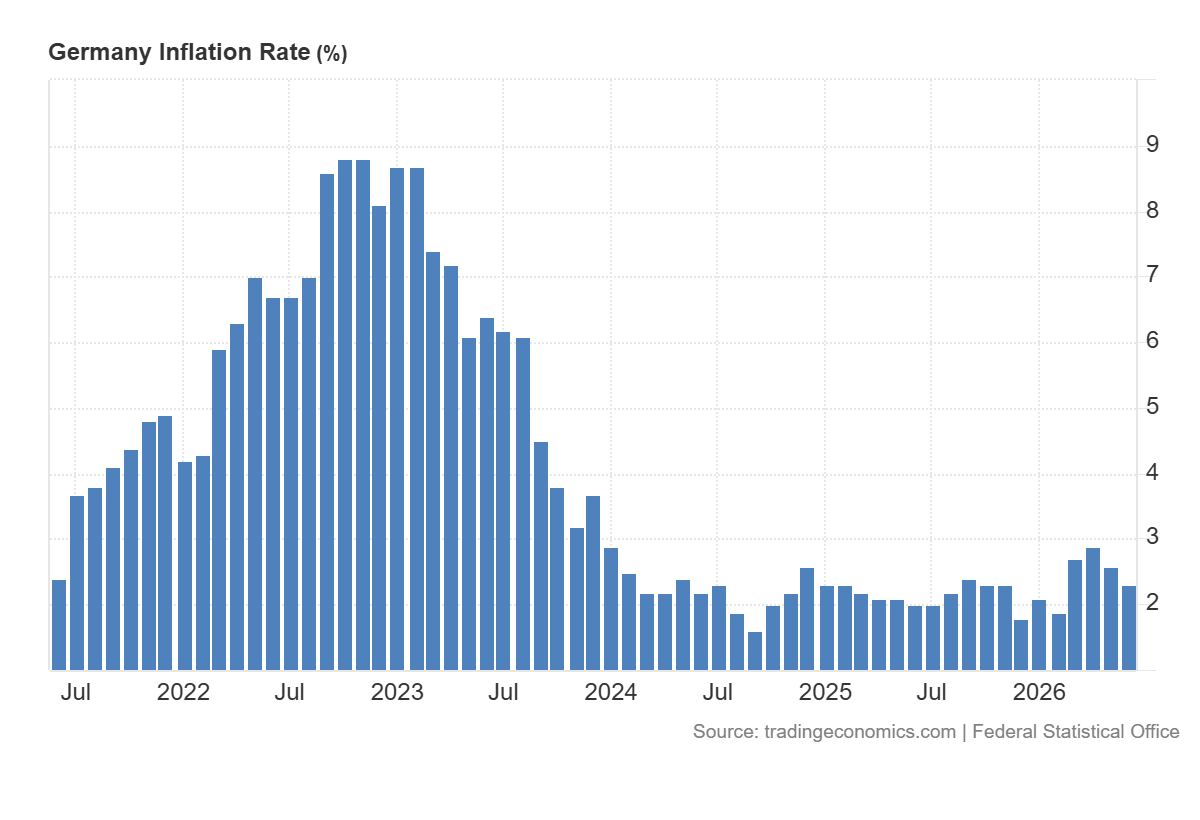
- Recent data: Germany’s CPI rose by 2.3% year-on-year in June
- Market impact: the data creates a moderately positive backdrop for the German stock market
DE 40 fundamental analysis
The German inflation data release has a moderately positive, but limited, impact on the DE 40 index. The annual Consumer Price Index slowed from 2.6% to 2.3% in June, while prices fell by 0.3% month-on-month. At the same time, the published figures were fully in line with the forecast and confirmed the preliminary estimate, so much of the information had already been factored into stock prices before the final data was released. For this reason, the publication itself is unlikely to trigger a sharp rise in the DE 40, although it creates a more favourable backdrop for the German stock market.
For the DE 40, this could result in growing interest in stocks of companies focused on domestic consumption, industry, and capital expenditure. Slower price growth supports household purchasing power and reduces the likelihood of a sharp fall in consumer spending. At the same time, lower inflation typically leads to a decline in government bond yields, as investors begin to expect less restrictive monetary policy.
DE 40 technical analysis
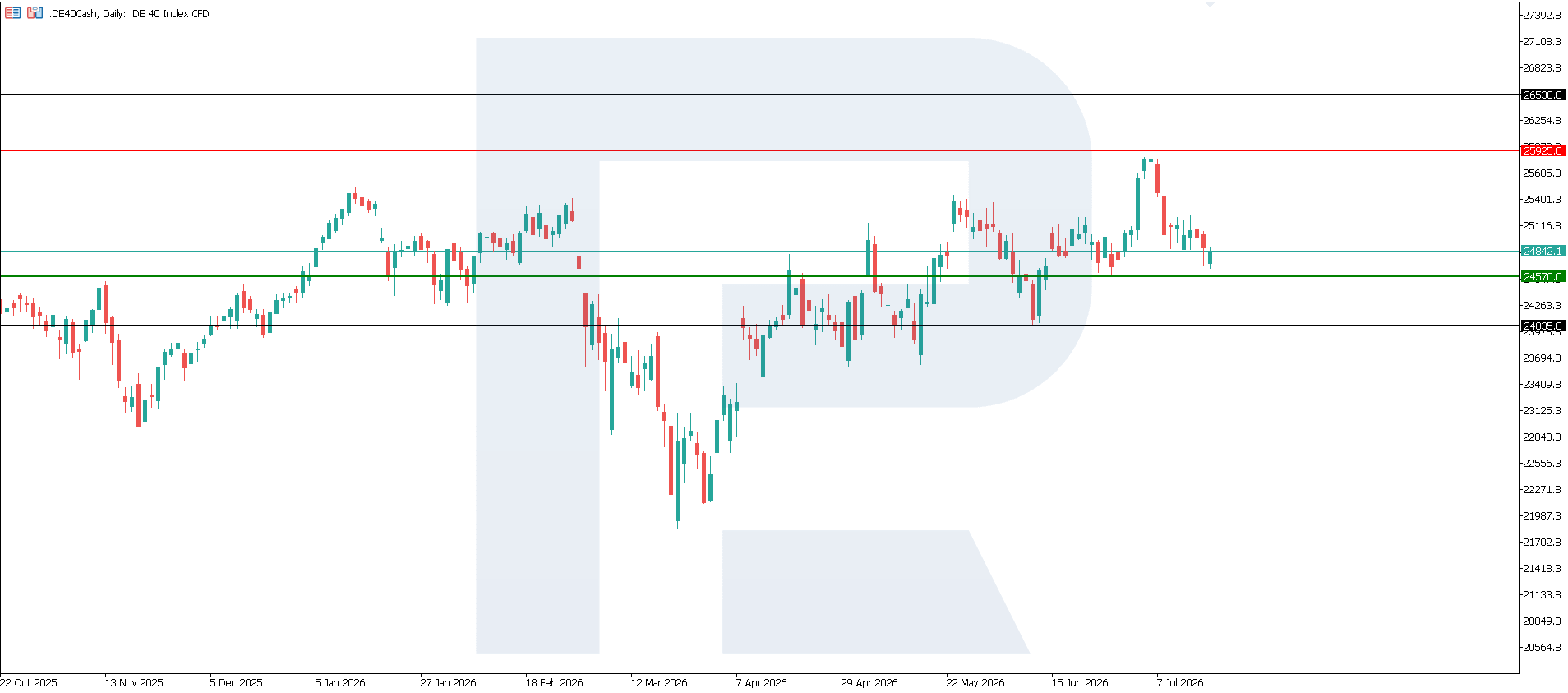
The DE 40 index moved into a corrective decline after hitting a new all-time high. The nearest resistance level formed at 25,925.0, while the key support level is located at 24,570.0. Despite the current correction, the medium-term uptrend remains intact. Only a breakout below the support level could signal a trend reversal. If growth resumes, the next target could be 26,530.0.
The DE 40 price forecast outlines the following scenarios:
- Pessimistic DE 40 scenario: a breakout below the 24,570.0 support level could push the index down to 24,035.0
- Optimistic DE 40 scenario: a breakout above the 25,925.0 resistance level could propel the index up to 26,530.0
Summary
Overall, the release creates a moderately positive backdrop for the DE 40 and the German stock market, but it is not a sufficiently strong basis for sustained growth in the index. The fact that the actual result matches the forecast reduces the likelihood of a pronounced initial reaction. Consumer, industrial, chemical, technology, and real estate-related companies may receive the main support. The nearest upside target remains 26,530.0.
Editors’ picks

EURUSD forecast 2026–2027: technical analysis, price levels & predictions
EURUSD has pulled back from the 2026 high of 1.1915 and is now trading near 1.1450 — below both EMA65 and EMA200 — with the active scenario shifting from bullish to bearish. The ECB raised rates to 2.40%, but the Fed holds at 3.75%, and US inflation (3.5%) continues to outpace the eurozone (2.8%). A confirmed break below 1.1280 opens the next downward wave toward 1.1080. We break down the key levels, three trading scenarios with entry triggers, and what Deutsche Bank, Morgan Stanley and UBS are forecasting for EURUSD in 2026.

Gold (XAUUSD) forecast 2026: predictions based on fundamental and technical analysis
Gold has corrected over 25% from its all-time high of 5,597 USD and is now trading near 4,100 USD — testing a critical support zone. Is this the bottom, or will the downtrend continue? We break down the key levels (support 3,920 USD, breakout trigger 4,500 USD), three trading scenarios with entry levels, and what J.P. Morgan, Goldman Sachs and Deutsche Bank are forecasting for gold in 2026.
Ang mga pagtataya na ipinakita sa seksyong ito ay nagpapakita lamang ng pribadong opinyon ng may-akda at hindi dapat ituring bilang gabay para sa pagtetrade. Walang pananagutan ang RoboForex para sa mga resulta ng pagtetrade batay sa mga rekomendasyon sa pagtetrade na inilarawan sa mga analytical review na ito.