
Stock market outlook for the week of 16–20 November 2026: key levels for world indices
Global stock indices begin the week amid heightened uncertainty. Investors are assessing the outlook for Federal Reserve monetary policy, returns on investment in artificial intelligence, corporate earnings, and the state of leading economies, with additional focus on US inflation data and central bank decisions.
Key levels for the week
| Instrument | Week | Support | Resistance | Scenario |
|---|---|---|---|---|
| US 500 | −2.7% | 7,350.0 | 7,507.0 | Sell below 7,350.0 |
| US Tech | −3.2% | 26,598.0 | 27,815.0 | Sell below 26,598.0 |
| US 30 | 3.4% | 50,955.0 | 51,885.0 | Buy above 51,885.0 |
| DE 40 | 3.8% | 25,690.0 | 26,157.0 | Buy above 26,157.0 |
| JP 225 | −2.2% | 57,000.0 | 60,520.0 | Sell below 57,000.0 |
Events that can move indices this week
| Date | Event | Instruments affected |
|---|---|---|
| Tuesday, 10 November 2026 | US CPI for October | US 500, US 30, US Tech |
| Wednesday, 11 November 2026 | German CPI | DE 40 |
| Thursday, 12 November 2026 | US initial jobless claims | US 500, US 30, US Tech |
| Friday, 13 November 2026 | Eurozone GDP | DE 40 |
| Friday, 13 November 2026 | US Producer Price Index (PPI) | US 500, US 30, US Tech |
US indices forecast: US 30, US 500, and US Tech
Fundamental analysis
The US market is under pressure as investors reassess technology company valuations and worry that large-scale investments in artificial intelligence may fail to deliver the expected returns. Strong labour market data adds to uncertainty, with investors increasingly factoring in the possibility of a Federal Reserve rate hike in December. Slowing inflation could ease concerns about further monetary tightening by the Fed. Conversely, rising inflation would intensify pressure on the stock market through higher bond yields and a higher cost of capital.
Technology companies have come under pressure amid investors' doubts about the returns on capital expenditure on AI infrastructure. The Nasdaq lost 5.5% in one trading session last week, while companies' market capitalisation fell by approximately 2.5 trillion USD. Interest in risk assets is recovering at the start of the new week, but the sustainability of the rebound remains to be tested.
Confirmation of strong demand for computing capacity and improved profit forecasts could bring buyers back. If AI spending continues to grow faster than revenue, pressure on technology stocks may persist.
For the US 30, the resilience of consumer demand, production costs, and the outlook for industrial businesses are important. Unlike the technology sector, the index depends more heavily on the results of traditional industrial, financial, and consumer companies. A strong labour market supports economic activity but also complicates the Fed's efforts to contain inflation. Slowing inflation alongside sustained consumer activity could support the industrial and financial sectors. However, high inflation and the prospect of tighter Fed monetary policy could undermine investor sentiment.
US 500 technical analysis
The US 500 began the trading week by extending its corrective wave following last week's sharp decline. After rebounding from the 7,350 support level, the US 500 tested resistance at 7,430. Prices may now complete the correction and resume their decline, with support at 7,350 as the first target. A breakout below this level would open the way for a continued downward movement, with the next potential target at 7,310.
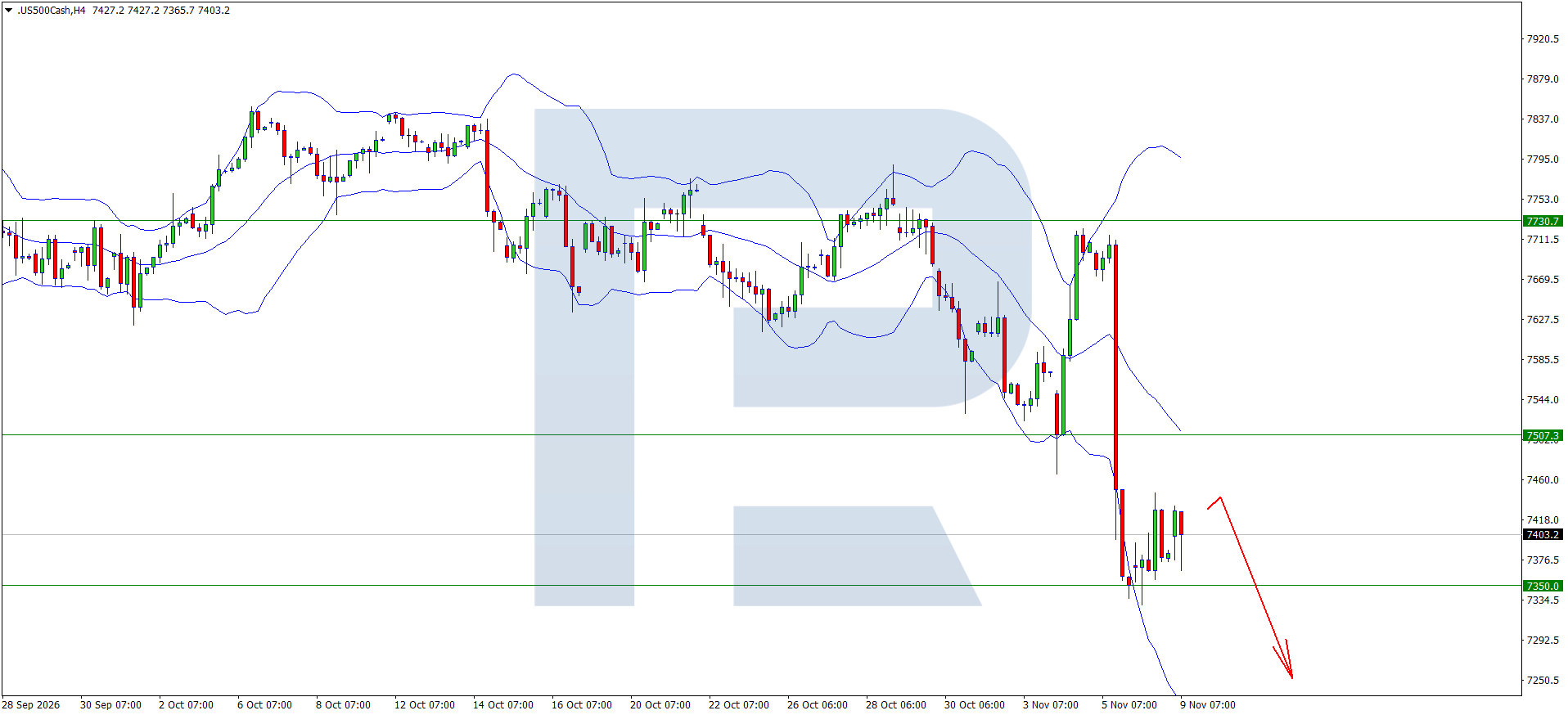
US 500 trading scenario
US Tech technical analysis
The US Tech index is undergoing a correction following last week's decline. The price continues to rebound from the 26,598 support level, while fading upward momentum signals that the rebound may be nearing its end. Prices could subsequently return to the support area and, following a breakout below it, continue the downtrend. The next downside target would be the 24,820 support level.
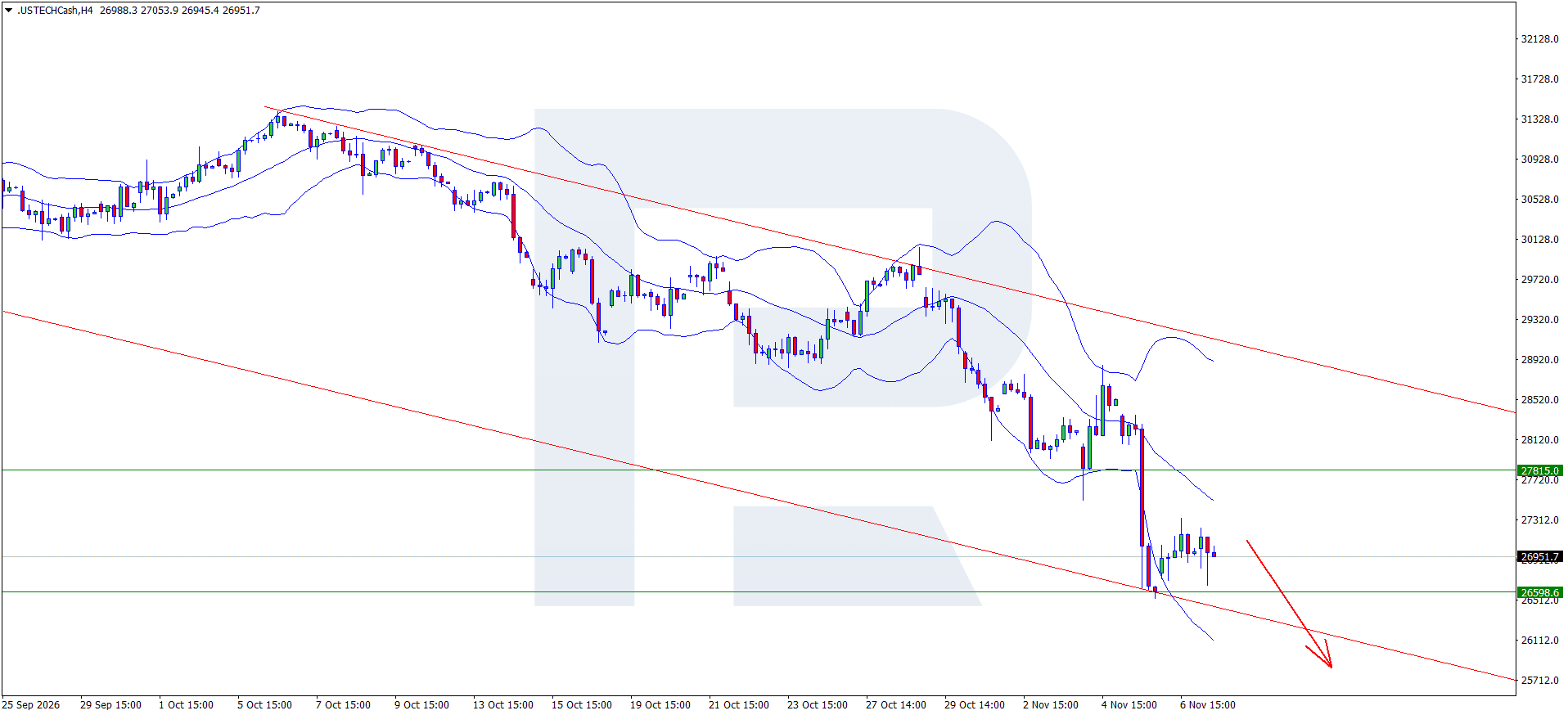
US Tech trading scenario
US 30 technical analysis
Following last week's decline, the US 30 index is correcting after rebounding from support at 50,955. At this stage, a breakout above resistance at 51,885 could signal the continuation of the upward wave, with the next resistance level at 52,780 as the upside target.
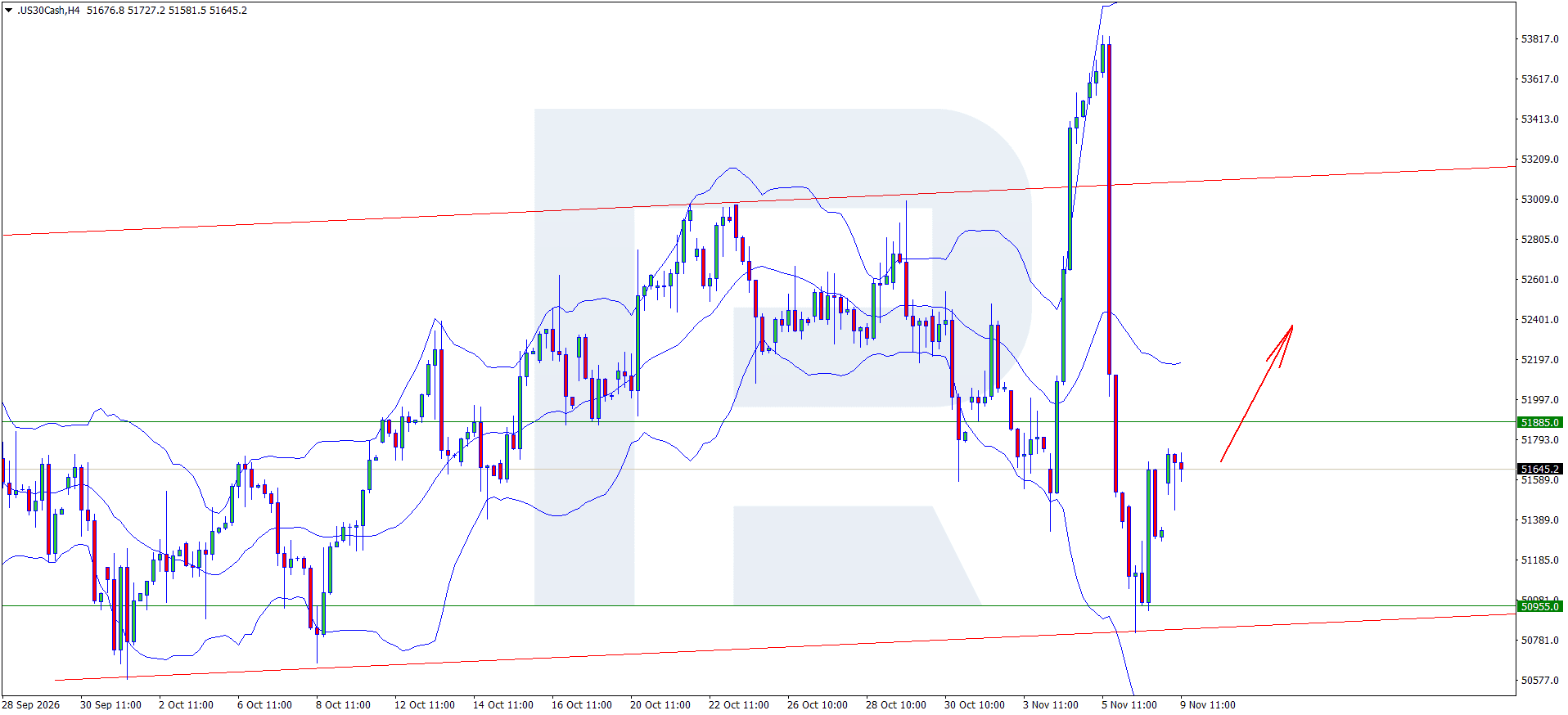
US 30 trading scenario
European index forecast: DE 40
Fundamental analysis
The German market is entering a week packed with earnings reports. Financial results from leading industrial, insurance, and technology companies will be in focus. Energy costs, export demand, and the prospects for a recovery in the German economy are also significant. Strong results from German corporations and easing inflationary pressure could support the DE 40. Meanwhile, weak forecasts from the industrial sector, deteriorating export demand, and signs of an economic slowdown in the eurozone will remain negative factors for the index.
DE 40 technical analysis
The DE 40 index continues to rise after rebounding from the 25,690 support level. As the price remains within an ascending channel, a breakout above resistance at 26,157 would signal a continued upward wave, with the target at the next resistance level at 26,630.
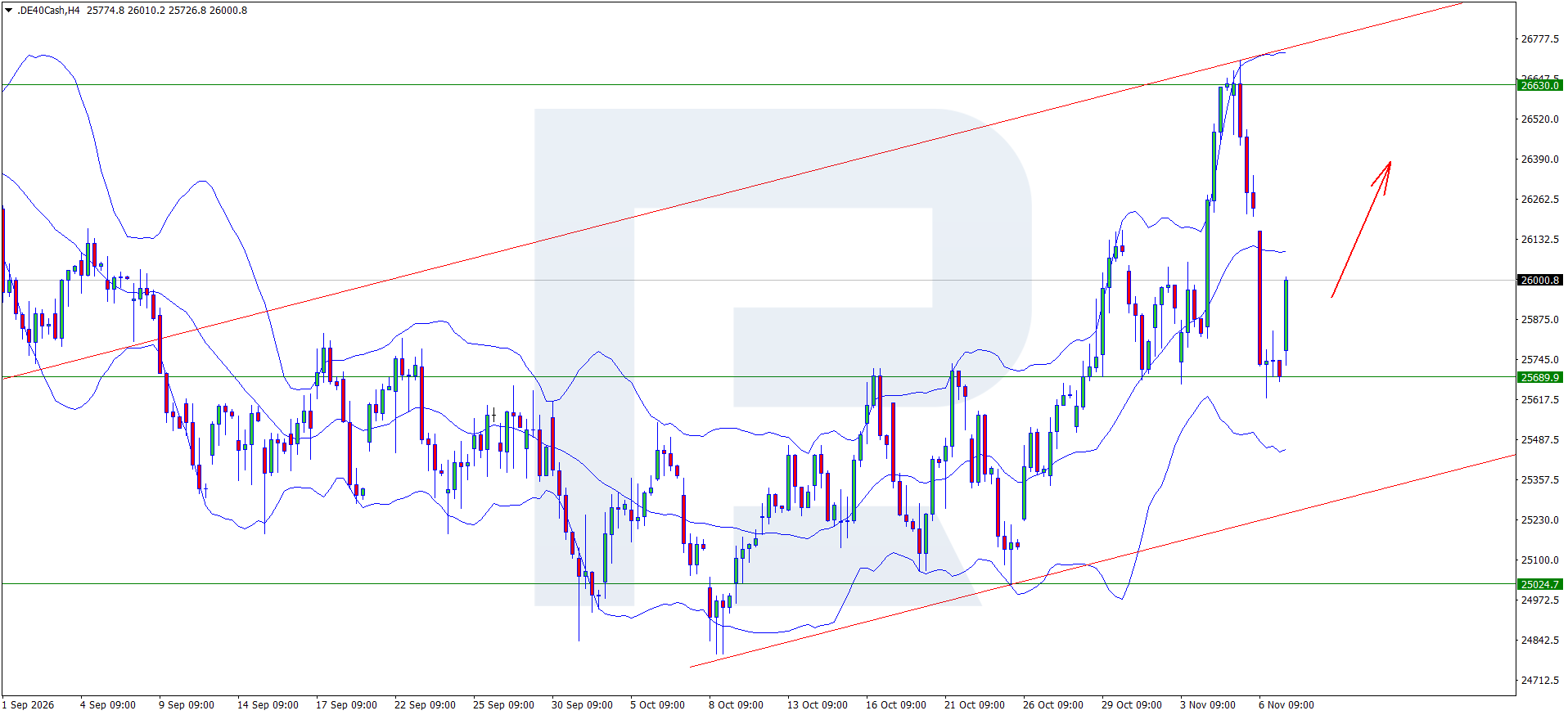
DE 40 trading scenario
Asian index forecast: JP 225
Fundamental analysis
The Japanese market is starting the week with a notable recovery, with the JP 225 gaining around 3.5% amid improving sentiment across Asian markets. Investors are returning to buying after the previous decline in technology shares. However, risks associated with AI company valuations, the yen exchange rate, and potential changes to Bank of Japan monetary policy remain. A recovery in global demand for technology products and favourable earnings reports from Japanese exporters could support the JP 225. More hawkish signals from the Bank of Japan and a stronger yen could limit gains in shares of export-oriented companies.
JP 225 technical analysis
The JP 225 index continues to correct amid the broader downtrend. The price has rebounded from support at 57,000 and may now complete the correction. A return to the 57,000 support level followed by a breakout below it could signal another downward wave. In this case, the next support at 55,800 would be the downside target.
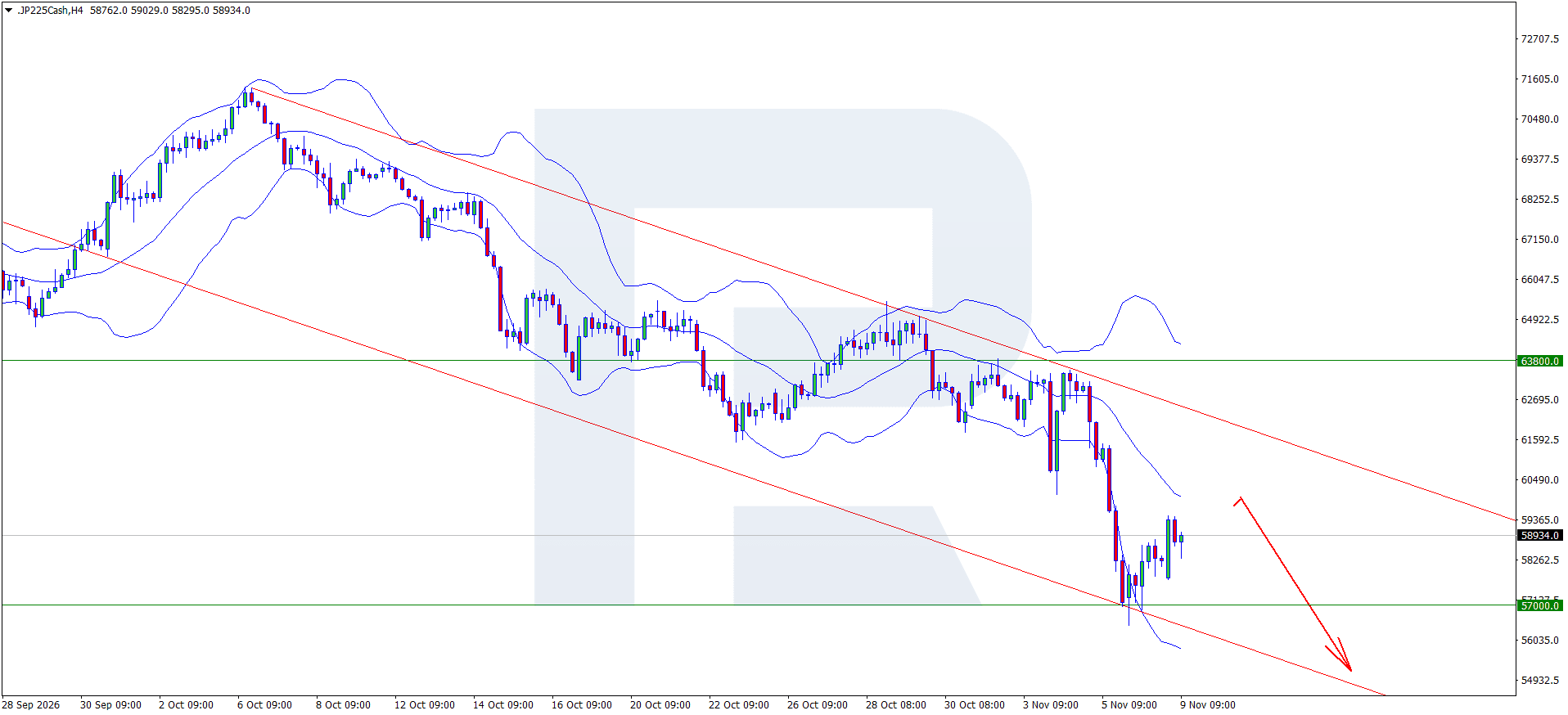
JP 225 trading scenario
Summary and what to watch this week
Overall, the fundamental backdrop for the US 500, US Tech, US 30, DE 40, and JP 225 remains mixed. Slowing inflation, strong corporate earnings, and recovering demand could support the markets. However, the risks of tighter Fed policy, high AI-related costs, and weakness in the global economy could limit the indices' recovery. This week, the key factors to watch will be US and German inflation, US employment, and investors' reactions to incoming macroeconomic data.
Editors’ picks


EURUSD forecast 2026–2027: technical analysis, price levels & predictions
The EURUSD outlook for 2026 and 2027: key levels on the daily chart, three trading scenarios and the policy gap between the Fed and the ECB that drives the pair.

Gold (XAUUSD) forecast 2026: technical analysis, price levels & predictions
Where gold could trade in 2026: key levels, three trading scenarios with entry triggers and the forecasts from J.P. Morgan, Deutsche Bank and Goldman Sachs.
Ang mga pagtataya na ipinakita sa seksyong ito ay nagpapakita lamang ng pribadong opinyon ng may-akda at hindi dapat ituring bilang gabay para sa pagtetrade. Walang pananagutan ang RoboForex para sa mga resulta ng pagtetrade batay sa mga rekomendasyon sa pagtetrade na inilarawan sa mga analytical review na ito.