
JP 225 forecast: the index continued to update all-time highs
The JP 225 stock index updated its all-time high after a correction. The JP 225 forecast for today is positive.
JP 225 forecast: key takeaways
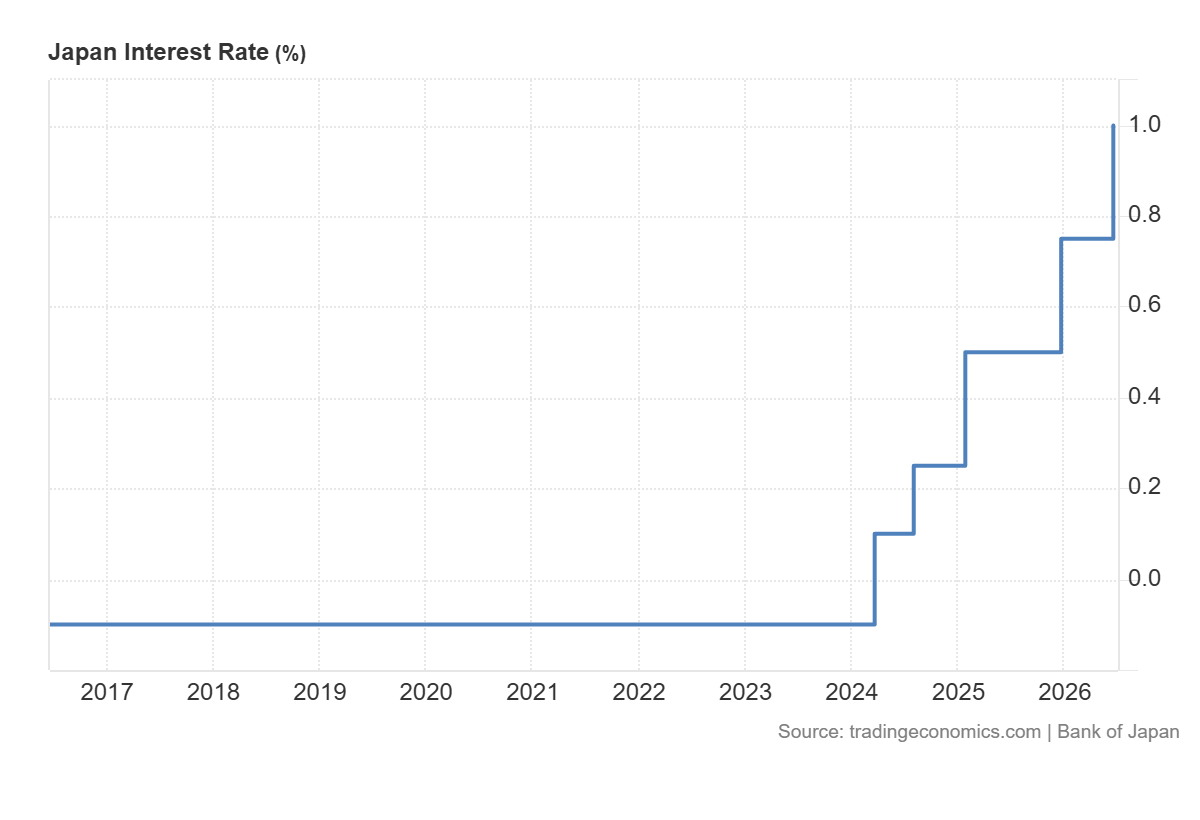
- Recent data: Japan’s policy rate stood at 1.00%
- Market impact: the effect on the Japanese equity market is mixed
JP 225 fundamental analysis
The Bank of Japan’s decision to raise the rate from 0.75% to 1.00% can generally be assessed as a moderately negative, but not shock-driven, factor for the JP 225 index. The increase itself matched the market forecast, so a sharp repricing of Japanese equities may not occur solely because of the decision. However, the level of the rate itself matters: this is the highest level since the mid-1990s, confirming Japan’s transition towards tighter monetary policy after a prolonged period of extremely low rates. The Bank of Japan explains the decision by the need to control inflation risks, while also indicating that financial conditions remain sufficiently favourable for the economy.
For the JP 225 index, the impact will be mixed. On the one hand, the rate increase raises borrowing costs for companies, reduces the appeal of equities with high valuations, and may intensify pressure on domestic demand. This is especially important for companies that depend on lending, capital expenditure, and consumer activity.
JP 225 technical analysis
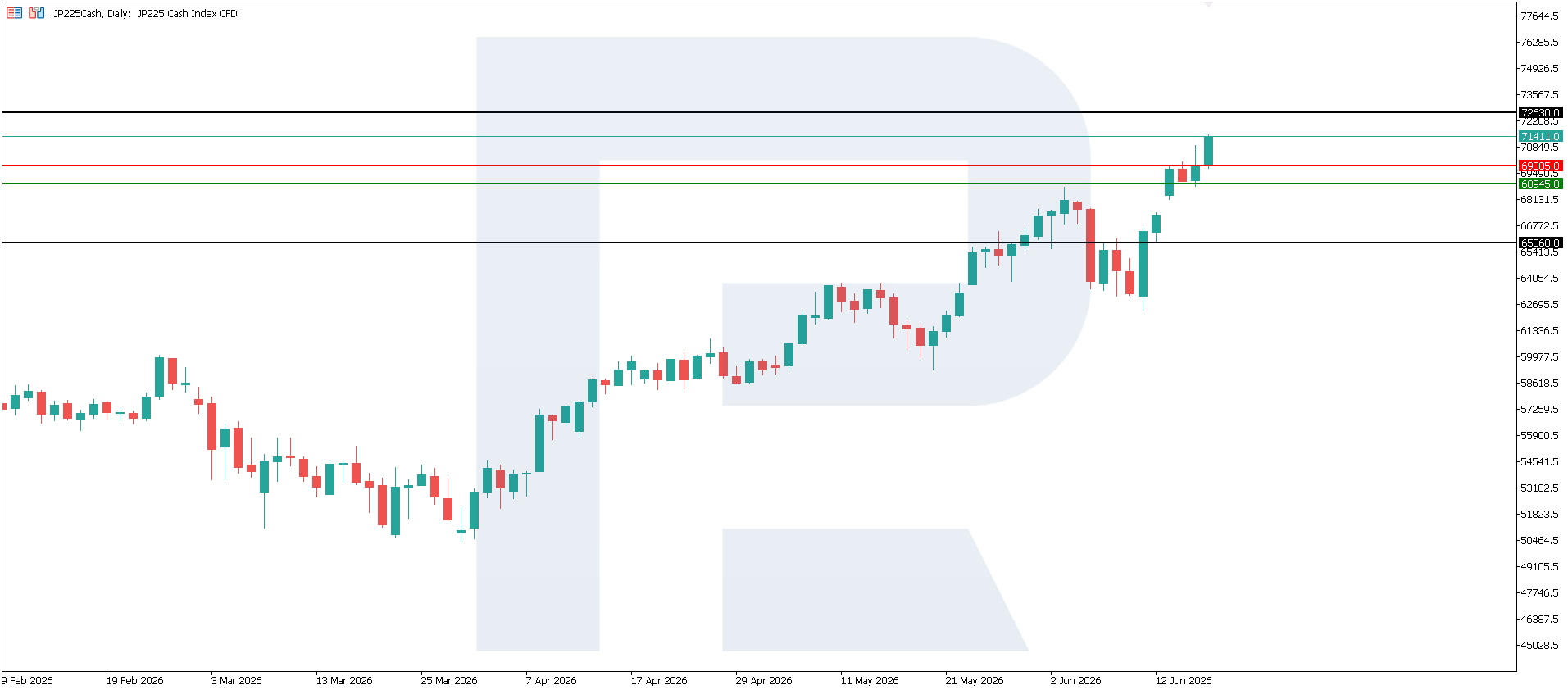
The JP 225 index updated its all-time high and formed a new uptrend, with new support forming at 68,945.0. Resistance at 69,855.0 was broken. The current trend may become long-term. The 72,630.0 level is considered the next potential upside target.
For the JP 225 index price forecast, the following scenarios can be highlighted:
- Pessimistic JP 225 forecast: if quotes break below the support level at 68,945, they may fall to 65,860.0
- Optimistic JP 225 forecast: if quotes consolidate above the broken resistance level at 69,855.0, they may rise to 72,630.0
Summary
Overall, the publication increases the likelihood of investors adopting a more cautious approach towards the Japanese equity market. In the near term, the key factors will be the dynamics of the yen, Japanese government bond yields, Bank of Japan comments on further rate increases, and the corporate sector’s response to the rising cost of capital. If the regulator signals a gradual approach, the JP 225 index may maintain resilience. If the market starts pricing in a faster rate-hike cycle, pressure on equities, especially exporters and growth companies, may intensify. The next downside target for the JP 225 is the 60,950.0 level.
Editors’ picks

EURUSD forecast 2026–2027: technical analysis, price levels & predictions
The ECB holds rates at 2.15% while the Fed stays at 3.75% — and that divergence is the central driver of EURUSD in 2026. The pair is range-bound between 1.1400 and 1.1915, with Deutsche Bank targeting 1.2500 and Morgan Stanley calling for 1.3000 by year-end. We analyse the technicals, break down the macro factors, and outline three trading scenarios with specific entry levels.

Gold (XAUUSD) forecast 2026: predictions based on fundamental and technical analysis
Where is gold headed after pulling back from the all-time high of 5,597 USD? XAUUSD is consolidating near 4,518 USD between key levels 4,220 USD and 4,855 USD, with major banks targeting 5,243–6,200 USD by year-end. Read our comprehensive gold forecast: technical analysis across three timeframes, trading scenarios with specific entry levels, Fed policy and central bank demand outlook, and institutional predictions for 2026 and beyond.
Ang mga pagtataya na ipinakita sa seksyong ito ay nagpapakita lamang ng pribadong opinyon ng may-akda at hindi dapat ituring bilang gabay para sa pagtetrade. Walang pananagutan ang RoboForex para sa mga resulta ng pagtetrade batay sa mga rekomendasyon sa pagtetrade na inilarawan sa mga analytical review na ito.