
JP 225 forecast: the index is correcting
The JP 225 stock index is correcting after falling by more than 18% and may overcome the resistance level. The JP 225 forecast for today is negative.
JP 225 forecast: key takeaways
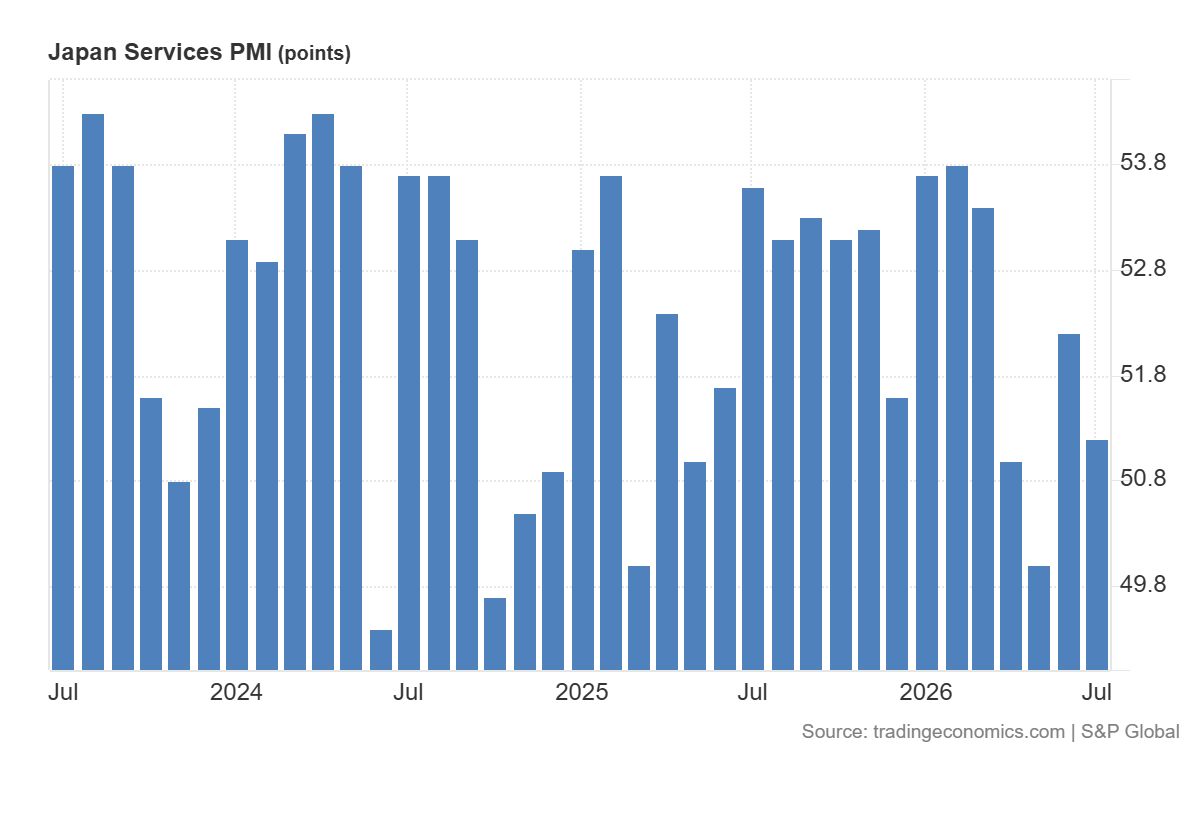
- Recent data: Japan’s services PMI came in at 51.2 in July
- Market impact: the effect on the Japanese stock market is mixed
JP 225 fundamental analysis
Japan’s services PMI fell to 51.2 in July, below a forecast of 51.9 and down from a previous reading of 52.2, which is a moderately negative signal for the Japanese economy. The indicator remains above the 50-point threshold separating expansion from contraction. This means that the services sector continues to grow, although the pace of growth has slowed significantly and came in below market expectations. Such dynamics may indicate weaker domestic demand, more cautious behaviour by consumers and businesses, and a gradual slowdown in economic activity following the stronger results recorded in the previous period.
For the JP 225 index, the initial reaction may be moderately negative. Weaker data could raise concerns about the sustainability of Japan’s economic recovery and the outlook for corporate earnings growth, especially for companies whose operations depend primarily on the domestic market. However, the scale of the decline in the PMI is not yet sufficient to form a pronounced negative scenario.
JP 225 technical analysis
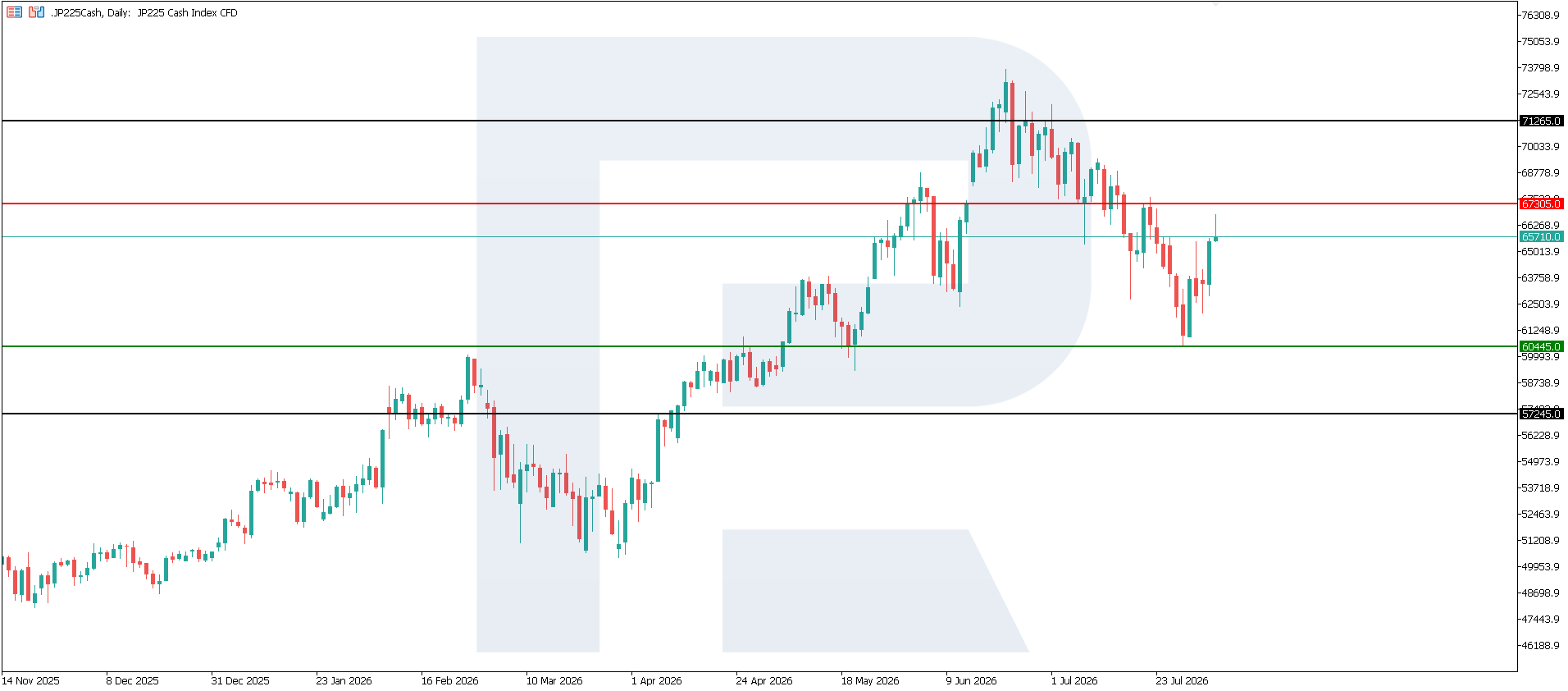
The JP 225 index completed its decline and began a correction. A new support level has formed around 60,445.0, while the nearest resistance is located at 67,305.0. The price is headed towards the resistance level, and a breakout above it would signal a shift to an uptrend. The index may also initially enter a sideways range. If the decline resumes, the next target could be 57,245.0.
The JP 225 price forecast outlines the following scenarios:
- Pessimistic JP 225 scenario: a breakout below the 60,445.0 support level could send the index down to 57,245.0
- Optimistic JP 225 scenario: a breakout above the 67,305.0 resistance level could boost the index up to 71,265.0
Summary
The release of Japan’s services PMI is moderately negative for the Japanese stock market, but it does not indicate that the economy has begun to contract. The JP 225 is likely to show a moderate negative reaction followed by stabilisation. Companies focused on domestic demand, the financial sector, and consumer services may come under pressure. Exporters, by contrast, could receive support if the yen weakens and expectations of further Bank of Japan rate hikes decline. The next downside target for the JP 225 could be 57,245.0.
Editors’ picks

EURUSD forecast 2026–2027: technical analysis, price levels & predictions
EURUSD has pulled back from the 2026 high of 1.1915 and is now trading near 1.1450 — below both EMA65 and EMA200 — with the active scenario shifting from bullish to bearish. The ECB raised rates to 2.40%, but the Fed holds at 3.75%, and US inflation (3.5%) continues to outpace the eurozone (2.8%). A confirmed break below 1.1280 opens the next downward wave toward 1.1080. We break down the key levels, three trading scenarios with entry triggers, and what Deutsche Bank, Morgan Stanley and UBS are forecasting for EURUSD in 2026.

Gold (XAUUSD) forecast 2026: predictions based on fundamental and technical analysis
Gold has corrected over 25% from its all-time high of 5,597 USD and is now trading near 4,100 USD — testing a critical support zone. Is this the bottom, or will the downtrend continue? We break down the key levels (support 3,920 USD, breakout trigger 4,500 USD), three trading scenarios with entry levels, and what J.P. Morgan, Goldman Sachs and Deutsche Bank are forecasting for gold in 2026.
Ang mga pagtataya na ipinakita sa seksyong ito ay nagpapakita lamang ng pribadong opinyon ng may-akda at hindi dapat ituring bilang gabay para sa pagtetrade. Walang pananagutan ang RoboForex para sa mga resulta ng pagtetrade batay sa mga rekomendasyon sa pagtetrade na inilarawan sa mga analytical review na ito.