
EURUSD rises ahead of the key US inflation report
The EURUSD rate continues to strengthen amid a weaker US dollar, as investors await the release of key US inflation data. The rate currently stands at 1.1555. Discover more in our analysis for 10 June 2026.
EURUSD forecast: key takeaways
- Today, the market is focused on the release of the May US inflation report
- The monthly core CPI reading is expected to come in at 0.1%
- Expectations of easing inflation pressure are weighing on the US dollar
- EURUSD forecast for 10 June 2026: 1.1465
Fundamental analysis
The EURUSD rate is rising for the third consecutive trading session. Pressure on the US dollar increased amid renewed hostilities in the Middle East, casting doubt on the prospects for a long-term peaceful settlement in the region. Nevertheless, some analysts note that the latest exchanges of strikes do not yet point to a sharp escalation of the conflict. Despite rising tensions and the expiry of the ceasefire, traders believe that the situation is moving towards gradual de-escalation.
Later on Wednesday, the market will focus on the release of US inflation data for May. The Consumer Price Index report is viewed as a key factor for assessing the Federal Reserve’s next steps. After the stronger-than-expected employment report, investors continue to assess the probability that US interest rates will remain high for an extended period.
According to forecasts, monthly headline CPI growth will slow to 0.7%, while core CPI will increase by only 0.1%. Expectations of a further easing in inflation pressures are prompting a revision of market forecasts for the Federal Reserve’s monetary policy and adding to pressure on the US dollar.
Technical outlook
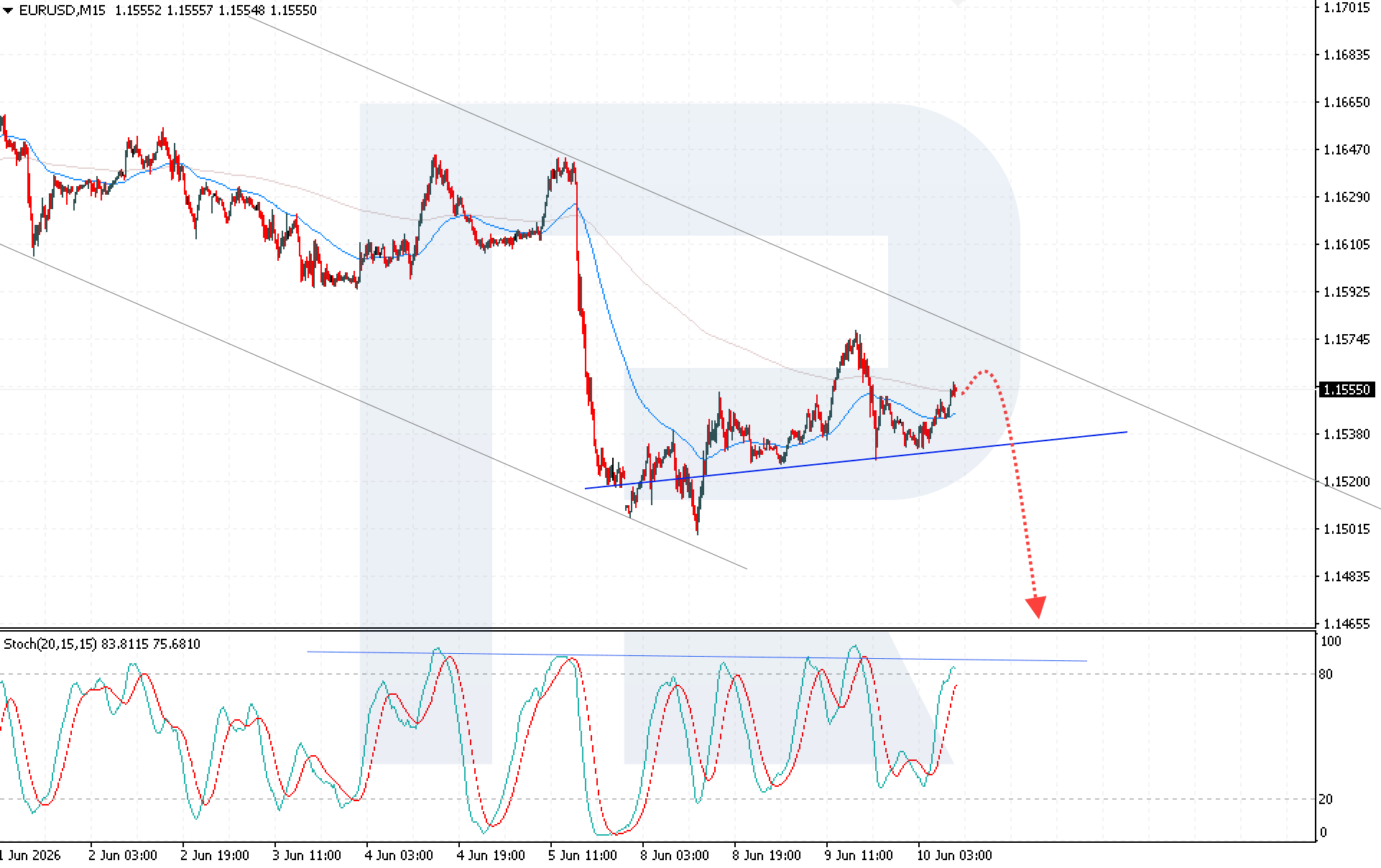
The EURUSD pair is correcting after the previous decline; however, despite the upward move, there remains a risk of a Head and Shoulders reversal pattern forming. Today’s EURUSD forecast suggests the current correction will end and the decline will resume, with the nearest target at 1.1465.
The technical picture remains favourable for a bearish scenario. The Stochastic Oscillator is in overbought territory, indicating the likelihood of a corrective rally coming to an end. A confident breakout of the neckline of the Head and Shoulders reversal pattern, followed by consolidation below 1.1525, would further confirm the decline.
An alternative scenario suggests stronger buying activity if the price breaks above the upper boundary of the descending channel and consolidates above 1.1580. Such a signal would indicate the cancellation of the Head and Shoulders reversal pattern, easing selling pressure, and stronger buyer positions, which will open the way for further growth.
EURUSD overview
- Asset: EURUSD
- Timeframe: M15 (Intraday)
- Trend: downward
- Key resistance levels: 1.1580 and 1.1615
- Key support levels: 1.1525 and 1.1500
EURUSD trading scenarios for today
Main scenario (Sell Stop)
A breakout below the lower boundary of the Head and Shoulders pattern and consolidation below 1.1525 would create conditions for opening short positions.
- Take Profit: 1.1465
- Stop Loss: 1.1560
Alternative scenario (Buy Stop)
A breakout above the upper boundary of the descending channel and consolidation above 1.1580 would signal a bullish correction and the cancellation of the reversal pattern.
- Take Profit: 1.1645
- Stop Loss: 1.1555
Risk factors
The main risks to the downside scenario are linked to a possibly weaker-than-expected US inflation report, which may strengthen expectations of Fed policy easing and support further EURUSD growth. An additional risk factor is a breakout above the 1.1580 resistance level, which may cancel the Head and Shoulders reversal pattern and trigger upward momentum with stronger buying activity.
Summary
Expectations of slower US inflation and lower demand for safe-haven assets continue to support the EURUSD rate. However, the pair's future performance will be largely determined by today’s release of US inflation data. EURUSD technical analysis suggests that the risk of a Head and Shoulders reversal pattern forming remains. As long as quotes hold below 1.1580, the priority scenario remains the completion of the current upward correction and the subsequent decline towards 1.1465.
Editors’ picks

EURUSD forecast 2026–2027: technical analysis, price levels & predictions
The ECB holds rates at 2.15% while the Fed stays at 3.75% — and that divergence is the central driver of EURUSD in 2026. The pair is range-bound between 1.1400 and 1.1915, with Deutsche Bank targeting 1.2500 and Morgan Stanley calling for 1.3000 by year-end. We analyse the technicals, break down the macro factors, and outline three trading scenarios with specific entry levels.

Gold (XAUUSD) forecast 2026: predictions based on fundamental and technical analysis
Where is gold headed after pulling back from the all-time high of 5,597 USD? XAUUSD is consolidating near 4,518 USD between key levels 4,220 USD and 4,855 USD, with major banks targeting 5,243–6,200 USD by year-end. Read our comprehensive gold forecast: technical analysis across three timeframes, trading scenarios with specific entry levels, Fed policy and central bank demand outlook, and institutional predictions for 2026 and beyond.
Ang mga pagtataya na ipinakita sa seksyong ito ay nagpapakita lamang ng pribadong opinyon ng may-akda at hindi dapat ituring bilang gabay para sa pagtetrade. Walang pananagutan ang RoboForex para sa mga resulta ng pagtetrade batay sa mga rekomendasyon sa pagtetrade na inilarawan sa mga analytical review na ito.