
The Fed is not saving the dollar, EURUSD is poised for a surge
US data continues to support the euro, with the EURUSD rate approaching the 1.1500 mark. For more details, see our analysis for 16 July 2026.
EURUSD forecast: key takeaways
- US retail sales: previously at 0.9%, projected at 0.2%
- US Producer Price Index (PPI): previously at 0.6%, currently at −0.3%
- EURUSD forecast for 16 July 2026: 1.1430 or 1.1550
Fundamental analysis
The EURUSD forecast takes into account that the pair continues to hold near the four-week highs reached yesterday following the release of weak US inflation data.
The main driver of the euro’s rise is not the strength of the European economy but the unexpected weakness of the US currency. Two inflation reports were released in the past two days, which dramatically changed expectations for the Federal Reserve interest rate: consumer inflation came in below forecasts, becoming the first signal of easing price pressures, while the Producer Price Index unexpectedly fell by 0.3% in June, and annual growth slowed to 5.5% against the expected 6.2%.
The only factor preventing the dollar from plummeting is the escalation of the conflict in the Strait of Hormuz. The US and Iran exchanged new strikes, while Iran threatened to block additional energy export routes.
The euro is hovering near four-week highs due to a shift in Federal Reserve rate expectations following weak inflation data. At the same time, buyers lack the strength for a decisive breakout above 1.1500, as geopolitical tensions in the Strait of Hormuz and rising oil prices are reigniting inflation fears, which is limiting the dollar’s decline. Today’s US retail sales data may become the trigger that determines whether the pair can reach the 1.1500 mark and consolidate above it.
Technical outlook
On the H4 chart, the EURUSD pair formed a Hanging Man reversal pattern near the upper Bollinger Band. At this stage, quotes may form a corrective wave following the pattern’s signal, with the downside target at the 1.1430 support level. A rebound from this level would open the door for continued upward movement.
At the same time, today’s EURUSD forecast also suggests another scenario, with the price potentially continuing to rise and testing the 1.1550 resistance level.
EURUSD overview
- Asset: EURUSD
- Timeframe: H4 (Intraday)
- Trend: bullish
- Key resistance levels: 1.1550 and 1.1615
- Key support levels: 1.1430 and 1.1310
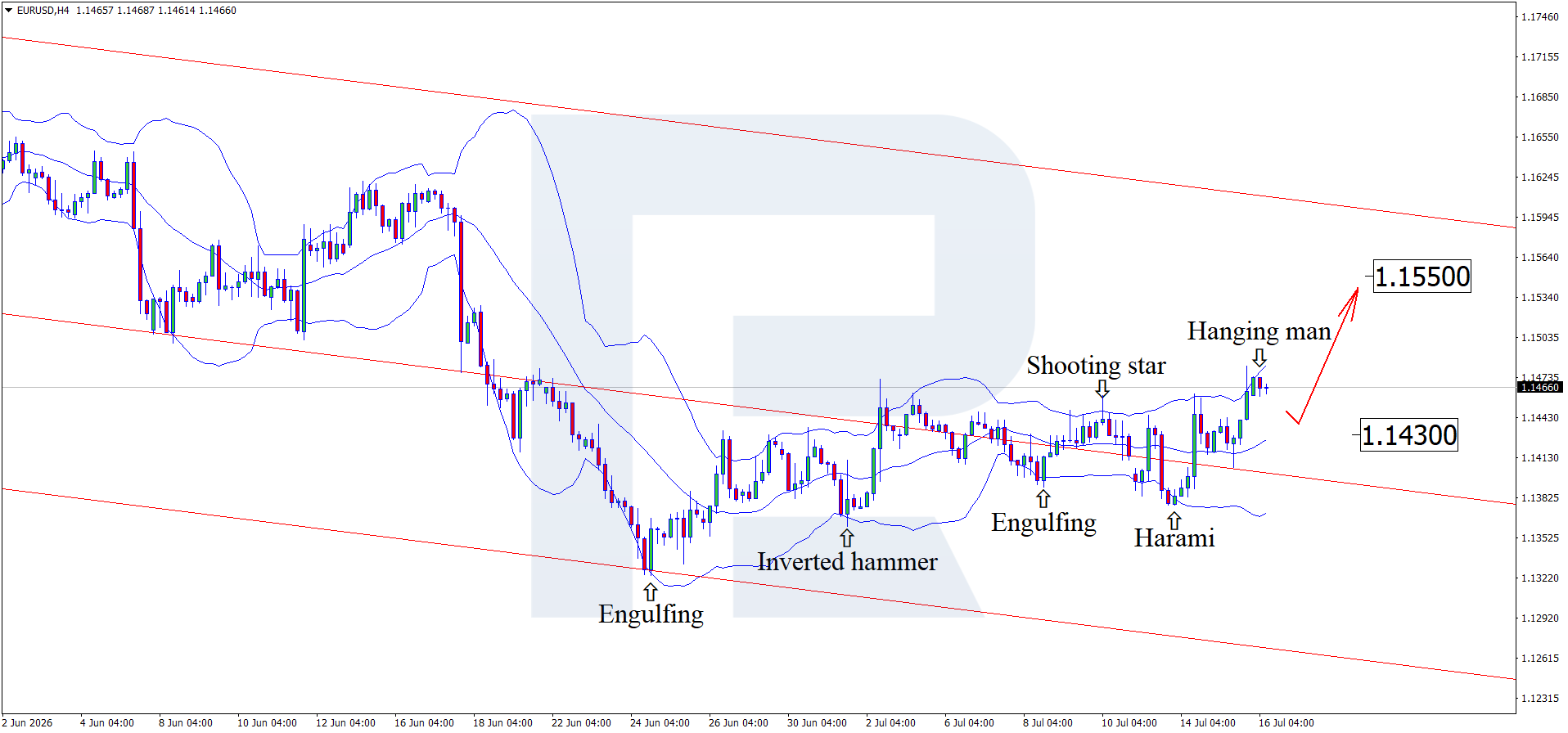
EURUSD trading scenarios for today
Main scenario (BuyStop)
A breakout and consolidation above the 1.1550 resistance level would confirm stronger buying pressure and create conditions for opening long positions.
- Take Profit: 1.1615
- Stop Loss: 1.1525
Alternative scenario (Sell Stop)
A breakout and consolidation below the 1.1430 support level would indicate a downward wave and create conditions for opening short positions.
- Take Profit: 1.1310
- Stop Loss: 1.1450
Risk factors
The main risk to the EURUSD upside scenario remains more hawkish rhetoric from Federal Reserve Chairman Kevin Warsh and an escalation of the conflict in the Middle East. These factors may pressure the euro and bring sellers back into the market.
Summary
The euro continues to recover following the release of weak US data. At the same time, EURUSD technical analysis suggests a correction towards the 1.1430 support level before growth.
Editors’ picks

EURUSD forecast 2026–2027: technical analysis, price levels & predictions
EURUSD has pulled back from the 2026 high of 1.1915 and is now trading near 1.1450 — below both EMA65 and EMA200 — with the active scenario shifting from bullish to bearish. The ECB raised rates to 2.40%, but the Fed holds at 3.75%, and US inflation (3.5%) continues to outpace the eurozone (2.8%). A confirmed break below 1.1280 opens the next downward wave toward 1.1080. We break down the key levels, three trading scenarios with entry triggers, and what Deutsche Bank, Morgan Stanley and UBS are forecasting for EURUSD in 2026.

Gold (XAUUSD) forecast 2026: predictions based on fundamental and technical analysis
Gold has corrected over 25% from its all-time high of 5,597 USD and is now trading near 4,100 USD — testing a critical support zone. Is this the bottom, or will the downtrend continue? We break down the key levels (support 3,920 USD, breakout trigger 4,500 USD), three trading scenarios with entry levels, and what J.P. Morgan, Goldman Sachs and Deutsche Bank are forecasting for gold in 2026.
Ang mga pagtataya na ipinakita sa seksyong ito ay nagpapakita lamang ng pribadong opinyon ng may-akda at hindi dapat ituring bilang gabay para sa pagtetrade. Walang pananagutan ang RoboForex para sa mga resulta ng pagtetrade batay sa mga rekomendasyon sa pagtetrade na inilarawan sa mga analytical review na ito.