
EURUSD rises for the second consecutive day as markets await signals from the ECB
The EURUSD pair is climbing higher for the second consecutive trading session amid expectations of the ECB decision and a weaker US dollar, with the rate currently at 1.1429. Discover more in our analysis for 23 July 2026.
EURUSD forecast: key takeaways
- The market expects the ECB to keep interest rates unchanged
- A pause in the ECB’s policy easing cycle is already priced in
- Germany’s ZEW Economic Sentiment Index rose to 26.3 in July
- EURUSD forecast for 23 July 2026: 1.1325
Fundamental analysis
The EURUSD rate continues to move higher, posting gains for the second consecutive session. Today, market participants are primarily focused on the European Central Bank meeting and the subsequent press conference by ECB President Christine Lagarde.
According to market estimates, the probability of the interest rate remaining unchanged at 2.25% is around 95%. A pause in the monetary policy easing cycle has already been largely priced in, so the key factor for the euro will be the regulator’s comments on the future rate path and its assessment of the eurozone’s economic outlook.
Fresh data from Germany provided additional support for the single currency. The ZEW Economic Sentiment Index unexpectedly rose to 26.3 points in July, compared to the forecast of 17.5, indicating improved investor sentiment and signs that businesses are gradually adapting to current economic challenges.
At the same time, pressure on the USD increased following a weak ADP US labour market report. According to the data, the US private sector added only around 98 thousand jobs in July, significantly below market expectations. Against this backdrop, the EURUSD pair remains above key support levels.
Technical outlook
The EURUSD rate continues to recover, with buyers gaining a foothold above the EMA-65, indicating a gradual strengthening of short-term bullish momentum. However, despite the local advance, the pair remains within a descending channel. The EURUSD forecast for today suggests renewed selling pressure, with a potential target at 1.1325.
The Stochastic Oscillator provides an additional signal in favour of a possible decline. The indicator is approaching a descending resistance line, suggesting a slowdown in the current recovery and the likelihood of renewed bearish movement. A breakout below the lower boundary of the short-term corrective channel, followed by consolidation below the 1.1395 support level, would confirm the negative scenario. In this case, sellers would receive a signal for a further downward move, with the next target at 1.1325.
However, an alternative scenario suggests a recovery in EURUSD. If buyers break confidently above the upper boundary of the descending channel and consolidate above the 1.1460 resistance level, this would invalidate the current bearish scenario and confirm that buyers have regained the initiative. In this case, the pair could continue its upward trajectory towards the next target at 1.1545.
EURUSD overview
- Asset: EURUSD
- Timeframe: H1 (intraday)
- Trend: bearish
- Key resistance levels: 1.1455 and 1.1490
- Key support levels: 1.1395 and 1.1365
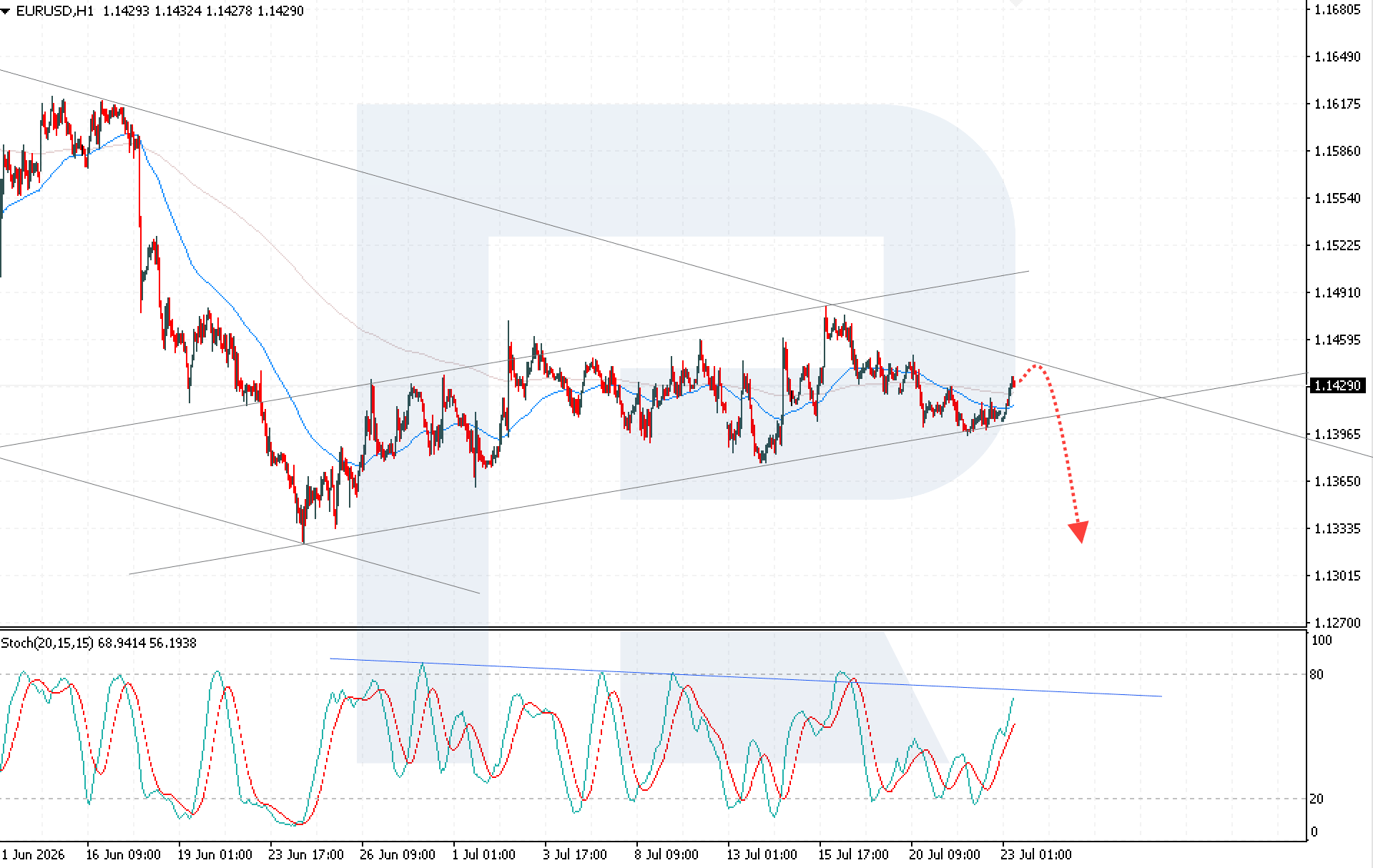
EURUSD trading scenarios for today
Main scenario (Sell Stop)
A breakout below the lower boundary of the bullish channel and consolidation below 1.1395 would indicate renewed bearish momentum, with lower targets in view.
- Take Profit: 1.1325
- Stop Loss: 1.1445
Alternative scenario (Buy Stop)
A breakout above the upper boundary of the medium-term descending channel and consolidation above 1.1455 would signal increased buying pressure and continued growth.
- Take Profit: 1.1545
- Stop Loss: 1.1420
Risk factors
The main risk to the bearish EURUSD scenario is buyers’ ability to keep the price above EMA-65 and break through the 1.1460 resistance level, which could strengthen bullish momentum. More dovish signals from the ECB could provide additional support for the euro.
Summary
The EURUSD pair maintains a short-term bullish bias amid expectations for the ECB meeting and improving sentiment in the eurozone. However, the technical picture indicates that correction risks remain, and the pair’s reaction to the 1.1395 and 1.1460 levels will be the key factor determining its next move.
Editors’ picks

EURUSD forecast 2026–2027: technical analysis, price levels & predictions
EURUSD has pulled back from the 2026 high of 1.1915 and is now trading near 1.1450 — below both EMA65 and EMA200 — with the active scenario shifting from bullish to bearish. The ECB raised rates to 2.40%, but the Fed holds at 3.75%, and US inflation (3.5%) continues to outpace the eurozone (2.8%). A confirmed break below 1.1280 opens the next downward wave toward 1.1080. We break down the key levels, three trading scenarios with entry triggers, and what Deutsche Bank, Morgan Stanley and UBS are forecasting for EURUSD in 2026.

Gold (XAUUSD) forecast 2026: predictions based on fundamental and technical analysis
Gold has corrected over 25% from its all-time high of 5,597 USD and is now trading near 4,100 USD — testing a critical support zone. Is this the bottom, or will the downtrend continue? We break down the key levels (support 3,920 USD, breakout trigger 4,500 USD), three trading scenarios with entry levels, and what J.P. Morgan, Goldman Sachs and Deutsche Bank are forecasting for gold in 2026.
Ang mga pagtataya na ipinakita sa seksyong ito ay nagpapakita lamang ng pribadong opinyon ng may-akda at hindi dapat ituring bilang gabay para sa pagtetrade. Walang pananagutan ang RoboForex para sa mga resulta ng pagtetrade batay sa mga rekomendasyon sa pagtetrade na inilarawan sa mga analytical review na ito.