
EURUSD holds steady ahead of Nonfarm Payrolls
The EURUSD pair is stabilising after its decline, remaining within a narrow range ahead of key US labour market data. The rate currently stands at 1.1522. Find out more in our analysis for 7 August 2026.
EURUSD forecast: key takeaways
- The main market factor is the upcoming Nonfarm Payrolls release
- Weak labour market data has strengthened expectations of Federal Reserve policy easing
- The euro received support from strong German data
- EURUSD forecast for 7 August 2026: 1.1635
Fundamental analysis
The EURUSD rate is attempting to recover from yesterday’s decline, but overall, the price continues to move within a sideways range for the sixth consecutive trading session. The market is currently consolidating between key levels, with the resistance level near 1.1560 and support around 1.1500.
Market participants are adopting a wait-and-see approach ahead of the week’s main economic report – the official US labour market data. This release could become the key factor in shaping the long-term trend for the dollar and the EURUSD pair.
Following the weak ADP report, which showed an increase of just 44 thousand private sector jobs versus expectations of around 70 thousand, investors became concerned that the official data could also indicate a marked slowdown in the US labour market. Weak economic data has already weighed on expectations for future Federal Reserve policy.
The euro also received additional support from strong German data. Factory orders rose by 3.1% month-on-month in June, significantly exceeding analysts’ forecasts. The improved performance of the eurozone’s largest economy helped ease pressure on the single currency and supported EURUSD’s attempt to recover from its recent correction.
Technical outlook
The EURUSD rate is declining and has almost reached the lower boundary of the bullish channel. Today’s EURUSD forecast suggests a renewed upward movement, with a potential target at 1.1635.
The Stochastic Oscillator further signals continued growth. The oscillator values rebounded from the support line and consolidated above oversold territory, indicating increased buying pressure. A rebound from the lower boundary of the bullish channel, followed by consolidation above the local resistance level of 1.1530, would confirm the bullish scenario. In this case, buyers could gain additional momentum for further upside.
At the same time, the risk of an alternative scenario remains amid the Nonfarm Payrolls release. If sellers regain control of the market and break below the lower boundary of the upward correction, with the price consolidating below the 1.1495 support level, this would signal weakening bullish pressure. In this case, the EURUSD pair could resume its decline towards the nearest target at 1.1415.
EURUSD overview
- Asset: EURUSD
- Timeframe: M30 (intraday)
- Trend: bullish
- Key resistance levels: 1.1535 and 1.1565
- Key support levels: 1.1515 and 1.1445
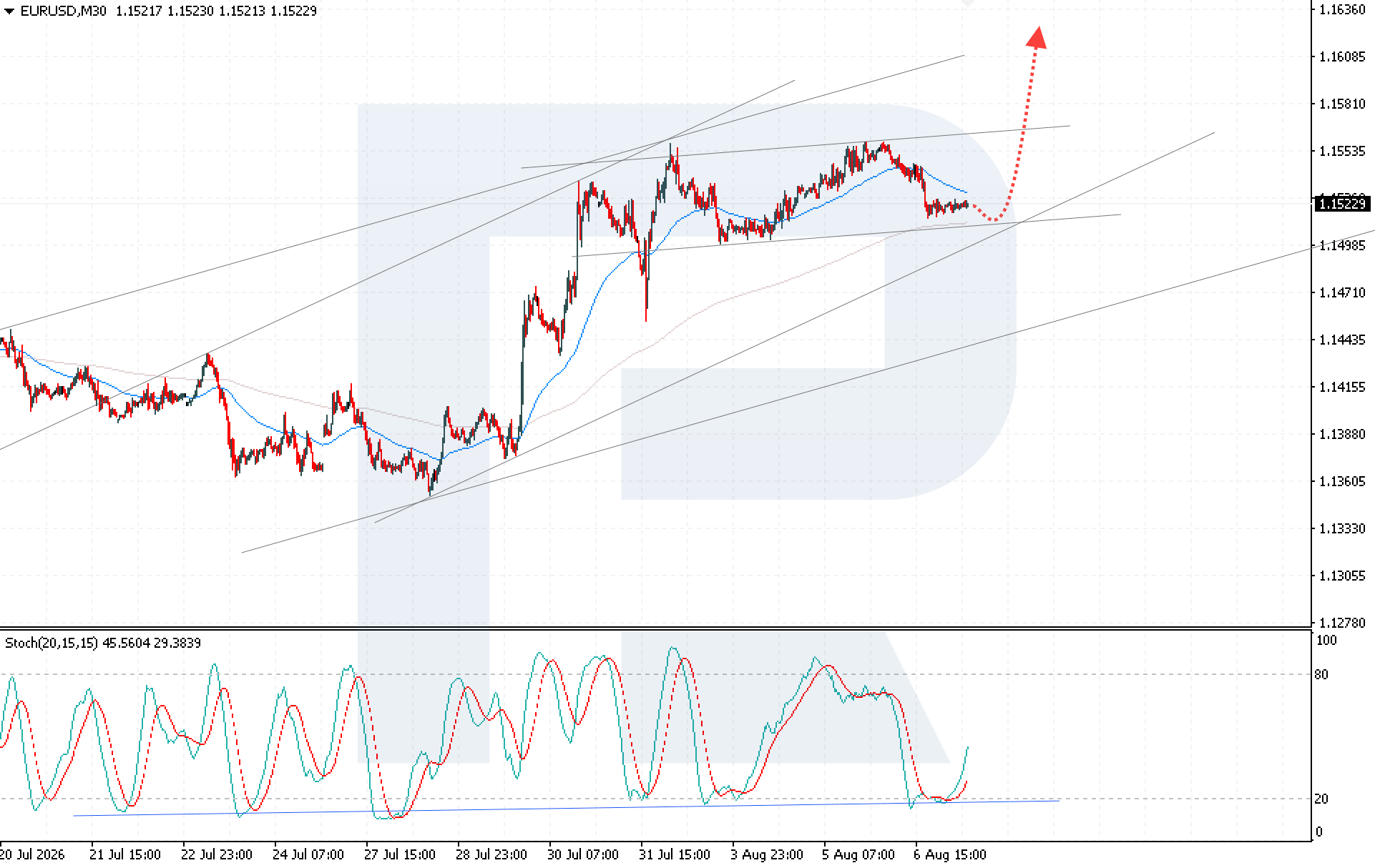
EURUSD trading scenarios for today
Main scenario (Buy Stop)
A breakout above the local 1.1530 resistance level would strengthen buying pressure and trigger further EURUSD growth. A stronger advance could be expected after a breakout above the upper boundary of the bullish channel.
- Take Profit: 1.1635
- Stop Loss: 1.1510
Alternative scenario (Sell Stop)
A breakout below the lower boundary of the ascending channel, with quotes consolidating below 1.1495, would indicate the end of the rise and trigger a bearish correction in the EURUSD pair.
- Take Profit: 1.1415
- Stop Loss: 1.1535
Risk factors
The main risk to the EURUSD upside scenario remains the Nonfarm Payrolls release, as strong US labour market data could strengthen the dollar and put pressure on the euro. An additional negative factor would be a breakout below the 1.1495 support level, which would indicate weakening buying momentum and increase the likelihood of a decline towards 1.1415.
Summary
The EURUSD pair remains in a consolidation phase ahead of the Nonfarm Payrolls release, with weak US labour market data and strong figures from Germany continuing to support buyers. A consolidation above 1.1530 could strengthen the bullish momentum towards 1.1635.
Editors’ picks

EURUSD forecast 2026–2027: technical analysis, price levels & predictions
EURUSD has pulled back from the 2026 high of 1.1915 and is now trading near 1.1450 — below both EMA65 and EMA200 — with the active scenario shifting from bullish to bearish. The ECB raised rates to 2.40%, but the Fed holds at 3.75%, and US inflation (3.5%) continues to outpace the eurozone (2.8%). A confirmed break below 1.1280 opens the next downward wave toward 1.1080. We break down the key levels, three trading scenarios with entry triggers, and what Deutsche Bank, Morgan Stanley and UBS are forecasting for EURUSD in 2026.

Gold (XAUUSD) forecast 2026: predictions based on fundamental and technical analysis
Gold has corrected over 25% from its all-time high of 5,597 USD and is now trading near 4,100 USD — testing a critical support zone. Is this the bottom, or will the downtrend continue? We break down the key levels (support 3,920 USD, breakout trigger 4,500 USD), three trading scenarios with entry levels, and what J.P. Morgan, Goldman Sachs and Deutsche Bank are forecasting for gold in 2026.
Ang mga pagtataya na ipinakita sa seksyong ito ay nagpapakita lamang ng pribadong opinyon ng may-akda at hindi dapat ituring bilang gabay para sa pagtetrade. Walang pananagutan ang RoboForex para sa mga resulta ng pagtetrade batay sa mga rekomendasyon sa pagtetrade na inilarawan sa mga analytical review na ito.