
EURUSD trades in a sideways trend
The main pressure on the European currency comes from deteriorating economic expectations in the eurozone, intensifying debt concerns in France, and the Federal Reserve's continued tight monetary policy. The rate stands at 1.1199. Read more in our analysis for 23 October 2026.
EURUSD forecast: key takeaways
- The Conference Board's US economic index remained unchanged at 99.6 points in September
- The European Commission published its preliminary consumer confidence index for October, which fell to −17.9 points
- EURUSD forecast for 23 October 2026: 1.1360
Fundamental analysis
One of the key factors shaping the outlook for the European currency remains accelerating inflation amid rising energy costs. According to Eurostat's final data published on 16 October, annual inflation in the eurozone rose from 3.2% in August to 3.8% in September. Core inflation, excluding energy, food, alcohol, and tobacco, stood at 2.5%.
A significant negative factor for the EURUSD rate remains the deteriorating situation in France's debt market. Amid political instability, mass protests, and disagreements over the state budget, the yield on ten-year French government bonds exceeded 5.1% on 22 October, reaching its highest levels since 2002.
At its September meeting, the Federal Reserve raised its target interest rate range by 25 basis points to 3.75–4.00%. At the same time, the ECB increased its deposit rate to 2.50%. Thus, US interest rates remain higher than those in Europe, making dollar-denominated assets more attractive.
Technical outlook
On the D1 chart, the EURUSD pair has formed a resistance level at 1.1270 and support at 1.1150. The broader trend is sideways, with the potential for further gains and a breakout above the resistance level. On the H4 chart, support has formed at 1.1185 and resistance at 1.1225. The main upside target is 1.1360.
Today's EURUSD forecast also considers an alternative scenario in which the price breaks below the 1.1150 support level and reaches 1.1070.
EURUSD overview
- Asset: EURUSD
- Timeframe: D1
- Trend: correction
- Key resistance levels: 1.1225 and 1.1270
- Key support levels: 1.1185 and 1.1150
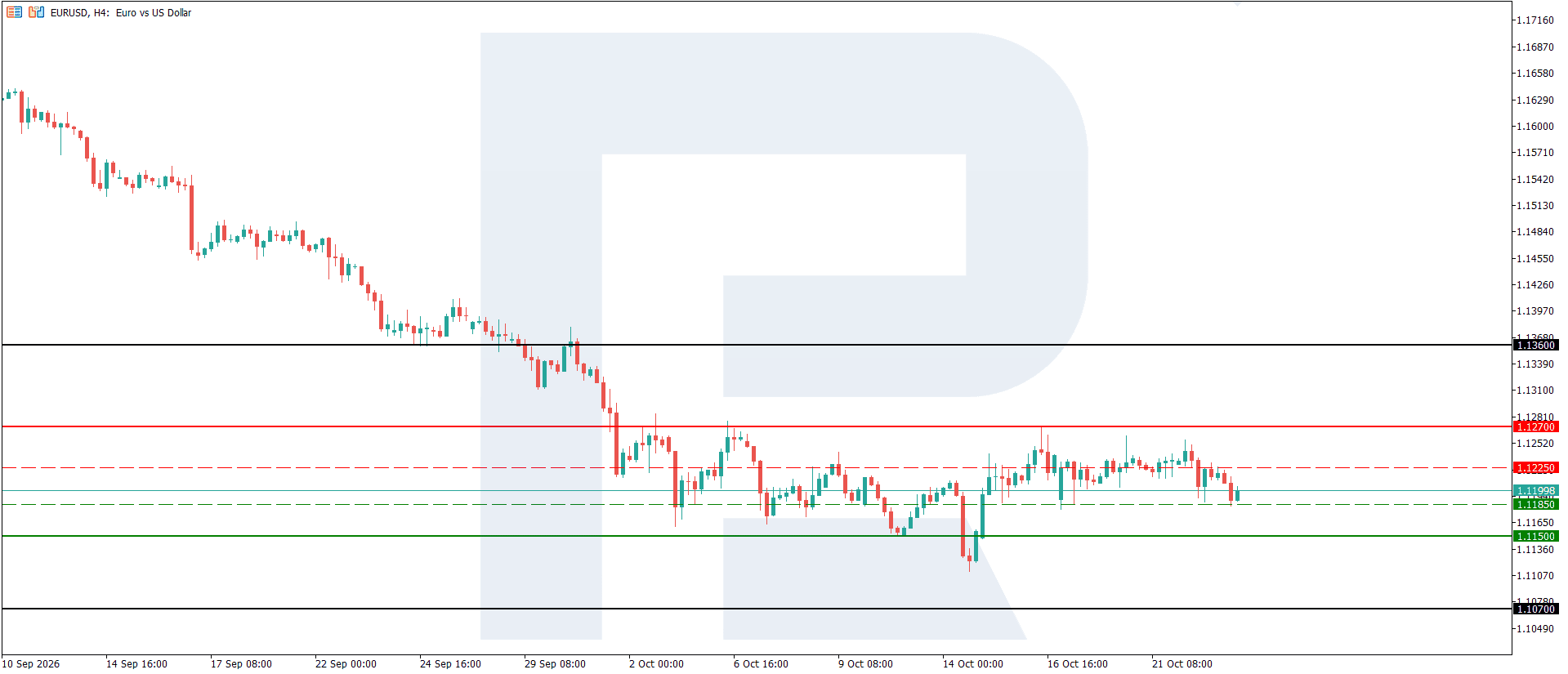
EURUSD trading scenario for today
A breakout above a local resistance level at 1.1225 would signal renewed bullish momentum and create conditions for opening long positions in EURUSD.
Risk factors
The main risk factors for the EURUSD pair remain uncertainty over the Fed and ECB’s future monetary policies, accelerating inflation in the US and eurozone, and slowing economic growth. A deterioration in Germany's economic situation, political instability in France, and rising energy prices could put additional pressure on the euro. At the same time, a weakening US labour market and a possible softening of the Fed's rhetoric could cause the dollar to decline and lead to an upward correction in EURUSD.
Summary
Overall, fundamental conditions for the EURUSD pair remain predominantly negative. High inflation and a resilient US labour market support expectations for a hawkish Federal Reserve policy, while accelerating inflation in the eurozone is accompanied by deteriorating consumer sentiment and increasing debt risks. This combination of factors limits the euro's potential to strengthen.
Editors’ picks


EURUSD forecast 2026–2027: technical analysis, price levels & predictions
The EURUSD outlook for 2026 and 2027: key levels on the daily chart, three trading scenarios and the policy gap between the Fed and the ECB that drives the pair.

Gold (XAUUSD) forecast 2026: technical analysis, price levels & predictions
Where gold could trade in 2026: key levels, three trading scenarios with entry triggers and the forecasts from J.P. Morgan, Deutsche Bank and Goldman Sachs.
Ang mga pagtataya na ipinakita sa seksyong ito ay nagpapakita lamang ng pribadong opinyon ng may-akda at hindi dapat ituring bilang gabay para sa pagtetrade. Walang pananagutan ang RoboForex para sa mga resulta ng pagtetrade batay sa mga rekomendasyon sa pagtetrade na inilarawan sa mga analytical review na ito.