
EURUSD awaits a news catalyst to continue its trend
The primary pressure on the European currency comes from deteriorating economic expectations in the eurozone, worsening debt problems in France, and the Federal Reserve's continued tight monetary policy. The EURUSD rate currently stands at 1.1215. Find out more in our analysis for 26 October 2026.
EURUSD forecast: key takeaways
- The preliminary HCOB eurozone composite Purchasing Managers' Index (PMI) for October came in at 51.9
- The preliminary US S&P Global composite PMI for October stood at 57.6
- EURUSD forecast for 26 October 2026: 1.1360
Fundamental analysis
At present, the fundamental balance is largely in favour of the US currency. The US economy is showing stronger growth in business activity, while signs of slowing economic growth are emerging in the eurozone.
One of the most significant events of last week was the release of preliminary October PMI data on 23 October. The eurozone composite index fell from 53.1 to 51.9 points, missing the forecast of 52.7 and marking its lowest level in four months. At the same time, eurozone companies face higher input prices due to rising energy costs and transport expenses. This creates an unfavourable combination of slowing growth and persistent inflationary pressure.
US economic data remains generally more favourable for the dollar. The preliminary US composite PMI released on 23 October declined from 58.4 to 57.6 points. Despite the fall, it remains significantly above the corresponding eurozone index and points to sustained strong business activity.
Technical outlook
On the EURUSD D1 chart, a resistance level has formed at 1.1270, while key support is located at 1.1150. In the medium term, the price continues to move sideways, retaining the potential to resume its rise. A breakout above the range’s upper boundary would create conditions for further gains. On the H4 chart, the nearest support level is located at 1.1185, with resistance at 1.1225. If the main bullish scenario materialises, the target is 1.1360.
An alternative EURUSD forecast suggests increased selling pressure. If the price breaks below a key support level at 1.1150 and consolidates beneath it, the likelihood of a downward move towards 1.1070 will increase.
EURUSD overview
- Asset: EURUSD
- Timeframe: D1
- Trend: correction
- Key resistance levels: 1.1225 and 1.1270
- Key support levels: 1.1185 and 1.1150
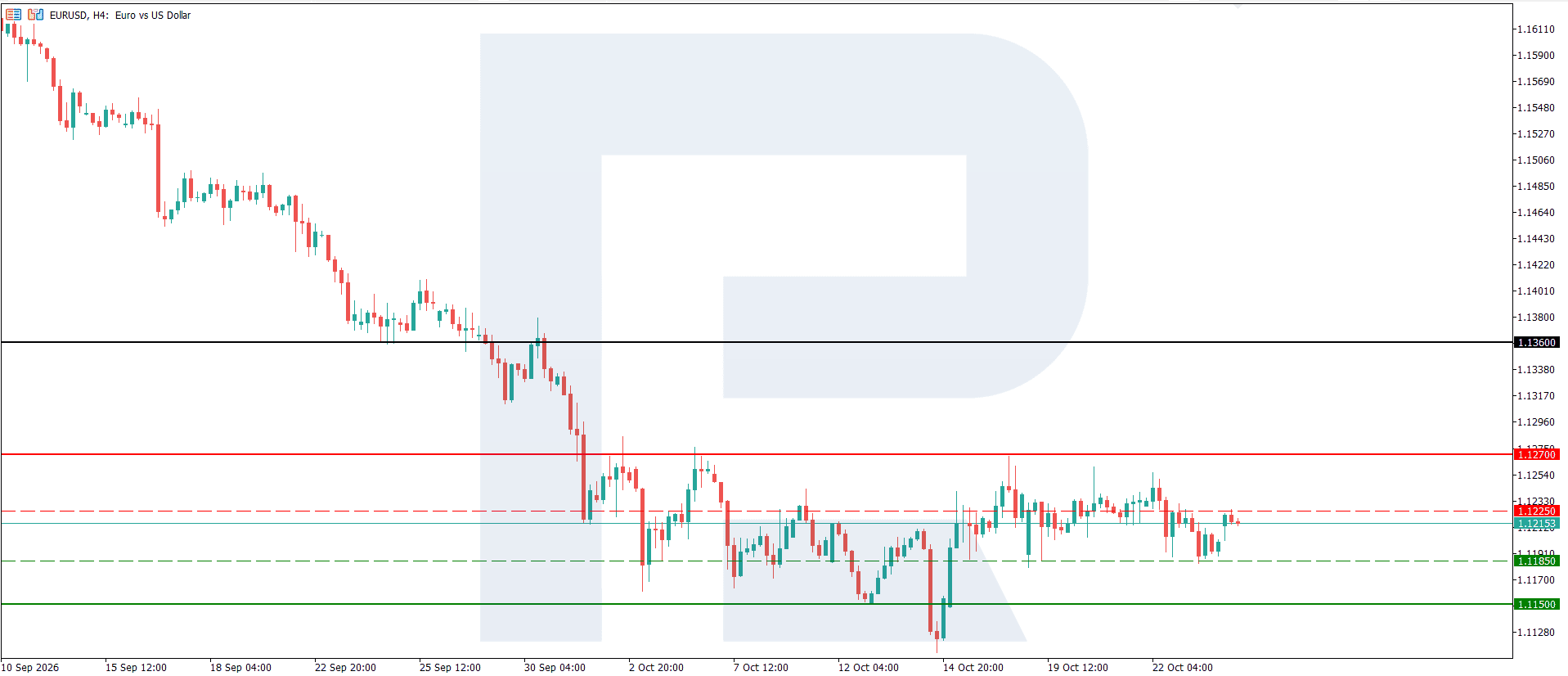
EURUSD trading scenario for today
A breakout above the local resistance level at 1.1225 would signal renewed bullish momentum and create conditions for opening long positions in EURUSD.
Risk factors
The main risks to the projected growth in the EURUSD pair include unexpectedly dovish Federal Reserve rhetoric, weaker-than-expected US GDP and PCE inflation figures, and a possible improvement in France's political and debt situation. Developments in the conflict in the Middle East remain another source of uncertainty. Higher energy prices could simultaneously fuel inflation in the US and the eurozone, but they also pose significant risks to European economic growth.
Summary
Fundamental and technical analysis of the EURUSD pair suggests that the outlook for the European currency remains moderately negative. The published PMI data confirms that the US economy is more resilient than the eurozone economy, while accelerating US inflation limits the Fed's scope to ease monetary policy. Economic uncertainty and rising government borrowing costs in France are adding to pressure on the euro.
Editors’ picks


EURUSD forecast 2026–2027: technical analysis, price levels & predictions
The EURUSD outlook for 2026 and 2027: key levels on the daily chart, three trading scenarios and the policy gap between the Fed and the ECB that drives the pair.

Gold (XAUUSD) forecast 2026: technical analysis, price levels & predictions
Where gold could trade in 2026: key levels, three trading scenarios with entry triggers and the forecasts from J.P. Morgan, Deutsche Bank and Goldman Sachs.
Ang mga pagtataya na ipinakita sa seksyong ito ay nagpapakita lamang ng pribadong opinyon ng may-akda at hindi dapat ituring bilang gabay para sa pagtetrade. Walang pananagutan ang RoboForex para sa mga resulta ng pagtetrade batay sa mga rekomendasyon sa pagtetrade na inilarawan sa mga analytical review na ito.