
Euro hits its lowest level since early 2025: EURUSD falls below 1.1100
The main pressure on the euro came from the release of US inflation data, which increased the likelihood of an additional Federal Reserve interest rate hike as early as December. For more details, see our analysis for 12 November 2026.
EURUSD forecast: key takeaways
- US CPI rose by 0.4% month-on-month in October, while core inflation increased by 0.3%, both exceeding market expectations
- According to Eurostat's preliminary estimate, annual consumer price inflation reached 4.0% in October, up from 3.8% in September
- EURUSD forecast for 12 November 2026: 1.1005
Fundamental analysis
The main pressure on the euro came from the release of US inflation data, which increased the likelihood of an additional Federal Reserve interest rate hike as early as December. Meanwhile, the economic situation in the eurozone remains mixed: accelerating inflation limits the ECB's scope to ease monetary policy, while rising energy prices also create additional risks to economic activity.
Headline US inflation rose by 0.4% month-on-month, above a forecast of 0.3%, while core CPI, which excludes volatile food and energy prices, increased by 0.3%, against expectations of 0.2%. Higher food and housing costs indicate that inflationary pressures persist in the US economy. The data is particularly significant following previous inflation surprises and prompted market participants to revise their expectations for the path of interest rates.
According to Eurostat's preliminary estimate, annual consumer price inflation reached 4.0% in October, up from 3.8% in September. Energy remains the main source of inflationary pressure, with prices rising by 20.8% year-on-year. Services inflation also accelerated to 3.3%. These figures are well above the ECB's target and increase the likelihood that restrictive monetary conditions will remain in place for an extended period.
The EURUSD forecast for 12 November 2026 is bearish.
Technical outlook
On the D1 chart, the EURUSD pair had been trading within a broad sideways channel, but a breakout below the 1.1115 support level has increased the likelihood of a continued downtrend. A resistance level has shifted to 1.1225, with a support level at 1.1115. On the H4 chart, local resistance lies at 1.1170, while support was at 1.1135 before shifting to 1.1065. The local trend remains bearish if the price consolidates below 1.1115. The target for this move is 1.1005.
However, today's EURUSD forecast also suggests an alternative scenario. The price could form a corrective wave and test the 1.1225 resistance level before declining. A breakout above this mark would open the way for a rise towards 1.1285.
EURUSD overview
- Asset: EURUSD
- Timeframe: H4
- Trend: bearish
- Key resistance levels: 1.1170 and 1.1225
- Key support levels: 1.1115 and 1.1065
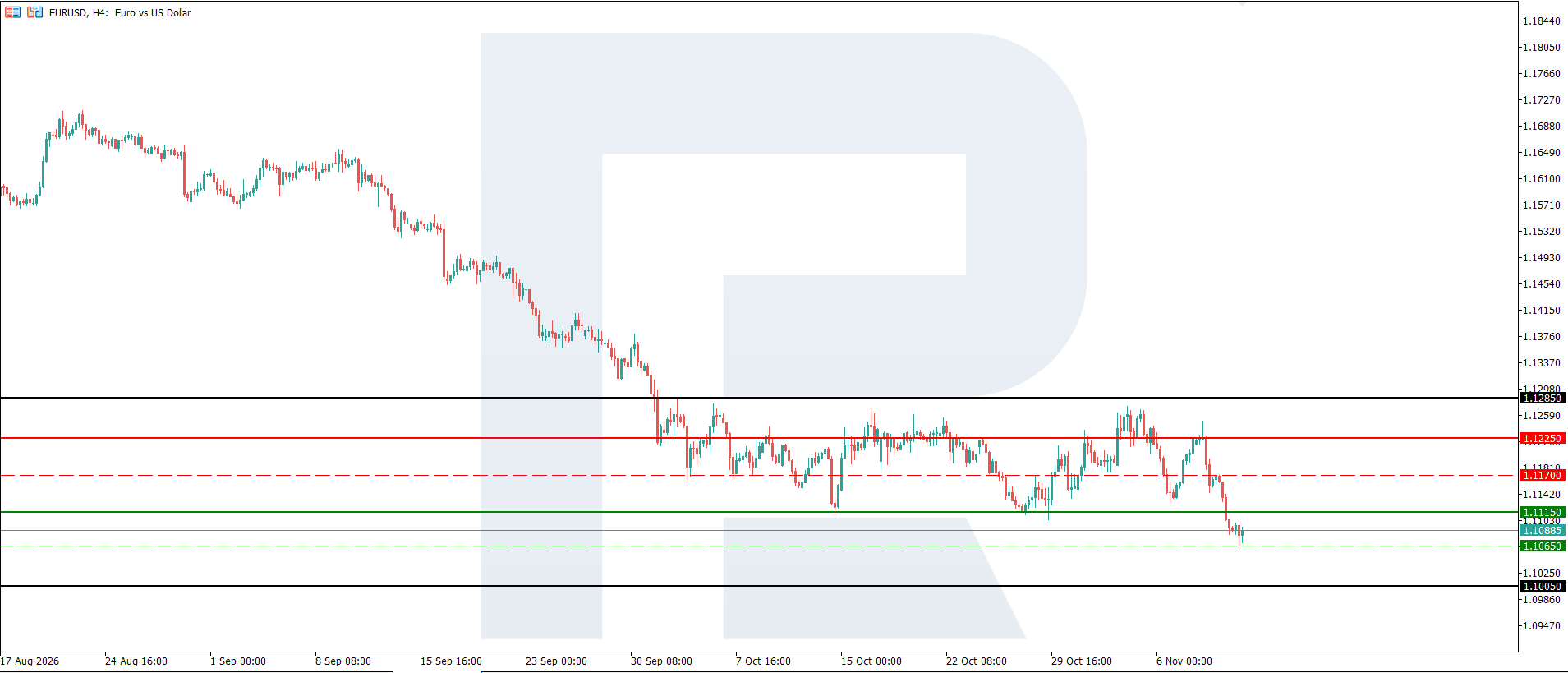
EURUSD trading scenario for today
A breakout below a local support level followed by consolidation below 1.1115 would confirm continued bearish momentum and set the stage for opening short positions.
Risk factors
The main risk to the bearish scenario remains a shift in expectations regarding Federal Reserve policy. Despite the increased likelihood of interest rate hikes, much of this has already been priced in by the market. Therefore, less hawkish rhetoric from the US central bank or weaker economic data could trigger profit-taking on long dollar positions and a recovery in the EURUSD pair.
Summary
Fundamental and technical factors indicate that the likelihood of a further decline in the EURUSD rate remains elevated. The resilience of the US labour market, higher-than-expected inflation, and expectations of additional Federal Reserve monetary policy tightening continue to support the dollar. From a technical perspective, the price could fall to 1.1030.
Editors’ picks


EURUSD forecast 2026–2027: technical analysis, price levels & predictions
The EURUSD outlook for 2026 and 2027: key levels on the daily chart, three trading scenarios and the policy gap between the Fed and the ECB that drives the pair.

Gold (XAUUSD) forecast 2026: technical analysis, price levels & predictions
Where gold could trade in 2026: key levels, three trading scenarios with entry triggers and the forecasts from J.P. Morgan, Deutsche Bank and Goldman Sachs.
Ang mga pagtataya na ipinakita sa seksyong ito ay nagpapakita lamang ng pribadong opinyon ng may-akda at hindi dapat ituring bilang gabay para sa pagtetrade. Walang pananagutan ang RoboForex para sa mga resulta ng pagtetrade batay sa mga rekomendasyon sa pagtetrade na inilarawan sa mga analytical review na ito.