
EURUSD remains below 1.1000 ahead of a data-heavy week
The EURUSD pair is hovering near 19-month lows after five consecutive sessions of declines. Higher-than-expected eurozone inflation has so far failed to support the euro, while hawkish Federal Reserve expectations have kept the dollar in the lead. The EURUSD rate currently stands at 1.0965. For more details, see our analysis for 23 November 2026.
EURUSD forecast: key takeaways
- The likelihood of an ECB rate hike in December exceeds 90%, but the market has already priced in this scenario, which has yet to provide support for the euro
- This week, the focus will be on eurozone and US PMIs, core PCE, US GDP, and the minutes of the ECB's October meeting
- EURUSD forecast for 23 November 2026: 1.0900
Fundamental analysis
The EURUSD pair remains below the psychological 1.1000 level and is hovering near its 19-month low. The pair ended last week with a sharp decline despite several macroeconomic signals that were positive for the euro.
Eurostat's final figures showed that eurozone core inflation for October was revised upwards to 2.6% year-on-year from the preliminary 2.5%, while headline inflation remained at 4.0%. At the same time, the ZEW economic sentiment index came in substantially better than expected. The market now estimates the probability of an ECB rate hike in December at over 90%, but this scenario is already fully priced in and is not supporting the euro.
Some recent US data came in weaker than expected, with industrial production falling by 0.4% in October and regional manufacturing indices also disappointing. Nevertheless, the dollar retains its advantage following the release of the Federal Reserve meeting minutes, according to which nearly all policymakers expect further rate hikes. The interest rate differential between the Federal Reserve and the ECB remains substantial and continues to favour the US currency.
Fiscal risks in France are another source of pressure on the euro. A rising risk premium on French bonds and uncertainty surrounding the 2027 budget make further ECB monetary tightening more challenging for certain eurozone countries.
The coming week will focus on preliminary eurozone and US PMIs, followed on Wednesday by the core PCE price index, the Federal Reserve's preferred inflation gauge, and the first estimate of US Q3 GDP. A stronger-than-expected PCE reading could reinforce expectations of a Federal Reserve rate hike and add to pressure on the EURUSD rate. The minutes of the ECB's October meeting will be released on Thursday.
The EURUSD forecast for 23 November 2026 is bearish.
Technical outlook
The EURUSD pair remains in a pronounced downtrend following a reversal from the 1.1272 area. The price has formed a succession of lower highs and lower lows, broken below the psychological 1.1000 level, and is now consolidating immediately above support at 1.0953. Today's EURUSD forecast suggests further declines, with a potential target at 1.0900.
MACD remains below the zero line, confirming that overall bearish momentum persists. However, the indicator line is above the signal line, suggesting that the current downward wave is losing momentum. The Stochastic Oscillator is in neutral territory, with the %K line at 48.02 and the %D line at 47.92. This configuration allows for local consolidation or a corrective rebound before the next move.
A breakout below the 1.0953 support level, followed by consolidation beneath it, would further confirm the main scenario. The bearish scenario would be invalidated if the EURUSD pair recovers above the 1.1013 resistance level. In that case, the correction could extend towards 1.1035 and then 1.1057.
EURUSD overview
- Asset: EURUSD
- Timeframe: H4
- Trend: bearish
- Key resistance levels: 1.1013 and 1.1057
- Key support levels: 1.0953 and 1.0900
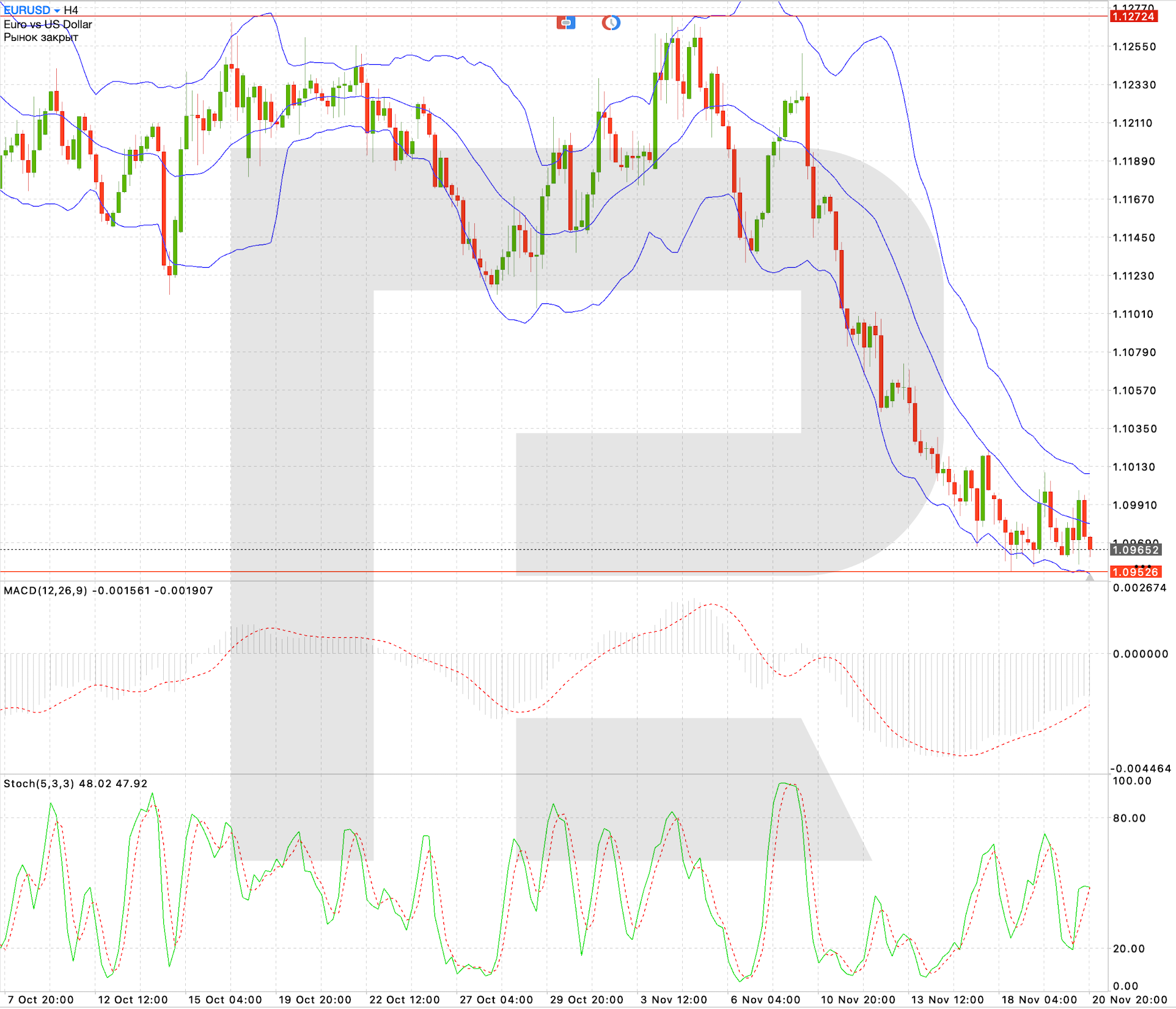
EURUSD trading scenario for today
A breakout below a key support level, followed by consolidation below 1.0953, would confirm the continuation of the downtrend and create conditions for opening short positions.
Risk factors
The main risk to the bearish EURUSD scenario would be weaker US inflation and economic growth data, which could reduce expectations of further Federal Reserve rate hikes. Strong eurozone PMIs or more hawkish signals in the ECB minutes could provide additional support for the euro. Consolidation above 1.1013 would weaken the bearish scenario and increase the likelihood of a correction towards 1.1057.
Summary
The EURUSD forecast for 23 November 2026 points to continued bearish momentum, with a potential downside target at 1.0900 and further confirmation if the price breaks below 1.0953.
Editors’ picks


EURUSD forecast 2026–2027: technical analysis, price levels & predictions
The EURUSD outlook for 2026 and 2027: key levels on the daily chart, three trading scenarios and the policy gap between the Fed and the ECB that drives the pair.

Gold (XAUUSD) forecast 2026: technical analysis, price levels & predictions
Where gold could trade in 2026: key levels, three trading scenarios with entry triggers and the forecasts from J.P. Morgan, Deutsche Bank and Goldman Sachs.
Ang mga pagtataya na ipinakita sa seksyong ito ay nagpapakita lamang ng pribadong opinyon ng may-akda at hindi dapat ituring bilang gabay para sa pagtetrade. Walang pananagutan ang RoboForex para sa mga resulta ng pagtetrade batay sa mga rekomendasyon sa pagtetrade na inilarawan sa mga analytical review na ito.