
EURUSD weekly forecast: steady growth remains the priority
The EURUSD pair enters the week of 17–21 August near 1.1537 amid reduced expectations for a Federal Reserve rate hike. The probability of a 25-basis-point hike in September has fallen to 35% from 55% a week earlier. The key event of the week will be the minutes of the latest FOMC meeting: a hawkish tone could revive demand for the dollar, while the emphasis on slowing inflation and a cooling economy would support the EURUSD rate.
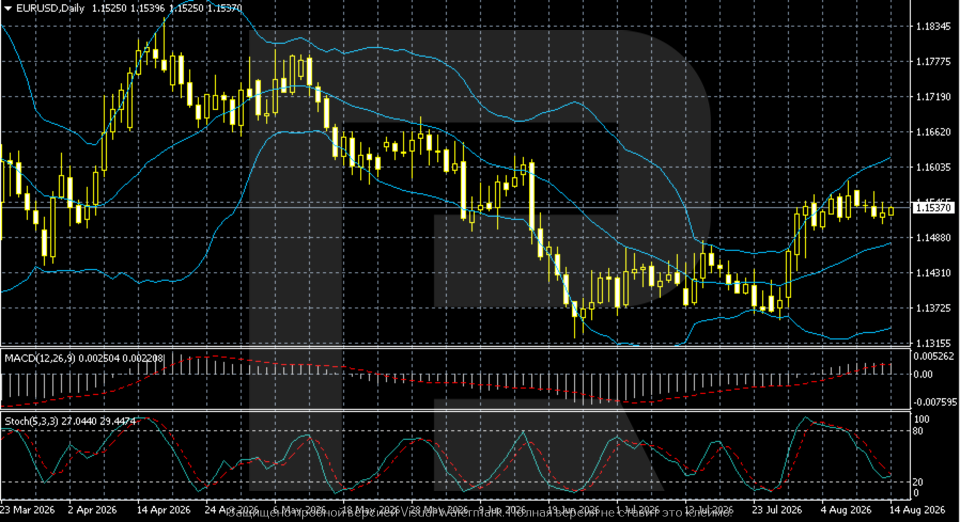
Technically, the EURUSD pair remains above the middle Bollinger Band, although bullish momentum has weakened noticeably. The nearest resistance is located in the 1.1545–1.1565 zone, and a breakout above it would open the way towards 1.1603. The support level lies at 1.1488, followed by 1.1431 and 1.1373. The Stochastic Oscillator has fallen towards the 20–30 area and is beginning to stabilise, leaving room for another rebound. As long as the pair remains above 1.1488, the baseline scenario is movement within the 1.1488–1.1565 range with a moderately positive bias.
EURUSD forecast for this week: quick overview
- Market focus: the EURUSD pair enters the week of 17–21 August near 1.1537. Pressure on the dollar increased after soft US inflation data: the July PPI was unchanged, while the CPI confirmed a further easing in price pressures. The likelihood of a 25-basis-point Federal Reserve rate hike in September has fallen to around 35%, down from 55% a week earlier. The key event of the week will be the minutes of the latest FOMC meeting, which will show how broadly further policy tightening is supported within the Federal Reserve
- Current trend: on the daily chart, the EURUSD pair continues to recover from the July lows but has moved into consolidation around 1.1537 in recent sessions. The price remains above the middle Bollinger Band, while MACD is still in positive territory, although bullish momentum is no longer strengthening. The Stochastic Oscillator has fallen into the 20–30 area and is beginning to stabilise. The nearest resistance is located in the 1.1545–1.1565 zone, followed by 1.1603 and 1.1662. Support levels are located at 1.1488, 1.1431 and 1.1373
- Weekly outlook: more accommodative FOMC minutes and a further decline in rate hike expectations would support the EURUSD pair and create conditions for a consolidation above 1.1565, with the prospect of a move towards 1.1603 and 1.1662. A more hawkish Federal Reserve tone or a renewed increase in inflation risks would revive demand for the dollar and increase the risk of a decline below 1.1488 towards 1.1431. The baseline scenario suggests movement within the 1.1488–1.1565 range with a moderately positive bias
EURUSD fundamental analysis
The EURUSD pair starts the week near 1.1537. Pressure on the US dollar previously increased after soft US inflation data: the July PPI remained flat, while the CPI reflected a further easing in price pressures. The market currently estimates the likelihood of a 25-basis-point Federal Reserve rate hike in September at around 35%, down from 55% a week earlier.
The key event of the week will be the minutes of the latest FOMC meeting on Wednesday. Investors will look for signals about how broadly the idea of further policy tightening is supported within the Federal Reserve. A more hawkish tone could restore demand for the dollar, while an emphasis on cooling inflation and the labour market would fuel expectations that rates will remain unchanged.
US housing market data is due on Tuesday, with building permits expected at 1.39 million, up from 1.374 million previously, while housing starts are projected to come in at 1.36 million versus 1.427 million. The external backdrop for the dollar will also be shaped by data from other major economies: UK unemployment figures are due on Tuesday, UK inflation on Wednesday, and Japanese inflation together with preliminary PMIs from Germany and the UK on Friday.
Geopolitical developments remain the main risk factor. The baseline backdrop for the dollar remains neutral to negative: a sustained USD recovery would require either more hawkish signals from the Federal Reserve minutes or a renewed increase in inflation risks.
EURUSD technical analysis
On the daily chart, the EURUSD rate continues to recover from the July lows but has entered a consolidation phase around 1.1537 in recent sessions. The price remains above the middle Bollinger Band but has failed to extend the move towards the indicator’s upper boundary. The short-term structure remains moderately positive, although momentum has lost strength.
The nearest resistance is located in the 1.1545–1.1565 zone. A consolidation above this area would open the way towards 1.1603 and then 1.1662. Support levels are located at 1.1488 and 1.1431, with a stronger support zone around 1.1373. As long as the EURUSD pair remains above 1.1488, the scenario of a deeper correction remains limited.
MACD is in positive territory and confirms continued bullish bias, although momentum is no longer strengthening. The Stochastic Oscillator has fallen towards the 20–30 area and is beginning to stabilise, leaving room for another rebound. The baseline scenario remains movement within the 1.1488–1.1565 range with a moderately positive bias.
EURUSD trading scenarios
The EURUSD pair enters the week of 17–21 August near 1.1537. Pressure on the dollar increased after soft US inflation data. The probability of a 25-basis-point Federal Reserve rate hike in September has fallen to around 35%, down from 55% a week earlier. The key event of the week will be the minutes of the latest FOMC meeting: a more hawkish tone could revive demand for the dollar, while an emphasis on cooling inflation and the labour market would support the EURUSD rate.
From a technical perspective, the EURUSD pair continues to recover from the July lows but has moved into consolidation around 1.1537 in recent sessions. The price remains above the middle Bollinger Band, while MACD is still in positive territory, although bullish momentum is no longer strengthening. The Stochastic Oscillator has fallen towards the 20–30 area and is beginning to stabilise, leaving room for another rebound.
- Buy scenario
A consolidation above the 1.1545–1.1565 resistance zone would confirm continued recovery and open the way towards 1.1603 and then 1.1662. The accommodative FOMC minutes and a further decline in expectations of a Federal Reserve rate hike could further support the pair.
- Sell scenario
A return below the 1.1488 support level would indicate a correction and create a risk of a decline towards 1.1431. A breakout below this mark would increase pressure on the EURUSD pair and bring the 1.1373 area back into focus.
Conclusion: buyers hold the upper hand in the short term, although momentum has weakened noticeably. The baseline scenario for the week is movement within the 1.1488–1.1565 range with a moderately positive bias. To continue its ascent, the EURUSD pair needs to consolidate above 1.1565, with the FOMC minutes as the main fundamental driver.
Summary
The EURUSD pair enters the week of 17–21 August near 1.1537. Softer US inflation data has weighed on the dollar: the July PPI was unchanged, while the CPI confirmed a further easing in price pressures. The likelihood of a 25-basis-point Federal Reserve rate hike in September currently stands at 35%, down from 55% a week earlier. The key event of the week will be the FOMC minutes, which will adjust expectations for the regulator’s future policy.
On the daily chart, the EURUSD pair continues to recover from the July lows and remains above the middle Bollinger Band, although bullish momentum has weakened. The nearest resistance is located in the 1.1545–1.1565 zone, and a breakout above it would open the way towards 1.1603. The support level lies at 1.1488, followed by 1.1431 and 1.1373. As long as the pair remains above 1.1488, the baseline scenario is movement within the 1.1488–1.1565 range with a moderately positive bias.
Editors’ picks

EURUSD forecast 2026–2027: technical analysis, price levels & predictions
EURUSD has pulled back from the 2026 high of 1.1915 and is now trading near 1.1450 — below both EMA65 and EMA200 — with the active scenario shifting from bullish to bearish. The ECB raised rates to 2.40%, but the Fed holds at 3.75%, and US inflation (3.5%) continues to outpace the eurozone (2.8%). A confirmed break below 1.1280 opens the next downward wave toward 1.1080. We break down the key levels, three trading scenarios with entry triggers, and what Deutsche Bank, Morgan Stanley and UBS are forecasting for EURUSD in 2026.

Gold (XAUUSD) forecast 2026: predictions based on fundamental and technical analysis
Gold has corrected over 25% from its all-time high of 5,597 USD and is now trading near 4,100 USD — testing a critical support zone. Is this the bottom, or will the downtrend continue? We break down the key levels (support 3,920 USD, breakout trigger 4,500 USD), three trading scenarios with entry levels, and what J.P. Morgan, Goldman Sachs and Deutsche Bank are forecasting for gold in 2026.
Ang mga pagtataya na ipinakita sa seksyong ito ay nagpapakita lamang ng pribadong opinyon ng may-akda at hindi dapat ituring bilang gabay para sa pagtetrade. Walang pananagutan ang RoboForex para sa mga resulta ng pagtetrade batay sa mga rekomendasyon sa pagtetrade na inilarawan sa mga analytical review na ito.