
EURUSD weekly forecast: US inflation to set the direction
The EURUSD pair closed the first week of September near 1.1627, below the August highs after a correction. Pressure on the dollar increased following a reassessment of Federal Reserve expectations, but strong US data has so far prevented the market from establishing a clear direction.
This week, the pair will remain highly sensitive to fresh macroeconomic data and monetary policy signals.
EURUSD forecast for this week: quick overview
- Market focus: August US inflation data will be the key event for EURUSD in the week of 7–11 September. Following comments from Christopher Waller, the market reduced the probability of a September Fed rate hike to around 50% from 63% a day earlier, so the new price data could significantly adjust expectations. If inflationary pressure continues to weaken, the case for a Fed pause will strengthen, putting additional pressure on the dollar. Strong readings, by contrast, would revive expectations of tighter policy and create downside risks for the EURUSD rate
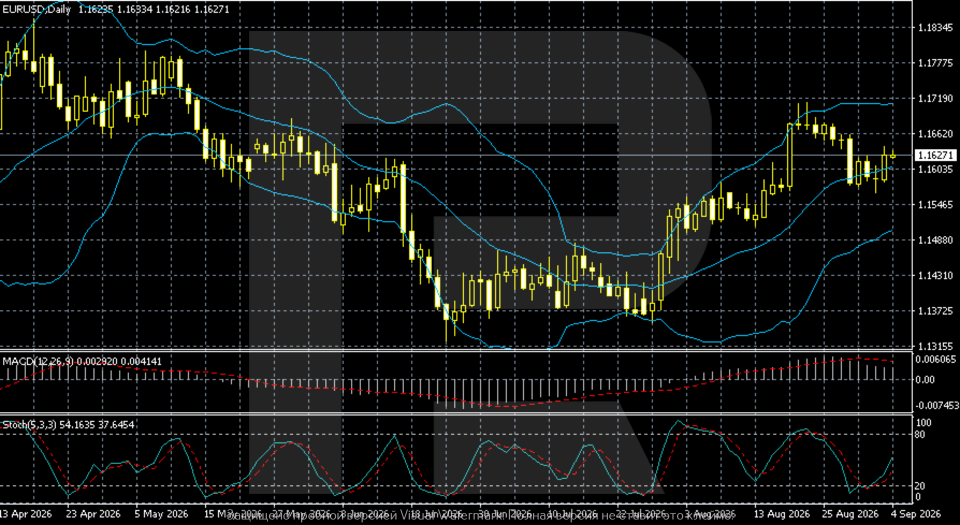
- Current trend: on the daily chart, the EURUSD pair is recovering after a decline from the 1.1690–1.1719 area. Recent candlesticks show stabilisation around the middle Bollinger Band, while the price holds slightly above the crucial 1.1603 level. MACD remains in positive territory, although the narrowing gap between the main and signal lines points to weakening of the previous bullish momentum. The Stochastic Oscillator, by contrast, has turned upwards after leaving oversold territory and is now rising into the neutral zone. This suggests a local recovery, but there is still no confirmation of a new trend momentum
- Weekly outlook: the baseline scenario for the coming week suggests the EURUSD pair will remain within the 1.1603–1.1719 range with a moderate advantage for buyers. For a full-fledged upward wave to develop, the pair needs to break above the intermediate resistance level at 1.1662 and consolidate above it. In this case, the market could retest the 1.1719 mark. Until such a breakout occurs, the upward move should be viewed more as a recovery after the correction. A move below 1.1603 would change the short-term picture and open the way towards 1.1547
EURUSD fundamental analysis
The fundamental backdrop for the dollar has become less clear-cut by the new week. Federal Reserve Governor Christopher Waller indicated that he would support keeping rates unchanged if price pressures continued to ease. Against this backdrop, the likelihood of a September rate hike fell to around 50%.
At the same time, the US real economy is not yet showing a noticeable slowdown. The S&P Global composite PMI for August rose to 56 from 54.5, while the services PMI increased to 56.5 from 54.6. The ISM services PMI also strengthened to 55.4 from 54.1 a month earlier. These readings indicate continued high economic activity and limit the scope for sharp easing by the Federal Reserve.
A weaker signal came from the labour market. JOLTS job openings totalled 7.271 million in July, compared to 7.330 million expected. Lower demand for workers may indicate a gradual normalisation of the labour market, but this indicator alone is not yet sufficient to establish a sustained bearish trend for the dollar.
Thus, the fundamental picture at the start of the new week appears balanced: the US economy remains strong, but rate expectations have become less hawkish. Inflation now takes on decisive importance, as it should show whether the market’s reduced expectations for further policy tightening are justified.
EURUSD technical analysis
On the daily timeframe, the EURUSD pair continues to form higher lows relative to the June–July base, so the medium-term structure remains bullish for now. After the August rise, the market encountered resistance around 1.1719 and entered a correction phase.
The nearest resistance level is located at 1.1662. A breakout above it would allow buyers to retest 1.1719, with 1.1778 and 1.1835 as the next upside targets. The key support area remains at 1.1603, followed by 1.1547 and 1.1480.
The price is trading around the middle Bollinger Band, indicating the market is entering a consolidation phase. MACD remains above zero, but bullish momentum has weakened. The Stochastic Oscillator is turning upwards and is around the middle of its range, creating scope for a further recovery.
The technical picture therefore remains moderately positive while the EURUSD pair trades above 1.1603, but a return to a sustainable uptrend will require a breakout above 1.1662 and then 1.1719.
EURUSD trading scenarios
The current EURUSD structure does not provide sufficient grounds for entering within the 1.1603–1.1662 range, so priority should be given to trades only after the price breaks beyond its boundaries.
- Buy scenario
A consolidation above 1.1662 would confirm a further recovery and create conditions for a retest of the August resistance level.
- Entry level: buy stop 1.1663
- Take profit: 1.1719
- Stop loss: 1.1630
- Risk-to-reward ratio: approximately 1:1.7
The trade idea is valid until 8:00 AM on 11 September 2026 (server time, UTC+3).
- Sell scenario
A breakout below 1.1603 would show that the recovery has failed to continue and that sellers are regaining the short-term initiative.
- Entry level: sell stop 1.1602
- Take profit: 1.1547
- Stop loss: 1.1633
- Risk-to-reward ratio: approximately 1:1.8
The trade idea is valid until 8:00 AM on 11 September 2026 (server time, UTC+3).
Summary
The EURUSD pair begins the new week at a point of balance between softer expectations for Fed policy and still-strong US economic indicators. The market has not yet gained sufficient momentum to break out of the current range.
From a technical perspective, the medium-term advantage remains with buyers, but the nearest move will be determined by the price reaction to the 1.1603–1.1662 boundaries. An upside breakout would increase the chances of a return to 1.1719. A breakout below the lower boundary would open the way for a deeper correction.
Editors’ picks

EURUSD forecast 2026–2027: technical analysis, price levels & predictions
EURUSD has recovered from the July lows and is trading near 1.1545 — back in bullish territory. The pair has reclaimed EMA65 on the daily, formed a bullish EMA crossover on H4, and the US-eurozone GDP gap has narrowed sharply (US 1.5% vs eurozone 1.0%). Goldman Sachs and Deutsche Bank both now target 1.2500 by year-end. A confirmed close above 1.1700 opens the path to 1.1805. We break down the key levels, three trading scenarios, and what the unprecedented 9-3 FOMC dissent vote means for EURUSD.

Gold (XAUUSD) forecast 2026: technical analysis, price levels & predictions
Gold has reversed its downtrend and is trading near 4,360 USD, back above both EMA65 and EMA200. ETF flows turned positive in July with 3 billion USD of net inflows, and central banks bought 288.9 tonnes in Q2 — up 62% year-on-year. A breakout above 4,500 USD opens the path to 4,855 USD and the 5,597 USD all-time high. We break down the key levels, three trading scenarios with entry triggers, and what J.P. Morgan, Deutsche Bank and Goldman Sachs are forecasting for gold in 2026.
Ang mga pagtataya na ipinakita sa seksyong ito ay nagpapakita lamang ng pribadong opinyon ng may-akda at hindi dapat ituring bilang gabay para sa pagtetrade. Walang pananagutan ang RoboForex para sa mga resulta ng pagtetrade batay sa mga rekomendasyon sa pagtetrade na inilarawan sa mga analytical review na ito.