
Intervention fails to save the yen: USDJPY prepares for another surge
The USDJPY rate continues to rise despite government efforts to strengthen the yen, with the price currently at 160.30. Discover more in our analysis for 31 July 2026.
USDJPY forecast: key takeaways
- Bank of Japan interest rate decision: previous reading 1.0%, actual reading 1.0%
- Japanese authorities carried out another intervention
- USDJPY forecast for 31 July 2026: 162.20 and 159.75
Fundamental analysis
Fundamental analysis for 31 July 2026 shows that the yen is losing ground again following intervention by the Japanese government.
The Bank of Japan held its key interest rate steady at 1.0%, in line with market expectations. At the same time, the regulator indicated quite explicitly for the first time that inflation could rise above its target. If price pressures do not begin to ease, interest rates are likely to rise further.
A day earlier, according to sources, the Japanese authorities carried out a large-scale intervention, buying yen and selling US dollars to halt the currency’s decline. The yen did strengthen noticeably afterwards, but the effect proved short-lived, and the market is already testing how determined Tokyo is to support the currency.
Market participants are now focused on two questions: whether the Bank of Japan will accelerate interest rate hikes and whether the authorities will return to the foreign exchange market if the yen continues to weaken. Analysts believe that intervention alone is insufficient for a long-term reversal of the exchange rate without faster monetary policy tightening.
The US dollar, meanwhile, is supported by high yields on US assets and the Federal Reserve’s hawkish stance. The Bank of Japan, by contrast, is increasingly signalling future rate hikes. At the same time, the authorities’ willingness to intervene in the currency market is only adding to tensions and making fluctuations in the pair more pronounced.
Technical outlook
On the H4 chart, the USDJPY pair formed a Hammer reversal pattern near the lower Bollinger Band and is trading around 160.30. Since the price has broken out of the ascending channel, it may form an upward wave following the pattern’s signal and return to the channel, with the first upside target at 162.20.
At the same time, the USDJPY forecast also considers an alternative scenario in which the pair may test the 159.75 support level before rising.
USDJPY overview
- Asset: USDJPY
- Timeframe: H4 (intraday)
- Trend: bullish
- Key resistance levels: 162.20 and 164.35
- Key support levels: 159.75 and 157.90
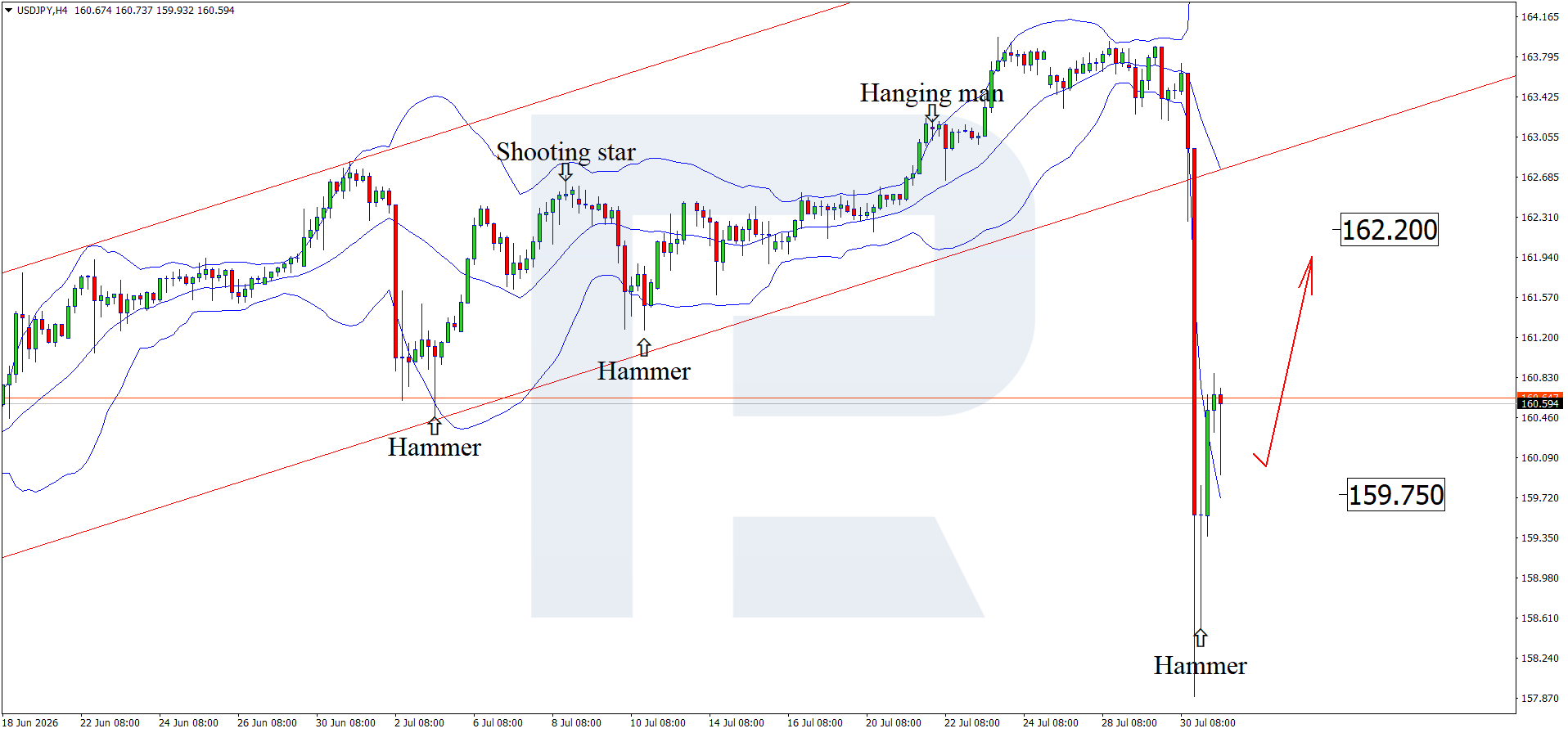
USDJPY trading scenarios for today
Main scenario (Buy Stop)
A breakout above the resistance level and consolidation above 162.20 would indicate increased buying pressure and create conditions for opening long positions in USDJPY.
- Take Profit: 164.35
- Stop Loss: 162.00
Alternative scenario (Sell Stop)
A breakout and consolidation below the 159.75 support level would signal a deeper bearish correction in the USDJPY rate.
- Take Profit: 157.90
- Stop Loss: 160.00
Risk factors
The main risk to the USDJPY bullish scenario remains increased selling pressure if the 157.75 support level is broken, which could lead to a further bearish correction. Additional pressure on the pair may come from continued yen strengthening amid more hawkish signals from the BoJ and intervention by the Japanese government in the market.
Summary
Another attempt by the Japanese government to strengthen the yen proved temporary, with the USDJPY rate resuming its upward trajectory after a sharp decline. USDJPY technical analysis suggests that quotes may rise towards 162.20.
Editors’ picks

EURUSD forecast 2026–2027: technical analysis, price levels & predictions
EURUSD has pulled back from the 2026 high of 1.1915 and is now trading near 1.1450 — below both EMA65 and EMA200 — with the active scenario shifting from bullish to bearish. The ECB raised rates to 2.40%, but the Fed holds at 3.75%, and US inflation (3.5%) continues to outpace the eurozone (2.8%). A confirmed break below 1.1280 opens the next downward wave toward 1.1080. We break down the key levels, three trading scenarios with entry triggers, and what Deutsche Bank, Morgan Stanley and UBS are forecasting for EURUSD in 2026.

Gold (XAUUSD) forecast 2026: predictions based on fundamental and technical analysis
Gold has corrected over 25% from its all-time high of 5,597 USD and is now trading near 4,100 USD — testing a critical support zone. Is this the bottom, or will the downtrend continue? We break down the key levels (support 3,920 USD, breakout trigger 4,500 USD), three trading scenarios with entry levels, and what J.P. Morgan, Goldman Sachs and Deutsche Bank are forecasting for gold in 2026.
Ang mga pagtataya na ipinakita sa seksyong ito ay nagpapakita lamang ng pribadong opinyon ng may-akda at hindi dapat ituring bilang gabay para sa pagtetrade. Walang pananagutan ang RoboForex para sa mga resulta ng pagtetrade batay sa mga rekomendasyon sa pagtetrade na inilarawan sa mga analytical review na ito.