
USDJPY pauses ahead of Nonfarm Payrolls
Attempts by the Japanese and US governments to strengthen the yen had only a temporary effect. The USDJPY rate currently stands at 157.65. Discover more in our analysis for 5 August 2026.
USDJPY forecast: key takeaways
- The Bank of Japan may continue to tighten monetary policy
- The market is awaiting the Nonfarm Payrolls report
- USDJPY forecast for 5 August 2026: 156.00 and 159.35
Fundamental analysis
Fundamental analysis for 5 August 2026 shows that the yen is losing ground again following the Japanese government’s intervention and is testing the 157.65 level.
The main focus remains the joint currency intervention by Washington and Tokyo. US Treasury Secretary Scott Bessent confirmed the US readiness to continue supporting Japan’s efforts to stabilise the yen. This significantly reduced speculative pressure on the Japanese currency and prompted market participants to be more cautious about betting against the yen.
Following statements by US and Japanese officials, the market increased the likelihood that the Bank of Japan may continue to tighten monetary policy at its September meeting. Expectations of an interest rate hike are becoming the main fundamental factor supporting the yen.
The key trigger for the USDJPY pair this week is the release of the July Nonfarm Payrolls report on Friday. Its results could significantly alter expectations regarding the Federal Reserve’s future actions and become a key driver of the USDJPY rate in the coming days.
The analysis for 5 August 2026 takes into account that the fundamental backdrop for the USDJPY pair has become more balanced. The yen is supported by the joint currency intervention by the US and Japan and growing expectations of a Bank of Japan rate hike. At the same time, the pair’s further movement will largely depend on US macroeconomic data, which will determine whether the Federal Reserve remains prepared for further monetary policy tightening.
Technical outlook
On the H4 chart, the USDJPY rate formed a Hammer reversal pattern near the lower Bollinger Band and is trading around 157.60. Since the price has broken out of the ascending channel, it could form an upward wave as the pattern signal plays out and return to the channel, with the first upside target at 159.35.
The USDJPY forecast also considers an alternative scenario in which the pair could test the 156.00 support level before rising.
USDJPY overview
- Asset: USDJPY
- Timeframe: H4 (intraday)
- Trend: range
- Key resistance levels: 159.35 and 161.50
- Key support levels: 156.00 and 155.60
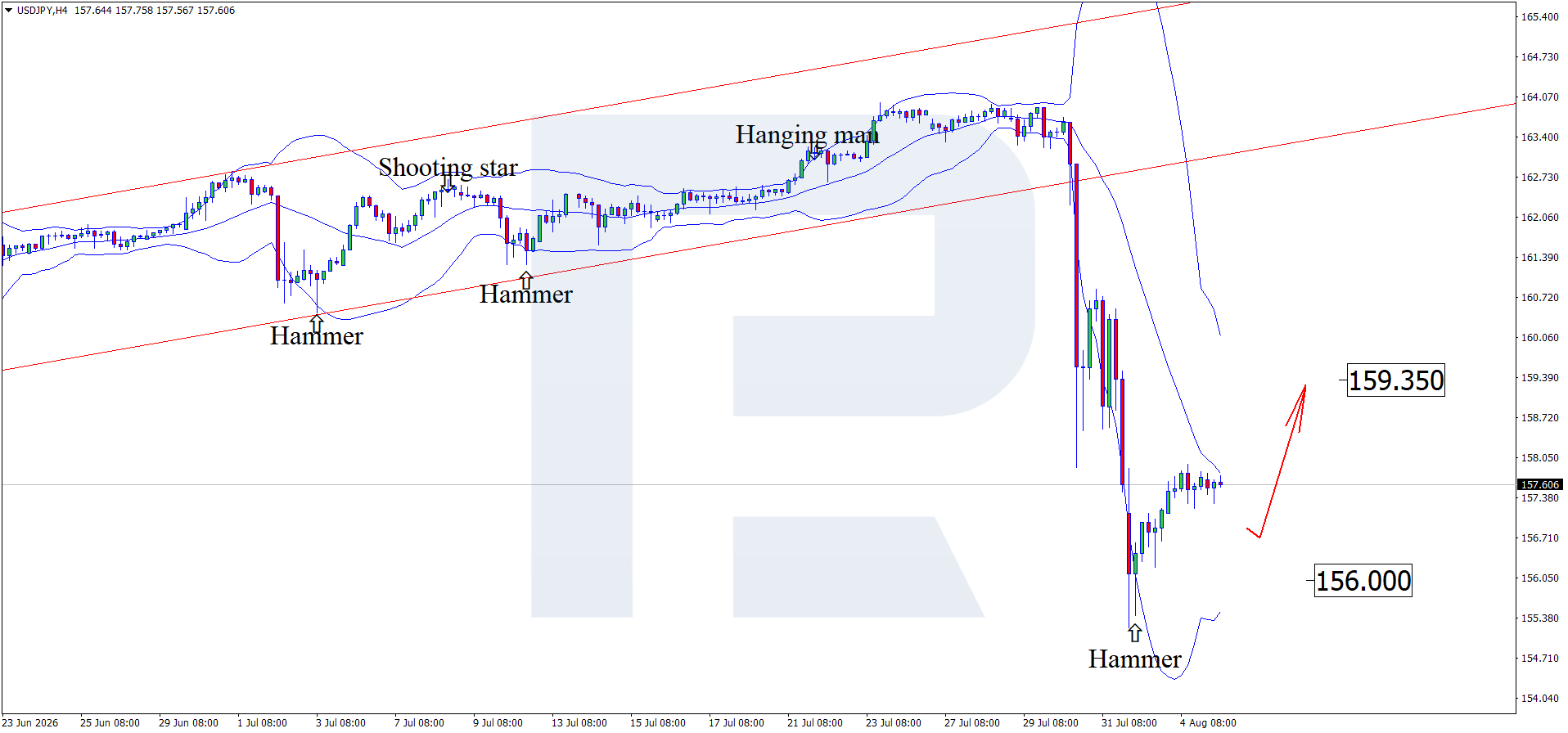
USDJPY trading scenarios for today
Main scenario (Sell Stop)
A breakout below the support level, followed by consolidation below 156.00, would indicate increased selling pressure and a continued decline.
- Take Profit: 155.60
- Stop Loss: 156.20
Alternative scenario (Buy Stop)
A breakout above the resistance level, followed by consolidation above 159.35, would signal further growth.
- Take Profit: 161.50
- Stop Loss: 159.15
Risk factors
The main risk to the USDJPY downside scenario is continued strong buying pressure following currency interventions and consolidation above key resistance levels. Geopolitical tensions and rising energy prices could add to pressure on the yen and push the USDJPY rate higher.
Summary
The intervention provided temporary support for the yen, with the market now awaiting US employment data. USDJPY technical analysis suggests a rise towards the 159.35 resistance level.
Editors’ picks

EURUSD forecast 2026–2027: technical analysis, price levels & predictions
EURUSD has pulled back from the 2026 high of 1.1915 and is now trading near 1.1450 — below both EMA65 and EMA200 — with the active scenario shifting from bullish to bearish. The ECB raised rates to 2.40%, but the Fed holds at 3.75%, and US inflation (3.5%) continues to outpace the eurozone (2.8%). A confirmed break below 1.1280 opens the next downward wave toward 1.1080. We break down the key levels, three trading scenarios with entry triggers, and what Deutsche Bank, Morgan Stanley and UBS are forecasting for EURUSD in 2026.

Gold (XAUUSD) forecast 2026: predictions based on fundamental and technical analysis
Gold has corrected over 25% from its all-time high of 5,597 USD and is now trading near 4,100 USD — testing a critical support zone. Is this the bottom, or will the downtrend continue? We break down the key levels (support 3,920 USD, breakout trigger 4,500 USD), three trading scenarios with entry levels, and what J.P. Morgan, Goldman Sachs and Deutsche Bank are forecasting for gold in 2026.
Ang mga pagtataya na ipinakita sa seksyong ito ay nagpapakita lamang ng pribadong opinyon ng may-akda at hindi dapat ituring bilang gabay para sa pagtetrade. Walang pananagutan ang RoboForex para sa mga resulta ng pagtetrade batay sa mga rekomendasyon sa pagtetrade na inilarawan sa mga analytical review na ito.