
USDJPY declines as the yen strengthens to levels last seen in late February 2026
The yen continued to strengthen, with USDJPY falling to its lowest levels in the past six months. The current USDJPY price is 154.11. Find out more in our analysis for 8 September 2026.
USDJPY forecast: key takeaways
- Lower liquidity and trading volumes due to the US holiday led to a significant strengthening of the yen
- The likelihood of a Federal Reserve interest rate hike in September rose to around 62%
- The market is awaiting the release of US inflation data on Friday
- USDJPY forecast for 8 September 2026: 156.25
Fundamental analysis
Fundamental analysis for 8 September 2026 shows that the USDJPY market situation has shifted slightly in favour of the dollar. In August, US Nonfarm Payrolls increased by 162 thousand, significantly exceeding the market forecast of around 56 thousand. The unemployment rate remained at 4.1%. Robust employment data fuelled expectations of a more hawkish Federal Reserve stance: following the release, the likelihood of a rate hike at the September meeting rose to around 57–62%.
Japanese government bond yields rose significantly, with the 10-year JGB yield exceeding 3% for the first time in around three decades. Higher yields on domestic assets make them more attractive to Japanese insurance companies, pension funds, and other major investors. This creates conditions for some capital to be repatriated from foreign bonds back to Japan to buy yen.
Last month, Japan sold 88 billion USD worth of foreign securities, marking the largest such sale on record. Most of the proceeds are likely being used to fund yen interventions. Japan is the world’s largest holder of US bonds.
The analysis for 8 September 2026 also takes into account that a breakout below 155 is significant not only from a technical analysis perspective. In previous periods, the yen’s appreciation following currency interventions stalled around this area. The USDJPY rate has now moved below it without a new official intervention. This indicates that the JPY’s appreciation is increasingly being driven by market factors: rate hike expectations, capital repatriation, and changes in investor positioning.
Technical outlook
On the D1 chart, the USDJPY pair has confidently broken below the 155.15 support level, with a new one yet to form. The resistance level has shifted to 156.75. On the H4 chart, support has formed at 152.85, while resistance has moved to 154.75. Conditions have now formed for an upward correction within the broader trend, with the first target for the correction at 156.25.
At the same time, the USDJPY forecast also considers an alternative market scenario in which the USDJPY pair could continue to decline and break below 152.85, targeting 151.55.
USDJPY overview
- Asset: USDJPY
- Timeframe: H4 (intraday)
- Trend: bearish
- Key resistance levels: 154.75 and 156.75
- Key support levels: 152.85 and 155.15
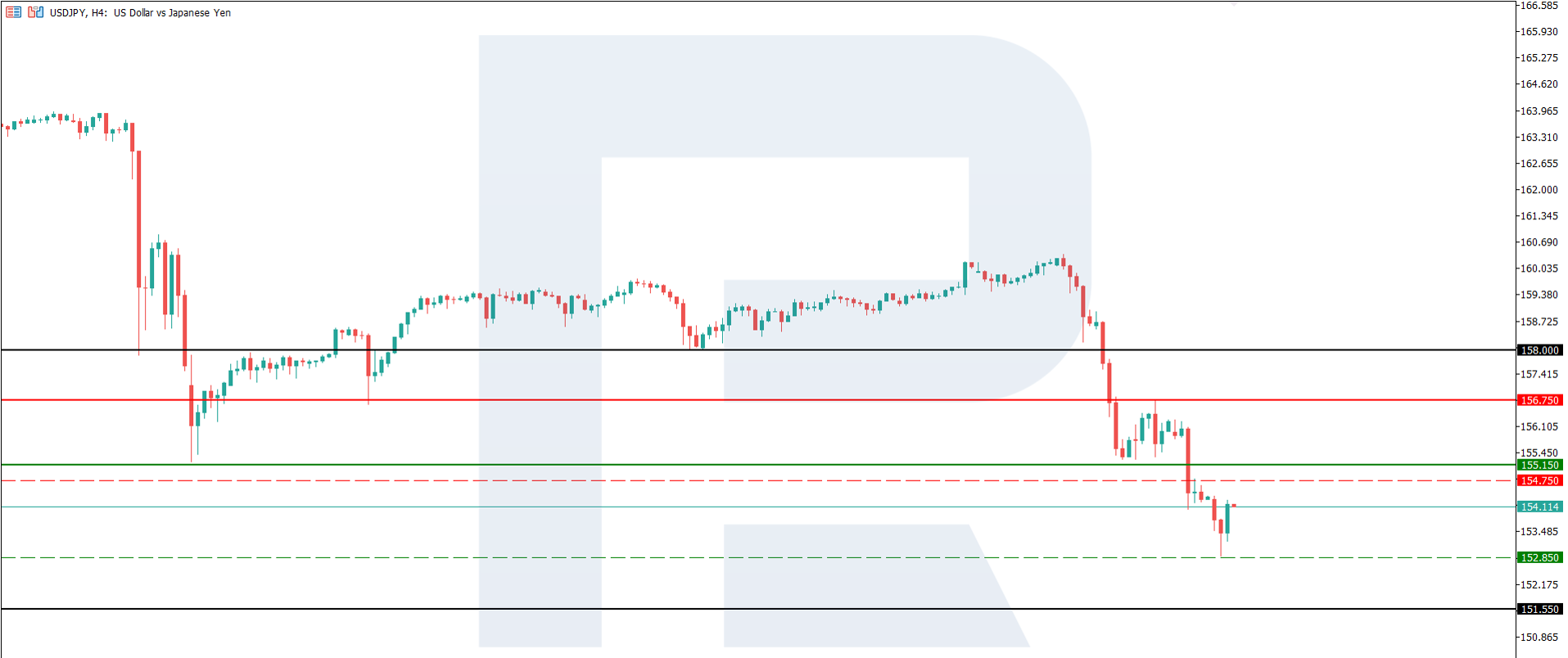
USDJPY trading scenario for today
Main scenario (Buy Stop)
Consolidation above the 154.75 resistance level would confirm the start of a correction and create conditions for further USDJPY growth.
- Current price: 154.11
- Entry level: 154.85
- Take profit: 156.25
- Stop loss: 154.45
- Risk-to-reward ratio: more than 1:3.5
The trade idea is valid until 8:00 AM on 9 September 2026 (server time, UTC+3).
Risk factors
The main factor limiting the yen’s potential for further gains is high oil prices. Japan is heavily dependent on energy imports, so rising oil prices worsen its trade balance and traditionally put pressure on the JPY. This forces the BoJ to pursue a tighter policy. As a result, the impact of this factor is mixed. In the US, high energy costs also increase inflation risks and could prompt the Federal Reserve to raise interest rates.
Summary
The main risk to this scenario is high inflation in the US. If the CPI confirms increasing inflationary pressure, the likelihood of a Federal Reserve rate hike could approach 100%, US bond yields could rise, and the dollar would have grounds for a corrective recovery. The upward move could be especially strong if the BoJ raises its interest rate on 18 September. USDJPY technical analysis suggests a correction towards 156.25.
Editors’ picks

EURUSD forecast 2026–2027: technical analysis, price levels & predictions
EURUSD has recovered from the July lows and is trading near 1.1545 — back in bullish territory. The pair has reclaimed EMA65 on the daily, formed a bullish EMA crossover on H4, and the US-eurozone GDP gap has narrowed sharply (US 1.5% vs eurozone 1.0%). Goldman Sachs and Deutsche Bank both now target 1.2500 by year-end. A confirmed close above 1.1700 opens the path to 1.1805. We break down the key levels, three trading scenarios, and what the unprecedented 9-3 FOMC dissent vote means for EURUSD.

Gold (XAUUSD) forecast 2026: technical analysis, price levels & predictions
Gold has reversed its downtrend and is trading near 4,360 USD, back above both EMA65 and EMA200. ETF flows turned positive in July with 3 billion USD of net inflows, and central banks bought 288.9 tonnes in Q2 — up 62% year-on-year. A breakout above 4,500 USD opens the path to 4,855 USD and the 5,597 USD all-time high. We break down the key levels, three trading scenarios with entry triggers, and what J.P. Morgan, Deutsche Bank and Goldman Sachs are forecasting for gold in 2026.
Ang mga pagtataya na ipinakita sa seksyong ito ay nagpapakita lamang ng pribadong opinyon ng may-akda at hindi dapat ituring bilang gabay para sa pagtetrade. Walang pananagutan ang RoboForex para sa mga resulta ng pagtetrade batay sa mga rekomendasyon sa pagtetrade na inilarawan sa mga analytical review na ito.