
USDJPY weakens as the dollar strengthens after the interest rate hike
The US dollar is strengthening after the Federal Reserve raised interest rates and signalled further monetary policy tightening. The current USDJPY price is 155.62. Find out more in our analysis for 17 September 2026.
USDJPY forecast: key takeaways
- The US Federal Reserve raised its policy rate to 4.00% for the first time since 2023
- The probability of another rate hike in October stands at 50%
- The market is awaiting the Bank of Japan's interest rate decision this Friday
- USDJPY forecast for 17 September 2026: 157.40
Fundamental analysis
USDJPY fundamental analysis for 17 September 2026 takes into account that the Federal Reserve's decision to raise rates by 25 basis points to a range of 3.75–4.00% strengthened the US dollar. A more important factor for USDJPY was not the rate hike itself, which had been largely expected by the market, but the updated monetary policy trajectory. According to the new projections, 16 of 18 Fed officials see scope for another rate increase before the end of 2026, implying a range of 4.00–4.25%. At the same time, a rapid shift to rate cuts in 2027 is not expected. High US Treasury yields and persistent inflationary pressure are providing additional support to the dollar.
However, the potential for further USDJPY gains is being limited by expectations of tighter Bank of Japan policy. At its 17–18 September meeting, the regulator is expected by the market to raise rates from 1.00% to 1.25%. The main focus will be not so much on the increase itself, as it has already been largely priced in, but on comments from Kazuo Ueda regarding the future rate-hike cycle. If the Bank of Japan signals a faster pace of policy tightening, the gap between US and Japanese interest rates will gradually narrow, which could support the yen and limit USDJPY gains.
High oil prices remain another factor. For the US, rising energy prices support inflation risks and increase the likelihood that the Federal Reserve will maintain a tight policy stance. For Japan, a major energy importer, expensive oil worsens the terms of trade and traditionally puts pressure on the yen. The current fundamental backdrop therefore remains mixed, although the US dollar retains a slight short-term advantage.
Technical outlook
On the daily chart, USDJPY has formed a support level at 152.95. The nearest resistance level is around 156.75. On the H4 timeframe, support is located near 154.95, while resistance has formed at 156.40. The yen continues to weaken, and the D1 resistance level is highly likely to be broken. If the pair continues to rise, the next target for buyers could be 157.40.
An alternative scenario suggests a further decline in USDJPY. If the price consolidates firmly below the 152.85 support level, selling pressure could intensify, opening the way towards the next target around 151.55.
USDJPY overview
- Asset: USDJPY
- Timeframe: H4 (Intraday)
- Trend: bearish
- Key resistance levels: 156.40 and 156.75
- Key support levels: 154.95 and 152.95
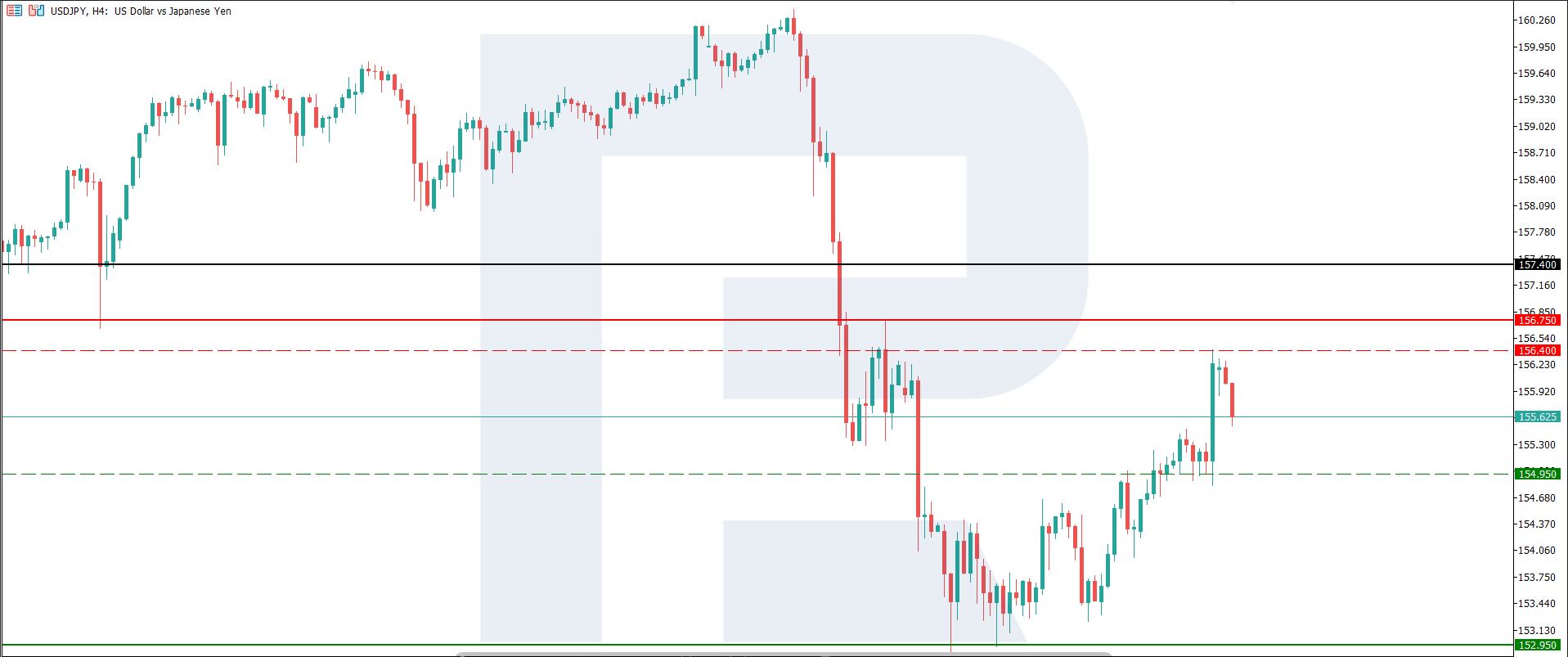
USDJPY trading scenario for today
Main scenario (Buy Stop)
Consolidation above the 156.40 resistance level would confirm a continuation of the correction and create conditions for further USDJPY growth.
- Current price: 155.62
- Entry level: 156.50
- Stop Loss: 156.10
- Take Profit: 157.40
- Risk-to-reward ratio: above 1:2.25
The trade idea is valid until 8:00 AM on 18 September 2026 (server time, UTC+3).
Risk factors
The main risks to the USDJPY outlook are associated with the possibility of the Bank of Japan taking a more hawkish stance than the market expects, which could accelerate yen appreciation and push the pair lower. Another risk is an unexpected slowdown in inflation or a deterioration in US macroeconomic data, as this could reduce expectations of further Federal Reserve rate hikes and lower US Treasury yields. An escalation in global geopolitical tensions could also support the yen as a safe-haven asset. In the opposite direction, risks to the bearish scenario include a further rise in oil prices, persistently high US inflation, and a more cautious stance from the Bank of Japan.
Summary
As a result, a moderately positive near-term scenario is developing for USDJPY. The Federal Reserve's rate hike, the possibility of another increase before year-end, and persistently high US Treasury yields are supporting the US dollar. The main risk to this scenario is the Bank of Japan meeting: more hawkish-than-expected rhetoric from the regulator could sharply strengthen the yen. USDJPY technical analysis suggests a correction towards 157.40.
Editors’ picks

EURUSD forecast 2026–2027: technical analysis, price levels & predictions
EURUSD has recovered from the July lows and is trading near 1.1545 — back in bullish territory. The pair has reclaimed EMA65 on the daily, formed a bullish EMA crossover on H4, and the US-eurozone GDP gap has narrowed sharply (US 1.5% vs eurozone 1.0%). Goldman Sachs and Deutsche Bank both now target 1.2500 by year-end. A confirmed close above 1.1700 opens the path to 1.1805. We break down the key levels, three trading scenarios, and what the unprecedented 9-3 FOMC dissent vote means for EURUSD.

Gold (XAUUSD) forecast 2026: technical analysis, price levels & predictions
Gold has reversed its downtrend and is trading near 4,360 USD, back above both EMA65 and EMA200. ETF flows turned positive in July with 3 billion USD of net inflows, and central banks bought 288.9 tonnes in Q2 — up 62% year-on-year. A breakout above 4,500 USD opens the path to 4,855 USD and the 5,597 USD all-time high. We break down the key levels, three trading scenarios with entry triggers, and what J.P. Morgan, Deutsche Bank and Goldman Sachs are forecasting for gold in 2026.
Ang mga pagtataya na ipinakita sa seksyong ito ay nagpapakita lamang ng pribadong opinyon ng may-akda at hindi dapat ituring bilang gabay para sa pagtetrade. Walang pananagutan ang RoboForex para sa mga resulta ng pagtetrade batay sa mga rekomendasyon sa pagtetrade na inilarawan sa mga analytical review na ito.