
Intervention threat sends USDJPY lower from 159.00: what next?
The USDJPY pair retreated from two-week highs following growing signals of possible intervention by the Japanese authorities in the foreign exchange market. The rate currently stands at 157.31. Find out more in our analysis for 28 September 2026.
USDJPY forecast: key takeaways
- The yen recovered after five sessions of declines amid fresh signs of concern from the Japanese and US authorities over its weakness
- USDJPY's approach to the psychological 160.00 level has once again increased expectations of possible currency intervention
- USDJPY forecast for 28 September 2026: 156.57 and 155.67
Fundamental analysis
The USDJPY rate fell towards the 158.00 level, while the yen ended a five-session losing streak and moved away from two-week lows. The currency was supported by comments from Finance Minister Satsuki Katayama, who stated that US President Donald Trump had expressed concern about the yen's performance during a meeting with Prime Minister Sanae Takaichi.
The market had already been closely watching the risk of intervention as the USDJPY pair approached the psychologically important 160.00 level. Further yen weakness could test Tokyo's readiness to step into the currency market again following the coordinated yen purchase by Japan and the US in late July – the first of its kind since 1998.
Katayama also reiterated that she would continue to coordinate with US Treasury Secretary Scott Bessent. The close interaction between the two countries increases the market's sensitivity to new official comments and limits the scope for a rapid return of the USDJPY rate to its recent highs.
At the same time, fundamental pressure on the yen has not disappeared completely. Expectations of further Federal Reserve rate hikes continue to support the wide yield differential between the US and Japan. Additional uncertainty comes from how quickly the Bank of Japan can proceed with its own policy-tightening cycle.
The USDJPY outlook is moderate.
Technical outlook
On the H4 timeframe, the USDJPY pair underwent a sharp correction after testing the 159.03 resistance area. The price has dropped below the middle Bollinger Band and is now heading towards the 156.57 support level, indicating a loss of short-term bullish momentum following a strong recovery from the September lows.
MACD remains above the zero line, but the indicator line is below the signal line and pointing downwards. This indicates a notable weakening of bullish momentum and increases the risk of a further correction. The Stochastic Oscillator is already in oversold territory. A reversal in the indicator's components suggests a local rebound before another decline.
The key support level remains 156.57. A breakout below it would confirm a further correction and open the way towards 155.67 and then 155.08. To restore the bullish scenario, the USDJPY pair needs to return above 158.00. The next significant resistance level would be 159.03.
USDJPY overview
- Asset: USDJPY
- Timeframe: H4 (Intraday)
- Trend: short-term bearish
- Key resistance levels: 158.00 and 159.03
- Key support levels: 156.57 and 155.67
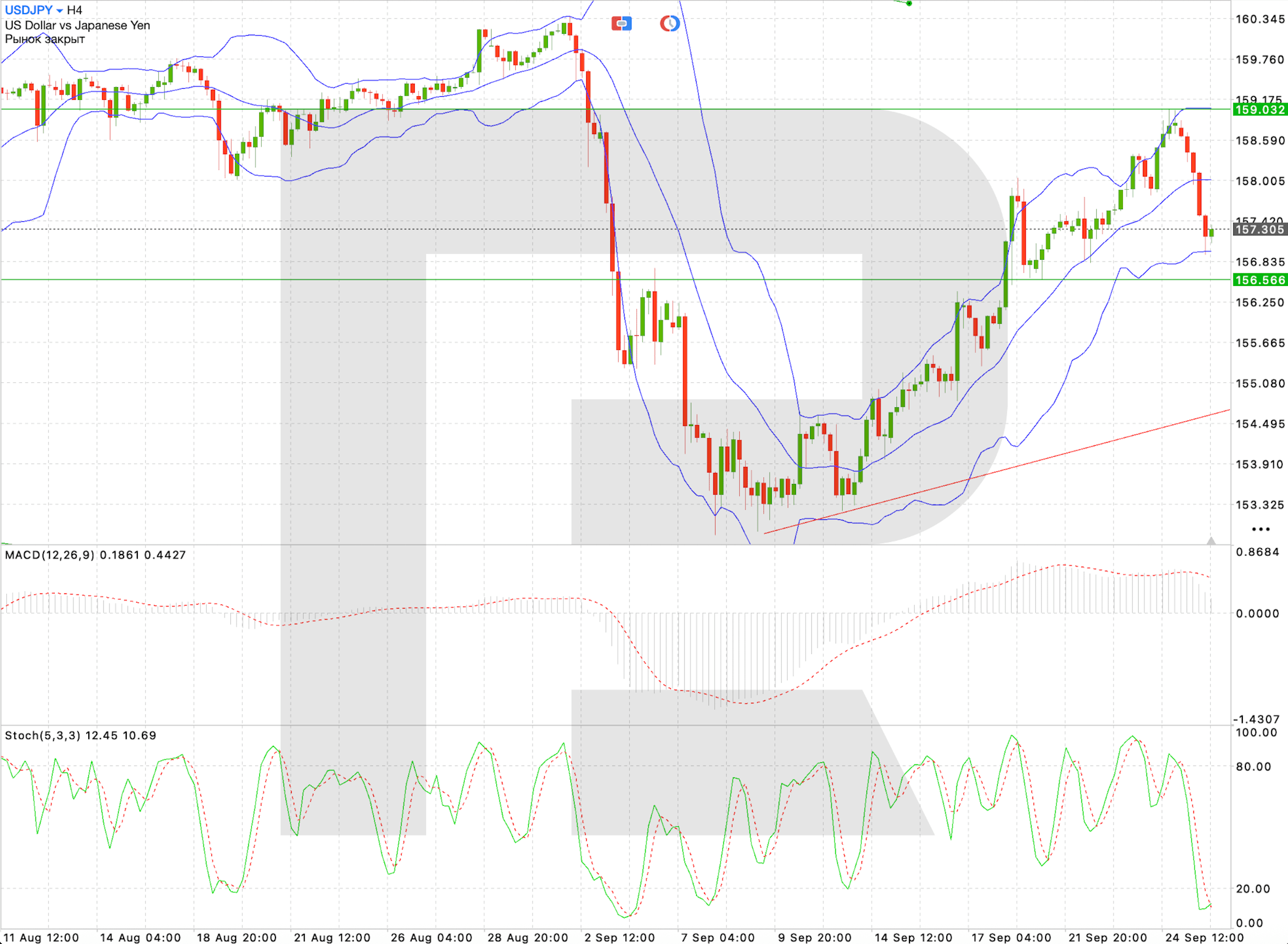
USDJPY trading scenario for today
Trading scenario (Sell Stop)
Consolidation below the 156.57 support level would confirm a continued downward correction after the reversal from 159.03 and create conditions for opening short positions.
- Current price: 157.31
- Entry level: 156.50
- Take profit: 155.67
- Stop loss: 156.92
- Risk-to-reward ratio: 1:1.98
The trade idea is valid until 8:00 AM on 29 September 2026 (server time, UTC+3).
Risk factors
The main risk to the bearish USDJPY scenario remains the wide interest rate differential between the US and Japan. New hawkish signals from the Federal Reserve could support the dollar and push the pair higher again. An additional technical risk is the oversold Stochastic Oscillator, which increases the likelihood of a local rebound. A return above 158.00 would weaken the current bearish scenario.
Summary
The USDJPY pair is correcting after failing to consolidate near 159.00, while the risk of currency intervention is providing additional support for the yen. The USDJPY forecast for today, 28 September 2026, does not rule out a decline towards 156.57 and then 155.67.
Editors’ picks

EURUSD forecast 2026–2027: technical analysis, price levels & predictions
The EURUSD outlook for 2026 and 2027: key levels on the daily chart, three trading scenarios and the policy gap between the Fed and the ECB that drives the pair.

Gold (XAUUSD) forecast 2026: technical analysis, price levels & predictions
Where gold could trade in 2026: key levels, three trading scenarios with entry triggers and the forecasts from J.P. Morgan, Deutsche Bank and Goldman Sachs.
Ang mga pagtataya na ipinakita sa seksyong ito ay nagpapakita lamang ng pribadong opinyon ng may-akda at hindi dapat ituring bilang gabay para sa pagtetrade. Walang pananagutan ang RoboForex para sa mga resulta ng pagtetrade batay sa mga rekomendasyon sa pagtetrade na inilarawan sa mga analytical review na ito.