
Yen weakness persists as USDJPY reverses sharply higher
The significant yield differential between the US and Japan remains the main factor supporting the US currency, sustaining demand for dollar-denominated assets. The USDJPY rate currently stands at 158.08. Discover more in our analysis for 9 November 2026.
USDJPY forecast: key takeaways
- US Nonfarm Payrolls increased by 165 thousand, surpassing a forecast of 65 thousand
- The unemployment rate stood at 4.1%, compared to expectations of 4.2%
- USDJPY forecast for 9 November 2026: 160.25
Fundamental analysis
USDJPY fundamental analysis indicates that the pair retains predominantly upward potential despite growing expectations of further interest rate hikes by the Bank of Japan. The significant yield differential between the US and Japan remains a key factor supporting the US currency, as it continues to drive demand for dollar-denominated assets. At the same time, accelerating wage growth in Japan, persistent inflationary pressure, and the possibility of further monetary policy tightening by the Japanese regulator limit USDJPY's upside potential and increase the risk of a corrective decline.
The key event of last week was the release of US labour market data for October. Nonfarm Payrolls increased by 165 thousand, well above a market forecast of 65 thousand, while the unemployment rate fell to 4.1%. Strong employment figures confirmed the resilience of the US economy and fuelled expectations of further Federal Reserve interest rate hikes. Following the release, the market estimates the probability of a December rate hike at nearly 80%, up from 67% the previous day.
The USDJPY forecast for 9 November 2026 is bullish.
Technical outlook
On the D1 chart, the USDJPY pair is trading in an uptrend, with the resistance level at 159.00 and the support level at 156.95. On the H4 chart, local resistance has shifted to 158.75, and support lies at 156.95. The local trend remains sideways, but the price is testing a resistance level and appears poised for a breakout, with the target at 160.25.
However, today's USDJPY forecast also envisages an alternative scenario. The price could form a corrective wave and test the 156.95 support level before rising. A breakout below this mark would pave the way for a decline towards 153.25.
USDJPY overview
- Asset: USDJPY
- Timeframe: D1 (Intraday)
- Trend: bullish
- Key resistance levels: 158.75 and 159.00
- Key support levels: 156.95 and 155.30
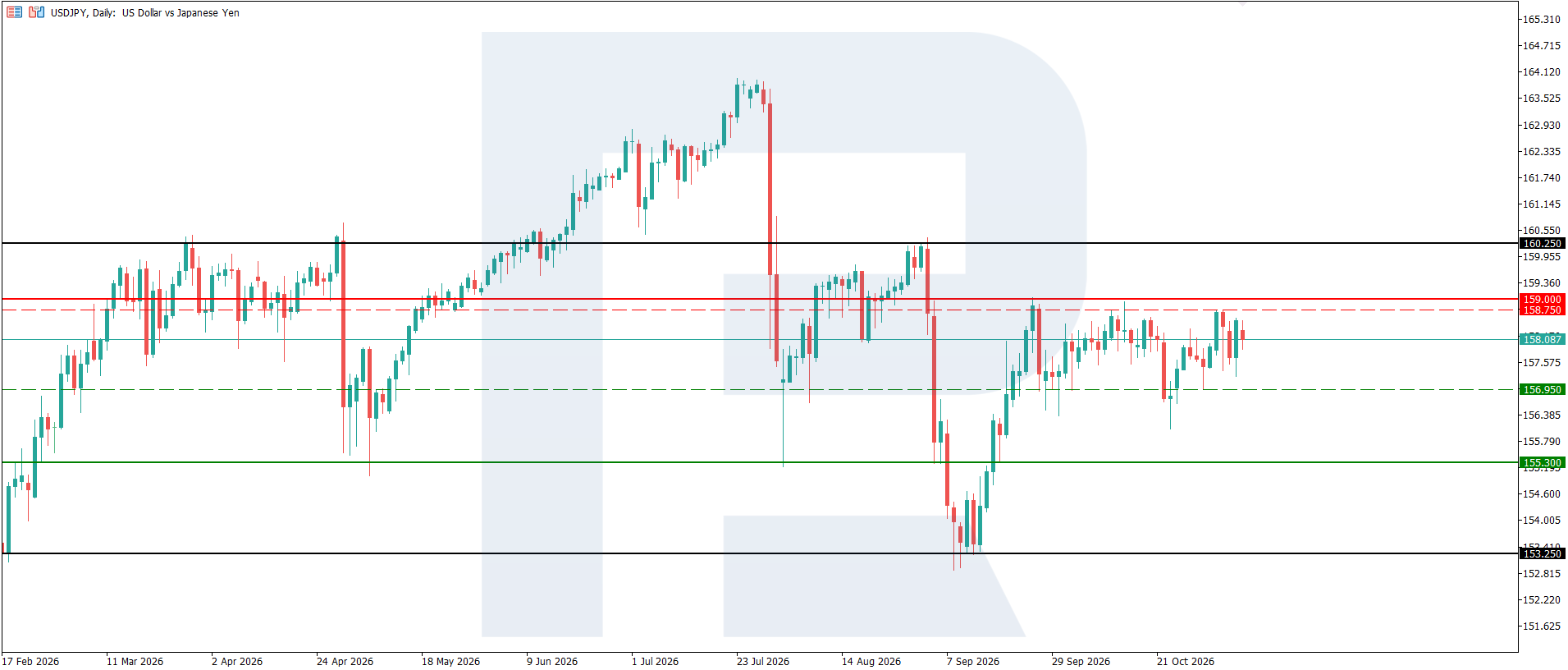
USDJPY trading scenario for today
A breakout above a local resistance level, with the price consolidating above 158.75, would favour opening long positions and confirm strengthening bullish momentum.
Risk factors
The main risk factors for the USDJPY pair remain uncertainty surrounding future Federal Reserve and Bank of Japan policies, a possible narrowing of the interest rate differential, and the threat of currency intervention by the Japanese authorities. Geopolitical tensions in the Middle East, fluctuations in global energy prices, and changes in worldwide demand for safe-haven assets create additional uncertainty. Japan remains a major importer of energy resources, so rising oil prices could worsen its terms of trade and increase inflationary pressure.
Summary
Fundamental factors predominantly point to continued upside potential for the USDJPY rate. Strong US labour market data, elevated inflation risks, and expectations of further Federal Reserve policy tightening are supporting the dollar. However, accelerating wage growth in Japan, inflation remaining above the target, and the Bank of Japan's willingness to continue raising interest rates create conditions for a gradual strengthening of the yen and limit the pair's upside potential.
Editors’ picks


EURUSD forecast 2026–2027: technical analysis, price levels & predictions
The EURUSD outlook for 2026 and 2027: key levels on the daily chart, three trading scenarios and the policy gap between the Fed and the ECB that drives the pair.

Gold (XAUUSD) forecast 2026: technical analysis, price levels & predictions
Where gold could trade in 2026: key levels, three trading scenarios with entry triggers and the forecasts from J.P. Morgan, Deutsche Bank and Goldman Sachs.
Ang mga pagtataya na ipinakita sa seksyong ito ay nagpapakita lamang ng pribadong opinyon ng may-akda at hindi dapat ituring bilang gabay para sa pagtetrade. Walang pananagutan ang RoboForex para sa mga resulta ng pagtetrade batay sa mga rekomendasyon sa pagtetrade na inilarawan sa mga analytical review na ito.