
USDJPY: falling US Treasury yields and intervention risks restrain the dollar
The US dollar has weakened following a decline in US bond yields. The USDJPY rate currently stands at 159.30. Find more details in our analysis for 25 November 2026.
USDJPY forecast: key takeaways
- Japanese Finance Minister Satsuki Katayama warned against excessive and one-sided exchange rate movements, emphasising Japan's readiness to coordinate with the US Treasury Department
- The US Conference Board Consumer Confidence Index rose from 91.9 to 103.3 points, exceeding a forecast of around 92.4 points
- USDJPY forecast for 25 November 2026: 160.85
Fundamental analysis
The Japanese yen is finding support amid persistent inflationary pressure. According to data released on 20 November, Japan's core inflation accelerated from 2.1% to 2.2% year-on-year, against a forecast of 2.3%. Despite coming in below expectations, inflation remains above the Bank of Japan's 2% target. Market participants are considering the possibility of an interest rate hike from 1.25% to 1.50% at the 18 December meeting. All else being equal, this scenario would help narrow the interest rate differential between Japan and the US.
Meanwhile, Japanese business activity data released yesterday was mixed. The manufacturing PMI rose from 53.3 to 53.7 points, exceeding a forecast of 53.5, while the services PMI declined from 51.7 to 50.5 points. Slower activity in the services sector could limit the pace of further Bank of Japan monetary tightening.
The key event for the currency pair will be today's release of the US Personal Consumption Expenditures (PCE) price index and the second estimate of US Q3 GDP. Accelerating inflation could trigger another wave of dollar strength, while weaker-than-expected data would support a continued downward correction in the USDJPY rate.
The USDJPY forecast for 25 November 2026 is moderately bullish.
Technical outlook
On the D1 chart, the USDJPY pair is trading in an uptrend. A resistance level is located at 160.05, while support has formed at 157.65. On the H4 chart, a local resistance level has shifted to 158.90, with a support level standing at 158.40. The local trend remains sideways, but the price is testing resistance and is poised for a breakout. The target for this move is 160.85.
However, today's USDJPY forecast also suggests an alternative scenario. The price could form a corrective wave and test the 157.65 support level before rising. A breakout below that level would open the way for a decline towards 156.65.
USDJPY overview
- Asset: USDJPY
- Timeframe: D1 (Intraday)
- Trend: bullish
- Key resistance levels: 160.05
- Key support levels: 157.65
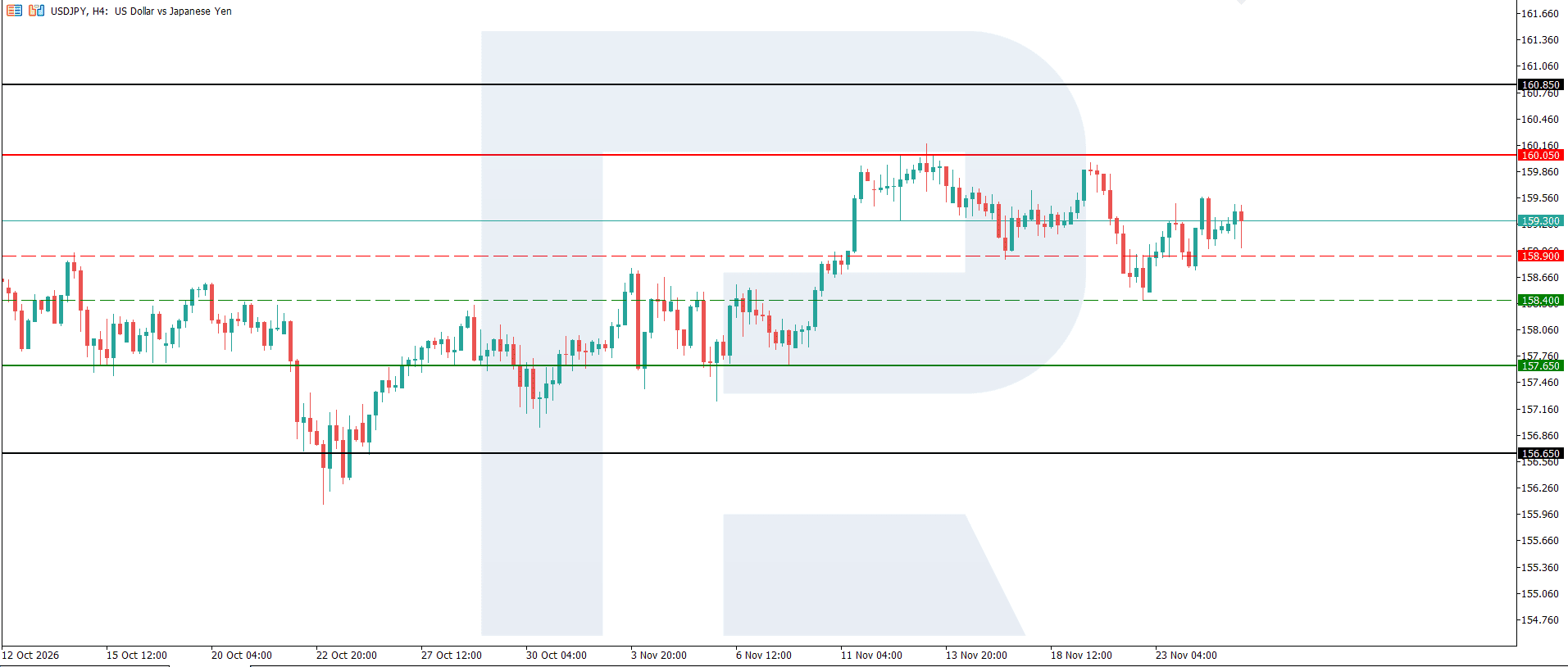
USDJPY trading scenario for today
Consolidation above the local resistance level at 158.90 would confirm renewed upward momentum and provide an opportunity to open long positions.
Risk factors
The main risk to the bearish USDJPY scenario is the Federal Reserve's continued hawkish monetary policy amid persistent inflation and strong US macroeconomic data. Higher-than-expected PCE and GDP readings could fuel expectations of an interest rate hike and trigger dollar appreciation. Another risk is the Bank of Japan maintaining a cautious stance on further monetary tightening.
Summary
The USDJPY forecast for 25 November 2026 suggests continued upward momentum. However, in the medium term, fundamental and technical factors point to a modest bearish bias. The risk of currency intervention, expectations of a Bank of Japan interest rate hike, declining US Treasury yields, and deteriorating global risk appetite create conditions for yen appreciation.
Editors’ picks


EURUSD forecast 2026–2027: technical analysis, price levels & predictions
The EURUSD outlook for 2026 and 2027: key levels on the daily chart, three trading scenarios and the policy gap between the Fed and the ECB that drives the pair.

Gold (XAUUSD) forecast 2026: technical analysis, price levels & predictions
Where gold could trade in 2026: key levels, three trading scenarios with entry triggers and the forecasts from J.P. Morgan, Deutsche Bank and Goldman Sachs.
Ang mga pagtataya na ipinakita sa seksyong ito ay nagpapakita lamang ng pribadong opinyon ng may-akda at hindi dapat ituring bilang gabay para sa pagtetrade. Walang pananagutan ang RoboForex para sa mga resulta ng pagtetrade batay sa mga rekomendasyon sa pagtetrade na inilarawan sa mga analytical review na ito.