Market Week Ahead (July 6 – 10): How to Trade the FOMC Minutes, Oil Swings and SpaceX Joining the Nasdaq-100

Five events will drive currencies, indices and oil this week, and each one comes with a clear trading scenario. SpaceX joins the Nasdaq-100 on Tuesday, the FOMC minutes land on Wednesday, China reports inflation on Thursday, Canada publishes jobs data on Friday, and the US-Iran talks keep the oil market on alert every single day. Below you will find the full calendar, the levels that matter for the S&P 500, EUR/USD, Brent, AUD/USD and CAD/JPY, and a ready-made plan for every release, so you are informed in advance what can happen and how to act when the numbers hit the screen.
Your Trading Week at a Glance
Economic Calendar: July 6 – 10
| Date | Event | Forecast / Previous | Instruments | Importance |
|---|---|---|---|---|
| Tue, Jul 7 | SpaceX Inclusion in the Nasdaq-100 | — | NAS100, S&P 500, Tech stocks | ●●● High |
| Wed, Jul 8 | FOMC Minutes | — | EUR/USD, USD Index, S&P 500 | ●●● High |
| Thu, Jul 9 | China CPI | 1.2% / 1.2% y/y | AUD/USD, Commodities | ●● Medium |
| Fri, Jul 10 | Canada Unemployment Rate | 7.0% / 6.6% | USD/CAD, CAD/JPY, Oil | ●●● High |
| All week | US-Iran Talks / Oil | — | Brent, WTI, USD/CAD | ●●● High |
Markets enter the week in stabilisation mode. Oil has settled into consolidation after its early-July spike, the dollar remains firm following soft US labour data, and equity indices are holding near their highs in a sideways pattern. That backdrop makes this a scenario trader's week: prices are coiled inside well-defined ranges, and each release below has the potential to break an instrument out of its range in a direction you can prepare for right now.
Trade Every Event This Week from One App
Currencies, indices, oil and stocks with real-time charts in RoboForex MobileTrader. Set your levels before the news hits.
7
Jul
Why It Matters
On July 7, SpaceX shares will be added to the Nasdaq-100. Index funds tracking assets worth more than 1.4 trillion USD become automatic buyers of the stock, regardless of valuation. Even with a weight below 1%, forced buying of this scale creates a short-term imbalance between supply and demand. The same day brings a second catalyst: the post-IPO quiet period ends, and the market receives its first full round of analyst research on the company. Both factors can inject volatility into the entire technology sector, which is why the trade here is the index itself.
Trading Scenarios — S&P 500
| If this happens | Likely move | What to watch |
|---|---|---|
| Passive inflows dominate, analyst coverage is upbeat | Index pushes toward 745 – 750 | A breakout above 745 confirms the bullish path |
| First analyst ratings come in restrained | Profit-taking, retest of 725 | A close below 725 opens the road to 715 |
Market Sentiment
Interest in the technology sector remains high after a strong second quarter, and investors continue to buy growth stories, with space and AI names at the front of the queue. Elevated valuations leave little tolerance for disappointment, so the reaction to Tuesday's analyst reports may prove sharper than the index inclusion itself. On the chart, the S&P 500 is consolidating after the June correction, holding above key support while MACD gradually stabilises, a sign the bearish impulse is fading.
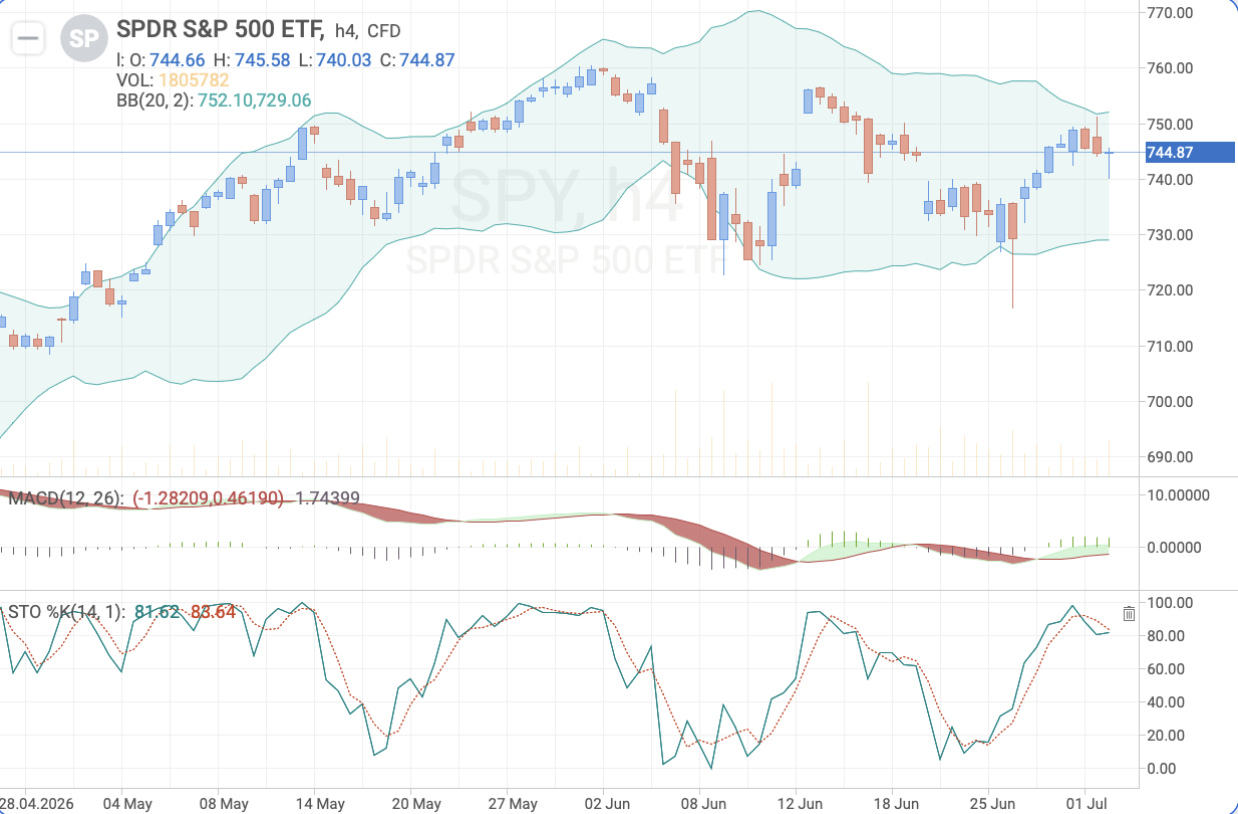
Key Levels — S&P 500
| Level | Value |
|---|---|
| Resistance | 745.00 / 750.00 |
| Support | 725.00 / 715.00 |
| Target | 750.00 |
8
Jul
Why It Matters
The minutes of the Fed's latest meeting show the reasoning behind the decision to leave rates unchanged. In plain terms: this document reveals how united the committee is on keeping rates high, and for how long. Investors will focus on two things — the assessment of inflation risks and the read on the labour market. Any hint at possible easing would reshape rate expectations within minutes of the release, and EUR/USD is typically the fastest instrument to react.
Trading Scenarios — EUR/USD
| If this happens | Likely move | What to watch |
|---|---|---|
| Minutes confirm a firm stance on high rates | Dollar strengthens, EUR/USD returns below 1.1400 | A break of 1.1400 extends pressure toward 1.1350 |
| Minutes hint at softer policy ahead | EUR/USD consolidates above 1.1500 | A close above 1.1500 opens the way to 1.1550 |
Market Sentiment
The current consensus assumes the Fed keeps policy restrictive for longer than previously expected, and after recent firm comments from officials, markets are pricing in limited room for rate cuts. Confirmation would keep the dollar strong; a surprise in the other direction would trigger the larger move, because it would force positioning to adjust. EUR/USD is gradually recovering after its decline while remaining inside a range, and MACD is showing signs of an upward reversal, pointing to a weakening downside impulse.
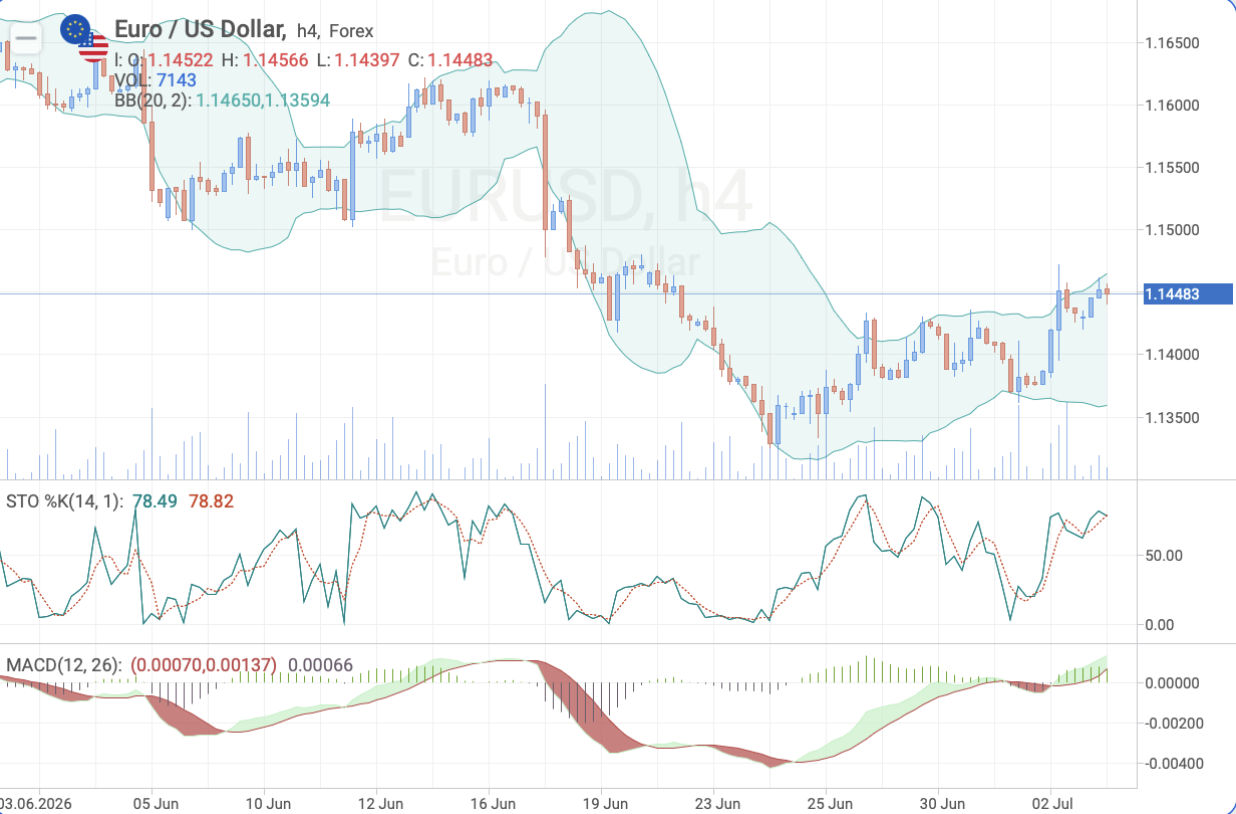
Key Levels — EUR/USD
| Level | Value |
|---|---|
| Resistance | 1.1500 / 1.1550 |
| Support | 1.1400 / 1.1350 |
| Target | 1.1550 |
6–10
Jul
Why It Matters
The US-Iran negotiations in Doha ended without a breakthrough, although both sides reported progress. Oil initially corrected lower on the news, then the picture changed sharply toward the end of the week as risks around the Strait of Hormuz rose again. Roughly a fifth of global oil supply passes through this waterway, which is why every headline from the talks moves Brent within minutes. The market is in waiting mode: escalation could cut supply abruptly, while progress at the table would send prices back down. For traders this means one thing — the 70 – 75 USD range in Brent is the battlefield, and a confirmed break on either side sets the direction.
Trading Scenarios — Brent
| If this happens | Likely move | What to watch |
|---|---|---|
| Tension around the Strait of Hormuz escalates | Brent breaks above 75, targets 80 USD | Commodity currencies (CAD, NOK) strengthen alongside |
| Talks produce visible progress | Brent slips below 70, targets 68 USD | Falling oil adds pressure on CAD ahead of Friday's jobs data |
Market Sentiment
The oil market remains highly sensitive to the news flow. After the recent spike above 90 USD, participants began taking profit on expectations of de-escalation, yet persistent instability keeps the risk premium embedded in prices and prevents a sustained downtrend from forming. Brent is under pressure after pulling back from recent highs, while MACD is close to an upward reversal, pointing to stabilisation attempts.
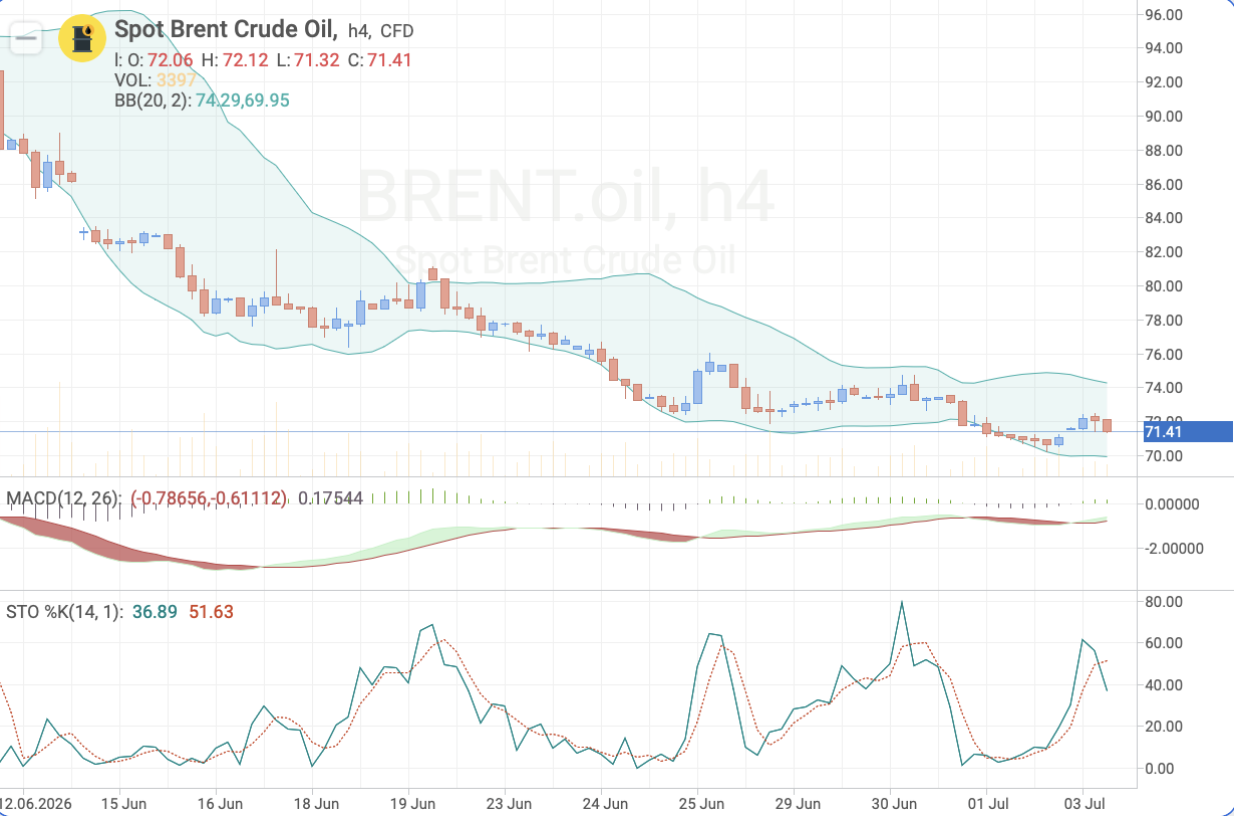
Key Levels — Brent
| Level | Value |
|---|---|
| Resistance | 75.00 / 80.00 USD |
| Support | 70.00 / 68.00 USD |
| Target | 80.00 USD |
9
Jul
Forecast
1.2% y/y
Previous
1.2% y/y
Why It Matters
Chinese inflation is a key gauge of demand in the world's second-largest economy. Weak price growth points to limited domestic spending, and since China is the largest buyer of raw materials globally, that weakness travels straight into commodity prices and the currencies tied to them. The Australian dollar is the classic proxy: China is Australia's biggest trading partner, so an upside or downside surprise in Thursday's CPI shows up in AUD/USD almost immediately.
Trading Scenarios — AUD/USD
| If this happens | Likely move | What to watch |
|---|---|---|
| CPI above 1.2%, demand recovery signal | AUD/USD recovers toward 0.7050 – 0.7100 | Commodity prices confirming the move |
| CPI at or below forecast | Pressure persists, retest of 0.6950 | A break of 0.6950 exposes 0.6900 |
Market Sentiment
The market expects inflation to stabilise, although risks of weak domestic demand persist, and any deviation from expectations feeds quickly into prices. AUD/USD is trading near the lower boundary of its range after a decline. MACD stays in negative territory, but the pace of the fall is slowing, which gives strong Chinese data a realistic chance to spark a recovery toward 0.7100.
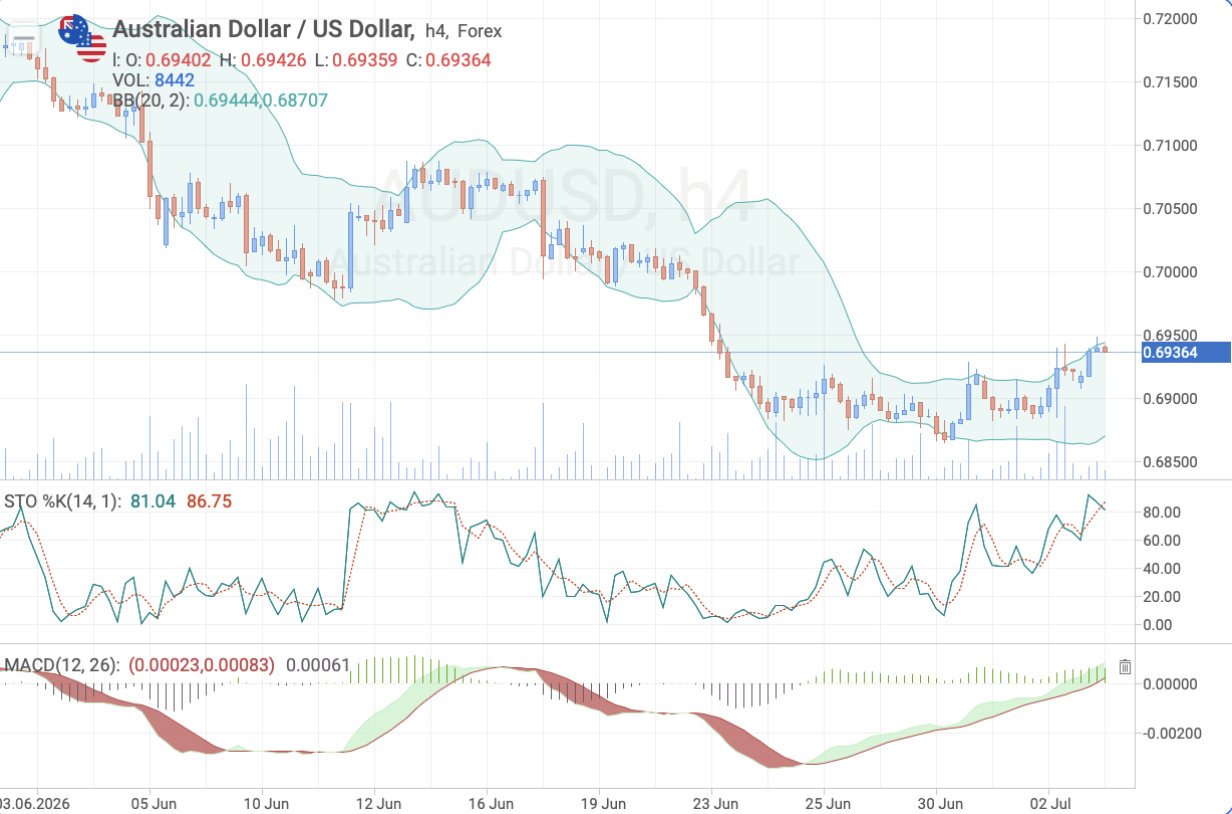
Key Levels — AUD/USD
| Level | Value |
|---|---|
| Resistance | 0.7050 / 0.7100 |
| Support | 0.6950 / 0.6900 |
| Target | 0.7100 |
10
Jul
Unemployment Forecast
7.0%
Previous
6.6%
Why It Matters
The forecast calls for a jump in unemployment from 6.6% to 7.0%, and a move of that size in a single report is rare. If confirmed, it signals a clearly slowing economy, gives the Bank of Canada more room to cut rates, and hits the Canadian dollar from two sides at once, because volatile oil prices are already pressuring CAD through the export channel. This combination makes Friday's release the cleanest single-currency setup of the week.
Trading Scenarios — CAD/JPY
| If this happens | Likely move | What to watch |
|---|---|---|
| Unemployment at 7.0% or higher | CAD/JPY extends decline toward 112.50 | Falling oil would accelerate the move |
| Labour market beats expectations | Rebound toward resistance at 114.80 | Oversold stochastic supports short-term recovery |
Market Sentiment
Expectations for the Canadian economy remain restrained, with the market pricing in a gradual cooling of the labour market against the backdrop of volatile oil. CAD/JPY is under pressure after a sharp drop in early July: the pair broke the lower boundary of its range and has yet to recover above key levels. MACD is reinforcing the downside impulse in negative territory, while the stochastic points to oversold conditions, which allows for short-term rebounds before any continuation lower.
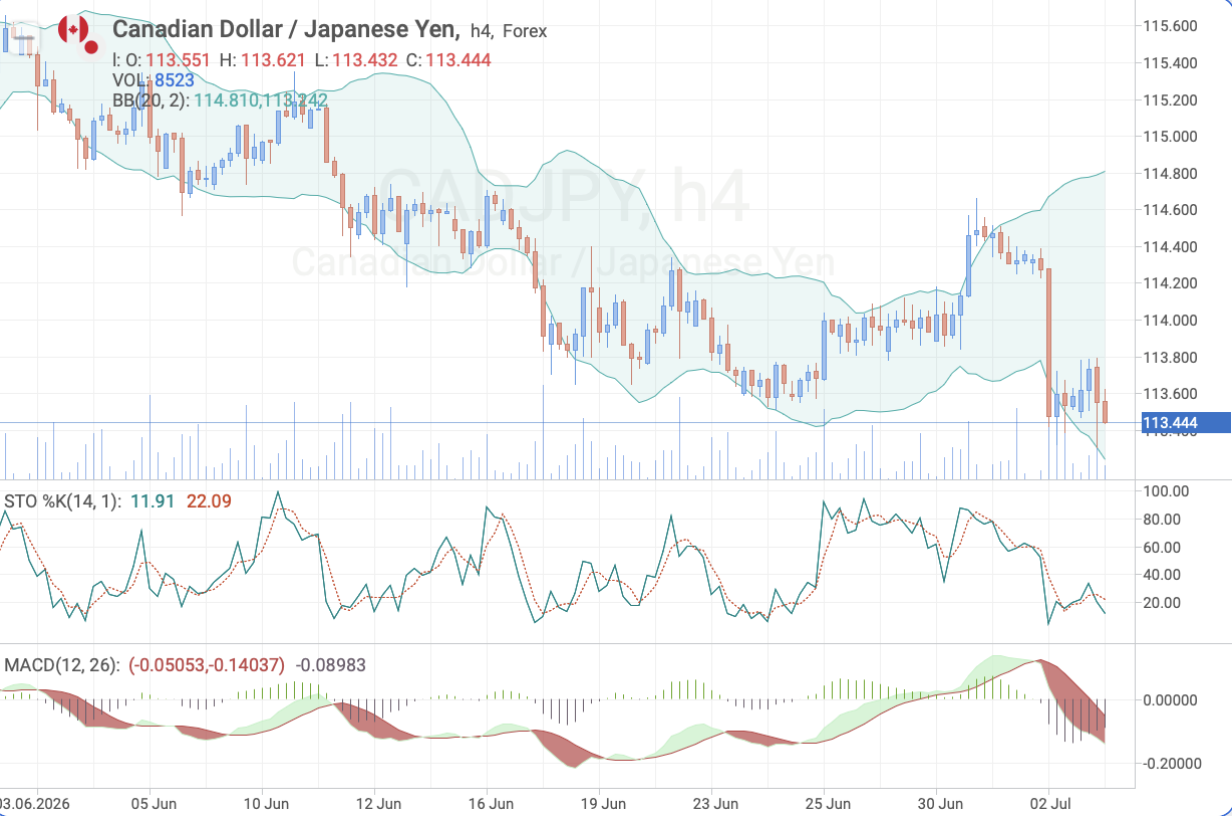
Key Levels — CAD/JPY
| Level | Value |
|---|---|
| Resistance | 114.80 / 115.50 |
| Support | 113.00 / 112.50 |
| Target | 112.50 |
How to Prepare Before Each Release
- Check the consensus. Markets move on the gap between the forecast and the actual number, so know the expected figure before it prints.
- Set your levels in advance. Place the support and resistance values from the tables above on your chart while the market is calm.
- Define both scenarios. Decide what you will do on a beat and on a miss, then let the release pick the scenario for you.
- Manage the first minutes. Spreads widen and prices whipsaw right after publication; a confirmed level break is a more reliable signal than the first tick.
New to trading the news? Read our full guide to the economic calendar to learn how forecasts, previous readings and actual figures interact.
Conclusion
The week builds from Tuesday's SpaceX inclusion in the Nasdaq-100 to Friday's Canadian jobs report, with Wednesday's FOMC minutes at the centre of the macro calendar. The minutes decide the dollar's direction: confirmation of a long period of high rates extends pressure on risk assets, while any sign of softer rhetoric gives stocks and EUR/USD room to advance toward their upper targets.
Oil runs as a parallel storyline capable of overriding the data at any moment. While the US-Iran talks continue without a final outcome, Brent trades inside the 70 – 75 USD battleground: a break above 75 targets 80, a slide below 70 accelerates the decline toward 68. Friday closes the week with the cleanest setup of all five events — a Canadian unemployment print at or above 7.0% strengthens the case for CAD/JPY moving to 112.50.
Ready to Trade This Week's Events?
Open an account in minutes, set the levels from this article on your chart and be prepared before the first release hits.
Open a Trading Account with RoboForex Any information provided in articles on this website is based solely on the personal opinions of the authors. These articles should not be construed as trading recommendations or a call to action. The authors and RoboForex accept no responsibility for the results of any trades made on the basis of these recommendations and reviews. Past performance is not indicative of future results. Trading stocks and CFDs involves a high risk of capital loss.