Market Week Ahead (July 20–24): Four Tests for the World's Central Banks

Last week showed that markets are gradually moving past individual geopolitical headlines. Despite another exchange of strikes in the Middle East and nerves around the Strait of Hormuz, the oil sector spent most of the week in a narrow range. Investors are increasingly weighing the actual probability of supply disruption rather than the statements themselves, and that probability remains low for now.
In the US, the second-quarter earnings season is underway. The largest banks opened with results above expectations, supporting appetite for risk assets and shifting investor attention from geopolitics back to the economy and corporate profits. This week the focus returns to macro data: markets will assess inflation in Canada and the United Kingdom, the European Central Bank's rate decision and Japanese inflation. Together these releases will recalibrate expectations for the next steps of the world's leading central banks.
In Brief
- Canada CPI (Monday, July 20) — the main reference point for Bank of Canada expectations and the Canadian dollar.
- UK CPI (Tuesday, July 21) — will shape expectations for the Bank of England's next decisions and the pound's direction.
- ECB Rate Decision and Christine Lagarde's press conference (Thursday, July 23) — the key event of the week for the euro and European markets.
- Japan CPI (Friday, July 24) — another test of the Bank of Japan's readiness to continue its rate-hiking cycle.
Key Events of the Week
| Date | Event | Instruments | Importance |
|---|---|---|---|
| Mon, Jul 20 | Canada CPI | USD/CAD, Canadian government bonds, Brent | ●●● High |
| Tue, Jul 21 | UK CPI | GBP/USD, UK gilt yields, FTSE 100 | ●●● High |
| Thu, Jul 23 | ECB Rate Decision + Lagarde Press Conference | EUR/USD, European government bonds, Euro Stoxx 50 | ●●● High |
| Fri, Jul 24 | Japan CPI | USD/JPY, Japanese government bonds, Nikkei 225 | ●● Medium |
Instant Access to Global Markets with RoboForex MobileTrader
20
Jul
Forecast
3.0% y/y
Previous
3.2% y/y
Why It Matters
At its July meeting the Bank of Canada kept its rate at 2.25% and made clear that future decisions will depend entirely on inflation. If price growth slows, the regulator gains room for another rate cut as early as autumn. A high reading, on the other hand, would force markets to reassess their expectations for further policy easing.
Market Reaction
A softer inflation print would strengthen the case for a Bank of Canada rate cut in the autumn and put pressure on the Canadian dollar. A reading above consensus would revive expectations of rates staying elevated for longer, supporting the currency. Canadian government bonds and Brent, which remains a key driver for the Canadian dollar, will also respond to the release.
Market Sentiment
Consensus on the Canadian dollar remains moderately positive. We expect a slight slowdown in inflation, though it is worth keeping in mind that the indicator remains well above the Bank of Canada's target. Any upside surprise would quickly bring back talk of rates staying high for an extended period. After several weeks of Canadian dollar strength, USD/CAD is gradually drifting toward the lower boundary of its range. MACD is starting to turn upward, but the price remains under pressure and holds below the averages of recent weeks. A soft inflation report would return the pair above 1.4060, while a stronger reading would increase the probability of a continued decline toward the 1.3970 area.
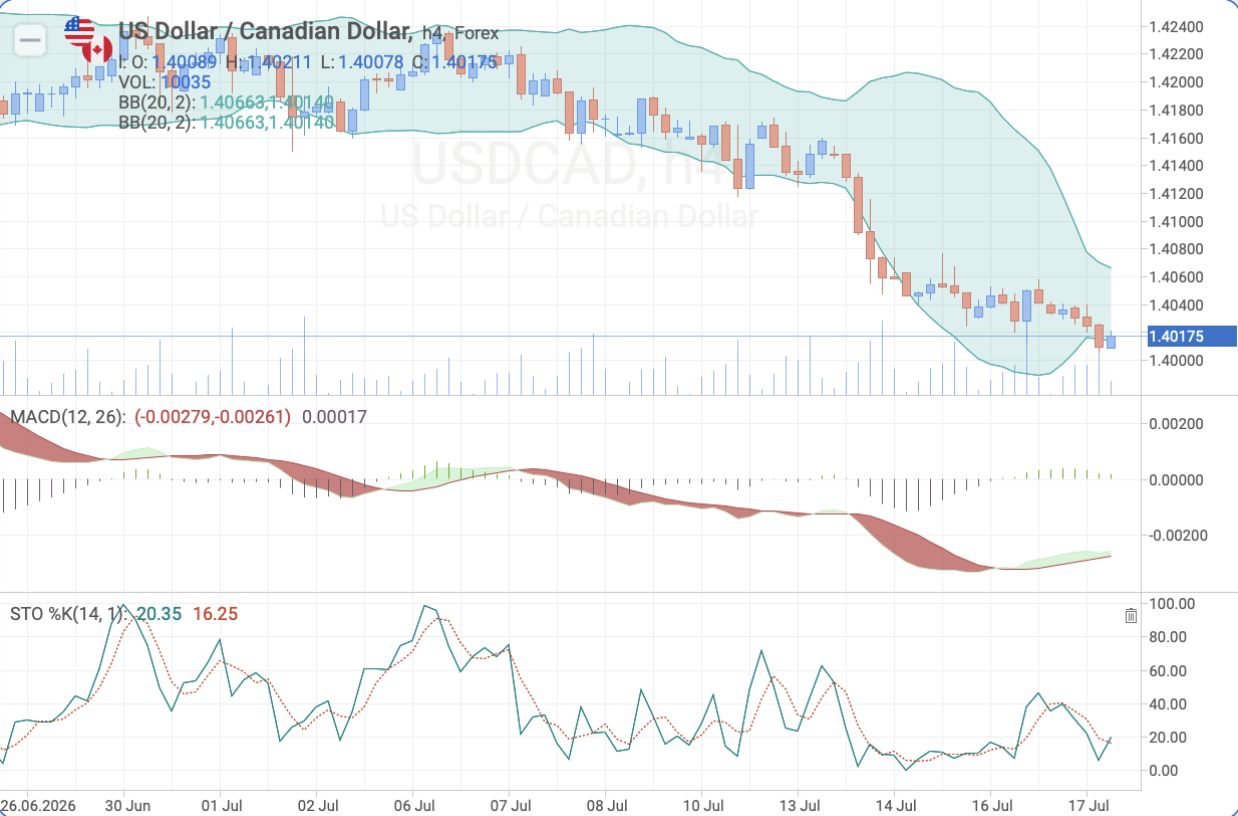
Key Levels — USD/CAD
| Level | Value |
|---|---|
| Resistance | 1.4065 / 1.4100 |
| Support | 1.4000 / 1.3970 |
| Target | 1.3970 |
21
Jul
Forecast
2.4% y/y
Previous
2.8% y/y
Why It Matters
Inflation remains the main reference point for the Bank of England. After a series of mixed macroeconomic reports, consumer price data will determine how quickly the regulator can move to further policy easing. If inflation continues to decline, the probability of a rate cut at one of the upcoming meetings will rise noticeably.
Market Reaction
A decline in inflation toward 2.4% would open the way for earlier Bank of England easing and add pressure on the pound. A reading above expectations would reinforce the case for rates staying high and support the British currency. UK gilt yields and the FTSE 100 will also react to the release, with the index typically benefiting from a weaker pound.
Market Sentiment
Consensus on the pound is becoming more cautious. This time markets expect inflation to slow to 2.4%, though it is worth noting that the services sector and the labour market continue to sustain steady price pressure. A high inflation print would once again strengthen expectations of rates staying elevated and support the British currency. After strong growth in mid-July, the pound has moved into a correction. The price is gradually pulling away from the upper Bollinger Band, MACD remains in negative territory, and the stochastic continues to decline. Soft inflation would extend the pressure on the pair and open the way toward the 1.3360 area, while a strong CPI reading would bring buyers back to the 1.3500 resistance.
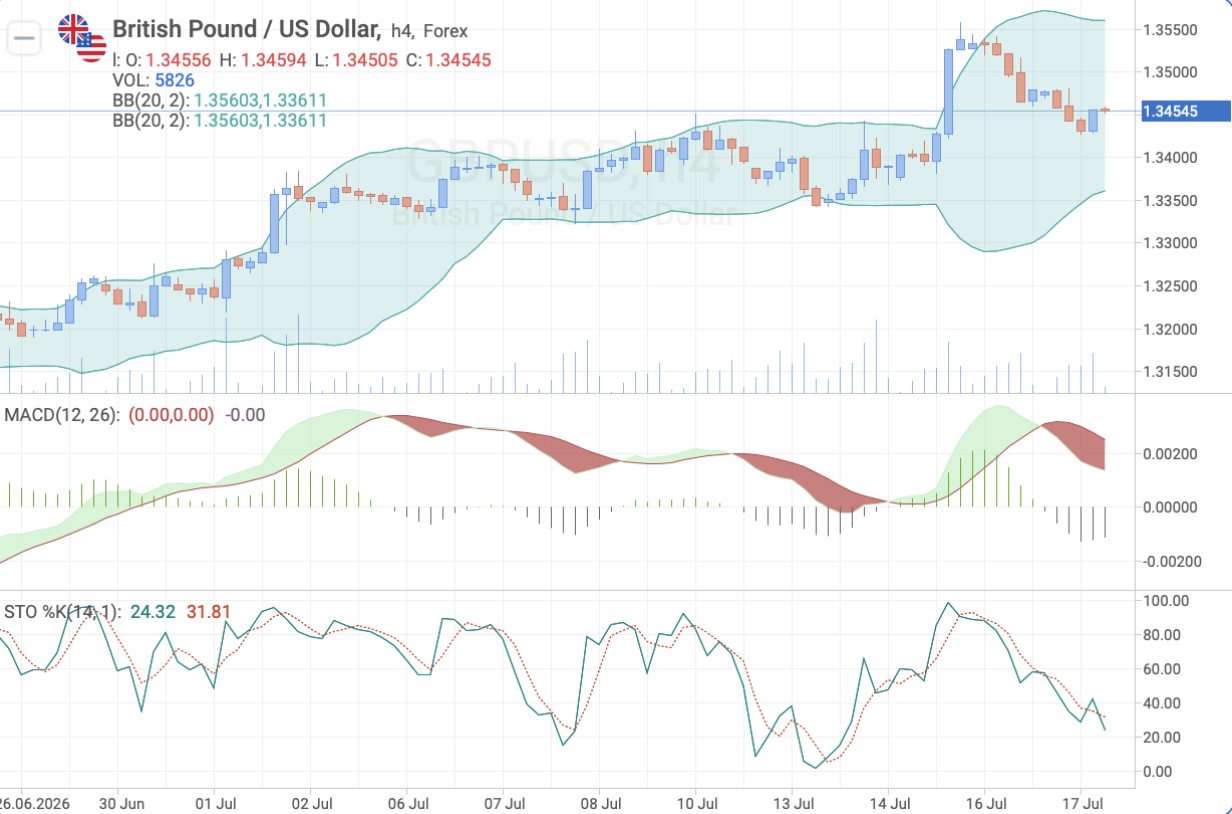
Key Levels — GBP/USD
| Level | Value |
|---|---|
| Resistance | 1.3500 / 1.3560 |
| Support | 1.3410 / 1.3360 |
| Target | 1.3360 |
23
Jul
Forecast
2.40%
Previous
2.40%
Why It Matters
After the July pause, markets have little doubt that the ECB will once again keep rates unchanged. The main interest lies in Christine Lagarde's comments, as the decision itself is widely anticipated. Investors will look for signals regarding the September meeting, the ECB's assessment of inflation and the degree of concern among policymakers about the slowdown in the Eurozone economy.
Market Reaction
Cautious rhetoric with no clear signal on the timing of rate cuts would leave the euro trading in its current range. Any shift in emphasis toward a weaker economy would increase pressure on the single currency, while firmer comments from Lagarde would support it. European government bonds and the Euro Stoxx 50 will take their cue from the press conference as well.
Market Sentiment
Consensus on the euro remains neutral. From this meeting we expect the ECB to maintain cautious rhetoric without clear signals of imminent rate cuts. After recovering in the first half of July, EUR/USD has moved into a consolidation phase. The pair is holding near the middle of its recent range, while MACD is gradually losing upward momentum and the stochastic continues to decline. If the ECB confirms its readiness to stay cautious, pressure on the euro would intensify with a return toward the 1.1380 area. Firmer rhetoric would bring buyers back to the 1.1470 resistance.
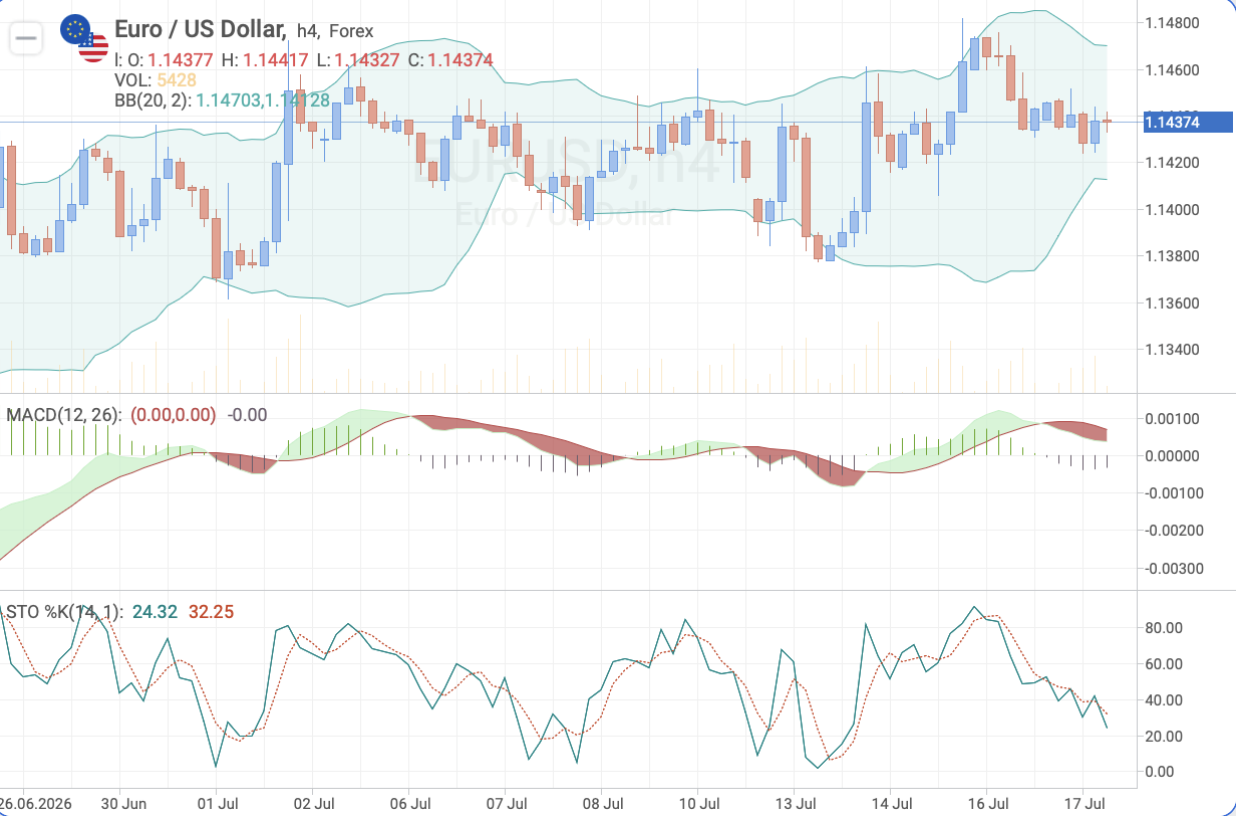
Key Levels — EUR/USD
| Level | Value |
|---|---|
| Resistance | 1.1470 / 1.1500 |
| Support | 1.1410 / 1.1380 |
| Target | 1.1380 |
24
Jul
Forecast
1.7% y/y
Previous
1.5% y/y
Why It Matters
Inflation remains the main reference point for the Bank of Japan after the start of its rate-hiking cycle. The regulator has repeatedly stated that further decisions will depend on the sustainability of price and wage growth. A strong report would increase the probability of another round of policy tightening before the end of the year, while weak data would once again lower expectations for the Bank of Japan's next steps.
Market Reaction
An acceleration in inflation would support the yen and strengthen the case for another Bank of Japan rate hike this year. A weak reading would push USD/JPY back toward its recent highs. Japanese government bonds and the Nikkei 225 will also respond, with the index sensitive to any yen strength given the export weight in its composition.
Market Sentiment
Consensus on the yen remains cautiously positive. We expect a slight acceleration in inflation, which would confirm the gradual recovery of domestic price pressure. At the same time, the risk of new currency interventions deserves close attention: USD/JPY remains near multi-year highs, and Japanese authorities have repeatedly stated their readiness to respond to excessive volatility. After the July surge, USD/JPY has settled above the 162 mark and continues to trade near local highs. MACD retains positive momentum, though its growth is gradually slowing, and the stochastic is starting to turn downward. This points to a weakening of the short-term upward move. Strong inflation would support the Japanese currency and trigger a correction in the pair toward the 161.50 area. If the data comes in weaker than expected, the dollar may test the 162.60–163.00 resistance.
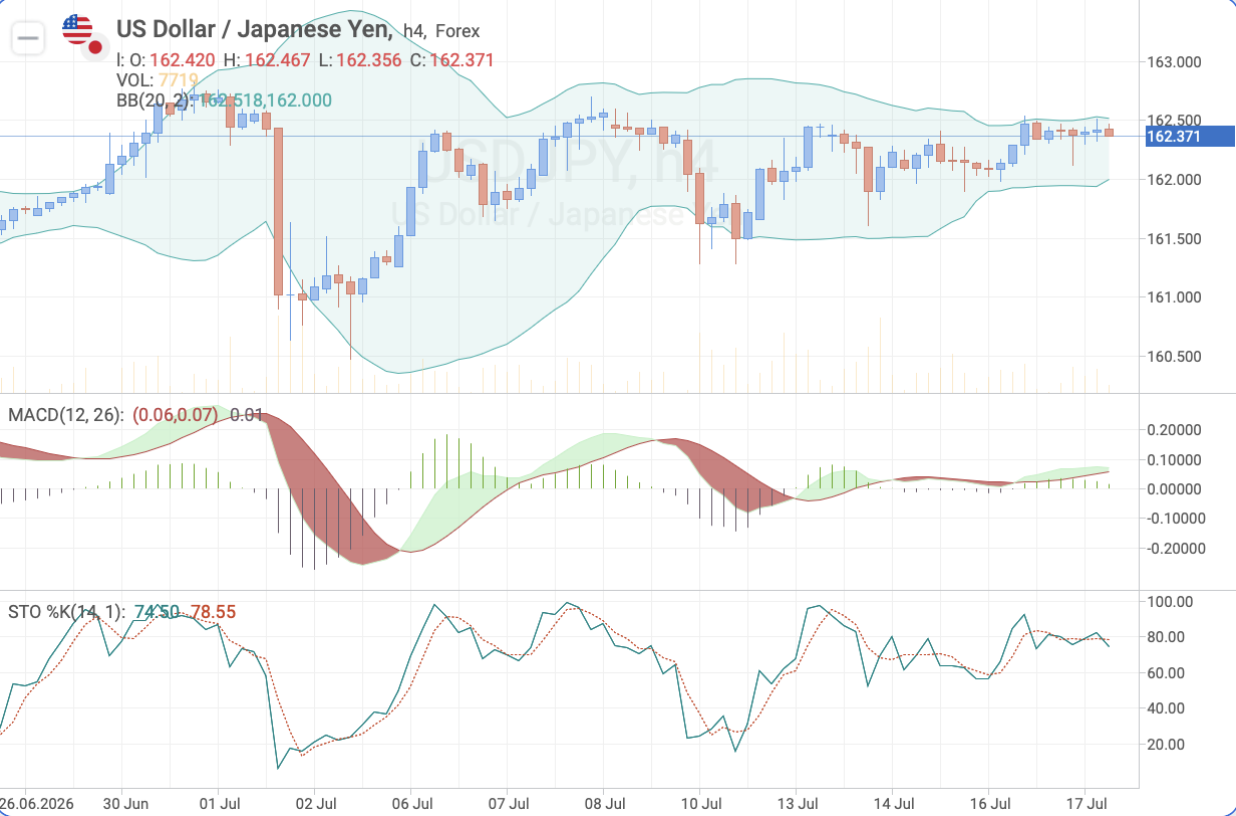
Key Levels — USD/JPY
| Level | Value |
|---|---|
| Resistance | 162.60 / 163.00 |
| Support | 162.00 / 161.50 |
| Target | 161.50 |
Track the forecasts and actual figures for each event — the gap between consensus and actual readings is what determines how sharply prices move. Learn more about how to read the economic calendar and trade the news.
Conclusion
The week runs from Monday's Canadian inflation report to Friday's Japanese CPI, with UK price data on Tuesday and the ECB decision on Thursday in between. Each release feeds directly into expectations for a specific central bank, which makes the currency pairs tied to these events the natural focus: USD/CAD, GBP/USD, EUR/USD and USD/JPY.
Thursday stands out as the central day. Christine Lagarde's press conference will show how the ECB views the balance between slowing inflation and a weakening Eurozone economy, and her tone will set the euro's direction into the final stretch of July. If the inflation reports across Canada, the UK and Japan confirm the expected trajectories, markets will head into August with a clearer picture of how quickly each central bank can move to its next step.
Any information provided in articles on this website is based solely on the personal opinions of the authors. These articles should not be construed as trading recommendations or a call to action. The authors and RoboForex accept no responsibility for the results of any trades made on the basis of these recommendations and reviews. Past performance is not indicative of future results. Trading stocks and CFDs involves a high risk of capital loss.