Boeing Nears 737 MAX Certification and the End of Its Multi-Year Crisis
Boeing has received two important positive signals this week. First, the US Federal Aviation Administration (FAA) expects to certify the Boeing 737 MAX 7 and 737 MAX 10 soon. Second, SMBC Aviation Capital, one of the world's largest aircraft leasing companies, has ordered 100 aircraft from the 737 MAX family.
In Brief
- The FAA says certification of the Boeing 737 MAX 7 and 737 MAX 10 is expected soon.
- SMBC Aviation Capital has placed an order for 100 Boeing 737 MAX aircraft.
- The 737 MAX crisis and the pandemic that followed sent Boeing shares down 78%.
- A bounce from support at 200 USD could lift BA stock towards a target of 250 USD.
- 24 out of 29 analysts rate BA shares as a Buy.
- If the FAA grants approval, the move may extend to 280 USD.
Trade Idea Parameters
Below are the specific parameters for the Boeing trade idea. The ticker for trading via RoboForex MobileTrader and MT5 on RoboForex is BA.
| Parameter | Value |
|---|---|
| Instrument | Boeing Co (NYSE: BA) |
| Ticker in MobileTrader / MT5 | BA |
| Idea Date | July 21, 2026 |
| Time Horizon | 1–3 months |
| Direction | ↑ Buy (Long) |
| Entry Level (trigger) | Buy Limit at 200 USD |
| Take Profit | 250 USD |
| Stop Loss | 184 USD |
| Position Size | No more than 3% of account · Medium risk |
Instant Access to Global Markets with RoboForex MobileTrader
737 MAX 7 and MAX 10 Certification
The US Federal Aviation Administration has stated that Boeing is closer to certifying the 737 MAX 7 and 737 MAX 10 than ever before. The FAA has yet to name exact dates, although the regulator previously expected approval of the MAX 7 in the summer of 2026 and the MAX 10 before the end of the year.
The main remaining obstacle has been a fix for the engine anti-ice system, which under a rare combination of conditions could lead to overheating. Boeing has developed a modified design and is at the final stage of agreeing it with regulators. By mid-July, the MAX 10 flight test programme was roughly 98% complete, with two test flights left to perform.
Once certification is granted, Boeing will be able to start handing over 30 already built MAX 7 jets and nine MAX 10s to customers. The launch of the MAX 10 carries particular weight: this version accounts for more than 28% of the remaining orders in the MAX family and should strengthen Boeing's position against the Airbus A321neo. Design approval, however, will only be the first stage. The company still needs to demonstrate consistent production quality and deliver aircraft on schedule.
Boeing Receives an Order for 100 737 MAX Aircraft
SMBC Aviation Capital has placed an order for 100 Boeing 737 MAX aircraft, comprising 60 Boeing 737-10s and 40 Boeing 737-8s. This is the first 737-10 purchase by SMBC and the largest single order for the most capacious MAX version among aircraft leasing companies. Following the deal, SMBC's total portfolio of owned, managed, and ordered 737 MAX family aircraft has grown to 450 units.
SMBC Aviation Capital services a fleet of roughly 1,700 aircraft and works with more than 170 airlines. The company buys jets to lease them out to carriers, so its order reflects expectations of long-term demand for the MAX family from a wide range of airlines. The core bet is on the 737-10, which allows carriers to increase capacity and lower costs per passenger.
For Boeing, the contract strengthens its future delivery backlog and confirms commercial interest in the 737-10. The financial effect, however, will arrive gradually as aircraft are handed over to the customer. On top of that, deliveries of the 60 ordered 737-10s will begin only after the model is certified, so the value of the deal depends directly on the FAA's decision and on Boeing's ability to steadily raise production.
How the Boeing Crisis Began
Boeing's crisis unfolded over several years, starting with two fatal crashes and continuing through the pandemic and a later quality incident. The timeline below shows the key events that reshaped the company and its stock.
Oct 2018
First 737 MAX 8 crash
A 737 MAX 8 crashes in Indonesia. The market initially treats it as an isolated incident.
Mar 2019
Second crash and global grounding
After the Ethiopian Airlines crash, regulators worldwide ground the entire 737 MAX family.
2019–2020
MCAS investigation
The probe reveals problems with the MCAS system, aircraft design, pilot training, disclosure, and certification. A heavy reputational blow for a company long seen as a symbol of American industrial reliability.
Jan 2024
Alaska Airlines door plug
A door plug detaches mid-flight from a 737 MAX 9. The aircraft lands safely, but questions return about assembly quality and production controls.
2024
Tighter FAA oversight
The FAA freezes 737 MAX production expansion and requires a comprehensive safety and quality plan.
2026
MAX 7 and MAX 10 certification ahead
Each certification step is now treated by the market as an exam. The MAX 7 and MAX 10 must show Boeing can pass stricter control and restore trust in new versions of its aircraft.
How the 737 MAX Crisis Changed Boeing’s Stock Performance
The 737 MAX problems became the main factor that reshaped the long-term trajectory of Boeing shares. Before the crisis, the stock was in a steady uptrend and reached a record closing price of 430 USD on March 1, 2019. After the first crash in October 2018, BA shares fell sharply and lost around 12% over the following weeks. The market, however, initially treated the accident as an isolated incident, and the stock quickly recovered.
The situation changed after the Ethiopian Airlines crash on March 10, 2019. Boeing shares closed at 400 USD on March 11, down from 422 USD in the previous session, a one-day loss of around 5.3%. Selling continued as airlines and regulators began grounding the 737 MAX. By March 12, the stock had dipped to 368 USD, and within a few weeks Boeing's market capitalisation had shrunk by 40 billion USD.
The pandemic delivered a further blow. The 737 MAX problems were compounded by the halt of international travel, order deferrals by airlines, and a sharp deterioration in Boeing's cash flow. On March 20, 2020, the shares closed at 95 USD. In less than 13 months, the stock had collapsed by 78% from its record 430 USD.
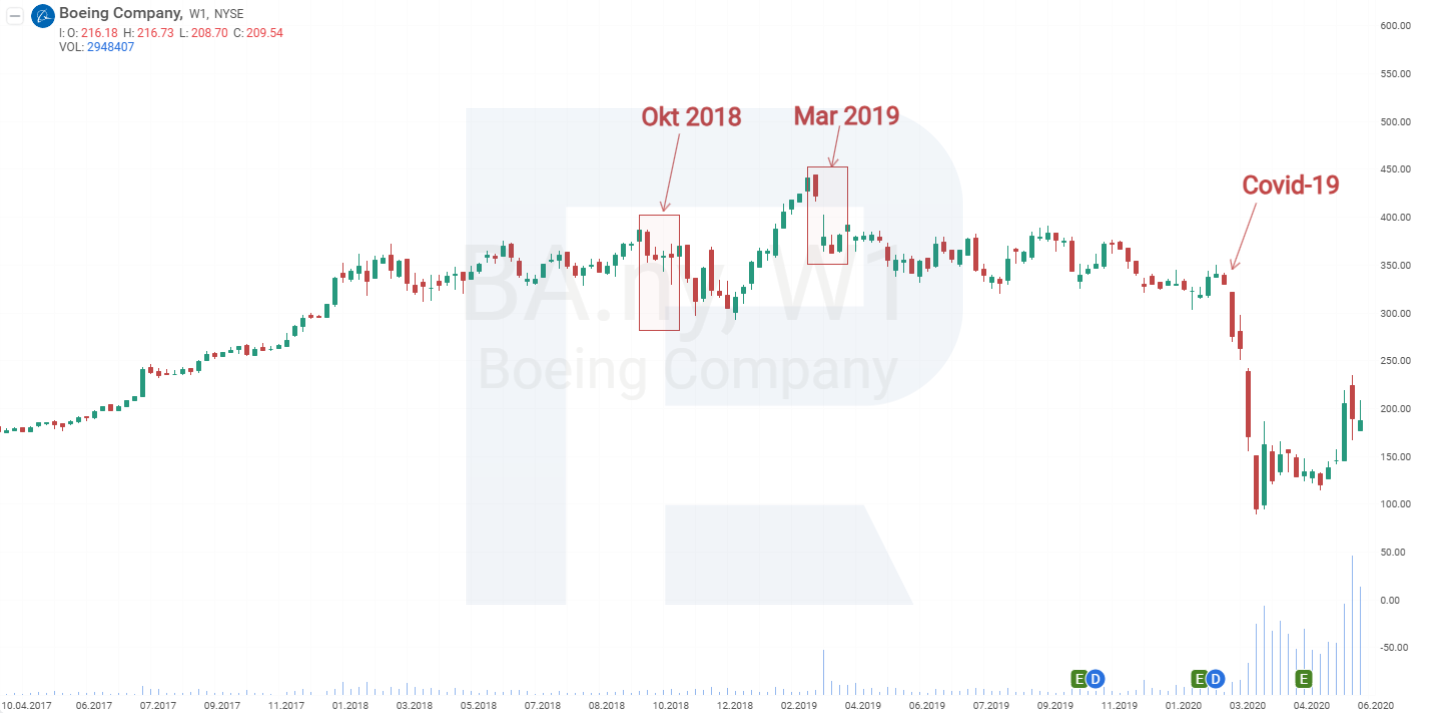
After the pandemic, the shares partially recovered but could not return to their 2019 highs. Another setback came in January 2024, when the door plug detached from the Alaska Airlines Boeing 737 MAX 9 described above. Boeing shares fell 8.03% in the first trading session after the incident. The stock started the year at 257 USD, yet by the end of January it was trading at 211 USD, down around 18%.
As a result, investors stopped viewing Boeing as a simple bet on the growth of global air travel. The stock's performance now depends primarily on production and delivery rates, relations with the FAA, spending on quality improvements, the ability to generate free cash flow, and the absence of new incidents.
This is what makes the certification of the MAX 7 and MAX 10 so significant for Boeing shares. Certification can reduce regulatory uncertainty and become the first catalyst for a sustainable uptrend, even if a return to record highs remains a longer-term prospect.
Why 737 MAX 7 and MAX 10 Certification Matters for Boeing
Certification of the Boeing 737 MAX 7 and 737 MAX 10 is important to the company for several reasons:
- Expanding the 737 MAX lineup. The MAX 7 targets the smaller-capacity segment and routes with lower passenger loads, while the MAX 10 is aimed at the market for large narrow-body aircraft.
- Deliveries of aircraft already built. Around 30 MAX 7 jets are awaiting handover to customers. After certification, Boeing can gradually move them out of inventory and recognise the deliveries in revenue.
- Protecting the order book. Further delays raise the risk of postponed deliveries, compensation payments, and the loss of some customers to competitors.
- Stronger competition with Airbus. The MAX 10 is set to compete with the Airbus A321neo in one of the most in-demand market segments: high-capacity, fuel-efficient narrow-body aircraft.
- Rebuilding regulator trust. Successfully certifying the two delayed models would show that Boeing can operate under tighter FAA control.
Open a Trading Account at RoboForex
Swap-free accounts, spreads from 0, and execution in 0.01 seconds.
Analyst Ratings for Boeing Stock
As of July 2026, Barchart analyst ratings for Boeing show a strong consensus in favour of buying: 24 out of 29 tracked analysts rate BA as a Buy, 4 as Hold, and only 1 expert recommends Sell.
Buy — 24
Hold — 4
Sell — 1
24 out of 29
recommend Buy (83%)
Hold
4 (14%)
Sell
1 (3%)
Average Target Price
268.63 USD
Maximum Target
305.00 USD
Minimum Target
204.00 USD
Boeing Stock Technical Analysis
On the weekly timeframe, Boeing shares are trading above the 200-period Moving Average, indicating that an uptrend prevails. The slope of the line is close to horizontal, however, so the move is at an early stage. A supportive news flow, including the possible certification of the 737 MAX and the large order from SMBC Aviation Capital, could lift the quotes and reinforce the uptrend.
The Stochastic indicator sits between the 20 and 80 levels, in the neutral zone. Within an uptrend, this position suggests the quotes still have room for a further move higher.
The trade idea for Boeing shares is therefore to place a Buy Limit order at the nearest support around 200 USD. The upside target is resistance at 250 USD. If the company receives FAA approval, the growth may continue, with 280 USD as the next objective. A correction could begin from that zone before another wave of growth. The nearest support below entry sits at 185 USD, so the Stop Loss is placed just under it, at 184 USD.
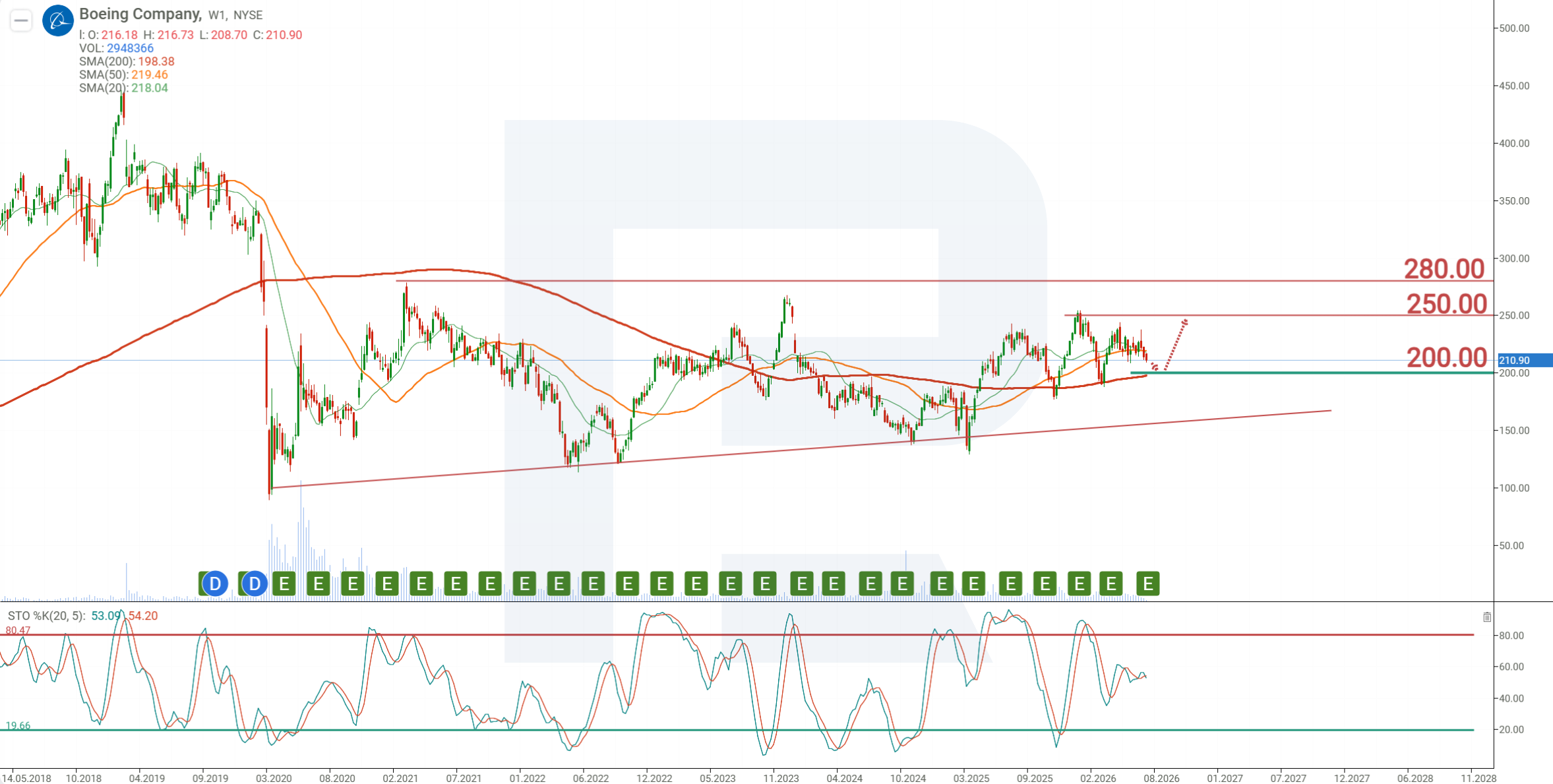
The technical analysis supports the following conclusions:
- The 200-period Moving Average (MA200) is below the price, indicating that an uptrend prevails.
- The Stochastic indicator is in the neutral zone, leaving the quotes room for a further move higher.
- The trade idea is to buy BA shares with a Buy Limit order at 200 USD.
- The main upside target is resistance at 250 USD.
Sample Trading Strategy for Boeing Stock
Below is a sample trading strategy for BA shares. This example is for educational purposes only and does not constitute investment advice. Investors should assess their own risk tolerance independently.
| Parameter | Value |
|---|---|
| Entry Point | Buy Limit at support of 200 USD per share |
| Take Profit | Resistance at 250 USD per share |
| Stop Loss | 184 USD, just below the 185 USD support |
| Risk / Reward Ratio | 1 : 3.1, potential profit is roughly 3.1× the risk |
| Position Size | No more than 3% of account |
Sample Calculation for 10 BA Shares
| Scenario | Calculation | Result |
|---|---|---|
| Buy 10 shares at 200 USD | 10 × 200 USD | 2,000 USD |
| If target reached (250 USD) | (250 − 200) × 10 | +500 USD (+25%) |
| If stop triggered (184 USD) | (200 − 184) × 10 | −160 USD (−8%) |
| Risk / Reward | 160 / 500 | 1 : 3.1 |
A risk/reward ratio of 1:3.1 looks favourable for position trading. Keep in mind that markets are volatile: BA shares can move both for and against an open position.
Trade with RoboForex MobileTrader
Live charts, deposits and withdrawals, analytics, and copy trading in one app.
Risks
Despite the positive news, Boeing remains a company with elevated operational risks:
- Possible certification delays. The FAA expects to approve the MAX 7 and MAX 10 soon, but there is no final decision yet. Any new technical questions could push the timelines back again.
- Production quality. After the problems of recent years, Boeing must prove that its strengthened controls deliver results on the assembly line.
- Delivery pace. Orders on their own do not improve cash flow. Boeing sees the financial effect only once aircraft are handed over to customers.
- Competition with Airbus. Even after MAX 10 certification, Boeing will be catching up with Airbus in the segment of large narrow-body aircraft.
- Financial pressure. Delays, compensation payments, rework, and slow growth in deliveries may keep weighing on free cash flow.
- Regulator scrutiny. The FAA has become stricter with Boeing. This reduces the likelihood of defects going unnoticed, while also making the approval and production processes slower.
Should You Buy Boeing Stock on This News?
The news of the imminent certification of the 737 MAX 7 and 737 MAX 10, together with the SMBC Aviation Capital order for 100 aircraft, is positive for Boeing. Certification could be an important step towards restoring trust. It will open the way for deliveries of the new models, reduce uncertainty around part of the order book, and show that Boeing can pass tighter FAA control.
The SMBC order reinforces that signal. A major lessor is willing to order 737 MAX jets, including the MAX 10, even before certification is complete. This points to sustained demand for the aircraft and to the confidence of professional aviation market participants in the long-term value of the MAX family.
For Boeing shares, this news could act as a medium-term driver. If certification arrives in the near future, investors may start pricing in growing deliveries and improving cash flow.
* The information in this article reflects the personal opinions of the authors. It should not be construed as trading advice or a call to action. The authors and RoboForex bear no responsibility for trading results based on the recommendations and reviews contained in this material. Past performance is not a guarantee of future results. Trading stocks and CFDs involves a high risk of capital loss.