What Is a Trading Robot and How Does It Work?
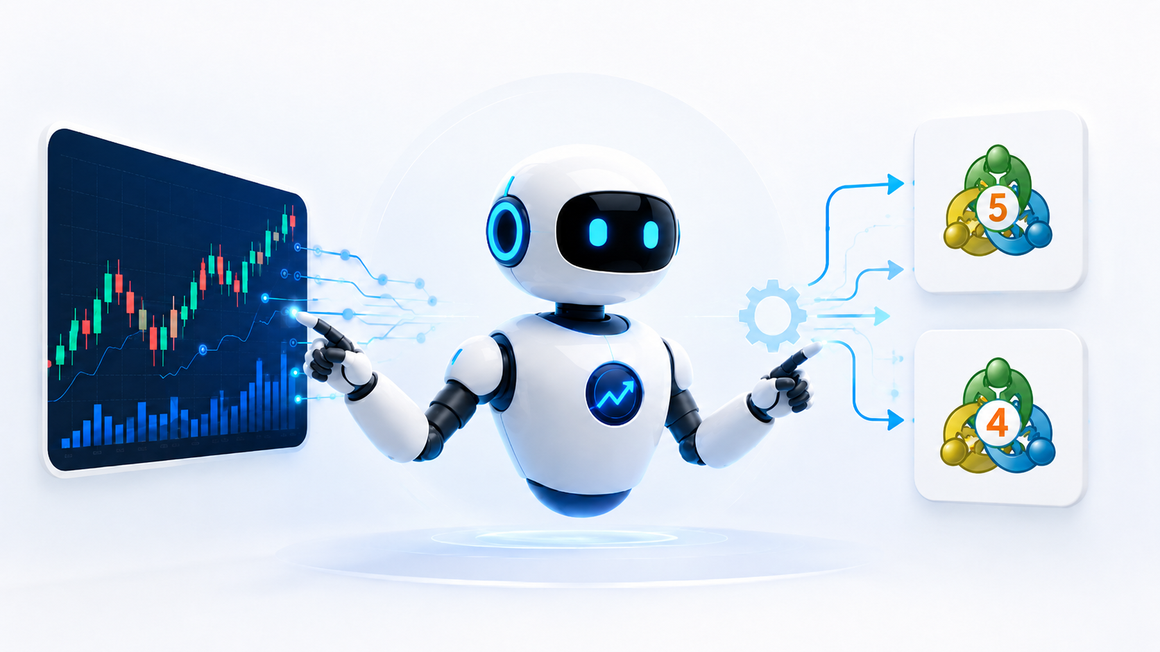
A trading robot (or trading bot) is an automated software program that analyzes financial markets, detects trading signals, and executes orders based on predefined strategic rules.
Its main advantage is discipline: it removes decisions driven by fear and greed. Its quality shows in a positive mathematical expectation over a long series of trades, checked by a backtest, a demo run and a small live start.
TL;DR
- Judge a robot by its mathematical expectation over a long series of trades.
- Backtest it on historical data, then run it on a demo account.
- Start live trading with a small share of your capital.
A trader with no programming background can now build a working trading robot: modern AI tools turn a plain-language description of a strategy into ready code. Automation keeps expanding on the markets themselves as well. Industry research puts algorithmic systems behind a significant share of turnover on developed markets, including Forex and the stock exchanges of the US and Japan.
Easy access to the technology solves only part of the task. A robot's results depend on the quality of its strategy and on competent risk management, which makes understanding how these algorithms work a core skill for every trader who uses automation.
In this article, we break down what a trading robot is, how it works, which types of automated systems exist, how professionals measure their performance, and which steps to complete before letting an algorithm trade on a live account.
What Is a Trading Robot?
A trading robot is software that connects to a trading terminal and executes operations automatically according to a predefined algorithm. In manual trading, the trader analyzes the market and makes every decision personally. A robot can run a full or partial working cycle without constant human presence: it analyzes data, searches for signals, opens and closes positions, and manages trade parameters.
Classic Rule-Based Robots on MQL5
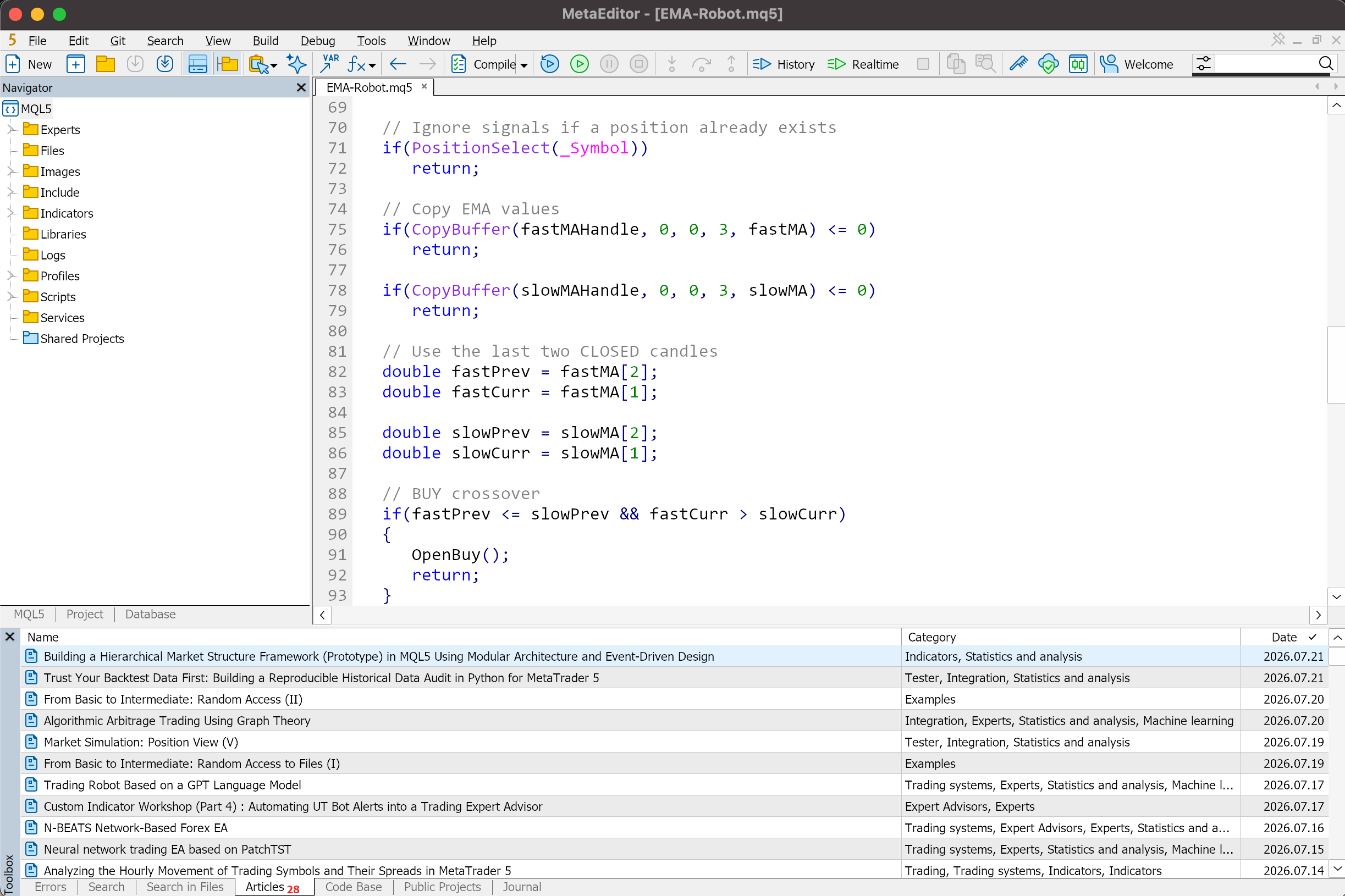
These are algorithms with predefined entry and exit rules written by a developer manually. The robot analyzes the market against fixed conditions and executes the strategy automatically, and it cannot change its own logic. A typical example is trading Moving Average crossovers or RSI signals.
AI-Assisted Algorithms
An intermediate branch that spread quickly thanks to the progress of artificial intelligence. The trading strategy itself stays classic, while writing the code becomes far simpler with AI tools. A trader can describe the strategy rules in plain language, and AI helps produce the Expert Advisor code, which then needs to be reviewed, tested, and optimized. A detailed walkthrough of this approach is available in the guide How to Launch a Trading Robot With AI: A Step-by-Step Guide for Beginners.
Self-Learning AI Agents
More complex systems that apply machine learning methods to analyze large volumes of data and find hidden patterns. Compared with classic robots, such models can account for more factors: market data, statistics, relationships between instruments, and other parameters. Most systems of this class require sophisticated development, quality data, and regular oversight.
Comparison of Trading System Generations
| Comparison Criterion | Classic Robots | AI-Assisted Systems | Self-Learning AI Agents |
|---|---|---|---|
| How it works | Fixed rules based on indicators and mathematical conditions | A classic trading algorithm with code produced by AI tools | Machine learning models that analyze large data sets |
| Market adaptation | Requires manual parameter changes | Requires changing the logic or regenerating the code | Can be updated by retraining models on new data |
| Entry barrier | Medium: requires an understanding of the strategy and basic programming | Low: AI simplifies code creation | High: requires Data Science, programming, and machine learning skills |
| Execution speed | High, limited only by the trading infrastructure | High, same as a regular algorithm | Depends on model complexity and data processing speed |
| Main risk | Loses effectiveness when market conditions change | Code generation errors or an imprecise strategy description | Hard-to-control decisions and limited model interpretability |
Types of Robot Trading Strategies
A robot's performance depends directly on the logic built into its algorithm. Different strategies target different market conditions: some perform better during strong trends, others during consolidation. The main classes of trading robots differ in how they search for signals, how often they trade, and how much risk they accept.
Trend-Following Robots
Algorithms built to trade in the direction of a strong market move. They identify a developing trend with Moving Averages, directional movement indicators, or breakout strategies and hold positions until signals of a weakening trend appear.
Who it suits Traders who prefer medium-term trading and are ready to hold positions from several hours to several days.
Main risk Extended sideways periods. During a flat market, trend robots can catch a series of false signals and build up a prolonged drawdown.
Counter-Trend Robots
Strategies focused on finding reversals and the return of price to its average value. These robots use oscillators, such as RSI or Stochastic, to define overbought and oversold zones.
Who it suits Markets with relatively stable volatility and frequent corrective moves.
Main risk A strong directional trend without a deep correction. Even at extreme RSI or Stochastic readings, price can keep moving the same way and produce a series of losing trades.
Scalping Robots
Expert Advisors that make a large number of short-term trades within a session on small timeframes, such as M1 or M5. Their goal is to capture small gains from short price moves.
Who it suits Experienced users who understand order execution mechanics and have access to accounts with low spreads and quality execution.
Main risk Heavy dependence on trading conditions. Wider spreads and execution delays can noticeably worsen the strategy's results.
Grid and Martingale Robots
These systems place orders according to a preset structure. They often open additional positions at fixed intervals or increase trade volume after a loss in an attempt to recover previous losses.
Who it suits Only experienced traders who fully understand the risk mechanics and the possible consequences of such strategies.
Main risk In a strong one-way market move against the open position, the number of trades and the total volume can grow quickly, which can lead to a deep drawdown or the loss of a large part of the capital.
Advantages and Limitations of Trading Robots
Trading robots automate strategy execution and strengthen trading discipline. At the same time, automation solves only part of the task, so an objective view of algorithmic trading requires weighing its strengths against the limitations that come with them.
Advantages
Round-the-clock market monitoring. A robot can track the set conditions and search for trading opportunities continuously, with no need for manual control by the trader.
Strict trading discipline. A robot removes the influence of emotions: fear, greed, the urge to win back losses, and departures from the trading plan.
High execution speed. An algorithm can evaluate market conditions and send orders faster than a human, which matters most for short-term strategies.
Several instruments at once. A robot can monitor multiple currency pairs, stocks, or cryptocurrencies in parallel without losing focus.
Faster strategy testing. Algorithms make it possible to check trading ideas on historical data quickly and analyze the results.
Limitations and Risks
Dependence on the built-in logic. The algorithm acts only within its programmed rules and cannot adapt to a changing market on its own.
Technical requirements. Stable operation needs a reliable internet connection, a correctly configured terminal, and a stable VPS server.
Software error risk. Bugs in the code, terminal failures, or problems with order execution can lead to unwanted results.
Dependence on strategy quality. The robot only follows the given rules. If the trading system has no statistical edge, automation will not make it profitable.
Changing market conditions. A strategy that worked well in the past can lose its edge when volatility, trends, or participant behavior change.
Trade on the Go With RoboForex MobileTrader
A portable trading workstation on your phone, on Android and iOS.
How Professionals Evaluate Trading Robots
Judging a robot by the size of its profit alone is one of the most common mistakes among beginning algo traders. High returns say little about the quality of a strategy if they were achieved through excessive risk. Professional analysis means assessing the system across several parameters at once. Before launch, a robot goes through testing on historical data, and its results are reviewed against key metrics.
Key Metrics for Evaluating Trading Algorithms
| Metric | What It Shows | What to Look For |
|---|---|---|
| Maximum Drawdown | The largest decline of capital from its historical peak during testing. It shows the level of risk the strategy carried in its worst period. | Up to 15%: conservative. 15 to 25%: moderate risk. Above 30%: critical risk that endangers the capital. |
| Profit Factor | The ratio of gross profit to gross loss. It shows how much profit the strategy earns per unit of loss. | Below 1.2: weak performance. 1.5 to 2.5: a healthy range for most systems. Above 3: check the system for over-optimization. |
| Recovery Factor | Net profit divided by maximum drawdown. It shows how well the system recovers from losing periods. | Below 2: recovery is slow. 3 and above: a good sign of resilience. |
| Expected Payoff | The average profit or loss per trade. It shows whether the strategy has a statistical edge. | The value should be positive and exceed trading costs: spread, commissions, and possible slippage. |
| Trade Sample Size | The number of completed trades needed for the statistics to be reliable. | At least 150 to 200 trades for active strategies, or a long observation period for systems with rare entries. |
Important
No single metric guarantees the profitability of a trading robot. A reliable assessment requires analyzing all indicators together, verifying results on independent data, and testing the strategy in live market conditions.
How to Assess a Trading Robot’s Reliability
The algorithmic trading market offers thousands of ready-made robots, and their quality varies widely. Professional products exist side by side with systems built on aggressive marketing, inflated return claims, or extreme risk levels. Before launching any Expert Advisor, it is worth assessing the reliability of its strategy along with the potential returns.
Signs of an Unreliable Trading Robot
Unrealistic return claims
Statements such as "100% winning trades," "you cannot lose" or "100% per month with no risk" should raise concern. Financial markets keep changing, growth gives way to decline and back again, so no strategy can produce stable profit in every environment. Reliable developers usually publish drawdown and risk data along with the return figures.
No real risk management
Risk control is one of the most important elements of any trading system. If a robot trades without stop-loss orders, the probability of heavy losses rises sharply. Strategies that hold losing positions in hope of a reversal, with no predefined exit plan, deserve particular caution.
Martingale and aggressive grid logic
Some robots increase position size after every loss, trying to recover previous losses with the following trades. The approach can show impressive returns for a while. A strong market move against the strategy, however, can quickly erase a large share of the capital. Before using an Expert Advisor, find out how it manages position size and whether it contains Martingale elements.
Curve-fitting to historical data
Strong results in a strategy tester do not always mean the robot will perform well in the future. Some strategies are tuned to a specific historical period and shine only on the data used for optimization. A dependable strategy shows stable behavior across different market segments and passes verification on independent data.
A perfect profit curve
Every real trading system goes through drawdowns and series of losing trades. If the profit chart looks like a nearly straight upward line without visible swings, it can point to hidden risks, order grids, or aggressive money management. Such results call for a deeper check before the robot touches a live account.
Pre-Launch Verification Checklist
Run through this checklist before allowing any robot to trade real money.
0 of 5 checked
Main Rule
When choosing a trading robot, assess the balance between potential return and risk. A reliable system may show temporary losses. What matters is clear working logic, a controlled drawdown, and confirmed statistics over a long stretch of time.
Where to Get a Trading Robot
There are three main ways to get your own automated trading system, and a fourth route that needs no robot of your own. The right option depends on the complexity of the strategy, the budget, technical skills, and the readiness to control development and testing personally.
Build One Yourself with AI
One of the most accessible ways to start algorithmic trading. Modern AI tools convert a plain-language description of a trading strategy into Expert Advisor code for the trading terminal. The trader needs to formulate the system's rules in detail: entry and exit conditions, indicator parameters, risk management, and additional settings. After the code is generated, it must be reviewed and backtested before any live use. A step-by-step walkthrough is available in the guide How to Launch a Trading Robot With AI: A Step-by-Step Guide for Beginners.
Use a Ready-Made Robot
This option suits traders who want to work with existing solutions. Specialized app stores for trading platforms, including the MQL5 Market in the MetaTrader ecosystem, offer thousands of paid and free Expert Advisors. Attractive statistics or high returns in the description are no guarantee of quality. Before buying, analyze the key metrics: maximum drawdown, profit factor, recovery factor, trade count, and live account results. Give the advertised returns less weight than the stability of the strategy and the level of risk it takes.
Order Custom Development
This route suits complex trading systems that need individual configuration: several indicators, news filters, advanced position management, or the analysis of additional data. Specialized platforms, such as the MQL5 Freelance service, help find professional developers. When ordering a custom robot, the key success factor is a precise technical specification that clearly describes every rule of the strategy.
Copy Trading as an Alternative
If you want the result of robot trading without building, buying or configuring a robot, copy trading is the shortest route. On the RoboForex Copy Trading service, formerly CopyFX, you choose a strategy run by another trader, subscribe to it, and its trades are copied to your account automatically. The service shows each strategy's return, its number of subscribers and its history, and you can filter the list and keep a watchlist before you commit any money.
Choosing a strategy works like choosing a robot. Look past the headline return at the maximum drawdown, the length of the track record and the number of trades, the same metrics described above for Expert Advisors. A modest return with a shallow drawdown over two years usually tells you more than a spectacular result over three months.
The difference is control. A robot follows rules you can read and test in the Strategy Tester. With copy trading you rely on another trader's decisions, and past results do not guarantee future returns, so start with a small share of your capital and keep your own risk limits in place.
Keep in Mind
Whichever route you choose, the core element remains the quality of the trading strategy. Automation makes an effective system more disciplined. It cannot turn a weak trading idea into a profitable algorithm.
Step-by-Step Plan for a Safe Robot Launch
Even when an Expert Advisor has passed verification and has a confirmed track record, its move to a live account should happen in stages. Skipping individual testing steps is one of the most frequent causes of losses among new users of automated systems.
1
Backtest on Historical Data
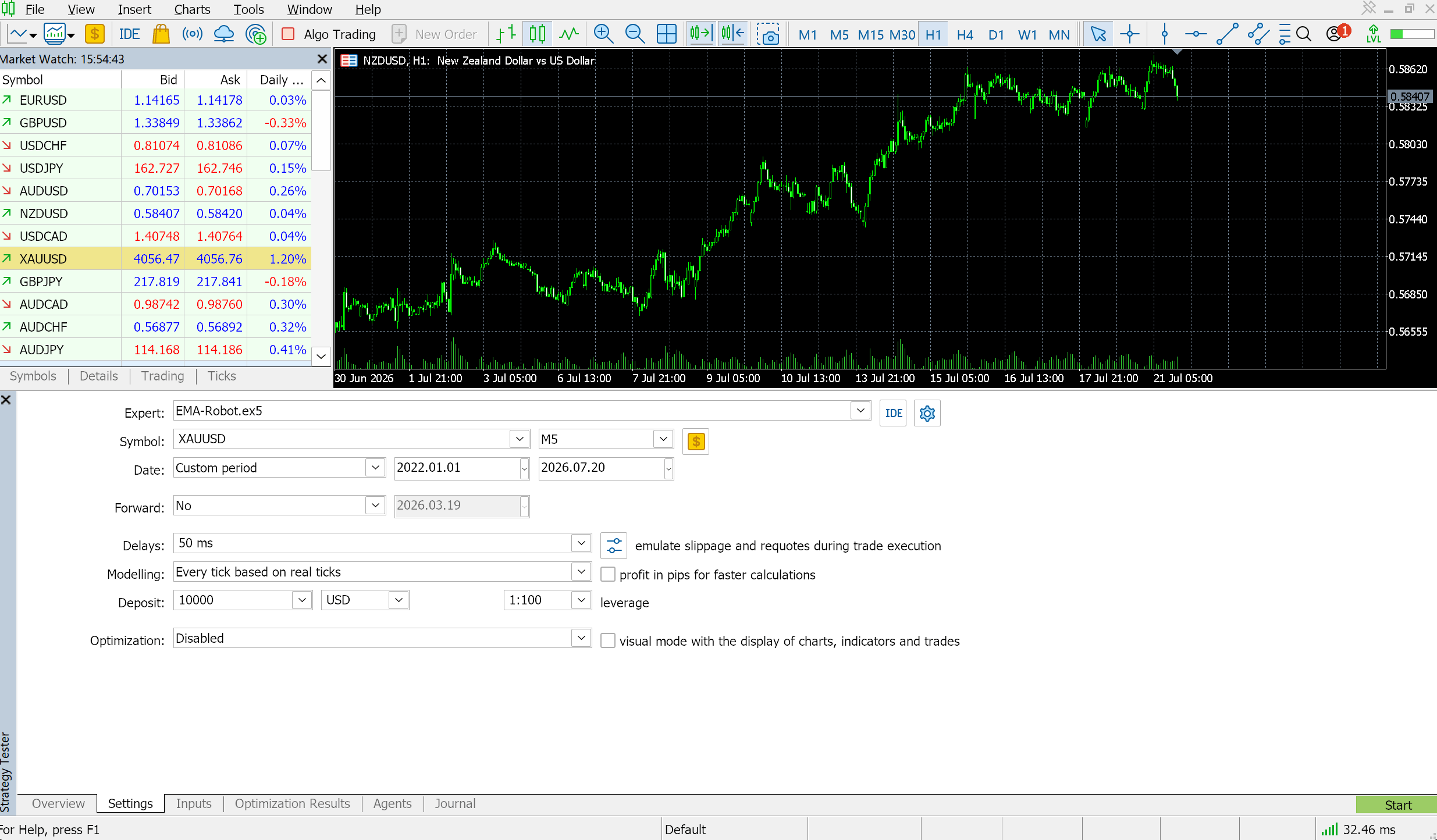
The first stage is testing the robot in the MetaTrader 5 Strategy Tester on historical quotes. For meaningful results, use a period of at least 3 to 5 years, so the test covers different market phases, both trends and sideways ranges. For higher accuracy, run the test in the "Every tick based on real ticks" mode, which reproduces historical price movement most precisely.
2
Robustness Check
After positive results, assess how the strategy handles less favorable trading conditions. Account for the influence of spreads and order execution details, which can reduce profitability compared with an idealized historical test. To do this, activate the mode that simulates random execution delays. It brings the tester's ideal conditions closer to the reality of a live market.
3
Demo Account Test
Next, install the robot on a VPS server and run it on a demo account for at least 2 to 4 weeks. This stage verifies the stability of the Expert Advisor in real time as much as the strategy itself:
- trades open and close correctly
- stop-loss and take-profit orders are placed properly
- execution errors and software failures are absent
- the connection to the trading server stays stable
The test confirms the robot functions correctly in live market conditions before real money is involved.
4
Minimal Lot on a Cent Account
After the previous stages are complete, the robot can start trading on a live account with a minimal amount of capital. A cent account works best here: it verifies the algorithm under real execution conditions with minimal financial risk. At the start, use the minimum trade volume, for example 0.01 lots, and avoid increasing position size until enough real-trading statistics accumulate.
Open a Trading Account at RoboForex
Demo and cent accounts for safe testing, swap-free options, and execution built for automated strategies.
Conclusion
A trading robot is a tool for the disciplined, automated execution of a trading strategy. It can monitor the market around the clock, execute trades in a fraction of a second, and keep emotions out of the decision process. No robot can promise a profit: its results depend on the strategy behind it and the risk it takes.
Modern AI tools have made building trading robots accessible to almost every trader. The success of algorithmic trading is defined by the effectiveness of the strategy and by competent risk management, while the quality of the code plays a supporting role. Before launching any Expert Advisor, evaluate it against the key metrics, understand its logic, and complete every verification stage in sequence, from the historical backtest to trading on a small live account. This approach turns a trading robot into a dependable instrument for long-term work on financial markets.
Frequently Asked Questions
Do trading robots really work?
Trading robots reliably do what they are built for: they execute the rules of a strategy automatically and remove emotions from the process. The financial result depends on the quality of the underlying strategy and on risk management. A robot with a statistical edge and controlled risk can stay effective over a long distance, while automation cannot fix a losing strategy.
Are trading robots legal?
Yes. Algorithmic trading is a standard practice on financial markets, used by private traders and large institutions alike. Brokers that support MetaTrader 4 and MetaTrader 5, including RoboForex, allow Expert Advisors on live accounts. Individual exchanges or brokers may restrict specific techniques, so it is worth checking the trading conditions of your account type.
Can beginners use a trading robot?
Yes, with preparation. AI tools have lowered the entry barrier, and a beginner can create a simple Expert Advisor from a plain-language strategy description. Before live trading, it is important to learn the basic evaluation metrics and follow the full verification path: a backtest, a demo account, and a small cent account.
How much does a trading robot cost?
Prices vary widely. Marketplaces offer free robots along with commercial ones priced from tens to several hundred USD, while custom development by a professional programmer is priced individually and usually costs more. Building your own robot with AI tools can bring the starting budget close to zero, with time spent on testing as the main investment.
What platform do trading robots run on?
The most popular environment is MetaTrader 4 and MetaTrader 5, where robots are called Expert Advisors and are written in the MQL4 and MQL5 languages. A robot runs inside the terminal on the trader's computer or, more reliably, on a VPS server that keeps it online around the clock.
Can AI create a trading robot?
Yes. Modern AI tools convert a plain-language description of strategy rules into Expert Advisor code. The generated code still requires human review, backtesting on historical data, and demo verification before any live use. A practical walkthrough is available in the guide How to Launch a Trading Robot With AI.
Can I run a trading robot on a cent account?
Yes. The RoboForex ProCent account is designed for testing strategies and Expert Advisors. The balance is shown in cents, so a 10 USD deposit appears as 1,000 US cents, and the same lot size puts 100 times less money at risk than on a standard account. It is the usual step between a demo run and full-size robot trading on a live account. ProCent covers forex pairs, metals and several cryptocurrencies, so check that the symbol your forex robot trades is available.
What is the difference between a trading robot and copy trading?
A trading robot is a program that follows fixed rules you can read, test and change. Copy trading repeats the trades of another trader, whose decisions you do not control. Both are forms of automated trading: a robot gives you more control over the logic, copy trading needs less setup.
Past results do not guarantee future performance. Trading financial instruments involves significant risk and may not be suitable for all investors.