
Netflix stock forecast for 2026: the acquisition of Warner Bros. Discovery and its potential impact on price
Despite strong Q4 2025 results, Netflix shares fell by 5% as the market focused on financial uncertainty stemming from the deal with Warner Bros. Discovery, which could affect the company’s cash flows.
Despite strong Q4 2025 results, Netflix shares fell by 5%, as the market focused on financial uncertainty arising from the deal with Warner Bros. Discovery, which could impact the company’s cash flows.
Netflix, Inc. (NASDAQ: NFLX) reported better-than-expected results for Q4 2025. Revenue reached 12.05 billion USD, with earnings per share (EPS) of 0.56 USD. Net income grew nearly 30%, and the paid subscriber base reached 325 million, while advertising revenue more than doubled. This reflects both steady growth in the core business and the successful development of new revenue streams.
Netflix confirmed its plans for 2026, with revenue expected to range from 50.7 to 51.7 billion USD (+12-14%), anticipating continued subscription revenue growth, a doubling of advertising sales, and an operating margin of 31.5%. For Q1 2026, Netflix forecasts revenue of around 12.16 billion USD.
The earnings report coincided with a significant change in the terms of the Warner Bros. Discovery (NASDAQ: WBD) acquisition: Netflix proposed a cash offer of 27.75 USD per share, valuing the deal at approximately 82.7 billion USD, to expedite shareholder voting and alleviate market uncertainty regarding the deal’s value.
Despite the strong results, investors reacted negatively, with shares falling by around 5%, as markets focused on the financial uncertainty surrounding the large WBD deal, including the pause on share buybacks and the potential impact of substantial liabilities on future cash flows.
This article provides a detailed overview of Netflix, Inc., including its quarterly reports, as well as a technical and fundamental analysis of NFLX shares, from which a stock forecast for Netflix, Inc. in 2026 is developed.
About Netflix, Inc.
Netflix, Inc. was founded on 29 August 1997 by Reed Hastings and Mark Randolph. The company initially delivered DVDs on a subscription basis. Clients could order a film through the website and receive it by post. In 2007, Netflix launched a streaming service, allowing users to watch movies and TV shows online.
The transition to live streaming was pivotal in the company’s history. Netflix began actively expanding its content library to include licensed films, series and original projects. By July 2024, Netflix had 277 million subscribers worldwide, making it the largest streaming platform.

Netflix, Inc.’s key financial flows
Netflix’s revenue mainly comes from streaming services, advertising, and other sources. The main components are outlined below:
- Subscription fees: Netflix’s primary revenue stream, derived from ad-supported and ad-free subscriptions.
- Advertising revenue: payments from companies for placing advertisements.
- Content licensing and distribution: revenue is generated from providing paid licences for Netflix’s original and purchased content to other platforms and TV channels. This segment also includes income from partnerships with telecommunication providers, cable companies, and other distributors that offer Netflix as part of their packages.
- Other revenue streams: sales of merchandise related to Netflix series and films (e.g. toys, apparel, and collectables). The company has also started investing in the gaming industry by offering mobile games based on its intellectual property, creating additional opportunities for revenue growth.
Most of Netflix’s revenue derives from streaming subscriptions, while advertising, licensing, and other business segments offer additional potential for income growth.
Netflix, Inc. Q2 2024 earnings results
Netflix released its Q2 2024 report on 18 July. Below is a comparison of its results with the same period in 2023:
- Revenue: 9.56 billion USD (+17%)
- Net income: 2.15 billion USD (+44%)
- Earnings per share: 4.88 USD (+48%)
- Operating profit: 2.60 billion USD (+44%)
- Operating margin: 27.2% (+490 basis points)
- Total subscribers: 277.65 million (+16%)
Although the company’s subscriber numbers continue to increase quarter over quarter, this growth is gradually slowing. The increase in memberships in Q4 2023 surpassed previous figures by 13.13 million, followed by 9.32 million in Q1 2024 and 8.05 million in Q2 2024. Netflix is facing challenges in identifying new catalysts for subscriber growth. The company is now attracting new subscribers by addressing password sharing and reducing the cost of ad-supported subscription plans. Market participants are sensitive to these statistics; a look at the stock behaviour when Netflix reported a loss of 200 thousand subscribers in Q1 2022 reflects this, dragging the share price down by over 30% and continuing its decline.
Netflix’s management plans to stop publishing subscriber statistics from 2025 onwards to mitigate these challenges and focus investors’ attention on revenue per user, total revenue, and operating margin.
Amid slowing membership growth, the company is exploring new growth drivers, with advertising viewed as a potential source. Netflix’s management has noted that advertising is becoming increasingly significant to the company’s operations. However, building this business from scratch will take time, meaning it is unlikely to become the primary driver of revenue growth in 2024 and 2025.
Netflix forecasts 14% year-on-year revenue growth in Q3 2024, although a lower increase in paying users is expected compared to the same period in 2023. At the same time, no changes are anticipated for the global average revenue per user.
Based on the 2024 results, revenue is projected to rise by 14−15%, compared with the earlier forecast of 13−15%, while the operating margin is expected to reach 26%, up from the earlier estimate of 25%. The company’s goal remains to increase operating profit.
Netflix, Inc. Q3 2024 earnings results
Netflix released its Q3 2024 report on 17 October. Below is a comparison of its data with the corresponding period in 2023:
- Revenue: 9.82 billion USD (+15%)
- Net income: 2.36 billion USD (+41%)
- Earnings per share: 5.40 USD (+20%)
- Operating profit: 2.94 billion USD (+25%)
- Operating margin: 29.6% (+720 basis points)
- Total subscribers: 282.7 million (+14%)
Co-CEO Theodore Sarandos noted that content production is recovering after last year’s strikes in Hollywood, with series rebounding more rapidly than films. The company’s advertising business showed significant growth, with the number of subscribers to ad-supported plans increasing by 35% from the previous quarter. More than half of new users in regions with ad services chose this package option. However, the company emphasised that effective ad monetisation will take time, and this segment will not become a primary revenue stream in the near term.
In Q4 2024, Netflix projected earnings per share of 4.20 USD, with revenue of 10.12 billion USD, representing annual revenue growth of 15%. The total number of subscribers was forecast to increase by 8.2 million to approximately 290.9 million.
The company anticipated that its advertising revenue would double in 2025, driven by a 150% increase in advertising commitments secured during 2024. Despite the upbeat forecast, Netflix noted that advertising was not expected to become a primary revenue driver in the near term. This guidance highlighted the company’s ongoing efforts to strengthen its position in the streaming market and diversify its revenue streams.
Netflix, Inc. Q4 2024 earnings results
Netflix released a strong Q4 2024 report on 21 January. Below is a comparison of its results with the corresponding period in 2023:
- Revenue: 10.24 billion USD (+16%)
- Net income: 1.87 billion USD (+99%)
- Earnings per share: 4.27 USD (+102%)
- Operating profit: 2.27 billion USD (+51%)
- Operating margin: 22.2% (+530 basis points)
- Total subscribers: 301.6 million (+15%)
In its commentary on the Q4 2024 results, Netflix’s management expressed satisfaction with the company’s strong financial performance and strategic progress. They highlighted a 16% year-on-year increase in revenue and a 102% rise in EPS, both of which exceeded market expectations. The quarter also saw a significant increase in subscriber numbers, reaching 301.6 million, driven by compelling content, including major releases such as the Jake Paul vs Michael Tyson fight and NFL games.
Management emphasised the importance of continued investment in original content, which has helped boost user engagement and reduce subscriber churn. Additionally, plans were announced to expand Netflix’s proprietary advertising platform to twelve countries, aiming to improve margins and monetisation by reducing reliance on intermediaries. Netflix’s management reiterated its confidence in the company’s strategic direction, highlighting that investment in content and the development of advertising technologies are key drivers of growth and long-term success.
For 2025, Netflix provided guidance indicating continued optimism. The company raised its full-year revenue forecast to approximately 44.00 billion USD – a 0.50 billion USD increase from previous estimates. The operating margin was projected at 29%, one percentage point above earlier expectations. Management also referred to plans for further investment and expansion across gaming, advertising, and live streaming, aiming to enhance the platform’s appeal to subscribers.
Netflix, Inc. Q1 2025 earnings results
On 17 April, Netflix released its Q1 2025 report, demonstrating strong financial performance once again. Below is a comparison of its data with the corresponding period in 2024:
- Revenue: 10.54 billion USD (+13%)
- Net income: 2.89 billion USD (+24%)
- Earnings per share: 6.61 USD (+25%)
- Operating income: 3.34 billion USD (+27%)
- Operating margin: 31.7% (+360 basis points)
Netflix demonstrated impressive resilience amid economic challenges, including concerns about US trade policy. The company reported a 13% year-on-year revenue increase to 10.5 billion USD and a rise in net income to 2.9 billion USD. CEO Greg Peters noted that Netflix has historically been a stable company, even during economic downturns, with no significant changes in customer behaviour.
A notable development was Netflix’s strategic shift towards advertising. The ad-supported plan accounted for 55% of new subscriptions in regions where it is available, highlighting the successful development of new revenue streams. The company plans to double its advertising revenues in 2025 through its proprietary ad platform.
For Q2 2025, Netflix projected revenue of 11.04 billion USD, reflecting steady growth driven by increases in both subscriptions and advertising revenue. The company maintained its annual revenue forecast within the 43.5 to 44.5 billion USD range and raised its operating margin target to 29% (up from 28%). These projections emphasise Netflix’s confidence in its strategy and its ability to navigate economic challenges.
In its Q1 2025 earnings commentary, Netflix set an ambitious target to reach a market capitalisation of 1 trillion USD by 2030. Ted Sarandos confirmed that this is not an official forecast or financial guidance. To achieve this target, Netflix planned to double its 2024 revenue of 39 billion USD by 2030, with a primary focus on expanding its advertising segment. The company expected to generate 9 billion USD from global advertising sales by leveraging the growing popularity of its ad-supported subscription tier. Additionally, Netflix invested in its advertising technology platform, launched on 1 April 2025, which is designed to enhance its advertising capabilities and drive further revenue growth.
Netflix’s long-term growth strategy, including the goal of reaching a market capitalisation of 1 trillion USD by 2030, demonstrates its commitment to innovation and considered development.
Netflix, Inc. Q2 2025 earnings results
On 17 July, Netflix released its Q2 2025 results, once again exceeding expectations. Below are the key figures compared with the same period in 2024:
- Revenue: 11.08 billion USD (+16%)
- Net income: 3.13 billion USD (+46%)
- Earnings per share: 7.19 USD (+47%)
- Operating income: 3.77 billion USD (+45%)
- Operating margin: 34.1% (+690 basis points)
Netflix delivered strong Q2 2025 results, with revenue rising 16% year-on-year to approximately 11.08 billion USD and a sharp increase in net income and earnings per share of 46−47% to 3.13 billion USD (7.19 USD per share), beating analyst expectations.
Advertising has become a new growth driver for Netflix. The company is actively developing its proprietary advertising platform, Ads Suite, which includes targeting, programmatic buying, and interactive formats. Netflix has confirmed that it expects to double advertising revenue in 2025, a segment that could significantly diversify its income streams. Content has remained a core strength. Although the company no longer discloses subscriber numbers, it reported high user engagement: the third season of Squid Game reached 122 million views, with releases such as Stranger Things and other flagship titles scheduled for the second half of the year. This helped support growth in viewing time and subscriber retention. Additionally, the implementation of AI has contributed to margin expansion. Management expected the full-year operating margin to be around 30%. The use of AI in content production and personalised recommendations has allowed the company to reduce costs and increase engagement.
For Q3 2025, management forecasted revenue of 11.53 billion USD, above the consensus estimate of 11.31 billion USD. Content expenses were forecast to rise in Q3 and especially in Q4, including costs associated with sports streaming. However, the company still projected margin growth both quarter-on-quarter and year-on-year.
Investor reaction to the Q2 2025 report was mixed. At first glance, the results were strong, with revenue and earnings per share exceeding expectations, and management raising the full-year forecast. However, despite this, shares fell by 5% the day after the report’s release, as a substantial part of the earnings growth was attributed not to operational improvements but to a favourable currency effect – a weakening US dollar.
Moreover, ahead of the report, shares had already risen significantly and were trading at a high premium – approximately 44 to 47 times forward earnings – nearly double the average level over the past three years. This meant the market had already priced in very high expectations. Consequently, following the report, some investors chose to take profits while shares were trading near their historical peak.
Netflix, Inc. Q3 2025 earnings results
Netflix released its Q3 2025 results on 21 October. The key figures compared with the same period in 2024 are as follows:
- Revenue: 11.51 billion USD (+17%)
- Net profit: 2.55 billion USD (+8%)
- Earnings per share: 5.87 USD (+9%)
- Operating profit: 3.25 billion USD (+12%)
- Operating margin: 28.2% (–140 bps)
- Free cash flow: 2.66 billion USD (+21%)
Netflix delivered strong revenue growth in Q3 2025 – up 16% year-on-year – in line with the company’s forecasts. However, profit came in slightly below expectations due to one-off expenses of 619 million USD related to a tax dispute in Brazil. The company recognised these costs within cost of revenue, thereby reducing the operating margin by more than five percentage points. Without this factor, the margin would have exceeded the projected 31.5% level. Earnings per share were 5.87 USD – higher than a year earlier (5.40 USD) but approximately 1 USD below Netflix’s internal forecast due to the tax-related charge.
Despite this, the company’s core business indicators remained very strong. Netflix reported record advertising sales and a substantial increase in long-term contracts with US advertisers. Platform viewing share rose to its highest level since late 2022 in both the US and the UK. The company highlighted strong audience interest in content – with KPop Demon Hunters leading the way among films – while live streaming continued to expand, including popular broadcasts of sporting events such as the Canelo vs Crawford fight. Management reported that the advertising business continues to grow rapidly and, according to external estimates, could more than double in 2025.
For Q4 2025, Netflix expected revenue of about 11.96 billion USD, up 17% year-on-year. The operating margin was forecast at around 23.9%, two percentage points higher than in the same quarter of the previous year. For the full year 2025, the company anticipated revenue of approximately 45.1 billion USD, a 16% increase from 2024. The forecast for operating margin was slightly lowered to around 29%, down from the earlier projection of 30%, due to the one-off tax-related costs in Brazil.
Netflix, Inc. Q4 2025 earnings results
Netflix released its Q4 2025 results on 20 January 2026. Below are the key figures compared with the same period in 2024:
- Revenue: 12.05 billion USD (+18%)
- Net income: 2.42 billion USD (+29%)
- Earnings per share (EPS): 0.56 USD (+31%)
- Operating income: 2.95 billion USD (+30%)
- Operating margin: 24.5% (+220 bps)
- Free cash flow: 1.87 billion USD (+35%)
For Q4 2025, Netflix delivered strong results, surpassing market expectations for both revenue and earnings per share. Revenue reached 12.05 billion USD, exceeding the analyst consensus estimate of around 11.97 billion USD. This was driven by subscriber base growth, which rose by 25 million new subscribers during the quarter, bringing the total subscriber count to 325 million. This boosted subscription revenue, which continued to grow due to increased demand for content. Net income amounted to 2.42 billion USD, reflecting 29% year-on-year increase. As a result, earnings per share (EPS) stood at 0.56 USD, also exceeding market expectations of around 0.55 USD.
The sharp decline in earnings per share compared with the previous quarter (from 5.87 to 0.59 USD) was due to a technical factor – on 10 November 2025, Netflix underwent a 10-for-1 stock split. This meant that for each share held by an investor on the record date (10 November 2025), they received nine additional shares, resulting in a tenfold increase in the total number of shares. Consequently, EPS decreased, as the same amount of profit was now spread over a larger number of shares, even though the company’s net income had increased.
The primary growth drivers for Netflix in the reported quarter were not only the increase in paid subscriptions but also the rise in advertising revenue. According to the company, advertising revenue for the quarter grew more than 2.5 times year-on-year, supporting its strategy to diversify revenue sources.
The company’s management also provided positive forecasts for Q1 2026, expecting revenue of around 12.16 billion USD, which represents a 15% increase compared with the same quarter last year. The forecast for earnings per share is 0.76 USD, which the market also viewed positively. Netflix expects its operating margin in the next quarter to reach 32.1%, confirming the company’s continued strong profitability. Compared with the same quarter last year, this improvement shows that Netflix is continuing to manage its costs effectively despite rising content expenses.
Regarding long-term forecasts, Netflix expects full-year revenue in 2026 to be between 50.7 and 51.7 billion USD, which is also a positive indicator for investors. Moreover, the company projects a twofold increase in advertising revenue to 3 billion USD for the year, which will contribute significantly to its future financial performance. This indicates that Netflix continues to develop its advertising model and views it as a crucial revenue source as the paid subscription market becomes saturated.
Fundamental analysis for Netflix, Inc.
Below is a fundamental analysis for NFLX based on Q4 2025 financial results:
- Liquidity and cash flow: Netflix demonstrated strong cash generation during the quarter. The company reported approximately 2.1 billion USD in operating cash flow, an increase compared with the same period last year, and free cash flow (FCF) amounted to about 1.9 billion USD. This indicates that after covering current operating expenses and mandatory investments, Netflix generates significant cash, which can be used to fund growth, repay debt, or support strategic initiatives. This performance reflects Netflix’s robust liquidity position.
- Debt and interest coverage: At the end of 2025, Netflix’s gross debt stood at 14.46 billion USD, within the company’s targeted range. The interest coverage ratio is approximately 14x, indicating strong profitability and the ability to service its debt obligations. The Debt/EBITDA ratio remains below 1.2x, minimising refinancing risks in a potentially volatile interest rate environment.
- Content liabilities and expense structure: The company continues to invest heavily in content, with content creation and acquisition expenses amounting to 18 billion USD in 2025. The total off-balance-sheet content obligations stand at around 21 billion USD, with the payment schedule spread evenly over the next 3 to 5 years, providing the company with flexibility in managing its cash flows. Operating margin reached the targeted 27%, driven by the expanding advertising subscriptions and optimised content production costs.
- Profitability and return on capital: Netflix maintains high profitability despite increasing costs. The operating margin for 2025 is estimated at 29.5%, confirming the company’s ability to convert a significant portion of revenue into operating profit. The company also exceeded revenue and EPS forecasts for Q4 2025, demonstrating strong operational efficiency. Its pricing strategy, platform digitalisation, and growth in advertising revenues are improving profit quality and reducing reliance on the subscription model alone. Regarding shareholder returns, the company noted suspending its share repurchase program to preserve liquidity for strategic initiatives (including a potential major acquisition of Warner Bros.), signalling a more conservative approach to capital allocation in the current cycle.
Fundamental analysis for NFLX – conclusion
Netflix continues to demonstrate financial resilience with a conservative capital structure, strong cash flow, and low debt burden. The company efficiently manages content liabilities and achieves good margins through advertising subscriptions and content cost optimisation. These factors enable Netflix to keep improving its profitability and operational efficiency despite rising content costs and changes to its subscription structure.
Netflix, Inc. key valuation multiples analysis
Below are the key valuation multiples for Netflix, calculated based on a share price of 86 USD for Q4 2025:
| Multiple | What it indicates | Value | Comment |
|---|---|---|---|
| P/E (TTM) | Price paid for 1 USD of earnings over the past 12 months | 35 | ⬤ Expensive relative to mature content businesses: the price reflects expectations that both profit and advertising will continue to grow. |
| P/S (TTM) | Price paid for 1 USD of annual revenue | 8.6 | ⬤ High valuation based on revenue – the market is paying a large proportion of future revenues today. |
| EV/Sales (TTM) | Enterprise value to sales, accounting for debt | 8.5 | ⬤ Given the almost negligible debt, the valuation remains high: investors are pricing in several more years of growth. |
| P/FCF (TTM) | Price paid for 1 USD of free cash flow | 41 | ⬤ The valuation for free cash flow still requires continued revenue and margin growth, with no surprises on expenses. |
| FCF Yield (TTM) | Free cash flow yield to shareholders | 2.4% | ⬤ Low free cash flow yield, but not negligible – the stock is sensitive to profit growth expectations. |
| EV/EBITDA (TTM) | Enterprise value to operating profit before depreciation and amortisation | 28 | ⬤ Significantly higher than the average for traditional media companies: the price reflects expectations for accelerated growth in advertising and content. |
| EV/EBIT (TTM) | Enterprise value to operating profit | 35 | ⬤ High price to operating profit. |
| P/B | Price to book value | 10 | ⬤ A normal level for streaming. |
| Net Debt/EBITDA | Debt burden relative to EBITDA | 0.2 | ⬤ Almost no net debt: the balance sheet is strong, and financial resilience allows Netflix to invest in content and advertising. |
| Interest Coverage (TTM) | Ability to cover interest expenses with operating profit | 32 | ⬤ Interest expenses are comfortably covered. |
Netflix valuation multiples analysis – conclusion
The company has had a strong financial year: revenue and profit increased, operating margin improved, the advertising business grew significantly, and the global subscriber base exceeded 325 million.
However, the current valuation based on multiples is relatively high: the market is paying for future profits and revenue at levels well above the average for traditional media businesses. This suggests that, over the next year, the stock will be sensitive to changes in revenue forecasts, margins, and the effectiveness of advertising revenue growth.
It is important to note that Netflix has paused its share buyback program, redirecting free cash flow towards the acquisition of Warner Bros. and HBO Max – a major strategic move. This introduces increased uncertainty and pressure on free cash flow in the coming quarters.
Netflix, Inc. acquires Warner Bros. Discovery Inc.
Netflix has agreed to acquire the majority of Warner Bros. Discovery’s (NASDAQ: WBD) assets, including the Warner Bros. studio, the HBO Max/HBO streaming service, and associated intellectual property rights such as DC Comics, Harry Potter, and Friends.
The deal is valued at 82.7 billion USD, though it has changed: initially structured as a combination of stock and cash, it will now be an all-cash transaction. Shareholders and the board of directors of Warner Bros. have backed the deal, which is expected to close in the third quarter of 2026 after the spin-off of parts of WBD’s business (cable networks and Discovery+ will become a separate publicly listed company called Discovery Global).
The deal will impact Netflix’s financial structure, as the company plans to pay the entire sum in cash, leading to a significant outflow of funds and potentially increasing its debt. This also means that it will pause share buybacks to preserve liquidity for the deal. Short-term profit pressure is expected due to acquisition-related expenses.
Among the advantages for Netflix, the significant expansion of its content library is a major benefit, with the addition of popular films and series. This is expected to help attract new subscribers and increase the average subscription value. The merger with Warner Bros. Discovery also strengthens Netflix’s position in the streaming market, creating greater opportunities for growth and expansion.
However, there is a risk that the deal may be blocked on antitrust grounds. Regulators in the US, EU, and UK will closely scrutinise the transaction to assess whether it may reduce competition in the premium content market. However, Netflix is unlikely to become a monopoly, as other major players such as Disney+, Amazon Prime Video, Apple TV+, and others remain in the market.
Following the acquisition of Warner Bros. Discovery, Netflix will gain extensive rights to popular content, including films and series from HBO, DC, and Warner Bros., which could help attract new subscribers and retain current ones. Furthermore, such a content library will allow Netflix to raise the average subscription fee through both subscriptions and paid premieres. As part of its growth strategy, Netflix will expand its global reach by leveraging well-known Hollywood content, strengthening its position in the streaming market, where competitors like Amazon, Disney, and Paramount also have libraries. The merger of the two platforms could result in reduced subscription costs for users, which in turn would stimulate subscriber base growth.
Expert forecasts for Netflix, Inc. stock for 2026
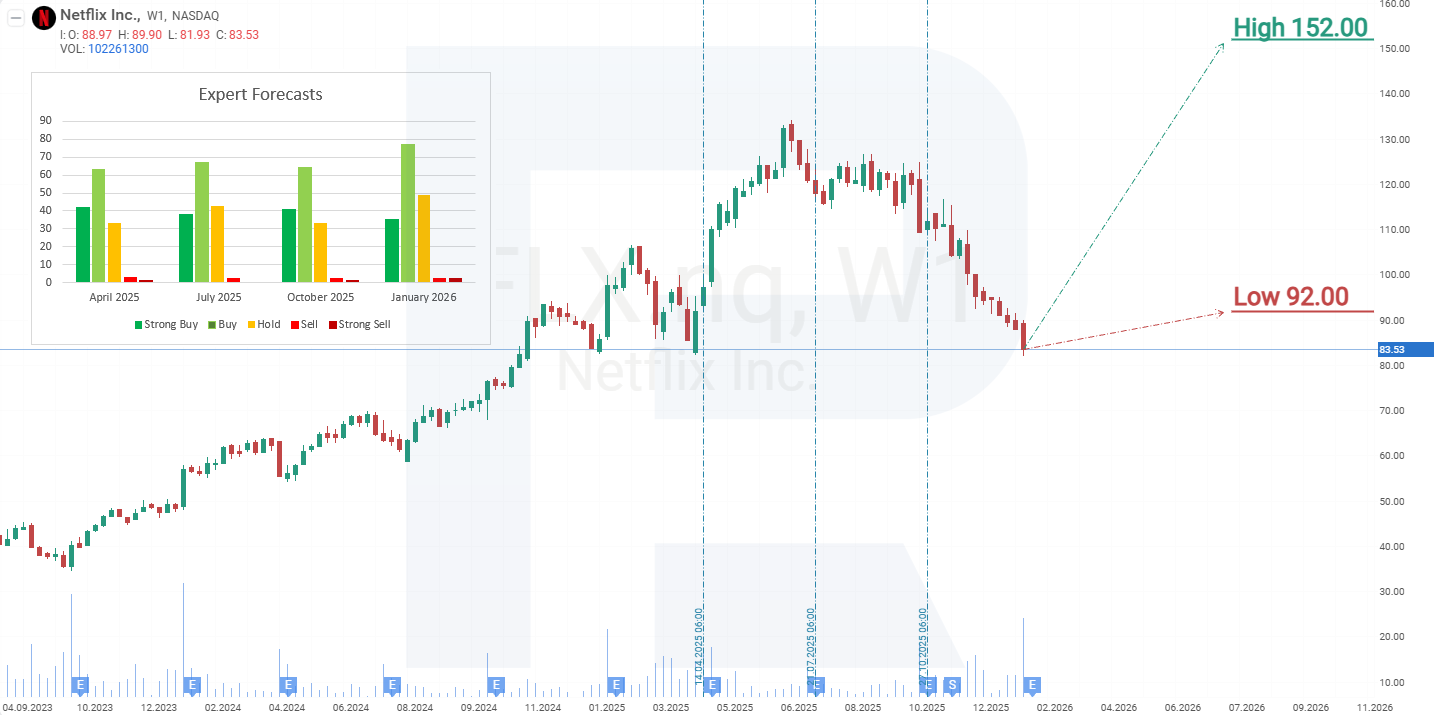
- Barchart: 24 of 42 analysts rated Netflix shares as Strong Buy, 3 as Buy, 13 as Hold, and 2 as Strong Sell. The upper price target is 152 USD, and the lower bound is 92 USD.
- MarketBeat: 34 of 51 analysts assigned a Buy rating to the shares, 16 recommended Hold, and 1 rated Sell. The upper price target is 151 USD, and the lower bound is 94 USD.
- TipRanks: 26 of 37 professionals recommended Buy, 10 Hold, and 1 recommended Sell. The upper price target is 150 USD, and the lower bound is 92 USD.
- Stock Analysis: 11 of 35 experts rated the shares as Strong Buy, 14 as Buy, and 10 as Hold. The upper price target is 151 USD, and the lower bound is 94 USD.
Netflix, Inc. stock price forecast for 2026
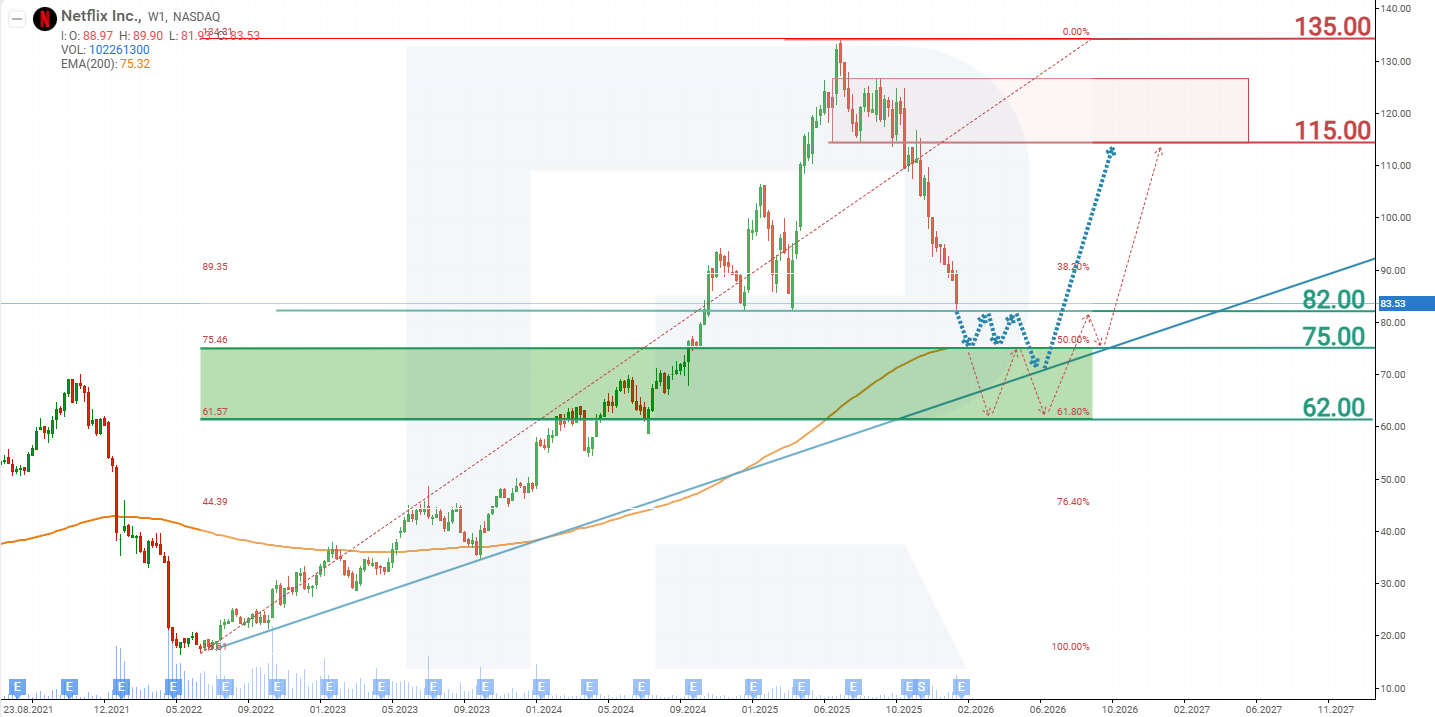
In June 2025, NFLX shares reached an all-time high of 134 USD, after which they began to decline. The release of the Q2 2025 report temporarily slowed the decline, but the Q3 report acted as a catalyst, pushing the price below the 115 USD support level and intensifying the share price decline. The reason for this investor reaction was the company’s lowered operating margin forecast. The pressure on Netflix shares did not subside. In December 2025, it was revealed that the company intended to acquire Warner Bros. Discovery Inc., which implied greater financial strain. As a result, NFLX shares dropped by 40% from June 2025 to January 2026. The new information that the deal will be fully cash-funded may continue to impact the stock price negatively for some time. Based on the current performance of NFLX shares, the potential price scenarios for Netflix in 2026 are as follows:
The base-case forecast for NFLX shares suggests testing support at 75 USD, followed by a rebound and price growth towards resistance at 115 USD. If this level is breached, the stock price could return to the all-time high of 135 USD.
The alternative forecast for NFLX stock suggests a decline to support at 62 USD, followed by consolidation, then a resumption of growth. The target level would be the resistance at 115 USD.
Risks of investing in Netflix, Inc. stock
Investing in Netflix stock carries risks and potential challenges for the company. These include:
- Content costs: producing high-quality original content requires a significant investment. Inflated costs may impact the company’s profitability.
- Market saturation – subscriber numbers may slow down in countries with high streaming service penetration.
- User reaction to ads: although users are currently tolerant of ads and subscribing to the ad-supported plan, a shift in user sentiment could significantly harm the company’s financial position.
Forecasts presented in this section only reflect the author’s private opinion and should not be considered as guidance for trading. RoboForex bears no responsibility for trading results based on trading recommendations described in these analytical reviews.