
Delta Air Lines – stock forecast for 2026 amid rising fuel prices
Delta Air Lines has exceeded earnings expectations and issued a strong outlook for Q2 of the 2026 financial year, but rising fuel prices are limiting optimism. The base scenario assumes a test of the 65 USD level, with potential upside towards 85 USD, provided demand for air travel remains strong.
Delta Air Lines (NYSE: DAL) released Q1 2026 results that exceeded market expectations. Revenue rose to 14.2 billion USD, the operating margin reached 4.6%, and adjusted earnings per share came in at 0.64 USD, compared with market expectations of around 0.57 USD.
The key driver behind the strong results was resilient demand for premium travel, corporate bookings, and loyalty programs, which enabled the company to deliver record revenue for the March quarter. At the same time, pressure on profitability persisted. Fuel costs increased, and the company specifically noted that the external environment for the airline sector remains challenging.
For Q2 2026, the company expects revenue growth of 10–13% year-on-year, an operating margin in the range of 6–8%, and adjusted earnings per share of 1.00–1.50 USD.
The report was initially well received by investors, as reflected in an 11% jump in DAL shares at the open. However, the risk of rising fuel costs and the resulting pressure on profitability cooled sentiment, leading to a subsequent decline in the share price.
This article examines Delta Air Lines, outlines the key sources of its revenue, summarises the company’s quarterly performance, and presents expectations for the next reporting period. It also includes a technical analysis of DAL, which forms the basis for a forecast for Delta Air Lines shares for the 2026 calendar year.
About Delta Air Lines, Inc.
Delta Air Lines, Inc. is one of the largest airlines in the US. The company was founded in 1925 as Huff Daland Dusters in Macon, Georgia, and the Delta brand was introduced in 1928 as Delta Air Service. It has operated under the name Delta Air Lines, Inc. since 1945.
Headquartered in Atlanta, Georgia, Delta provides passenger and cargo air transport services and operates related segments, including the SkyMiles loyalty program and aircraft maintenance services.
Delta Air Lines shares trade on the NYSE under the ticker DAL. Following its restructuring, the company returned to the New York Stock Exchange in 2007.

Delta Air Lines, Inc. Q1 2026 financial results
On 8 April, Delta Air Lines released its Q1 2026 results for the quarter ended 31 March 2026. Below are the key figures:
- Revenue: 14.20 billion USD (+10%)
- Net income (non-GAAP): 423 million USD (+45%)
- Earnings per share (non-GAAP): 0.64 USD (+42%)
- Operating margin: 4.6% (+10 basis points)
Revenue by segment:
- Passenger: 12.30 billion USD (+7%)
- Cargo: 226 million USD (+9%)
- Other: 3.33 billion USD (+41%)
Delta Air Lines delivered record revenue for the March quarter of 14.2 billion USD and adjusted earnings per share of 0.64 USD, compared with a consensus estimate of 0.57 USD.
Delta reported strong demand in both corporate and leisure segments, with premium, corporate, and loyalty segments acting as key growth drivers. Premium revenue increased by 14% year-on-year, loyalty and related revenues rose by 13%, while remuneration from American Express exceeded 2 billion USD, up 10%.
However, there were also negative factors. Fuel expenses rose by 8% year-on-year, the average fuel price increased by 7%, and non-fuel unit costs grew by 6%. In other words, demand remained strong, but rising costs offset some of this effect. This is why, on a GAAP basis, the picture appears significantly weaker: the company reported a loss per share of -0.44 USD, while on an adjusted basis, the quarter remained profitable.
For Q2 2026, Delta expects revenue growth of 10–13%, an operating margin of 6–8%, and EPS in the range of 1.00–1.50 USD. This guidance indicates that demand remains strong and that the company is experiencing solid momentum in its business.
Analysis of key valuation multiples for Delta Air Lines, Inc.
Below are the key valuation multiples for Delta Air Lines, Inc,. based on Q1 2026 results, calculated using a share price of 68 USD.
| Multiple | What it indicates | Value | Comment |
|---|---|---|---|
| P/E (TTM) | Price paid for 1 USD of earnings over the past 12 months | 9.94 | ⬤ Valuation on an earnings basis appears attractive, provided the company maintains its current level of profitability |
| P/S (TTM) | Price paid for 1 USD of annual revenue | 0.68 | ⬤ On a revenue basis, the stock is valued relatively low |
| EV/Sales (TTM) | Enterprise value to sales, accounting for debt | 0.82 | ⬤ This represents a comfortable level for a cyclical business |
| P/FCF (TTM) | Price paid for 1 USD of free cash flow | 9.78 | ⬤ Cash flow is valued at a reasonable level |
| FCF Yield (TTM) | Free cash flow yield to shareholders | 10.22% | ⬤ Yield is high |
| EV/EBITDA (TTM) | Enterprise value to operating profit before depreciation and amortisation | 6.51 | ⬤ On an EBITDA basis, the stock appears fairly attractive for investors |
| EV/EBIT (TTM) | Enterprise value to operating profit | 9.31 | ⬤ On an operating profit basis, valuation also appears attractive |
| P/B | Price to book value | 2.18 | ⬤ On a book value basis, valuation is acceptable |
| Forward P/E | Forward price-to-earnings (P/E) ratio | 10.25 | ⬤ If earnings forecasts are maintained, valuation appears attractive |
| Net Debt/EBITDA | Debt burden relative to EBITDA | 1.11 | ⬤ Leverage remains under control |
| Interest Coverage (TTM) | Ability to cover interest expenses with operating profit | 8.84 | ⬤ Interest coverage is strong |
Most key valuation metrics remain at levels that suggest the stock may offer upside potential, provided the company maintains resilient demand, favourable ticket pricing, and strong cash flow. In particular, a P/E below 10, EV/EBITDA of around 6.5, and an FCF yield above 10% stand out. This indicates that the current valuation does not appear overstretched, and the market is not yet pricing in an overly optimistic scenario.
At the same time, it is important to consider the nature of the business. Airlines are highly dependent on fuel prices, economic conditions, and overall demand for air travel, meaning that even low multiples do not make the stock defensive. For Delta, this factor is particularly relevant, as the company has already reported an increase in fuel expenses of more than 2 billion USD.
Overall, Delta shares appear inexpensive across several metrics, but this valuation is sensitive to external conditions.
Expert forecasts for Delta Air Lines, Inc. stock
- *Barchart*: 22 of 24 analysts assigned a Strong Buy rating to Delta Air Lines shares, 1 assigned a Moderate Buy rating, and 1 assigned a Strong Sell rating. The upper price target is 90 USD, and the lower bound is 70 USD.
- *MarketBeat*: 23 of 25 analysts assigned a Buy rating to the stock, 1 assigned a Hold rating, and 1 assigned a Sell rating. The upper price target is 90 USD, and the lower bound is 65 USD.
- *TipRanks*: 17 of 18 analysts assigned a Buy rating to the stock, and 1 assigned a Hold rating. The upper price target is 90 USD, and the lower bound is 70 USD.
- *Stock Analysis*: 11 of 19 analysts assigned a Strong Buy rating to Delta Air Lines shares, and 8 assigned a Buy rating. The upper price target is 90 USD, and the lower bound is 70 USD.
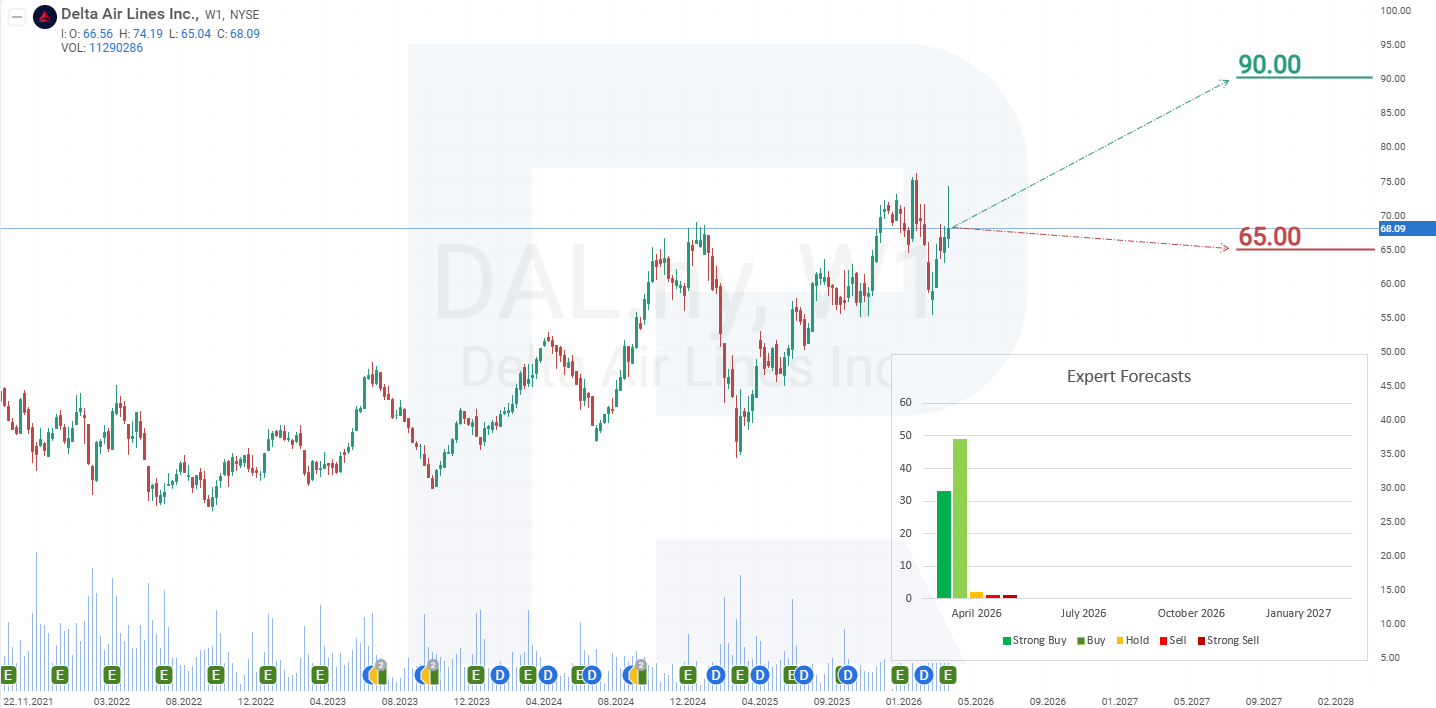
Delta Air Lines, Inc. stock price forecast for 2026
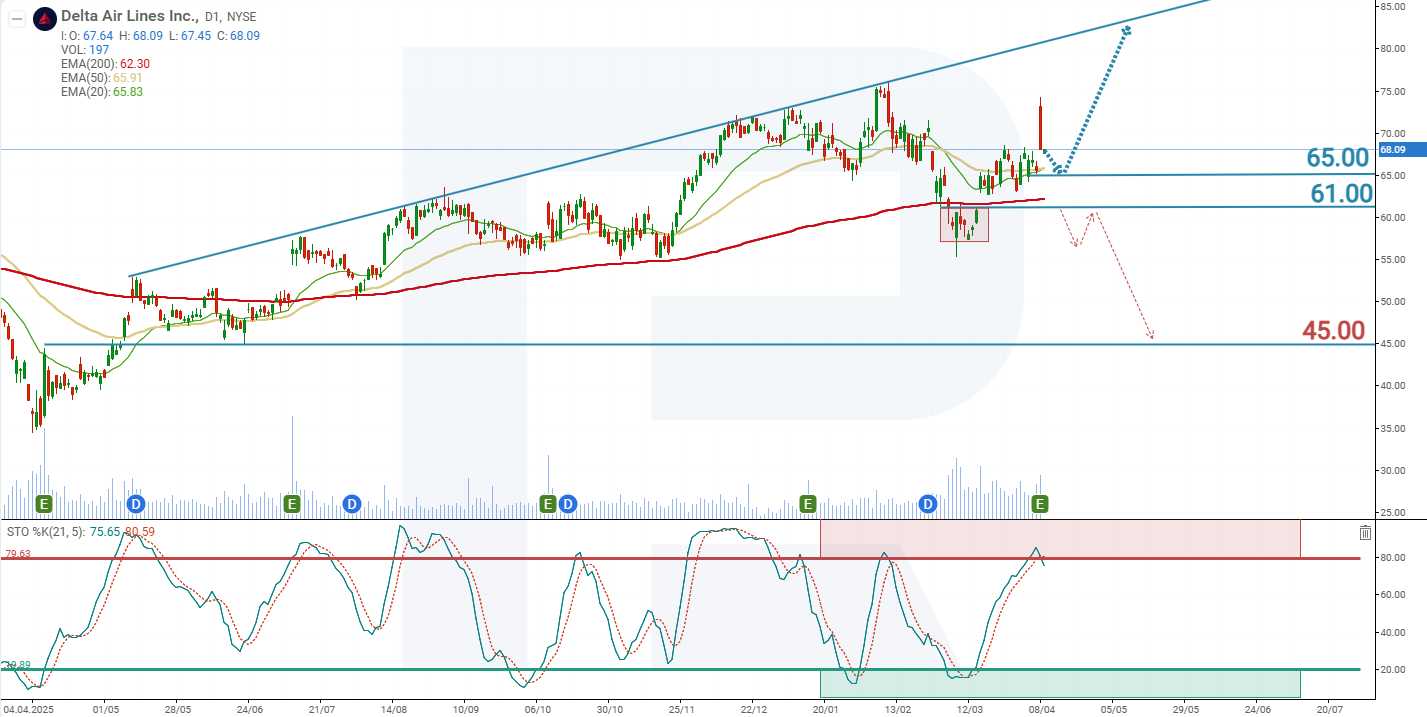
Delta Air Lines shares are trading above the 200-day moving average, suggesting an overall upward trend. However, the Stochastic indicator has reached overbought territory, signalling the need for a correction before the next upward move.
Based on the current price dynamics of Delta Air Lines shares, the possible scenarios for 2026 are as follows:
The base case forecast for Delta Air Lines shares assumes a test of support at 65 USD. Under this scenario, the Stochastic indicator would exit overbought territory and, if prices consolidate near support, move towards the oversold zone. A rebound from the 65 USD level would signal a resumption of the upward trend, with the next target at 85 USD. This scenario is supported by the start of the holiday season, when demand for air travel typically increases, which could help the company deliver strong results for Q2 2026.
The alternative forecast for Delta Air Lines stock assumes a break below support at 61 USD. In this case, the 200-day moving average would also be breached, signalling the end of the upward trend. Under this scenario, DAL shares could decline towards support at 45 USD.
This scenario would become more likely in the event of a further increase in fuel prices due to an escalation in the Middle East, as this would raise the airline’s costs and put pressure on its profitability.
Risks of investing in Delta Air Lines, Inc. stock
The key risks associated with investing in Delta Air Lines shares are outlined below:
- Fuel price risk. Against the backdrop of the Middle East conflict, this remains the primary risk for Delta. The company expects jet fuel prices of around 4.30 USD per gallon in Q2 2026, while the increase in fuel expenses compared with the previous year could exceed 2 billion USD, which is why management has not updated its full-year guidance.
- Demand risk. Delta has already been increasing fares and baggage fees to offset 40–50% of the additional fuel costs. If economic conditions weaken or passengers become more price-sensitive, margins could come under pressure.
- High capital intensity and still elevated leverage. Delta’s balance sheet has improved, but the business remains capital-intensive. In Q1 2026, the company reported 13.5 billion USD in adjusted net debt, spent 1.2 billion USD on capital expenditure, and allocated 1.6 billion USD to debt and lease repayments. This is not a critical situation, but in a weaker cycle, such a business typically becomes more dependent on cash flow.
Forecasts presented in this section only reflect the author’s private opinion and should not be considered as guidance for trading. RoboForex bears no responsibility for trading results based on trading recommendations described in these analytical reviews.