
NVIDIA stock forecast for 2026 following Q2 2027 earnings
NVIDIA stock continues to offer upside potential following another strong quarterly earnings report. This article analyses NVIDIA stock, examines the key drivers of NVDA, and presents a forecast for the second half of 2026.
NVIDIA Corporation (NASDAQ: NVDA) delivered strong results for Q2 2027, confirming exceptionally strong demand for AI infrastructure. Revenue increased to 96.22 billion USD, while the Data Center segment accelerated to 117% year-on-year growth. An analysis of NVIDIA stock shows that the company's principal growth drivers remain the expansion of its Data Center business, strong demand for Blackwell, and the beginning of the large-scale deployment of the new Vera Rubin architecture.
For Q3 2027, NVIDIA forecasts revenue of approximately 108 billion USD, plus or minus 2%, implying further growth of around 12% compared with the previous quarter. At the same time, the main risk is declining margins due to rising memory and other component costs.
This article reviews NVIDIA's financial results, analyses developments across its Data Center, Compute, and Networking businesses, evaluates changes in profitability, summarises analysts' views, and examines the technical outlook. Based on these factors, it presents a forecast for NVIDIA stock for the second half of 2026.
About NVIDIA Corporation
NVIDIA Corporation is a US tech company established in 1993 by Jensen Huang, Chris Malachowsky, and Curtis Priem. Jensen Huang has remained the company’s CEO since its foundation. NVIDIA specialises in producing GPUs, chips for AI, data centres, and autopilot systems. The company plays a key role in developing gaming, professional visualisation, and AI computing. NVIDIA also held a prominent place in the cryptocurrency mining industry as its graphics cards were widely used for mining Bitcoin, Ethereum, and other digital assets. The company went public on 22 January 1999 on the NASDAQ under the NVDA ticker symbol.
NVIDIA Corporation Q2 2025 financial results
On 28 August 2024, NVIDIA released its Q2 2025 financial results for the quarter ended 28 July 2024. Below are the key figures compared to the corresponding period of last year:
- Revenue: 30.04 billion USD (+122%)
- Net income: 16.95 billion USD (+152%)
- Earnings per share: 0.68 USD (+152%)
- Operating profit: 19.94 billion USD (+156%)
- Gross margin: 75.1% (+500 basis points)
Revenue by segment:
- Data Center: 26.27 billion USD (+154%)
- Gaming: 2.88 billion USD (+16%)
- Professional Visualization: 454 million USD (+20%)
- Automotive: 346 million USD (+37%)
In the first half of 2024, NVIDIA returned 15.40 billion USD to shareholders through share repurchases and dividends. As of the end of Q2 2024, the company had 7.50 billion USD remaining for stock buybacks. On 26 August 2024, the Board of Directors approved an additional 50.00 billion USD for share repurchases, with no expiration date.
Although the Q2 2025 results surpassed analyst forecasts, NVIDIA shares fell immediately after the release. Investors were not particularly impressed by the revenue and profit growth, as financial indicators had surged from 200% to 700% in the previous quarter. Maintaining such rapid growth over the long term is clearly unrealistic, but investor expectations remain elevated.
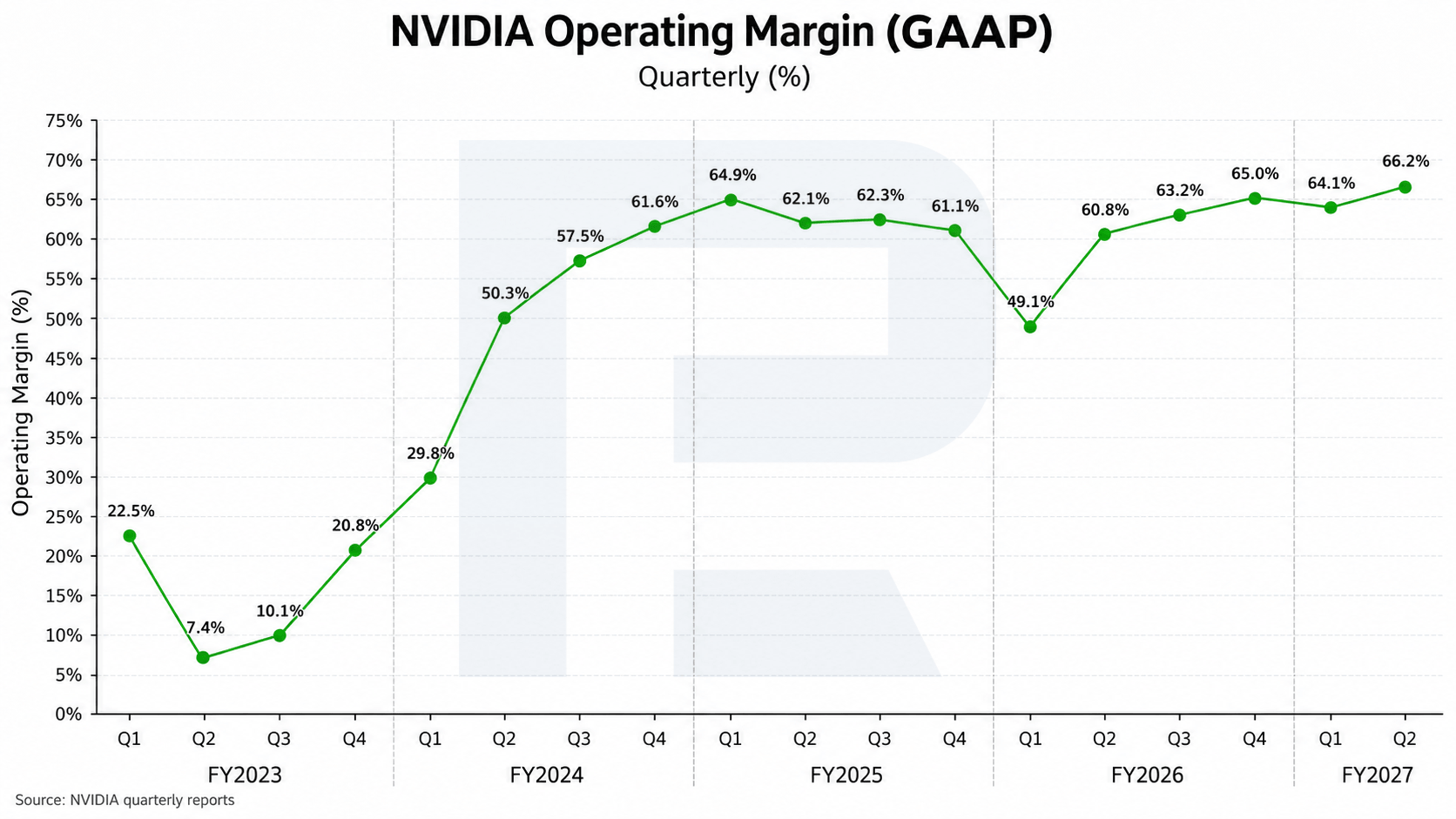
A fundamental analysis of NVIDIA’s report showed that revenue increased across all segments. The Data Center segment, which focuses on AI technologies, remained the leader. The company’s operating margin chart below illustrates the extent to which AI has influenced NVIDIA’s performance.
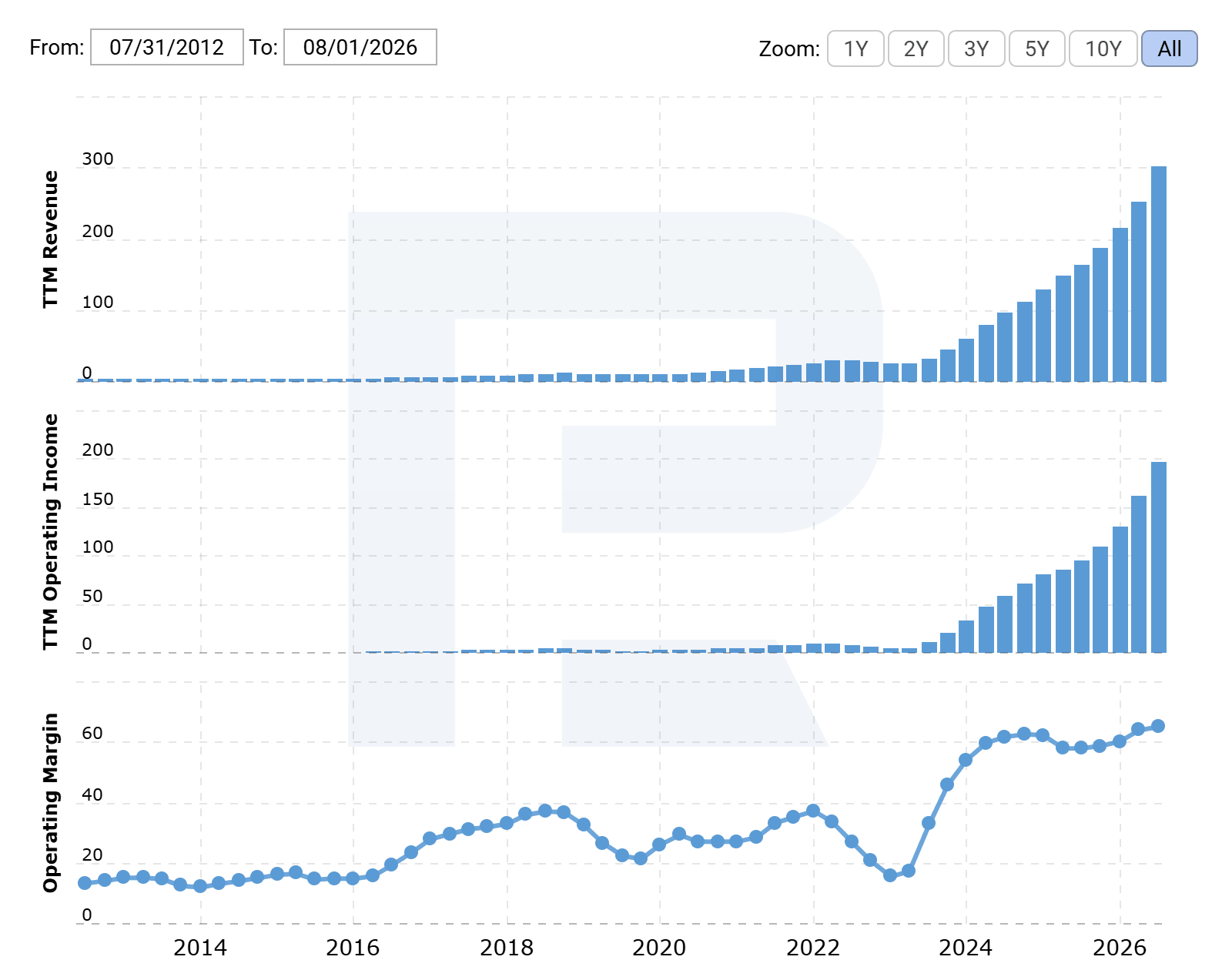
OpenAI announced ChatGPT on 30 November 2022, and by Q1 2023, NVIDIA reported an increase in its operating margin. It then grew at a rapid pace, even surpassing the levels seen during the cryptocurrency mining boom. In fact, this suggests that the company has been raising product prices without a decline in demand, allowing it to generate more than 50 cents in profit for every dollar invested.
NVIDIA Corporation Q3 2025 financial results
On 20 November 2024, NVIDIA released its Q3 2025 financial results for the quarter ended 27 October 2024. Below are the key figures compared with the corresponding period of last year:
- Revenue: 35.08 billion USD (+94%)
- Net income: 19.31 billion USD (+109%)
- Earnings per share: 0.78 USD (+111%)
- Operating profit: 21.86 billion USD (+110%)
- Gross margin: 74.6% (+60 basis points)
Revenue by segment:
- Data Center: 30.77 billion USD (+112%)
- Gaming: 3.27 billion USD (+15%)
- Professional Visualization: 486 million USD (+17%)
- Automotive: 449 million USD (+72%)
Jensen Huang commented on the report, saying that “The age of artificial intelligence is in full steam, driving a global shift to NVIDIA computing,” emphasising the strong demand for the Hopper and Blackwell microarchitecture products, which drove record results in the last quarter.
For Q4 2025, NVIDIA forecasted revenue of 37.50 billion USD (with a potential deviation of 2%) and a non-GAAP gross margin of 73.5%, reflecting confidence in continued growth despite supply restraints, particularly with the ramp-up of Blackwell production.
NVIDIA Corporation Q4 2025 financial results
On 26 February 2024, NVIDIA released its Q4 2025 financial results for the quarter ended 26 January 2025. Below are the key figures compared with the corresponding period of last year:
- Revenue: 39.33 billion USD (+78%)
- Net income: 22.09 billion USD (+80%)
- Earnings per share: 0.89 USD (+82%)
- Operating profit: 24.03 billion USD (+77%)
- Gross margin: 73.0% (+300 basis points)
Revenue by segment:
- Data Center: 35.58 billion USD (+93%)
- Gaming: 2.54 billion USD (–11%)
- Professional Visualization: 511 million USD (+10%)
- Automotive: 570 million USD (+103%)
Jensen Huang commented on the Q4 fiscal 2025 earnings report, saying that “artificial intelligence has been developing at an incredible pace, as agentic AI and physical AI are creating the basis for the next AI wave, which will revolutionise the largest industries”, underscoring the company’s key role in the AI boom, which led to record revenues of 39.30 billion USD. He highlighted the strong results of the Data Center segment, which reached 35.60 billion USD, thanks to demand for the Hopper and Blackwell microarchitecture solutions.
For Q1 2026, NVIDIA had projected revenue of 43.00 billion USD (with a possible variance of 2%) and a non-GAAP gross margin of 71.0%, indicating the company’s revenue remained robust. However, the decline in gross margin raised concerns among investors.
NVIDIA Corporation Q1 2026 financial results
On 28 May 2025, NVIDIA Corporation published its Q1 2026 financial results for the quarter ended 27 April 2025. The key figures, compared with the corresponding period of the previous year, are presented below:
- Revenue: 44.06 billion USD (+69%)
- Net income: 18.78 billion USD (+26%)
- Earnings per share (EPS): 0.76 USD (+27%)
- Operating income: 21.63 billion USD (+28%)
- Gross margin: 60.5% (–1,790 basis points)
Revenue by segment:
- Data Center: 39.11 billion USD (+73%)
- Gaming: 3.76 billion USD (+42%)
- Professional Visualization: 509 million USD (+20%)
- Automotive: 567 million USD (+72%)
NVIDIA's Q1 2026 results confirmed the company's strong position in the AI market. Revenue reached a record 44.06 billion USD, increasing 69% year on year. The Data Center business remained the company's principal growth driver, with revenue rising 73% to 39.11 billion USD, supported by strong demand for accelerated computing and AI infrastructure.
The main negative factor was US export restrictions on advanced AI chips to China. As a result of restrictions on H20 chip shipments, NVIDIA recorded a 4.5 billion USD inventory write-down and estimated that it had lost approximately 2.5 billion USD in revenue during the quarter. For Q2 FY2026, the company expected the export restrictions to reduce potential revenue by a further 8 billion USD.
At the same time, growing demand in North America, Europe, and the Middle East partially offset the impact of the Chinese market. Additional support came from the rollout of the new Blackwell architecture, which continued to see strong demand from hyperscalers, enterprise customers, and government AI projects.
For Q2 2026, NVIDIA forecast revenue of approximately 45 billion USD. This guidance reflected the accelerating adoption of the new Blackwell chip architecture, which, according to Jensen Huang, was already seeing unprecedented demand from hyperscalers, government AI initiatives, and major enterprise customers. The company expected this strong demand to continue through the remainder of the fiscal year for both its AI hardware and software products.
NVIDIA Corporation Q2 2026 financial results
On 27 August 2025, NVIDIA released its Q2 2026 financial results for the quarter ended 27 July 2025. Key figures compared with the same period last year are as follows:
- Revenue: 46.74 billion USD (+56%)
- Net income: 26.42 billion USD (+59%)
- Earnings per share (non-GAAP): 1.05 USD (+56%)
- Operating profit: 30.16 billion USD (+30%)
- Gross margin: 72.7% (–300 bps)
Revenue by segment:
- Data Center: 41.09 billion USD (+56%)
- Gaming: 4.28 billion USD (+48%)
- Professional Visualization: 601 million USD (+32%)
- Automotive: 586 million USD (+69%)
- OEM & Other: 173 million USD (+97%)
NVIDIA reported strong results for Q2 2026. Revenue reached 46.7 billion USD (+6% q/q, +56% y/y). The main driver was the Data Center segment, which posted 41.1 billion USD (+5% q/q, +56% y/y), with growth supported by Blackwell chip shipments (the Blackwell Data Center subsegment rose 17% sequentially). Gross margin was 72.4% GAAP and 72.7% non-GAAP. Adjusted earnings per share (non-GAAP EPS) came in at 1.05 USD. However, this included a one-time positive effect from the release of a previously established 180 million USD reserve related to H20 chip deliveries to China. Excluding this one-off, EPS would have been 1.04 USD. Gaming revenue increased to 4.3 billion USD, Professional Visualization reached 601 million USD, and Automotive was 586 million USD.
The company emphasised that there were no H20 chip sales to China during the quarter, and forecasts for the next period also exclude these sales. The board approved an increase in the share repurchase program by a further 60 billion USD. The dividend was set at 0.01 USD per share, with a record date of 11 September 2025 and a payment date of 2 October 2025.
The outlook for Q3 2026 projected revenue of approximately 54.0 billion USD (±2%), a non-GAAP gross margin of around 73.5% (±50 bps), non-GAAP operating expenses of roughly 4.2 billion USD, other income around 500 million USD, and an effective tax rate of roughly 16.5% (±1 pp). The company expected to close the financial year with a non-GAAP margin of around 73.5%. It is important to note that this forecast did not factor in potential H20 chip sales to China. For investors, this meant that management’s base-case scenario was built solely on current global demand and the acceleration of new Blackwell chip shipments, without assuming a recovery in the Chinese market.
NVIDIA Corporation Q3 2026 financial results
On 19 November 2025, NVIDIA released its Q3 2026 financial results for the quarter ended 26 October 2025. The key figures, compared with the same period in the previous year, are as follows:
- Revenue: 57.01 billion USD (+62%)
- Net income (non-GAAP): 31.76 billion USD (+59%)
- Earnings per share (non-GAAP): 1.30 USD (+60%)
- Operating profit (non-GAAP): 37.75 billion USD (+62%)
- Gross margin (non-GAAP): 73.6% (–140 bps)
Revenue by segment:
- Data Center: 51.22 billion USD (+66%)
- Gaming: 4.27 billion USD (+30%)
- Professional Visualization: 760 million USD (+56%)
- Automotive: 592 million USD (+32%)
- OEM & Other: 174 million USD (+79%)
NVIDIA’s Q3 2026 results came in ahead of market expectations. Revenue reached approximately 57 billion USD, and non-GAAP EPS was 1.30 USD – both exceeding analyst forecasts. The company once again delivered strong growth in both revenue and profit.
The primary source of income remains the Data Center segment, which generated 51.2 billion USD, up 66% year-on-year and accounting for nearly 90% of total revenue. Other segments, including Gaming, continue to grow at a slower pace and make up a smaller share of the total.
Management issued a strong outlook for Q4 2026, forecasting revenue of around 65 billion USD and a gross margin of approximately 75% – also above analyst expectations. According to management, NVIDIA has already secured confirmed orders for its new Blackwell and Rubin chips worth around 500 billion USD through the end of 2026, with demand for AI hardware continuing to exceed supply.
Management also emphasised that the current growth does not appear to be a bubble: clients continue to invest heavily in infrastructure, while production capacity remains a limiting factor. However, analysts caution that growth rates may eventually slow due to power-supply constraints and market saturation. For now, based on the Q3 results and guidance for the next quarter, demand for NVIDIA’s products remains extremely strong.
NVIDIA Corporation Q4 2026 financial results
On 25 February 2026, NVIDIA released its Q1 2027 financial results for the quarter ended 25 January 2026. Below are the key figures compared to the same period last year:
- Revenue: 68.13 billion USD (+73%)
- Net income (non-GAAP): 39.55 billion USD (+79%)
- Earnings per share (non-GAAP): 1.62 USD (+82%)
- Operating profit (non-GAAP): 46.11 billion USD (+81%)
- Gross margin (non-GAAP): 75.2% (+220 basis points)
Revenue by segment:
- Data Center: 62.31 billion USD (+75%)
- Gaming: 3.73 billion USD (+47%)
- Professional Visualization: 1.32 billion USD (+159%)
- Automotive: 604 million USD (+6%)
- OEM & Other: 161 million USD (+28%)
NVIDIA reported a very strong Q4 2026 result, surpassing market expectations, although investors typically expect even more acceleration from a company of this calibre. Revenue reached 68.13 billion USD (+73% YoY and +20% QoQ), with adjusted earnings per share (EPS) coming in at 1.62 USD, exceeding the consensus estimate of 1.53 USD.
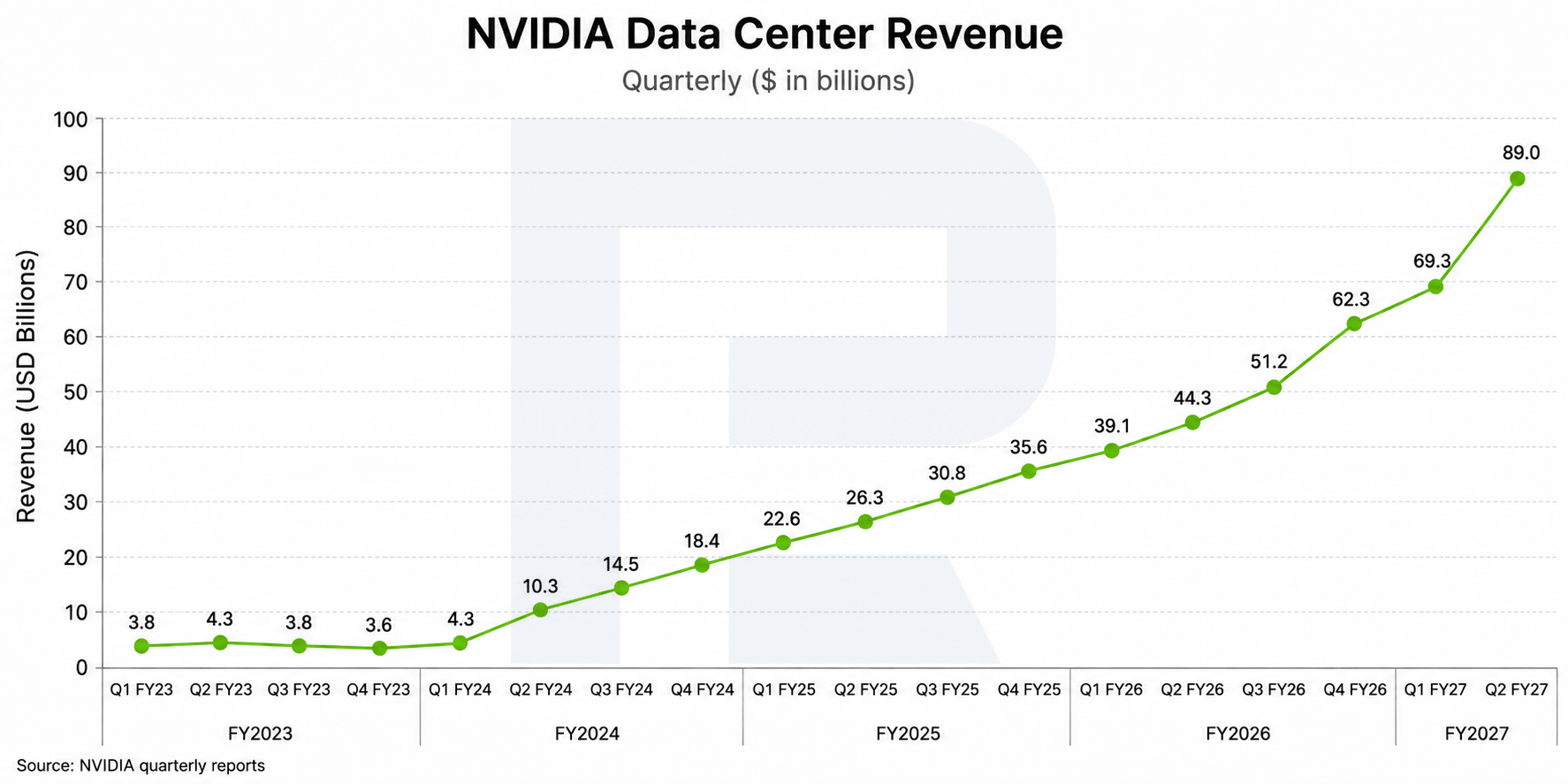
The primary growth driver for the quarter, as in previous periods, was the Data Center segment. Revenue in this area reached 62.31 billion USD (+75% YoY and +22% QoQ), driven by both computing and networking.
In terms of profitability, the quarter was exceptionally strong: gross margin increased to 75.0% (GAAP) and 75.2% (non-GAAP), while net income under GAAP totalled 43.0 billion USD, with GAAP EPS of 1.76 USD. In the 2026 financial year, NVIDIA returned 41.1 billion USD to shareholders through buybacks and dividends, while maintaining a significant buyback program balance of 58.5 billion USD.
The outlook for the next quarter is also strong. For Q1 2027, the company forecasts revenue of approximately 78.0 billion USD, significantly exceeding analyst expectations (the average estimate being around 72.6 billion USD). NVIDIA specifically noted that the guidance excludes revenue from Data Center compute in China. The company also mentioned that it had received licences to ship small volumes of H200 to China. However, this does not alter the overall picture, as growth is driven by global demand outside China.
NVIDIA Corporation Q1 2027 financial results
On 20 May 2026, NVIDIA Corporation published its Q1 2027 financial results for the quarter ended 26 April 2026. The key figures, compared with the corresponding period of the previous year, are presented below:
- Revenue: 81.62 billion USD (+85%)
- Net income (non-GAAP): 45.55 billion USD (+139%)
- Earnings per share (non-GAAP): 1.87 USD (+140%)
- Operating income (non-GAAP): 53.78 billion USD (+147%)
- Gross margin (non-GAAP): 75.0% (+1,450 basis points)
Revenue by segment:
- Data Center: 74.25 billion USD (+92%)
- Hyperscale: 37.87 billion USD (+115%)
- AI Clouds, Industrial & Enterprise: 37.37 billion USD (+74%)
- Edge Computing: 6.37 billion USD (+28%)
NVIDIA's Q1 2027 results confirmed that the company continues to deliver exceptionally strong growth. Revenue increased to 81.62 billion USD, up 85% year on year and 20% compared with the previous quarter. The Data Center segment remained the principal growth driver, with revenue increasing from 62.3 billion USD in Q4 FY2026 to 75.2 billion USD.
Profitability also remained exceptionally strong. Non-GAAP gross margin reached 75.0%, non-GAAP operating income increased to 53.78 billion USD, and non-GAAP EPS rose to 1.87 USD, exceeding market expectations of approximately 1.77 USD.
For Q2 2027, NVIDIA forecast revenue of approximately 91 billion USD, above market expectations of 87.2 billion USD. The company also noted that the forecast excludes Data Center Compute shipments to China, meaning customers in other markets are expected to remain the principal source of growth.
Another positive development was the increase in capital returned to shareholders. During the quarter, NVIDIA returned approximately 20 billion USD through share repurchases and dividends, approved a new 80 billion USD share repurchase program, and increased its quarterly dividend to 0.25 USD per share.
NVIDIA Corporation Q2 2027 financial results
On 26 August 2026, NVIDIA Corporation published its Q2 2027 financial results for the quarter ended 26 July 2026. The key figures, compared with the corresponding period of the previous year, are presented below:
- Revenue: 96.22 billion USD (+106%)
- Net income (non-GAAP): 53.95 billion USD (+118%)
- Earnings per share (non-GAAP): 2.22 USD (+120%)
- Operating income (non-GAAP): 63.96 billion USD (+124%)
- Gross margin (non-GAAP): 75.0% (+250 basis points)
Revenue by segment:
- Data Center: 89.02 billion USD (+117%)
- Hyperscale: 48.71 billion USD (+102%)
- AI Clouds, Industrial & Enterprise: 40.31 billion USD (+138%)
- Edge Computing: 7.20 billion USD (+27%)
NVIDIA's Q2 2027 results were exceptionally strong, suggesting that the company has not yet reached the peak of its revenue growth. Revenue climbed to 96.22 billion USD, up 106% year on year and 18% compared with the previous quarter. This also exceeded NVIDIA's own quarterly revenue guidance of approximately 91 billion USD by 5.7%.
The Data Center business remained the principal growth driver. Segment revenue reached 89.02 billion USD, increasing 117% year on year. By comparison, Data Center revenue had risen 92% year on year in Q1 2027. Despite an already demanding comparison base, annual growth in the segment accelerated further.
The composition of growth within the Data Center segment is particularly noteworthy. Hyperscale generated 48.71 billion USD, up 102% year on year, while AI Clouds, Industrial & Enterprise revenue rose 138% to 40.31 billion USD. This suggests that NVIDIA's demand base is becoming increasingly diversified, with AI companies, specialised cloud providers, enterprise customers, and government projects making a growing contribution.
This diversification could become an important source of future growth. NVIDIA expects customers outside the traditional hyperscaler segment to account for approximately half of its Data Center business. The company's addressable market is gradually expanding beyond the largest cloud data centres into enterprise, industrial, and government AI infrastructure.
Blackwell continues to drive growth, while Vera Rubin is emerging as the next major catalyst. Current financial performance continues to be driven primarily by Blackwell Ultra, but the results show that NVIDIA has already entered the next stage of its product cycle. Production shipments of Vera Rubin have begun, and the company has secured orders from leading hyperscalers, AI cloud providers, and server manufacturers. NVIDIA expects Vera Rubin to account for approximately 20% of Data Center revenue as early as Q3 2027.
This is particularly important amid concerns about a slowdown following the Blackwell product cycle. The market had expected NVIDIA's growth to moderate after the large-scale deployment of Blackwell. Instead, the opposite is occurring. The company is transitioning customers to its next-generation architecture before the current cycle has concluded, while simultaneously increasing the amount of hardware sold within each AI system.
Networking has become another important growth driver. Revenue from this business reached another record high and increased 18% from the previous quarter, while Spectrum-X Ethernet sales rose 2.6-fold year on year. This demonstrates that NVIDIA is steadily increasing the value of its platform for every data centre built by supplying customers with GPUs, CPUs, networking equipment, and software infrastructure.
The main weakness in the results was profitability, which remains the biggest risk to NVIDIA stock. Although non-GAAP gross margin remained at 75% in Q2, NVIDIA expects it to decline to 74% in Q3. More importantly, management indicated that gross margin could fall to 71–72% in Q4, before stabilising at around 72–73% in FY2028. The company attributed this to sharply higher memory and other component costs.
For NVIDIA stock, this is a crucial consideration. As long as revenue continues to grow at its current pace, lower margins are unlikely to pose a serious threat to absolute earnings. However, a sustained decline in profitability could limit further upside in the share price, even if revenue continues to increase.
As a result, the peak in revenue growth does not yet appear to be in sight, whereas profitability has likely approached its highest level of the current cycle. The trend in gross and operating margins is therefore likely to become one of the most important indicators to monitor over the next few quarters.
For Q3 2027, NVIDIA forecasts revenue of 108 billion USD, plus or minus 2%. If the company achieves the midpoint of this guidance, quarterly revenue would increase by a further 12%. Management also expects Hyperscale growth to accelerate in Q4 as shipments of Vera Rubin continue to ramp up.
Even more significant was NVIDIA's first preliminary outlook for 2028. The company expects revenue to increase by 70% year on year, while emphasising that this forecast is constrained by supply capacity rather than demand. According to management, customer demand continues to exceed available production capacity, and supply shortages are likely to persist at least until the end of 2028.
If this outlook is confirmed, it would significantly reduce the risk that the AI investment cycle is nearing its end. NVIDIA is effectively telling the market that, over the next year, the primary constraint on growth will be manufacturing capacity rather than a shortage of customer demand.
NVDA fundamental analysis and NVIDIA's key growth drivers in 2026
The principal driver of NVIDIA's growth remains global investment in AI infrastructure. The world's largest technology companies continue to increase spending on data centres. However, when assessing NVDA's outlook, it is more important to monitor how this demand is reflected in NVIDIA's financial performance.
Data Center revenue. The Data Center segment remains the company's principal growth driver, reflecting demand for Blackwell accelerators, server systems, and other AI infrastructure.
Over the past few years, Data Center has become NVIDIA's primary source of revenue and now accounts for more than 90% of the company's sales. As long as the segment continues to grow rapidly, AI investment by Microsoft, Amazon, Meta, Alphabet, Oracle, and other major customers will continue to provide direct support for NVIDIA's financial performance.
A slowdown in Data Center revenue could become one of the earliest signs that the AI investment cycle is beginning to lose momentum.
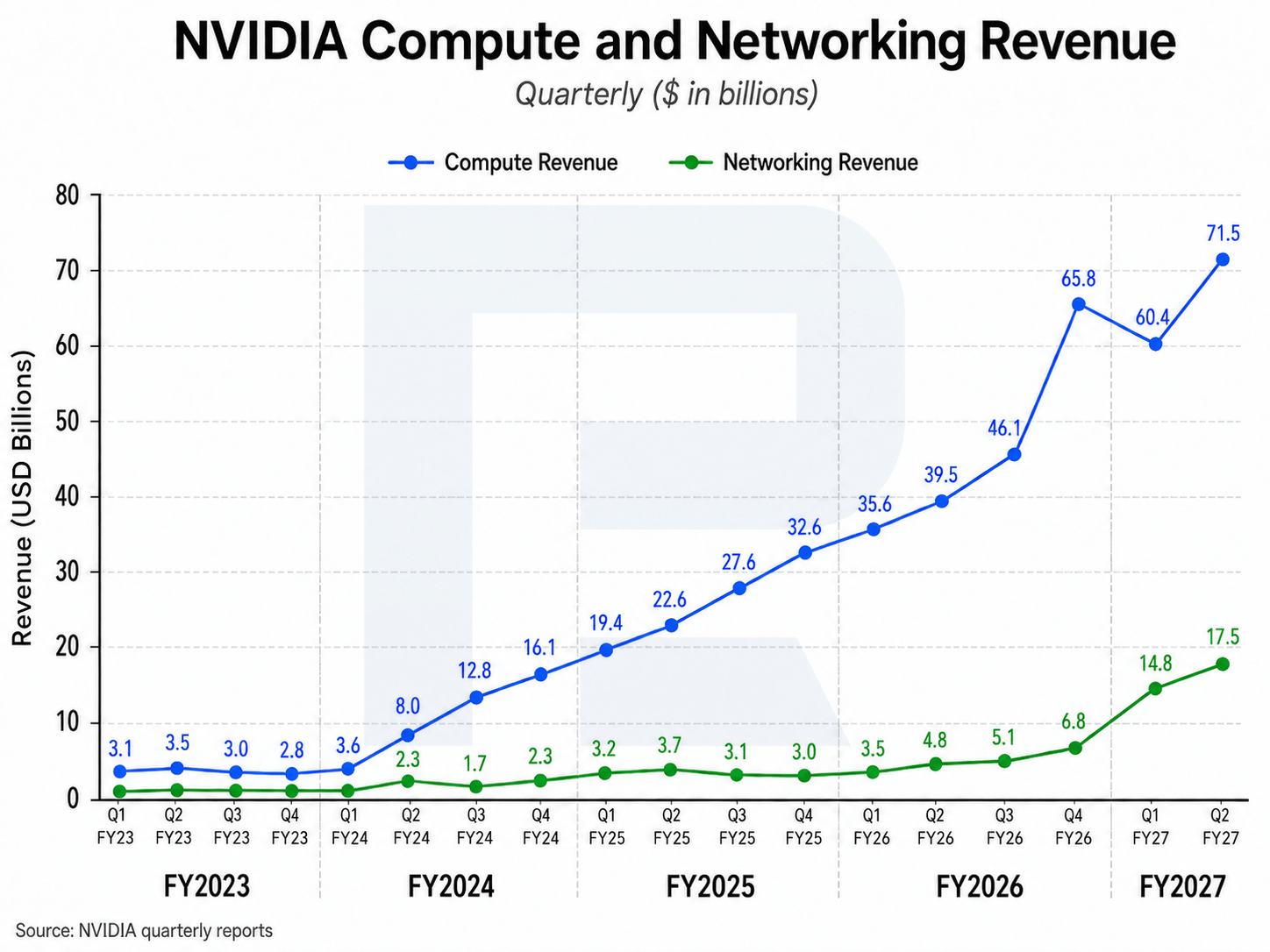
Compute and Networking. It is also important to monitor the composition of the Data Center business. Compute reflects sales of GPUs and computing systems, while Networking reflects demand for networking equipment used to connect thousands of accelerators within large AI clusters.
Growth in Networking is particularly important for NVIDIA's long-term outlook. The company is gradually expanding beyond GPUs and becoming a provider of integrated data centre infrastructure.
If both Compute and Networking continue to grow, NVIDIA will generate more revenue from each new AI cluster, increasing the potential size of its addressable market.
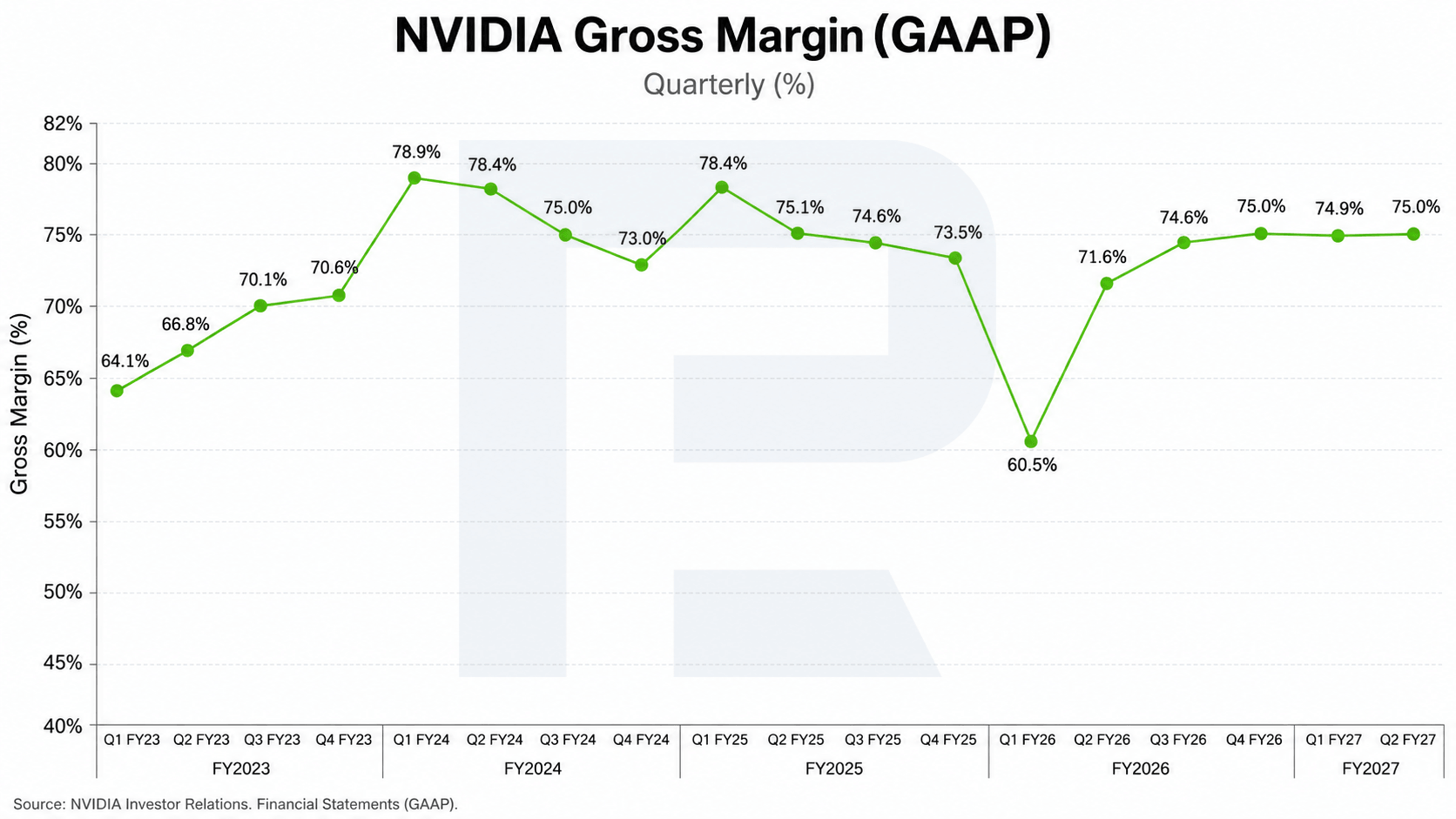
Gross margin. The next key indicator is gross margin. It helps investors assess NVIDIA's ability to maintain high profitability as the business expands, production costs rise, and competition intensifies.
In Q2 2027, non-GAAP gross margin remained at around 75%. However, NVIDIA expects it to decline to 74% in Q3 and 71–72% in Q4 due to rising memory and other component costs.
A sustained decline in gross margin could become an early indication of weakening profitability, even if demand for the company's products remains strong.
Operating margin. Operating margin shows how effectively revenue growth is translated into profit growth. In Q2 2027, the margin remained at around 66%, while operating income continued to grow faster than revenue.
The combination of a high operating margin and the rapid expansion in the Data Center business remains one of the principal factors supporting NVIDIA's earnings.
Financial performance continues to confirm exceptionally strong demand for AI infrastructure. The Data Center business continues to expand rapidly, with both Compute and Networking delivering strong growth. This indicates that NVIDIA's core business continues to scale.
At the same time, profitability is becoming the company's principal risk factor. NVIDIA expects gross margin to decline over the coming quarters, meaning the outlook for NVIDIA stock will largely depend on the company's ability to offset higher costs through continued Data Center growth and pricing power.
The peak in revenue growth does not yet appear to be in sight. However, profitability has likely approached its highest level of the current cycle. If the expected decline in margins is followed by a noticeable slowdown in Data Center growth, it would be a much stronger signal that NVIDIA is transitioning from a phase of hypergrowth to a more mature stage of development.
For NVIDIA stock, the key question is whether the company can offset higher costs through continued Data Center growth and greater pricing power. For now, strong growth in Compute and Networking continues to support NVIDIA's investment case.
Expert forecasts for NVIDIA Corporation
stock
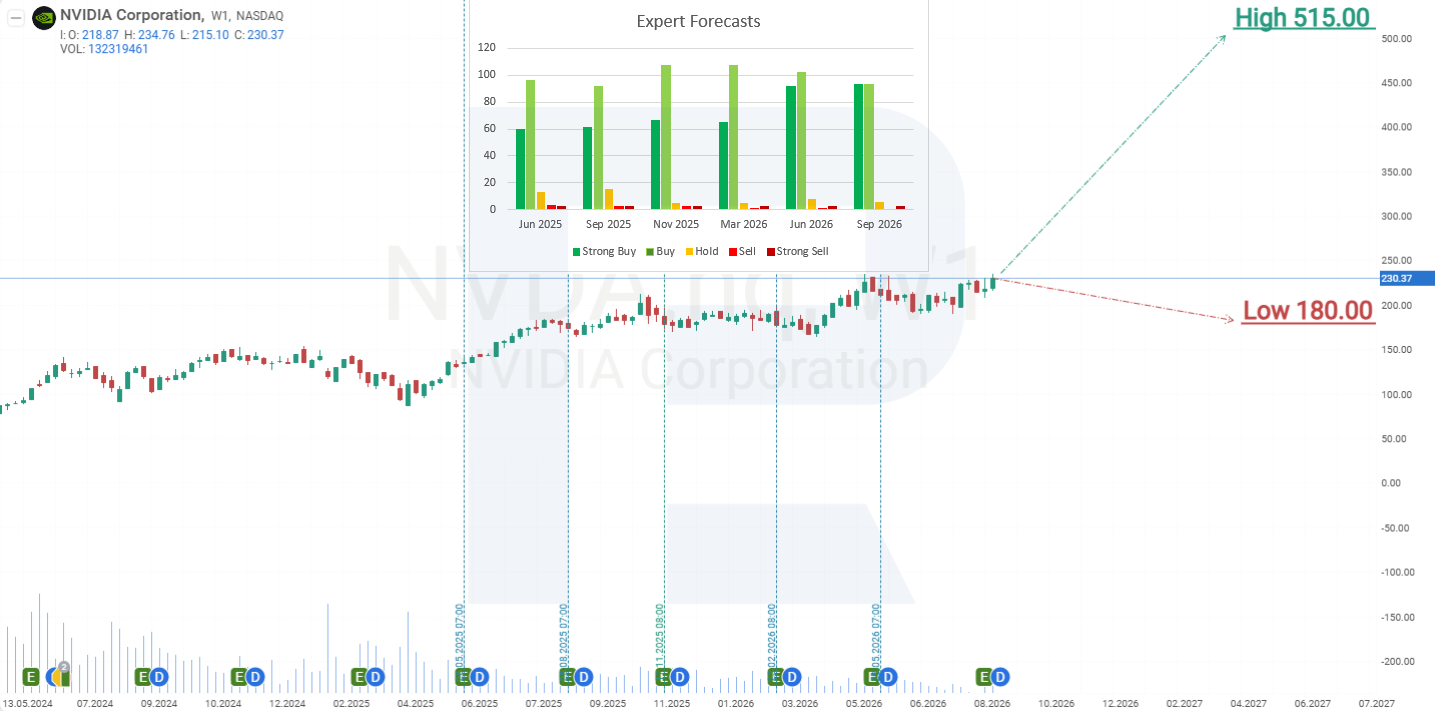
- Barchart: 45 of 50 analysts rate NVIDIA stock as Strong Buy, 3 as Buy, 1 as Hold, and 1 as Strong Sell. The highest price target is 515 USD, while the lowest is 180 USD.
- MarketBeat: 52 of 55 analysts rate the stock as Buy, while 3 rate it as Hold. The highest price target is 515 USD, while the lowest is 218 USD.
- TipRanks: all 29 analysts rate NVIDIA stock as Buy. The highest price target is 465 USD, while the lowest is 275 USD.
- Stock Analysis: 48 of 60 analysts rate NVIDIA stock as Strong Buy, 9 as Buy, 2 as Hold, and 1 as Strong Sell. The highest price target is 515 USD, while the lowest is 180 USD.
Most analysts remain positive on NVIDIA. According to Barchart, MarketBeat, TipRanks, and Stock Analysis, the overwhelming majority of analysts recommend buying NVDA stock, although the range of price targets remains wide.
However, NVIDIA's future share price performance will depend on whether the company's financial results continue to meet the market's exceptionally high expectations.
NVIDIA Corporation stock price forecast for 2026
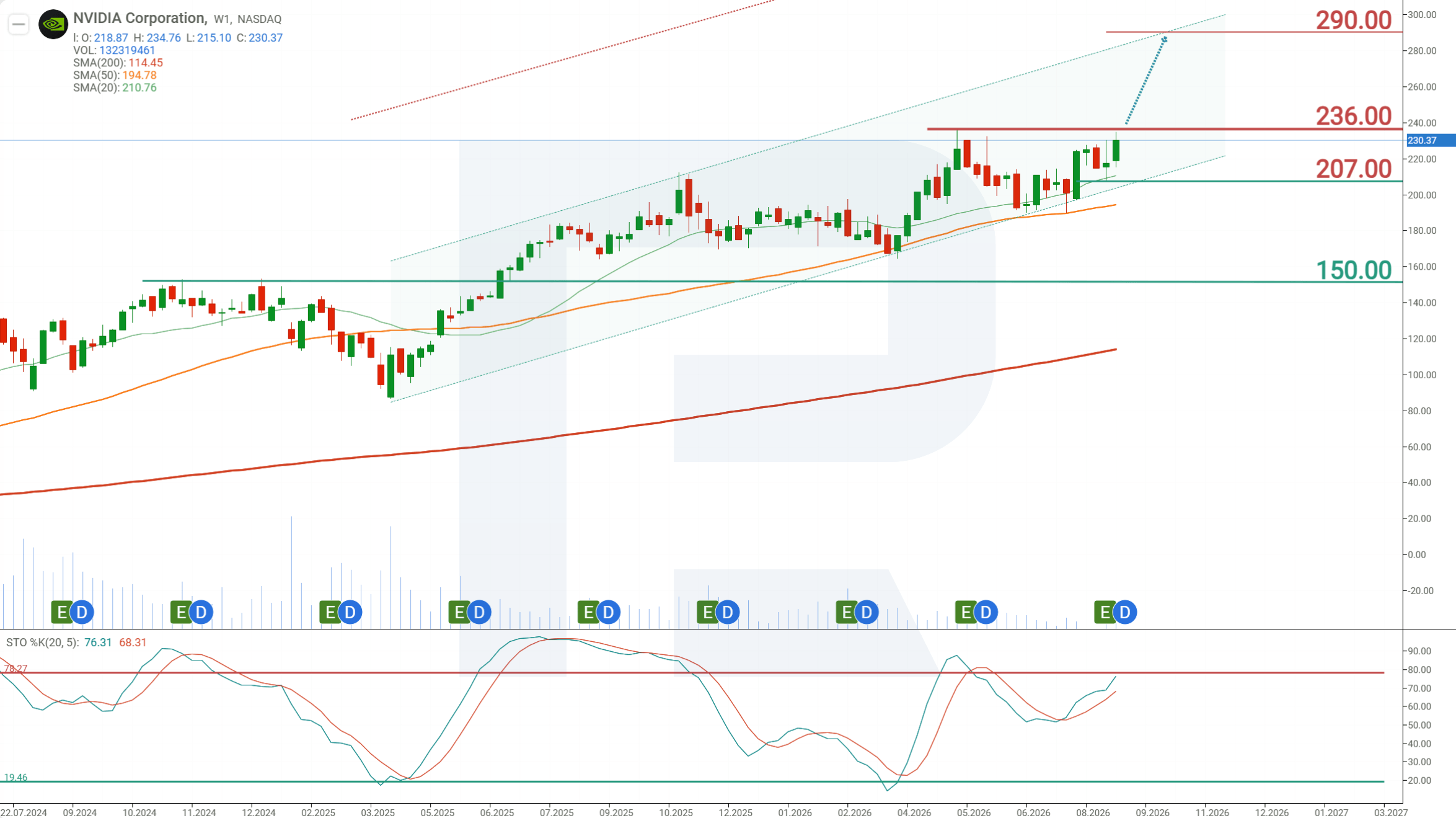
At the time of writing, NVDA stock is trading at around 230 USD.
On the weekly chart, NVDA stock is trading above its 200-period Moving Average, indicating that the long-term uptrend remains intact. The 20-period and 50-period Moving Averages also remain below the current price, confirming continued bullish momentum. At the same time, the Stochastic indicator is approaching overbought territory. This suggests that the strong upward momentum is likely to continue, although it also increases the likelihood of short-term corrections.
The key resistance level on the chart is 236 USD. A decisive break above this level could open the way for further gains. Based on the current performance of NVIDIA stock, the following scenario outlines its potential movement in the second half of 2026.
The trading strategy for NVDA stock is to place a Buy Stop order at 237.00 USD, above the 236.00 USD resistance level. Take Profit is recommended at 288.00 USD, near the upper boundary of the ascending channel. A Stop Loss is recommended at 204.00 USD, below the nearest support level at 207.00 USD.
Buy Stop – 237.00
Take Profit – 288.00
Stop Loss – 204.00
The risk-to-reward ratio for this trade is 1:1.5.
Position management: Once the stock has moved 10% in the projected direction, move the Stop Loss to the entry level. The protective stop should then be trailed 10% behind the price. Continue trailing the stop until the position is closed, either at the Take Profit or the Stop Loss, depending on which level is reached first.
Conclusion
An analysis of NVDA shows that NVIDIA's fundamental outlook remains strong. The Data Center business continues to deliver triple-digit annual growth, Blackwell continues to see strong demand, and Vera Rubin is beginning to shape the next stage of the company's product cycle.
The principal risk over the coming quarters will be a decline in gross margin. If NVIDIA can offset higher costs through continued Data Center growth while maintaining strong earnings growth, the outlook for further gains in NVDA stock will remain positive.
From a technical perspective, the outlook for NVIDIA stock remains positive, provided the price breaks convincingly above the key 236 USD resistance level. In that scenario, the next upside target could be 288 USD, near the upper boundary of the ascending channel.
Forecasts presented in this section only reflect the author’s private opinion and should not be considered as guidance for trading. RoboForex bears no responsibility for trading results based on trading recommendations described in these analytical reviews.