
Gold (XAUUSD) weekly forecast: the structure has shifted to a downtrend
Gold (XAUUSD) enters the week of 30 March–3 April below 4,500 USD per ounce after the previous decline. Pressure on quotes remains amid uncertainty around the Middle East conflict and conflicting signals regarding US-Iran talks. Rising oil prices support inflation risks and keep central banks in a hawkish stance, limiting demand for the metal.
The baseline scenario for the week is consolidation with the risk of further decline. As long as prices remain below 4,600–4,800, the priority is a retest of the 4,200–4,300 area.
XAUUSD forecast for this week: quick overview
- Weekly performance: gold (XAUUSD) came under pressure and fell below 4,500 USD per ounce. The main factor is uncertainty around the Middle East conflict and mixed signals regarding US-Iran talks. Rising oil prices strengthen inflation expectations and keep central banks in a hawkish stance, curbing gold demand
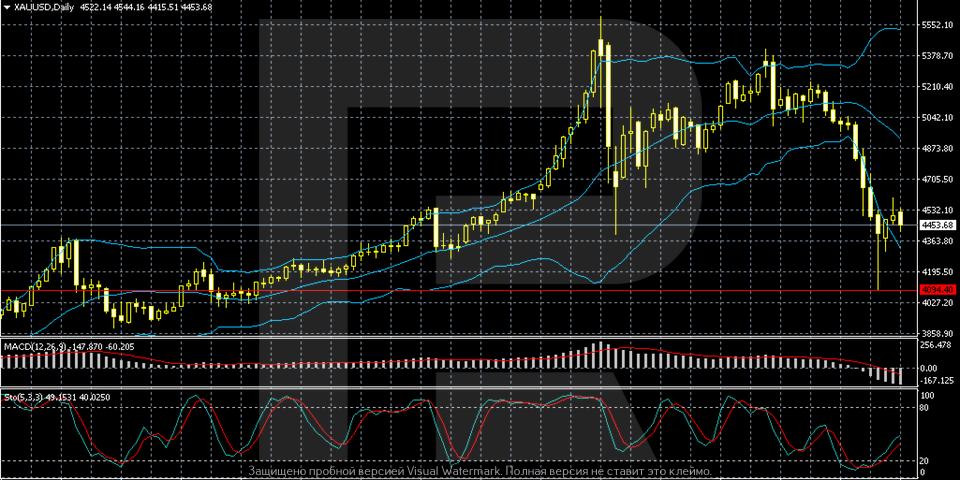
- Support and resistance: on the daily chart, the structure has turned bearish after a reversal from 5,400. Prices have consolidated below the middle Bollinger Band and are forming lower highs. The latest impulse was a drop to 4,200–4,300 followed by a rebound to 4,400–4,500, with the support level at 4,200–4,300 and resistance at 4,600–4,800
- Fundamentals and outlook: the baseline scenario suggests continued pressure and the risk of a renewed decline as long as prices remain below 4,600–4,800
Gold (XAUUSD) fundamental analysis
Gold ended the week under pressure and fell below 4,500 USD per ounce, partially giving back gains from previous sessions. The main factor remains uncertainty around the Middle East conflict and conflicting signals about possible talks between the US and Iran.
Washington speaks of dialogue and, according to media reports, sent Iran a 15-point settlement plan aimed at de-escalation and reopening the Strait of Hormuz. However, Tehran denies that any talks are taking place and is putting forward its own conditions, which include control over the strategic route. The redeployment of US troops to the region is creating additional tension, increasing the risks of further escalation.
Geopolitics continues to pressure gold through the oil market. Rising energy prices strengthen inflation expectations and shift the stance of major central banks towards tighter policy. As a result, demand for the metal as a safe-haven asset is offset by the high-rate factor.
XAUUSD technical analysis
On the daily chart, XAUUSD has been moving in a steady uptrend since the start of the year, reaching new highs above 5,400. However, after hitting the peaks, the market reversed sharply, accompanied by higher volatility and active profit-taking.
From this point, the structure changed: prices began to form lower highs, broke below the middle Bollinger Band, and consolidated in the lower part of the range. Recent moves are impulsive, with a fast drop into the 4,200–4,300 area and a subsequent technical rebound to 4,400–4,500.
Indicators confirm selling pressure: MACD is in negative territory, and the Stochastic Oscillator merely signals a possible short-term correction. Overall, the bearish scenario remains the priority, and the current rise appears to be corrective.
XAUUSD trading scenarios
The fundamental backdrop for gold remained tense last week, with XAUUSD falling below 4,500 USD per ounce amid uncertainty around the Middle East conflict and conflicting signals regarding US-Iran talks. Washington points to diplomatic efforts, but Tehran denies them and puts forward its own conditions. Through the oil market, geopolitical tensions increase inflation risks and keep central banks in a more hawkish stance, limiting demand for gold.
From a technical perspective, the structure has shifted to a downtrend. After reaching new highs above 5,400, prices reversed, broke below the middle Bollinger Band, and consolidated in the lower part of the range, forming lower highs. Recent moves are impulsive, with a decline into the 4,200–4,300 area and a subsequent rebound to 4,400–4,500. MACD is in negative territory, while the Stochastic Oscillator indicates only a short-term correction. The nearest support level is in the 4,300–4,200 area, with resistance at 4,600–4,800.
- Buy scenario
Long positions are possible if prices return and consolidate above 4,600, with the potential to move to 4,800.
- Sell scenario
A breakout below 4,300 will intensify bearish pressure and open the way towards 4,200.
Conclusion: the baseline scenario is a correction within a downtrend with the risk of continued decline amid high rates and inflation expectations.
Summary
Gold (XAUUSD) ended the week below 4,500 USD per ounce under pressure from geopolitical uncertainty around the Middle East conflict and conflicting signals regarding US-Iran talks. Rising oil prices have fuelled inflation expectations and are keeping central banks in a more hawkish stance, curbing demand for the metal.
Technically, the structure has shifted to a downtrend after hitting new highs above 5,400. Prices have consolidated below the middle Bollinger Band and are forming lower highs. The baseline scenario suggests consolidation in the 4,300–4,600 range with the risk of further decline below 4,300.
Editors’ picks
 EURUSD 2026-2027 forecast: key market trends and future predictions
This article provides the EURUSD forecast for 2026 and 2027 and highlights the main factors determining the direction of the pair’s movements. We will apply technical analysis, take into account the opinions of leading experts, large banks, and financial institutions, and study AI-based forecasts. This comprehensive insight into EURUSD predictions should help investors and traders make informed decisions.
 Gold (XAUUSD) forecast 2026 and beyond: expert insights, price predictions, and analysis
Dive deep into the Gold (XAUUSD) price outlook for 2026 and beyond, combining technical analysis, expert forecasts, and key macroeconomic factors. It explains the drivers behind gold’s recent surge, explores potential scenarios including a move toward 4,500 to 5,000 USD per ounce, and highlights why the metal remains a strong hedge during global uncertainty.
Forecasts presented in this section only reflect the author’s private opinion and should not be considered as guidance for trading. RoboForex bears no responsibility for trading results based on trading recommendations described in these analytical reviews.