
Gold (XAUUSD) weekly forecast: a chance for growth has emerged – the market is ready for it
Gold (XAUUSD) enters the week of 20–24 April around 4,800 USD per ounce, driven by expectations of talks between the US and Iran and a possible long-term agreement that could reduce inflationary pressures. At the same time, uncertainty around the Strait of Hormuz remains: it is closed despite discussions about extending the ceasefire.
The baseline scenario for the new week is consolidation with an upward bias. As long as prices hold above 4,700, the potential for growth towards 4,850–4,900 remains. Losing this level will bring back the risk of a decline to the 4,500–4,300 area.
XAUUSD forecast for this week: quick overview
- Weekly performance: gold (XAUUSD) recovered and consolidated above 4,800 USD per ounce after falling earlier in the week. Support came from expectations of talks between the US and Iran and a possible easing of inflationary pressures. At the same time, uncertainty around the Strait of Hormuz remains: the strait remains closed despite discussions about extending the ceasefire. Since the conflict began, the metal remains about 9% lower
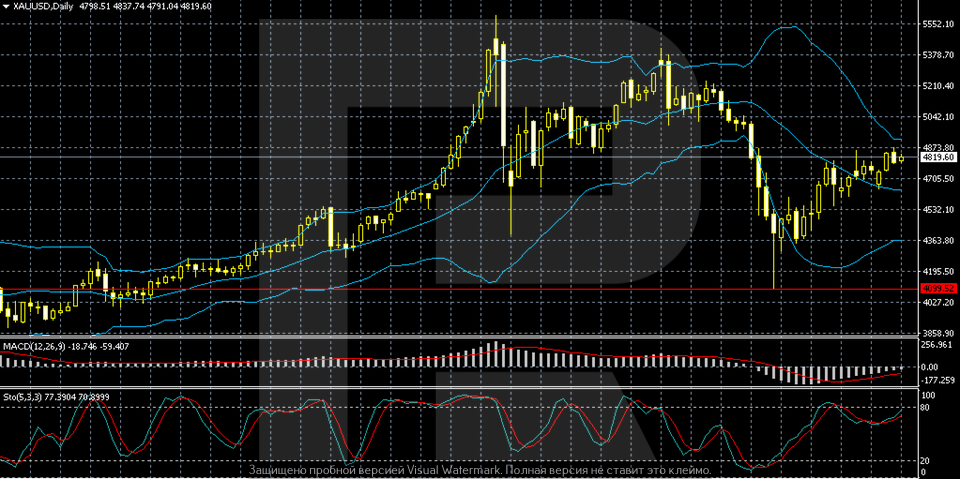
- Support and resistance: on the daily chart, the market moved into a correction phase after the decline from 5,400–5,500 to 4,200–4,300. Prices are currently stabilising around the middle Bollinger Band, forming a sideways range, with support levels at 4,700 and 4,500 and resistance at 4,850–4,900
- Fundamentals and outlook: the baseline scenario is consolidation with an attempt to rise towards the upper boundary of the range. Upside potential is limited by overbought signals and the need to consolidate above 4,900. Further performance will depend on progress in the talks and shifts in inflation expectations
Gold (XAUUSD) fundamental analysis
Gold ended the week with a recovery amid reduced geopolitical risks. Gold (XAUUSD) managed to return above 4,800 USD per ounce, recouping the early-period pullback. Support came from expectations of renewed talks between the US and Iran and the likelihood of a long-term agreement. Such a deal could reduce inflationary pressures.
The sides are considering extending the current two-week ceasefire to preserve room for diplomatic dialogue. The Strait of Hormuz remains effectively closed amid an ongoing double blockade, which keeps uncertainty elevated.
Market focus is gradually shifting to a possible second round of talks, with key topics expected to include the reopening of the strait and issues related to Iran’s nuclear program.
Overall, in recent weeks, gold has been bolstered by diplomatic progress in the Middle East. Easing tensions have lowered inflation expectations and reduced pressure on central banks regarding further tightening.
But despite the current rebound, gold prices remain about 9% lower since the conflict began, reflecting the market’s sensitivity to changes in the geopolitical landscape.
XAUUSD technical analysis
On the daily chart, XAUUSD has formed a correction phase after a strong uptrend. Prices have previously been hitting highs around 5,400–5,500, but this was followed by a sharp decline with increased volatility. The latest downside momentum pushed quotes into the 4,200–4,300 area, from where they began to rebound and attempt to stabilise.
Prices are currently recovering and trading near the middle Bollinger Band, indicating a shift from bearish momentum to sideways movement. The nearest resistance is located in the 4,850–4,900 zone, where the upper boundary of the current range runs. The support level is forming around 4,700 and lower, near 4,500, where buyers previously became more active.
Indicators signal a gradual recovery: MACD is moving out of negative territory, showing weakening downside momentum, while the Stochastic Oscillator is approaching overbought territory, which may limit further upside in the short term. Overall, the market is moving into a consolidation phase with a possible attempt to test the resistance level, but sustainable growth will require a consolidation above 4,900.
XAUUSD trading scenarios
The fundamental backdrop for gold is stabilising but remains sensitive to headlines. XAUUSD ends the week above 4,800 USD per ounce, recovering on expectations of talks between the US and Iran and a possible reduction in inflationary pressure. At the same time, uncertainty around the Strait of Hormuz remains: the strait stays closed despite discussions about extending the ceasefire. Overall, the metal remains about 9% below its pre-conflict levels.
Technically, the market is moving into consolidation after a correction from 5,400–5,500 to 4,200–4,300. Prices are trading near the middle Bollinger Band, indicating balance. MACD is exiting negative territory, while the Stochastic Oscillator is close to overbought territory, limiting the upside. Range: support levels – 4,700 and 4,500, resistance – 4,850–4,900.
- Buy scenario
A consolidation above 4,850–4,900 will open the way for growth.
- Sell scenario
A breakout below 4,700 will send prices lower towards 4,500.
Conclusion: consolidation with an upward bias amid ongoing geopolitical uncertainty.
Summary
Gold (XAUUSD) is hovering above 4,800 USD per ounce after a volatile week and a recovery from lows near 4,200–4,300. The geopolitical backdrop remains the key driver: expectations of talks reduce inflation risks, but uncertainty around the Strait of Hormuz keeps volatility elevated.
Technically, the structure has shifted into a consolidation phase after the correction from the 5,400–5,500 highs. Prices are trading near the middle Bollinger Band within the 4,700–4,900 range. The baseline scenario is sideways trading with attempts to rise towards the upper boundary, but without a consolidation above 4,900; pullback risks remain.
Editors’ picks
 EURUSD 2026-2027 forecast: key market trends and future predictions
This article provides the EURUSD forecast for 2026 and 2027 and highlights the main factors determining the direction of the pair’s movements. We will apply technical analysis, take into account the opinions of leading experts, large banks, and financial institutions, and study AI-based forecasts. This comprehensive insight into EURUSD predictions should help investors and traders make informed decisions.
 Gold (XAUUSD) forecast 2026 and beyond: expert insights, price predictions, and analysis
Dive deep into the Gold (XAUUSD) price outlook for 2026 and beyond, combining technical analysis, expert forecasts, and key macroeconomic factors. It explains the drivers behind gold’s recent surge, explores potential scenarios including a move toward 4,500 to 5,000 USD per ounce, and highlights why the metal remains a strong hedge during global uncertainty.
Forecasts presented in this section only reflect the author’s private opinion and should not be considered as guidance for trading. RoboForex bears no responsibility for trading results based on trading recommendations described in these analytical reviews.