
Gold (XAUUSD) weekly forecast: gold outlook is very limited
Gold (XAUUSD) enters the week of 4–7 May near 4,550 USD per ounce, remaining near one-month lows after continuing to decline. Pressure persists amid rising energy prices and heightened inflation expectations. The Strait of Hormuz is effectively closed, the US continues its blockade of Iran, and the conflict is dragging on. The market is reducing expectations for rate cuts and is even considering a more hawkish scenario in the future, which is dampening demand for gold.
The baseline scenario for the week is consolidation with a downward bias. While prices hold above 4,550–4,600, attempts to recover towards 4,800–4,900 are possible. A loss of this area would increase pressure and bring back the risk of a decline to the 4,500–4,300 area.
XAUUSD forecast for this week: quick overview
- Weekly performance: gold (XAUUSD) held near 4,550 USD per ounce, remaining near one-month lows. Pressure intensified due to rising energy prices and inflation expectations amid the Middle East conflict and the blockage of the Strait of Hormuz
- Support and resistance: on the daily chart, the market broke out of the uptrend after reversing from 5,400–5,500 and entered a correction phase, falling to the 4,300–4,400 zone. Prices are now consolidating in the 4,550–4,800 range. The nearest support levels are located at 4,550 and 4,300, while resistance stands at 4,800–4,900
- Fundamentals and outlook: the baseline scenario is consolidation with a downward bias. Elevated inflation risks and expectations of persistently high rates limit demand for gold. Further performance will depend on geopolitics and central bank signals
Gold (XAUUSD) fundamental analysis
Gold (XAUUSD) closed the week near 4,550 USD per troy ounce, close to one-month lows. Pressure increased amid rising energy prices, which boosted inflation expectations and reduced the appeal of the metal as a non-yielding asset.
The geopolitical backdrop remains the key factor. The US maintains a naval blockade of Iran, linking it to reaching a nuclear agreement. Tehran accuses Washington of economic pressure. The conflict is dragging on, and the Strait of Hormuz remains effectively closed.
Investors are revising expectations for monetary policy overall. Bets on rate cuts this year are shrinking, and even a rate-hike scenario by 2027 is coming into focus, adding to pressure on gold.
The Federal Reserve left policy settings unchanged this week, although several officials opposed the decision. This highlights widening disagreements within the Fed amid high uncertainty.
As a result, the gold market remains sensitive to inflation and geopolitics. As long as energy prices stay high and rate expectations remain hawkish, the metal’s recovery potential is limited.
XAUUSD technical analysis
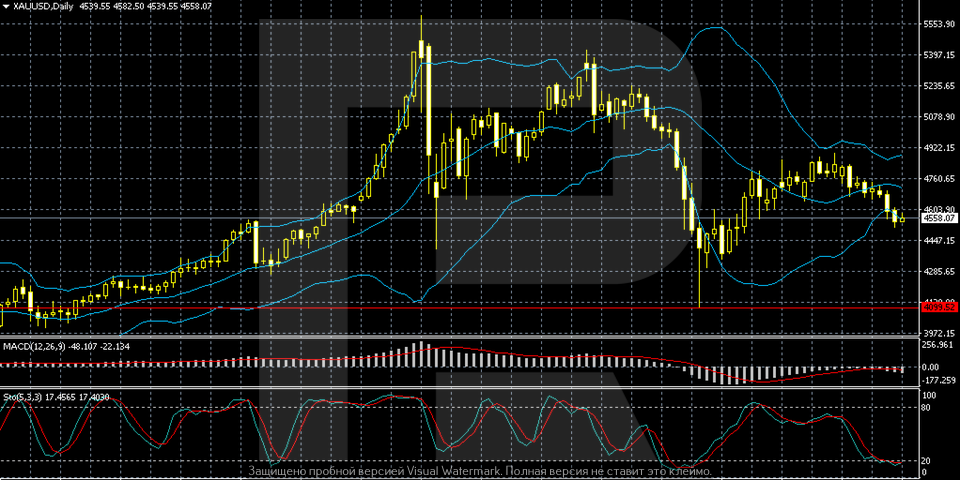
The XAUUSD daily chart shows that after a strong uptrend, prices formed a peak in the 5,400–5,500 area, followed by a sharp reversal lower. This move was accompanied by high volatility and long candlesticks, indicating active profit-taking and a shift in balance in favour of sellers. The decline quickly brought quotes into the 4,300–4,400 area, where a local bottom formed.
After that, the market began to recover, but the rise has been uneven. Prices returned to the 4,600–4,800 zone but failed to consolidate above it and are now moving lower again. Bollinger Bands indicate a narrowing range after the sharp expansion, signalling a transition into a consolidation phase. The current area around 4,550–4,600 acts as the nearest support, while resistance is in the 4,800–4,900 region.
Indicators confirm weakening momentum. MACD remains in negative territory, although selling pressure is gradually easing, and the Stochastic Oscillator is near oversold territory, suggesting short-term rebounds. Overall, the structure appears to be a correction within a broader balance phase: the market is searching for direction and awaiting a new fundamental driver.
XAUUSD trading scenarios
The fundamental backdrop for gold remains tense. XAUUSD ended the week near 4,550 USD per ounce, hovering near its monthly lows. Pressure is mounting due to rising energy prices, which fuel inflation expectations and reduce the attractiveness of the metal as a non-yielding asset. The Strait of Hormuz is effectively closed, the US maintains its blockade of Iran, and negotiations show no progress. Against this backdrop, the market is revising rate expectations: the likelihood of cuts is decreasing, and even a tightening scenario over a longer horizon is coming into focus. An additional signal came from disagreements within the Federal Reserve, which increased uncertainty.
Technically, the market is in a consolidation phase after the sharp decline from 5,400–5,500 to 4,300–4,400. The recovery proved unstable: prices failed to hold above 4,600–4,800 and are moving lower again. Bollinger Bands are narrowing, indicating lower volatility and accumulation. MACD remains in negative territory, but the downside momentum is weakening, while the Stochastic Oscillator is near oversold territory, suggesting short-term bounces. Range: support levels are located at 4,550 and 4,300, with resistance at 4,800–4,900.
- Buy scenario
A consolidation above 4,800–4,900 would open the way for a more confident recovery.
- Sell scenario
A breakout below 4,550 would increase pressure and could return prices to 4,300.
Conclusion: the market is in a balance phase after the decline, with a downward bias. Further dynamics will hinge on geopolitics and rate expectations.
Summary
Gold (XAUUSD) is hovering near 4,550 USD per ounce, remaining close to one-month lows. The geopolitical backdrop remains the key factor: the Strait of Hormuz is effectively closed, the US maintains its blockade of Iran, and the conflict continues to fuel inflation expectations. Against this backdrop, the market is reducing bets on policy easing and is considering a more hawkish scenario in the future, which limits interest in gold.
Technically, the structure has shifted into a consolidation phase after the reversal from the 5,400–5,500 highs and the fall to 4,300–4,400. Current dynamics in the 4,550–4,800 area look like an unstable recovery without a clear trend: movements are choppy, with pullbacks. Prices stand near the middle Bollinger Band, with the range narrowing. The baseline scenario is sideways movement with a downward bias. Without a consolidation above 4,800–4,900, risks of a return to 4,500–4,300 remain.
Editors’ picks
 EURUSD 2026-2027 forecast: key market trends and future predictions
This article provides the EURUSD forecast for 2026 and 2027 and highlights the main factors determining the direction of the pair’s movements. We will apply technical analysis, take into account the opinions of leading experts, large banks, and financial institutions, and study AI-based forecasts. This comprehensive insight into EURUSD predictions should help investors and traders make informed decisions.
 Gold (XAUUSD) forecast 2026 and beyond: expert insights, price predictions, and analysis
Dive deep into the Gold (XAUUSD) price outlook for 2026 and beyond, combining technical analysis, expert forecasts, and key macroeconomic factors. It explains the drivers behind gold’s recent surge, explores potential scenarios including a move toward 4,500 to 5,000 USD per ounce, and highlights why the metal remains a strong hedge during global uncertainty.
Forecasts presented in this section only reflect the author’s private opinion and should not be considered as guidance for trading. RoboForex bears no responsibility for trading results based on trading recommendations described in these analytical reviews.