
Gold (XAUUSD) weekly forecast: revised CPI and Fed rate forecasts dampen the outlook
Gold (XAUUSD) enters the week of 18–22 May around 4,700 USD per ounce, pressured by strong US inflation data. The market has completely ruled out a Fed rate cut in 2026. This supports the dollar and yields, limiting gold’s upside potential. Geopolitical tensions around Iran and high oil prices simultaneously continue to support demand for safe-haven assets.
The baseline scenario for the week is consolidation within a wide range. While XAUUSD prices hold above 4,630–4,475, the market may continue attempts to recover towards 4,780–4,850. Losing support will increase pressure on gold and heighten the risks of a deeper correction.
XAUUSD forecast for this week: quick overview
- Weekly performance: gold (XAUUSD) is hovering around 4,700 USD per ounce after declining for two sessions. Pressure on the market comes from strong US inflation data and rising expectations that the Federal Reserve will maintain a tight policy stance. At the same time, geopolitical tensions around Iran and high oil prices continue to drive demand for safe-haven assets
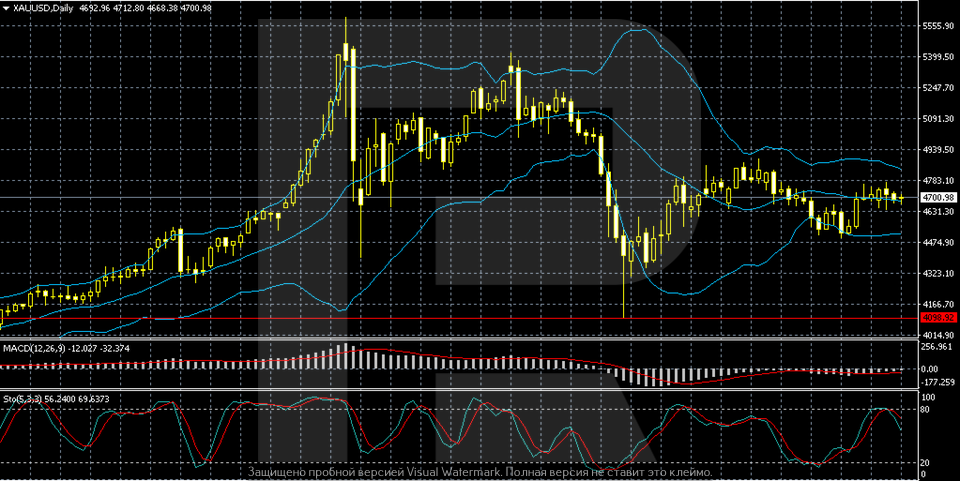
- Support and resistance: on the daily chart, gold remains in a broad consolidation phase after a correction from highs above 5,400 and a drop to 4,300–4,350. The market has now stabilised in the 4,500–4,900 range, with the nearest support levels at 4,630 and 4,475 and resistance at 4,780–4,850
- Fundamentals and outlook: the baseline scenario suggests continued sideways movement. Geopolitical risks and the situation around the Strait of Hormuz support interest in safe-haven assets; however, the Fed’s hawkish rhetoric, high US inflation, and rising yields are limiting gold’s potential for further gains. The future XAUUSD movement will depend on Federal Reserve signals, oil price movements, and developments in talks between the US and Iran
Gold (XAUUSD) fundamental analysis
Gold (XAUUSD) remains under pressure after two sessions of losses and is trading around 4,700 USD per ounce. The main market driver is accelerating US inflation, which strengthens expectations that the Federal Reserve will maintain a tight policy stance.
Last week’s data showed that US producer inflation rose at the fastest pace since 2022, while consumer inflation accelerated to 3.8%, marking the highest level since May 2023, primarily driven by high energy prices and rising trade costs amid the conflict around Iran.
After the data release, the market completely ruled out a Fed rate cut in 2026 and is increasingly pricing in the probability of another rate hike before the end of the year. This is a negative factor for gold, as rising yields and a stronger dollar reduce the attractiveness of a non-yielding safe-haven asset.
Investors are also keeping a close eye on Donald Trump’s visit to China. The market is monitoring the prospects for US–China trade talks, as well as developments around Iran and the Strait of Hormuz.
For now, gold (XAUUSD) remains caught between two opposing drivers: geopolitical tensions support demand for safe-haven assets, while the Fed’s hawkish rhetoric limits the potential for further gains.
XAUUSD technical analysis
On the daily chart, gold (XAUUSD) remains in a broad consolidation phase after a strong rally in Q1 2026. Previously, prices climbed above 5,400, but after reaching local highs, the market faced increased profit-taking and shifted into a deep correction. Pressure on gold intensified amid rising US yields, accelerating inflation, and expectations of a more hawkish Federal Reserve stance.
In April, prices fell sharply to the 4,300–4,350 area, where steady demand from buyers re-emerged. The market subsequently recovered and moved back above 4,700. Gold is currently trading around the middle Bollinger Band, with the trading range gradually narrowing, indicating a decrease in volatility after the strong impulsive moves of recent months.
The technical picture remains neutral. MACD is near the zero level, reflecting the lack of clear medium-term momentum. Meanwhile, the Stochastic Oscillator is turning down from overbought territory, signalling a possible weakening of short-term upside. The nearest resistance is in the 4,780–4,850 area, while support levels lie at 4,630 and 4,475.
While Gold (XAUUSD) remains within a wide range, the market continues to balance between two key factors. On the one hand, geopolitical tensions and high oil prices support demand for safe-haven assets. On the other hand, the Federal Reserve’s hawkish rhetoric and rising expectations of higher-for-longer rates limit XAUUSD’s upside potential.
XAUUSD trading scenarios
The fundamental backdrop for gold (XAUUSD) remains mixed. Producer inflation rose in April at its fastest pace since 2022, while consumer inflation was up to 3.8%, the highest level since May 2023. Following the data release, the market has completely ruled out a Fed rate cut in 2026 and is increasingly anticipating another rate hike before the end of the year. This is supporting the dollar and dampening interest in gold. At the same time, geopolitical tensions continue to fuel demand for safe-haven assets.
Technically, the market is in a broad consolidation phase following a sharp reversal from highs above 5,400 and a drop to the 4,300–4,350 area. After the recovery, prices returned above 4,700, but the upside momentum is gradually weakening. The nearest resistance is located in the 4,780–4,850 area, with support levels at 4,630 and 4,475.
- Buy scenario
A sustained move above 4,780–4,850 would increase the likelihood of continued recovery and a move towards the upper boundary of the range.
- Sell scenario
A breakout below 4,630 would add to pressure on XAUUSD and could send the market back down to 4,475.
Conclusion: the gold market remains in a wait-and-see mode.
Summary
Gold (XAUUSD) is hovering around 4,700 USD per ounce, under pressure following strong US inflation data. The market has completely ruled out a Federal Reserve rate cut in 2026, which is supporting the dollar and yields and limiting gold’s upside potential.
Technically, XAUUSD remains in a broad consolidation phase after a reversal from highs above 5,400 and a drop to 4,300–4,350. The market has now stabilised in the 4,500–4,900 range, with volatility gradually declining. The baseline scenario suggests continued sideways movement. As long as prices remain below 4,780–4,850, the risks of a return towards 4,630–4,475 remain.
Editors’ picks
 EURUSD 2026-2027 forecast: key market trends and future predictions
This article provides the EURUSD forecast for 2026 and 2027 and highlights the main factors determining the direction of the pair’s movements. We will apply technical analysis, take into account the opinions of leading experts, large banks, and financial institutions, and study AI-based forecasts. This comprehensive insight into EURUSD predictions should help investors and traders make informed decisions.
 Gold (XAUUSD) forecast 2026 and beyond: expert insights, price predictions, and analysis
Dive deep into the Gold (XAUUSD) price outlook for 2026 and beyond, combining technical analysis, expert forecasts, and key macroeconomic factors. It explains the drivers behind gold’s recent surge, explores potential scenarios including a move toward 4,500 to 5,000 USD per ounce, and highlights why the metal remains a strong hedge during global uncertainty.
Forecasts presented in this section only reflect the author’s private opinion and should not be considered as guidance for trading. RoboForex bears no responsibility for trading results based on trading recommendations described in these analytical reviews.