
EURUSD weekly forecast: bullish sentiment is not enough
The EURUSD pair ended the week with gains up to 1.1637, rebounding on US dollar weakness following the resumption of US statistical publications after a record 43-day government shutdown. The likelihood of a December Fed rate cut has decreased to 50%, down from 95% a month ago. This keeps the US dollar under pressure and supports competing currencies.
Additional support for the euro came from renewed risk appetite and partial normalisation of capital flows into the eurozone. However, the region’s weak economic momentum limits the potential for further gains.
This week, the market will watch for new components of US economic data following the reopening of federal agencies, and signals from Fed officials that could shape the short-term EURUSD trajectory.
EURUSD forecast for this week: quick overview
- Market focus: the EURUSD pair ended its second consecutive week higher, reflecting ongoing pressure on the dollar following the return of macroeconomic data publications after the US record shutdown. The backlog of reports may reveal a slowing economy. Market expectations for a December Fed rate cut have dropped to 50%, down from 95% a month ago
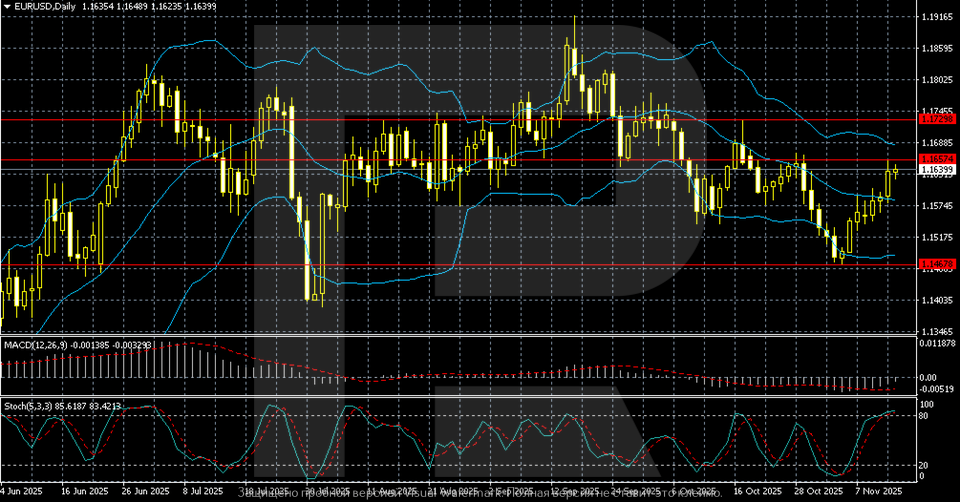
- Current trend: the pair has recovered to the 1.1635–1.1640 area following the November rebound from the 1.1467 support level. The technical picture has improved: the price is now in the upper half of Bollinger Bands, while MACD is reducing its negative histogram. The Stochastic Oscillator in overbought territory signals the risk of a local pullback
- Outlook for 17 – 21 November: the base case is consolidation within the 1.1467–1.1657 range. A breakout above 1.1657 would confirm a bullish reversal, opening the path to 1.1720–1.1745. Failure to breach resistance maintains the risk of a return to the 1.1500–1.1550 zone
EURUSD fundamental analysis
The EURUSD pair closed its second consecutive week with gains, indicating growing uncertainty about the state of the US economy amid the resumption of data publications following the end of the record shutdown. Traders fear that the reports accumulated during the freeze may show signs of economic weakening.
US dollar weakness coincided with a sell-off in US stocks and bonds – a signal of declining confidence in US assets. During the week, US President Donald Trump signed a temporary budget that ended the 43-day shutdown and reopened government operations. However, the White House warned that some data for October would not be released due to the inability to collect it during the shutdown.
Expectations around the Fed’s interest rate path are adjusting. The probability of a 25-basis-point rate cut in December has dropped to about 50%, from 95% a month earlier. However, markets still expect an easing cycle in 2026. This keeps the dollar from recovering.
EURUSD technical analysis
On the daily chart, the EURUSD rate is recovering after falling at the end of October. The pair has risen to 1.1635–1.1640, but remains below the key resistance level at 1.1657, which has capped upside moves multiple times.
The next major zone is 1.1720–1.1745, where reversals occurred in September. The support level lies around 1.1467, from where the price rebounded confidently in early November.
Technical indicators confirm the recovery impulse. The price has moved into the upper half of the Bollinger Bands channel, expanding the upper range, indicating increased buying pressure. MACD remains in negative territory, but its histogram is shrinking, signalling a gradual trend reversal. The Stochastic Oscillator is in overbought territory (above 80), showing strong bullish momentum but also signalling the risk of a local correction.
Overall, the chart structure provides grounds for a potential upward reversal, but to confirm the bullish scenario, the pair must consolidate above 1.1657.
EURUSD trading scenarios
The EURUSD pair ended the week around 1.1635–1.1640, continuing to recover after bouncing from the 1.1467 support level in November. Dollar weakness due to expectations of fresh data following the record US shutdown allowed the euro to strengthen for the second consecutive week.
The technical picture remains mixed. The pair is still trading below the key resistance level at 1.1657, which has repeatedly capped gains. The EURUSD pair is in the upper half of Bollinger Bands, signalling recovery momentum. However, MACD remains negative, and the Stochastic Oscillator in overbought territory warns of a potential local pullback.
- Buy scenario
Long positions become relevant if the price holds above 1.1657. In this case, targets shift to 1.1720–1.1745, and then 1.1800.
Stop-loss: below 1.1550
- Sell scenario
Short positions are preferred if the price breaks below 1.1550, which would increase pressure and return the pair to the 1.1500–1.1470 range. A breakout below the 1.1467 support level opens the path to 1.1380–1.1300.
Stop-loss: above 1.1657
Conclusion: the base scenario is consolidation within the 1.1550–1.1650 range, with the risk of a retest of 1.1470 if the dollar strengthens. To confirm a bullish reversal, the EURUSD pair must consolidate above 1.1657, which remains the key resistance zone for now.
Summary
During the week of 17–21 November, the EURUSD rate is expected to remain in a neutral range, reflecting market caution ahead of the Fed’s December decision. Dollar weakness following soft private employment data in the US supported the euro, but uncertainty around the release of delayed macroeconomic reports and the lack of clear signals from central banks on both sides of the Atlantic prevent sustained growth.
Technically, the pair is holding within the 1.1470–1.1600 range, without a clear breakout of key levels. Indicators suggest that downward momentum is weakening, but the recovery potential to 1.1680–1.1730 is limited unless the pair consolidates above 1.1600. If the dollar strengthens and Fed rhetoric becomes more hawkish, a retest of 1.1470–1.1450 is likely. The baseline scenario for the week is sideways movement, with a slight bullish bias if US data comes out weak.
Bullish
Forecasts presented in this section only reflect the author’s private opinion and should not be considered as guidance for trading. RoboForex bears no responsibility for trading results based on trading recommendations described in these analytical reviews.